
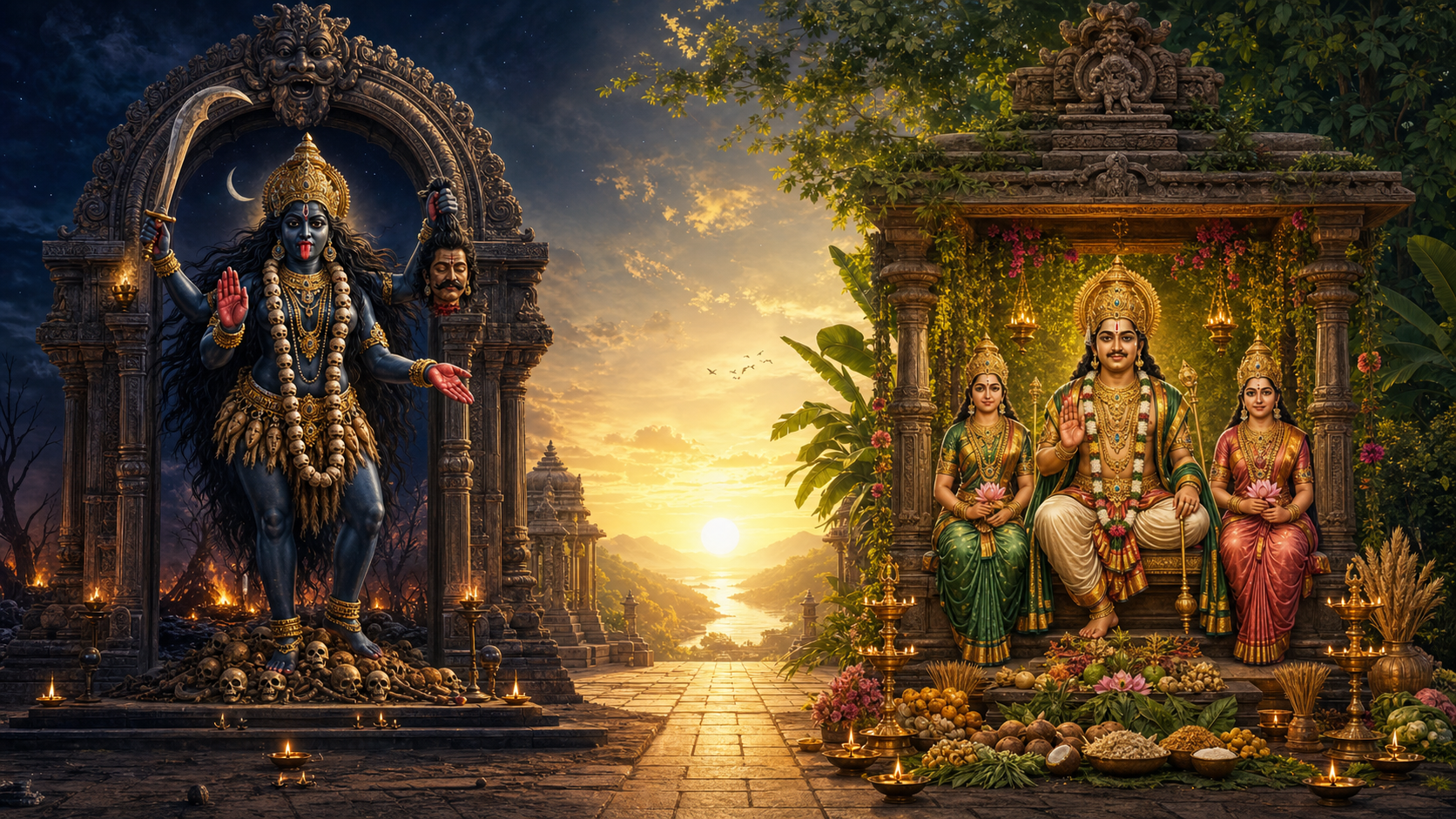
You may recognize a deity and still feel unsure before the image. Why does a compassionate Mother hold a severed head? Why does a guardian appear beside consorts associated with completeness and abundance? If you isolate one detail, fierce imagery can look violent and peaceful imagery can seem merely decorative.
Read the whole form as a spiritual instruction. The setting identifies what you must face. The posture and companions reveal relationships. Weapons show what must be overcome. Hand gestures disclose what the deity protects and gives. This approach lets you understand Kali’s confrontation with mortality and Adhi Maha Sastha’s ordered guardianship without mistaking terror for holiness or household stability for spiritual bondage.
Start with the deity’s task, not the most dramatic object

A sacred image has a grammar. Every element qualifies the others, so the meaning of a sword depends on who holds it, what the other hands promise, where the deity stands, and what transformation the complete form produces.
Use four passes whenever you encounter unfamiliar iconography:
- Notice the direction and setting. These tell you which condition of existence the form addresses: death, change, disorder, a threshold, household responsibility, or another field of dharma.
- Observe the posture and relationships. A deity alone, upon another divine figure, or accompanied by consorts does not communicate the same spiritual mode.
- Read destructive and reassuring signs together. A weapon may identify what is being removed, while abhaya and varada mudras reveal why it is removed.
- Ask what kind of person the image calls you to become. If your interpretation produces fascination but no clearer conduct, it remains incomplete.
This prevents two common errors. The first is literalism: treating symbolic death as approval of physical violence. The second is sentimentality: reducing divine protection to a promise that nothing difficult will happen. Dharmic guardianship is more demanding. It protects the conditions in which truth, discipline, compassion, and freedom can grow.
Kali guards freedom by exposing what cannot be kept
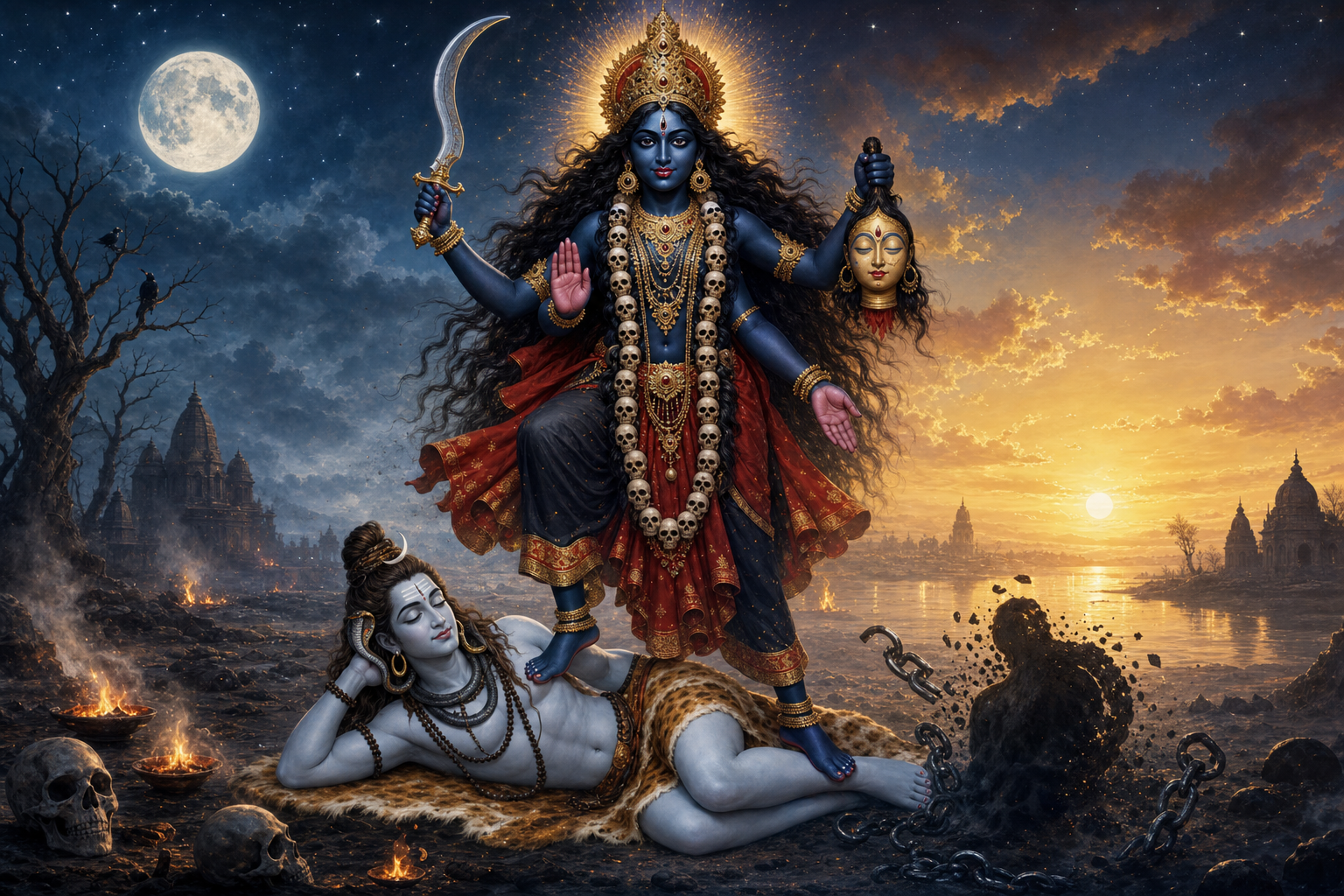
Kali’s fearsome appearance becomes intelligible when you begin with her orientation. In the Dakshina Kali vision, she faces south, the direction associated with Yama, death, and transformative passage. She does not turn the devotee away from impermanence. She teaches the devotee to meet it without surrendering to fear.
Her ferocity therefore has a precise target: avidya, the ignorance that makes the temporary appear permanent and the limited ego appear absolute. Destruction means the ending of error, not contempt for life. The distinction matters. Kali does not make cruelty sacred; she reveals how fear, clinging, and false identity lose their rule over you.
Her dark form, three eyes, unbound hair, and sky-clad body intensify that disclosure. Darkness evokes an unbounded reality that cannot be reduced to a familiar object. The three eyes perceive past, present, and future. Her lack of concealment strips away social pretense and attachment. Nothing superfluous survives the encounter.
The khadga, or sword, represents discriminating knowledge. The severed head signifies the surrender of ahankara, the ego that insists on possessing every role and achievement. The garland of heads and girdle of arms extend the same teaching: limited identities and habitual actions are not the final measure of consciousness. These symbols are severe because the bondage they address is persistent.
The cremation ground makes impermanence unavoidable. It is the place where titles, possessions, appearances, and bodily distinctions reach their common limit. Kali’s position upon Shiva expresses the inseparability of dynamic shakti and pure consciousness: creation and dissolution belong to one sacred rhythm, not to rival realities.
Now look at her open hands. Abhaya offers fearlessness; varada offers grace and fulfillment. These gestures keep the fierce symbols from being misread. The same form that cuts delusion also protects and blesses. Kali’s guardianship is liberating because she does not merely defend the personality’s preferred arrangements. She guards the devotee’s movement toward truth.
A three-part Kali contemplation
- Name one ending or change you are resisting. Keep it concrete: a role that has changed, a plan that failed, a possession you cannot keep, or a certainty that no longer holds.
- Identify the extra bondage created by your response. The event itself may be painful, but denial, status anxiety, blame, or the demand for total control can add another layer.
- Choose one truthful and non-harming cut. Correct a false statement, admit a limit, relinquish an unnecessary defense, or stop pretending that an ended phase can be restored exactly as it was.
Finish with the two open hands, not with the sword. Ask what protection you need in order to act honestly and what wholesome possibility can emerge after release. If your reading produces contempt for life, delight in another person’s suffering, or an urge to harm, you have reversed the icon’s meaning. The sword is discrimination; its purpose is freedom from ignorance.
Adhi Maha Sastha guards the conditions in which dharma grows
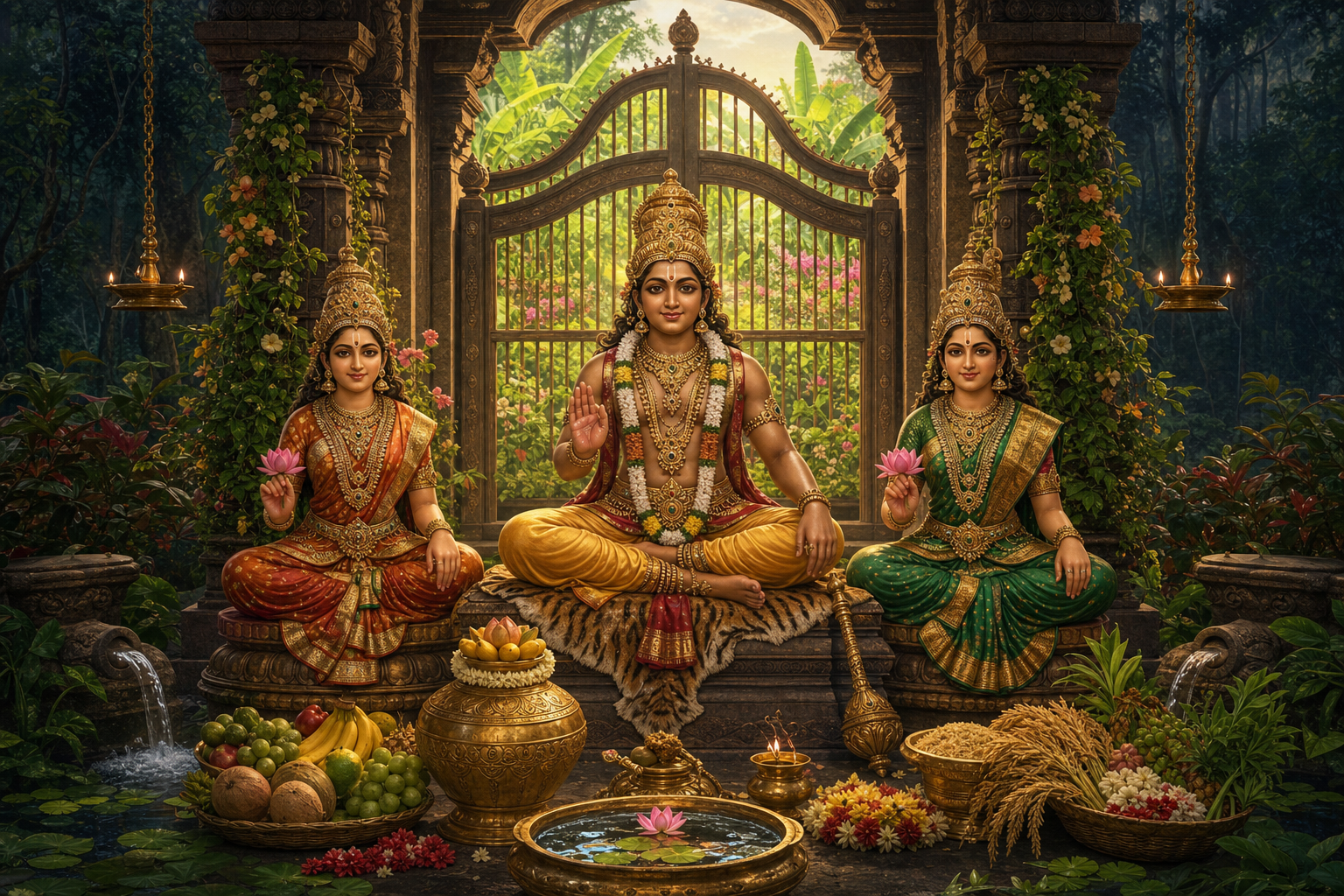
Adhi Maha Sastha presents another mode of guardianship. Adhi conveys what is primordial or supreme, Maha indicates greatness, and Sastha means ruler or teacher. In temple traditions of Kerala and Tamil Nadu, he is not only a sentry who repels danger. He is a guardian whose protection is joined to instruction, justice, compassion, and disciplined power.
That union corrects a shallow idea of protection. A wall can keep something out, but dharmic guardianship must also teach those within the wall how to live. Authority without instruction becomes arbitrary. Instruction without protection may leave the good unable to endure. Sastha holds the two responsibilities together.
Purna and Pushkala make the family form especially important. Purna signifies fullness or completeness; Pushkala signifies abundance, auspicious expansion, and well-being. Their presence frames household life as a field for responsibility, harmony, and spiritual realization. Grihastha life is not portrayed as a regrettable interruption of sadhana. Family duty, community cohesion, and ethical prosperity can become its substance.
Abundance is not left without a moral boundary. Set beside a deity who rules and teaches, it must be interpreted through dharma. Purna asks whether life is inwardly whole; Pushkala asks whether well-being can expand auspiciously. Together they challenge both deprivation disguised as spirituality and accumulation mistaken for fulfillment.
The icon commonly places Sastha upon a sacred peetha, with Purna and Pushkala to his sides and abhaya and varada expressing protection and blessing. Temple memory also associates Sastha with settlements, thresholds, and routes. These are not random locations. A threshold is where ordered space meets uncertainty; a route is where the traveler leaves familiar protection. The guardian’s presence turns vigilance into an ethical responsibility rather than permanent suspicion.
The family form should not be forced into opposition with the celibate yogi honored at Sabarimala. One form foregrounds tapas, restraint, and inward discipline; the other foregrounds household harmony and benevolent protection. The difference reveals a continuum of dharma. Inner discipline makes trustworthy guardianship possible, while outward responsibility tests whether discipline has matured into service.
Apply this form to one sphere you actually help sustain: your home, workplace, temple, or neighborhood. Ask three questions. What boundary protects people without humiliating them? What rule teaches the reason for right conduct instead of merely punishing failure? What would abundance look like if it included responsibility and mutual care? Then make one repair: clarify an expectation, fulfill a neglected duty, share a resource fairly, or support someone carrying a communal burden.
Use four questions to connect guardianship with liberation
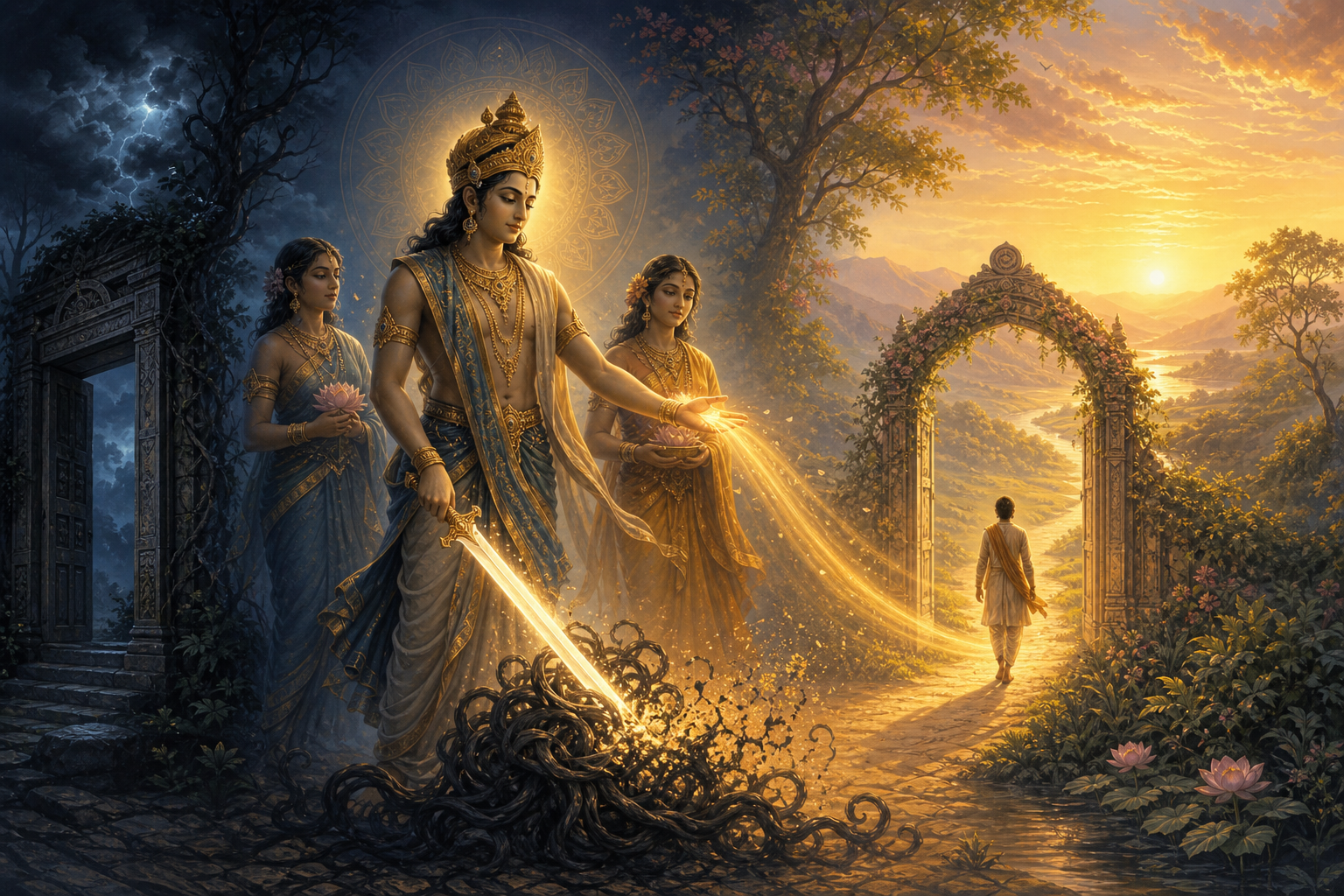
Kali and Adhi Maha Sastha should not be reduced to interchangeable symbols. Their forms address different spiritual situations. Yet reading them through the same four questions shows why guardianship and liberation belong in one conversation.
| Question | Kali | Adhi Maha Sastha |
|---|---|---|
| What condition is faced? | Mortality, change, fear, and attachment | Disorder, vulnerable thresholds, and responsibilities that require steady authority |
| What protects the devotee? | Discriminating knowledge that cuts ignorance, joined to abhaya | Guardian-teacher authority shaped by justice, compassion, and discipline |
| What grace is offered? | Release from fear and limited identity, joined to varada | Wholeness, auspicious abundance, moral clarity, and benevolent protection |
| What conduct follows? | Face impermanence truthfully and relinquish what binds | Protect others responsibly and order shared life through dharma |
The table exposes the connecting principle. Guardianship without a liberating purpose can harden into control. Liberation without guarded conditions can become an excuse to neglect duties, relationships, and vulnerable people. Kali asks whether protection serves truth rather than attachment. Sastha asks whether authority creates the order in which disciplined and compassionate life can flourish.
You can test any interpretation by completing one sentence: “This form asks me to face ___, protects me from ___, grants the capacity to ___, and obliges me to ___.” Fill every blank with something visible in the complete icon. If you cannot connect the symbol to conduct, look again before claiming to have decoded it.
Recognize Dharmic resonance without erasing differences
These forms also offer a disciplined way to speak across Dharmic traditions. Kali’s cutting of delusion can resonate with Buddhist prajna, while her confrontation with impermanence can call Jain aparigraha to mind. Fearlessness and trust in the Divine can echo the Sikh ideals of nirbhau and nirvair. Sastha’s compassionate strength similarly finds ethical parallels in Buddhist wisdom and compassion, Jain disciplined nonviolence, and Sikh seva and righteous protection.
Resonance is a bridge, not proof that distinct doctrines are identical. When discussing these connections, say that one teaching “resonates with” or “offers a parallel to” another. Name the original term and its tradition. Do not replace Kali, Sastha, prajna, aparigraha, nirbhau, or seva with a vague claim that every path teaches the same thing. Respectful unity becomes stronger when it preserves the integrity of each path.
Key takeaways
- Read direction, setting, posture, objects, companions, and mudras as one symbolic field. No dramatic detail should be interpreted alone.
- Kali’s fierce form targets ignorance, fear, clinging, and false identity. Her abhaya and varada mudras show that the purpose of destruction is protection and release.
- Adhi Maha Sastha combines the roles of guardian and teacher. Purna and Pushkala place fullness and abundance within household duty and ethical order.
- Guardianship serves liberation when it protects truth and the conditions for dharmic life. It becomes mere control when preservation is treated as an end in itself.
- Shared Dharmic values can illuminate one another without making Hindu, Buddhist, Jain, and Sikh teachings interchangeable.
- The practical test of symbolic understanding is changed conduct: greater honesty before impermanence, firmer self-discipline, more responsible protection, and more compassionate use of authority.
At your next darshan, do not try to decode every feature. Choose the setting or direction, one hand gesture, and one relationship within the image. Complete the four-part sentence above, then act on its final clause before the day ends. A deity symbol becomes spiritual instruction when it reforms how you see, what you protect, and what you are willing to release.
References
- DharmaRenaissance Blog – Decoding Kali’s Fierce Grace: Kali Tantra Symbolism, South-Facing Form, and Liberation
- DharmaRenaissance Blog – Adhi Maha Sastha with Purna and Pushkala: Timeless Guardian of Dharma in South India
