
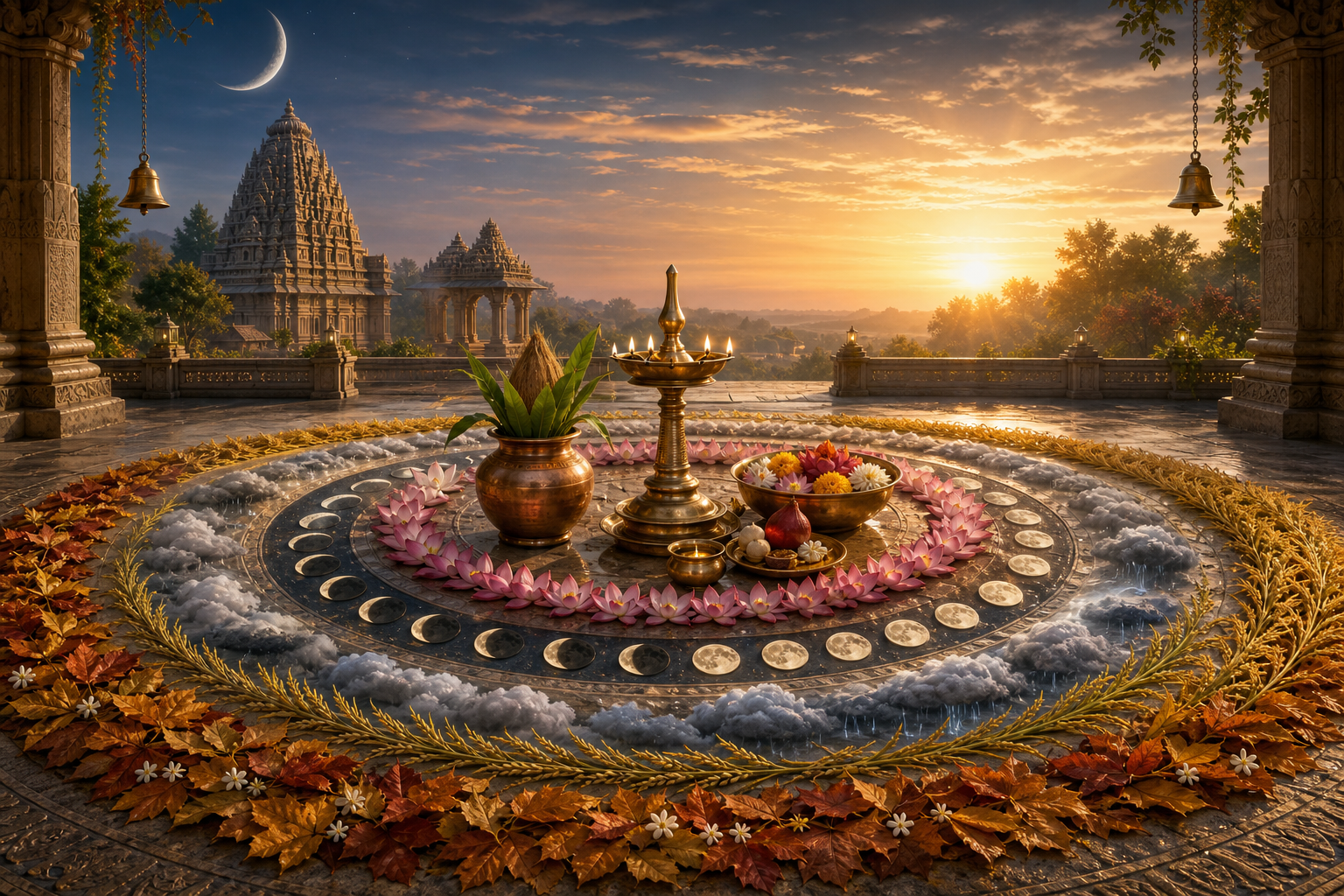
You are preparing a vrata, temple visit, or family puja, but two calendars show neighboring dates. Do not settle the question by choosing the first date you see. First match the Panchang to the place where you will observe the rite and to the calendrical tradition your family or temple follows.
A sacred calendar does more than assign festivals to boxes. It joins lunar calculation, local sunrise, seasonal change, ritual sequence, and disciplined conduct. Once you separate those layers, you can resolve date disagreements more intelligently and recover the deeper purpose of recurring observances.
The sacred calendar has layers, not just dates

A civil calendar asks which numbered day follows another. A sacred calendar asks several questions at once: Which lunar condition governs the observance? Where is the practitioner? Which month-reckoning system is being used? Does a particular temple, sampradaya, or ritual lineage apply an additional rule?
- Tithi: The lunar day often determines a vrata or festival. It need not begin or end at civil midnight.
- Local sunrise: A tithi can extend across neighboring civil dates, so its relationship to sunrise matters. Location and time zone can therefore change the date shown for an observance.
- Nakshatra, yoga, and karana: These Panchang factors can refine the timing when a rite or muhurta requires them.
- Month reckoning: Purnimanta and amanta calendars divide and name lunar months differently. A different month label does not necessarily mean that communities are observing a different lunar sky.
- Regional and lineage rules: A general calendar identifies the likely day; your regional Panchang, temple bulletin, and inherited practice determine how you should apply it.
The practical consequence is simple: never copy a tithi-based festival from another city without checking it locally. Tithis can straddle civil dates, and reliable planning depends on local sunrise calculations. This matters especially when you are making a sankalpa, arranging travel, or coordinating a family ritual across time zones.
Month names require the same care. In the February 2026 example, North Indian purnimanta reckoning moves through Magh toward Falgun, while amanta systems used by many Telugu, Kannada, Marathi, and Gujarati families move through Magha toward Phalguna. The labels differ because the month boundaries differ. Treating one label as universally correct creates a dispute where none may exist.
Keep the ritual date and the muhurta as two separate decisions. First establish the day according to the governing tithi and your tradition. Then identify an appropriate window within that day using the relevant tithi, nakshatra, weekday, yoga, or other local rule. A generally favorable weekday or Abhijit Muhurta does not by itself replace the tithi prescribed for a tithi-based vrata.
Chaturmasya shows how sacred time becomes a ritual cycle

Here, Chaturmasya refers specifically to the Shrauta cycle of seasonal offerings. It should not be confused with every later retreat, vrata, or seasonal custom that uses a related name. In this Vedic setting, three sacrifices recur at four-monthly intervals:
- Vaishvadeva begins the sequence. Its orientation toward the larger community of beings makes nourishment and gratitude central to the opening of the cycle.
- Varuna-praghasa turns attention toward Varuna, water, rain, restraint, and the restoration of balance. The offering places human life inside a larger field of ecological and cosmic reciprocity.
- Sakamedha concludes the sequence. Its position matters: it gathers and seals a rhythm that began with Vaishvadeva and passed through Varuna-praghasa.
Mahahavis should not simply be added as a fourth festival date. Havis is the oblation placed in the sacred fire, while maha gives the offering a heightened and comprehensive scope. Within the Chaturmasya framework, Mahahavis points to the fullness of offering: nourishment received, obligations acknowledged, relationships repaired, and the cycle brought toward completion.
This structure corrects a common modern habit. We tend to treat a sacred occasion as an isolated appointment: perform the puja, distribute prasad, and return to ordinary time. A ritual cycle asks more of you. Its opening establishes an intention, its middle tests that intention under changing conditions, and its conclusion requires you to account for what the observance changed.
Details are not identical in every textual lineage. Traditions associated with Apastamba, Baudhayana, and Katyayana preserve liturgical and regional variations. If two ritual descriptions differ, do not assume that one must be a corrupted version of the other. First identify the Shrauta-sutra, region, and lineage behind each procedure. For actual performance, follow one coherent tradition under qualified guidance instead of assembling a new rite from disconnected instructions.
A six-step method for planning a sacred observance
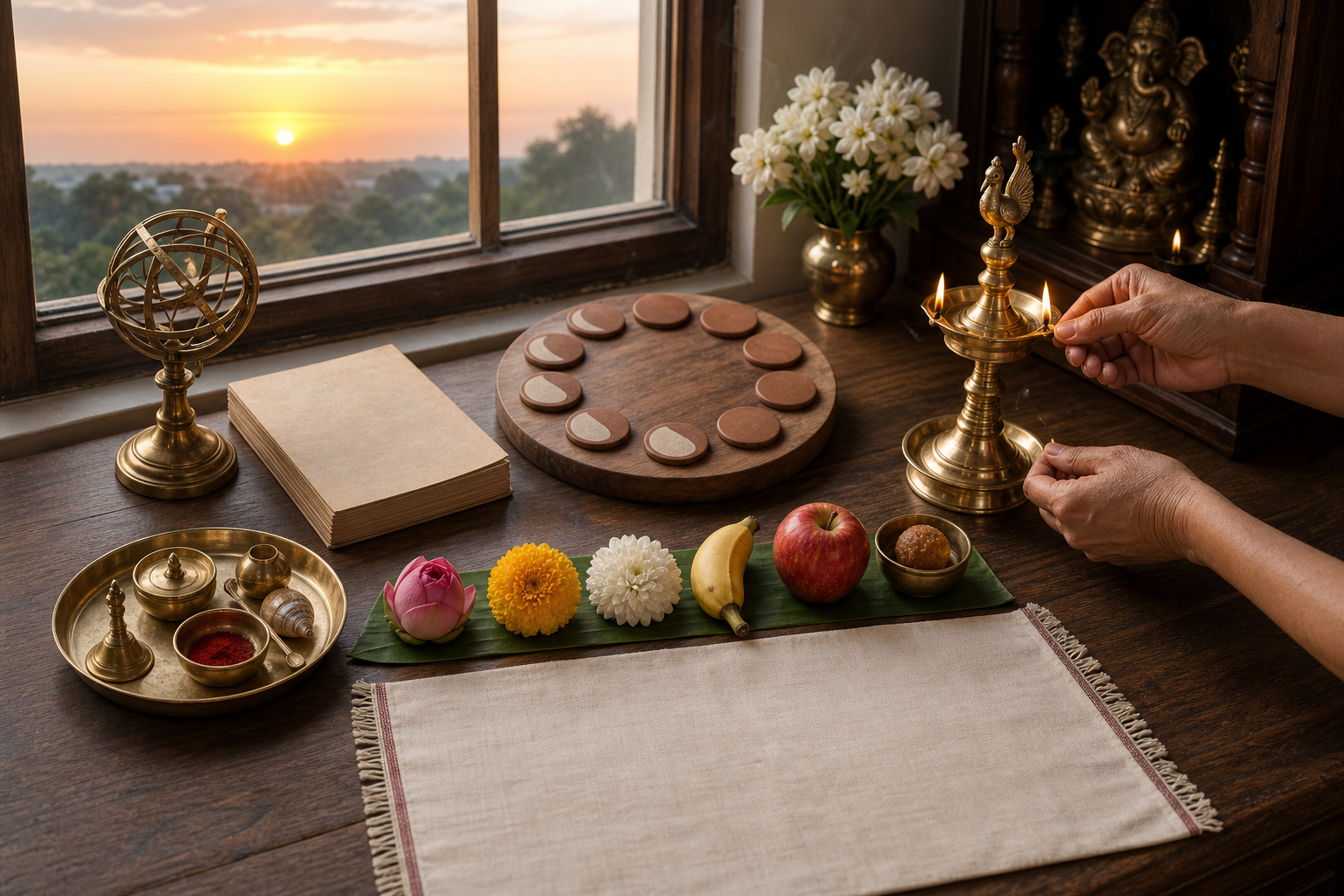
You do not need to master every calendrical calculation before using a Panchang responsibly. You do need to ask the questions in the right order.
- Name the observance precisely. Write down whether you are planning a tithi-based vrata, a household puja, a temple service, a seasonal discipline, or study of a Shrauta cycle. A generic festival listing cannot supply the procedural details of every ritual form.
- Fix the location. Use the city and time zone where the observance will actually occur. If relatives participate from another country, they may need their own local date rather than a mechanical conversion of your clock time.
- Identify the calendrical tradition. Note whether the month is being reckoned by an amanta or purnimanta system and whether your family follows a particular regional Panchang. This prevents a difference in month labels from becoming a false disagreement about the observance itself.
- Find the governing lunar condition. Check the relevant tithi in relation to local sunrise. Add nakshatra, yoga, karana, and weekday only when the observance or muhurta calls for them. Do not let a convenient civil date overrule the governing condition without a tradition-specific reason.
- Confirm the community application. Before making a sankalpa, booking travel, or arranging an abhisheka or archana, compare your result with a trusted local Panchang and the temple’s announced schedule. If they differ, ask which sunrise rule or regional convention produced the temple date.
- Plan the conduct as well as the ceremony. Decide what preparation begins the observance, what restraint or service sustains it, and what act marks completion. Use biodegradable puja materials where practical, reduce single-use items, and distribute prasad responsibly so that the outward offering does not contradict its ethical purpose.
For a household inspired by the Chaturmasya ethos, the ethical arc can remain modest and honest. Begin with gratitude for food and the beings involved in sustaining life. At the next point in the cycle, undertake a concrete act of care for water, rain-dependent life, or shared resources. Close with daan, seva, responsible food sharing, or another act that integrates the discipline into community life. These are contemporary applications of the cycle’s values, not replacements for the Shrauta sacrifices themselves.
Recognize shared Dharmic rhythms without erasing differences

Seasonal restraint is not unique to one Dharmic path, but similar timing does not make different traditions liturgically identical. The useful comparison lies in the disciplines cultivated, not in pretending that every rite has the same theology.
- Hindu Shrauta practice joins oblation, mantra, seasonal awareness, and reciprocity within a defined sacrificial sequence.
- Buddhist Vassa uses the rains retreat as a period of discipline and reflection. Magha Puja near the Magha full moon emphasizes sangha, sila, and metta.
- Jain Paryushana and Chaturmas observances emphasize restraint, ahimsa, meditation, and vrata within their own doctrinal and communal settings.
- Sikh seva and langar express generosity and shared responsibility, while Basant-season kirtan gives seasonal change a distinct musical and devotional form.
If you are organizing a shared Dharmic event, label each practice by its own tradition. Let a Hindu rite remain Hindu, a Buddhist retreat remain Buddhist, a Jain vrata remain Jain, and Sikh seva remain grounded in Sikh practice. Unity becomes credible when communities cooperate in compassion, service, restraint, and truthful living without dissolving their differences into a generic ceremony.
Key takeaways
- A festival date is an output of a local calendrical rule, not a permanent number on the civil calendar.
- Check the governing tithi against local sunrise before relying on a date copied from another city or time zone.
- Amanta and purnimanta month labels can differ without representing a contradiction in the underlying lunar cycle.
- Choose the ritual day first and the muhurta within that day second.
- The Shrauta Chaturmasya cycle moves through Vaishvadeva, Varuna-praghasa, and Sakamedha at four-monthly intervals.
- Mahahavis expresses the comprehensive meaning of the great offering; it should not be reduced to a fourth calendar entry.
- Honor textual variation by following a coherent lineage rather than blending procedures from several Shrauta-sutras.
For your next observance, write down six fields on one page: the rite, location, calendar tradition, governing tithi, local temple confirmation, and the act of conduct that will carry its meaning forward. That small record turns the sacred calendar from a stream of reminders into a rhythm you can actually live.
References
- DharmaRenaissance Blog — Mahahavis and Chaturmasya: Unveiling the Sacred Cycle of Great Vedic Offerings
- DharmaRenaissance Blog — Hindu Festivals in February 2026: Your Sacred Magha–Falgun Guide to Dates, Tithis, Muhurats
