
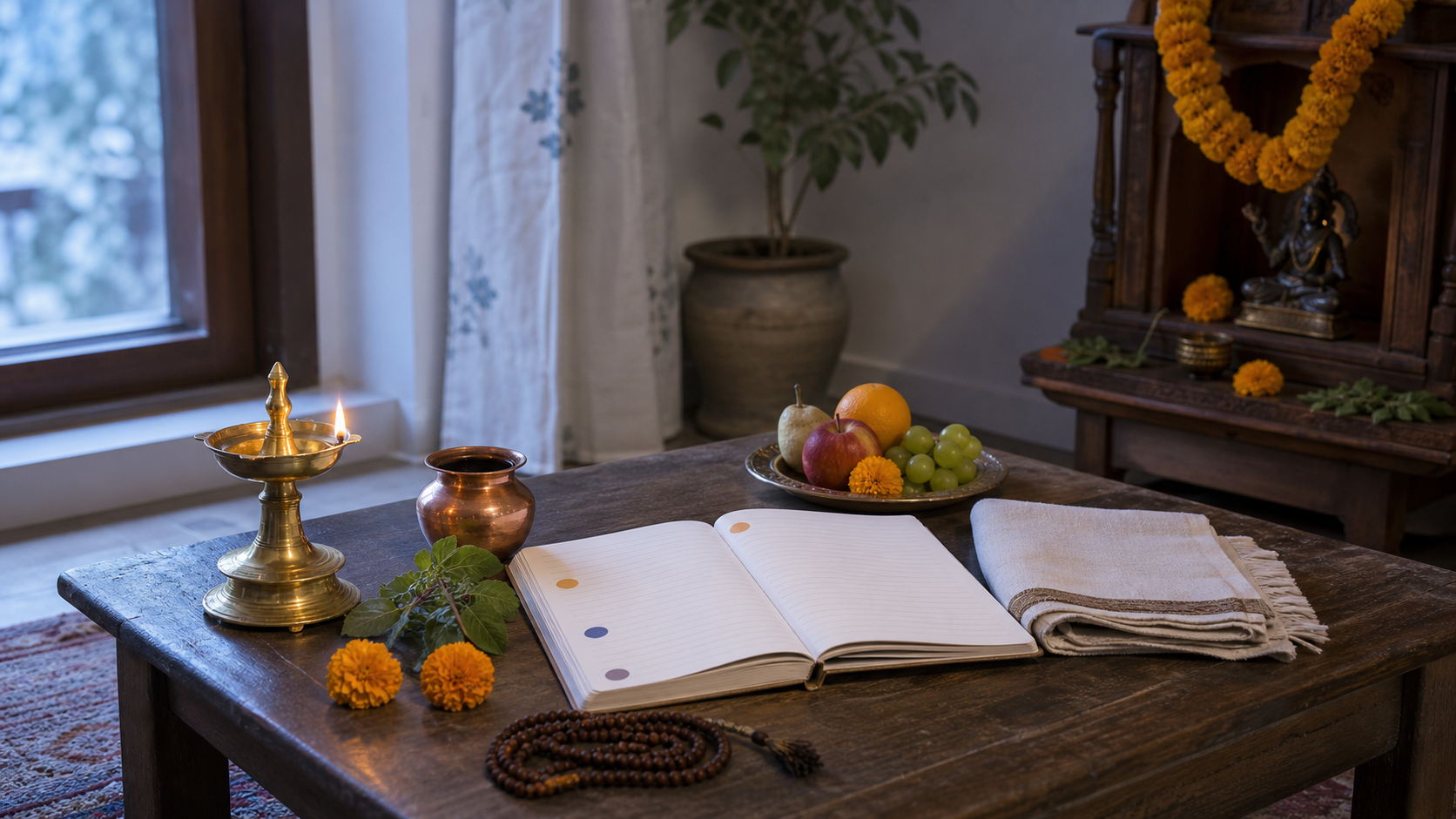
You may already have several 2026 festival dates saved and still not know which evening to prepare, when a vrata ends, or which observance belongs to your family. A sacred calendar becomes usable only when a Gregorian date is joined to the local tithi, the rules of the observance, and your living tradition.
For Magha, build a working calendar that answers three questions: when does the relevant tithi prevail where you live, what does your parampara ask you to do, and what is the smallest complete form you can perform attentively? That gives you enough precision to practise without pretending that every city or sampradaya follows the same clock.
Anchor every date to your local Panchang

February 2026 intersects Magha and Falgun in several Telugu, Kannada, Marathi, Gujarati, and North Indian Hindi calendars. The observances themselves are tied to lunar tithis, however, not to midnight-to-midnight civil dates. Local sunrise, time zone, regional calendar practice, and Panchang calculation method can therefore change the civil date or ritual window shown for your location.
This matters whenever a tithi begins on one civil day and ends on another. Do not assign an observance merely to the date containing the most hours of that tithi. Vrata traditions can use sunrise, a prescribed part of the day, or another festival-specific rule to decide which civil date receives the observance. Your calendar must record the tithi interval and the observance date as separate pieces of information.
- Select a primary Panchang calculated for your city, not merely for your country or time zone.
- Copy the tithi start and end times together with the local sunrise. If the tithi crosses sunrise, mark that visibly rather than reducing the entry to a date alone.
- Cross-check the result against another reliable Panchang and the programme issued by a nearby temple. Use the temple schedule for communal participation and your family or guru’s instruction for lineage-specific home rites.
- Record the completion rule. For a vrata, that includes parana or the appropriate way of ending the fast; for a temple festival, it may include a public puja or darshan time distinct from the astronomical tithi.
Thursday, January 29, 2026 shows why the distinction is necessary. Shukla Ekadashi is listed in most regions until 11:38 AM, followed by Dwadashi. The phrase “in most regions” is essential: 11:38 AM is not a universal time that should be copied into every household calendar. Confirm the interval for your city and then apply the Ekadashi and parana rules followed by your tradition.
Build a Magha map in layers, not a crowded festival list
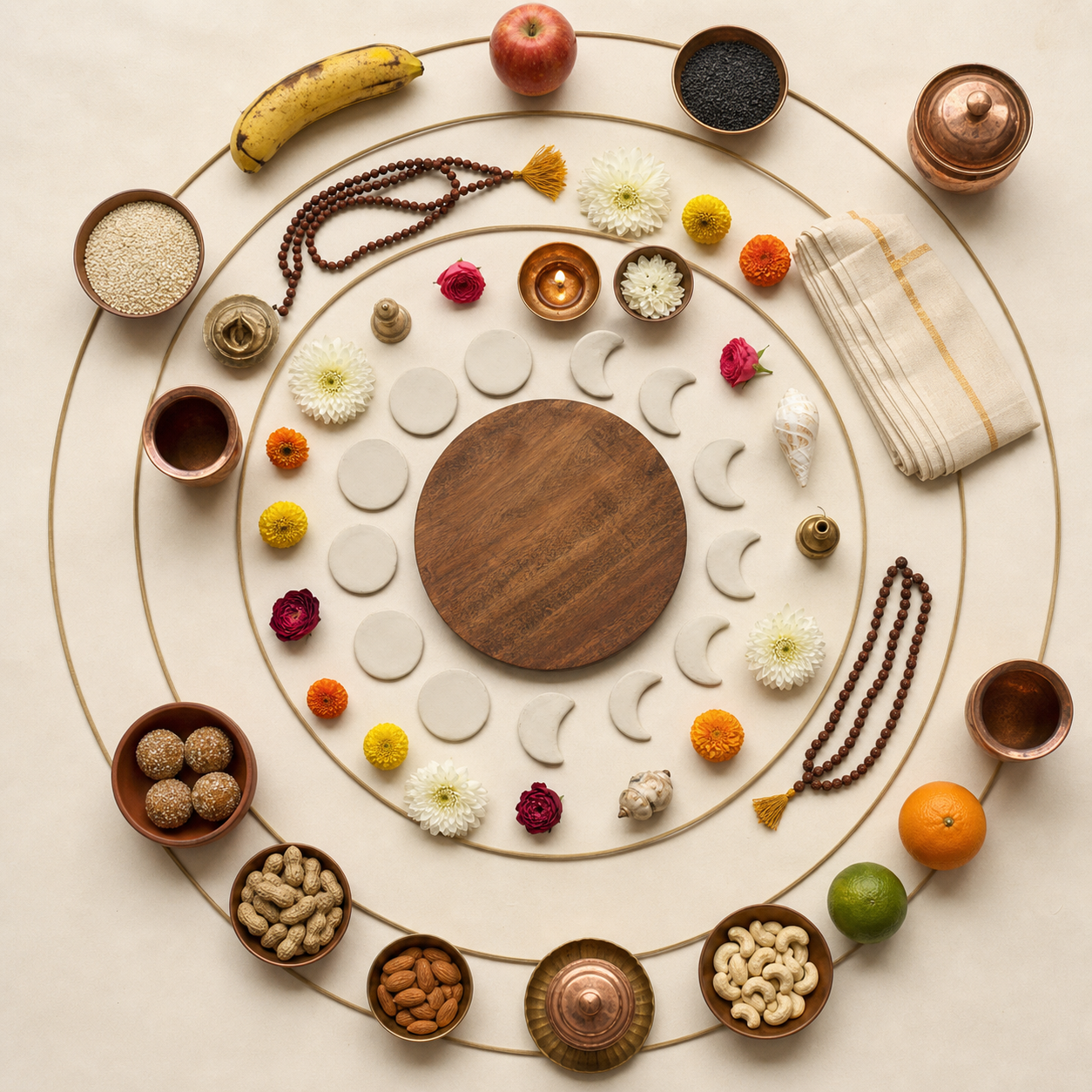
Magha contains more possible observances than most households can sustain with equal attention. The practical answer is not to treat every name as a new obligation. Separate your established daily discipline, recurring vrata rhythm, Magha focal days, and any household milestone that needs an independently chosen muhurta.
| Calendar layer | What may belong there | Decision to make |
|---|---|---|
| Daily foundation | Sandhya or another established nitya practice, japa, study, dana, and seva | Preserve a modest baseline even when no festival occurs. |
| Fortnightly and monthly rhythm | Ekadashi in each paksha, Pradosh Vrat, Sankashti Chaturthi, Masik Vinayak Chaturthi, Purnima, Amavasya, and Masik Shivaratri | Enter the local tithi window, vrata rule, and completion or parana instruction. |
| Magha focal observances | Vasant Panchami, Ratha Saptami, Bhishma Ashtami, Maghi Purnima, Mauni or Magh Amavasya, and the ninth day of Shyamala Navaratri where observed | Choose the days supported by your sampradaya, family practice, or temple community and verify their local dates. |
| Household milestones | Aksharabhyasam, griha pravesh, namkaran, engagement, or a property-related decision | Do not assume that a festival date is automatically the correct muhurta for a separate samskara or commitment. |
The recurring observances and Magha-Falgun focal days require location-specific tithi confirmation for 2026. Put a status beside each entry: “family observance” for inherited duties, “chosen observance” for a practice you are adding deliberately, or “community event” for a temple programme. These labels prevent a public celebration, a personal vrata, and a family rite from becoming one confused obligation.
Keep muhurta selection in a separate column or calendar. A shubh muhurta can involve Tithi, Nakshatra, Yoga, Karana, Chandrabalam, Tarabalam, and family-specific considerations. If you are scheduling a significant ceremony or financial commitment, ask a competent local guide to evaluate those factors before you confirm vendors or invite guests. An auspicious festival name by itself does not settle that decision.
Let Bhishma Ashtami move from remembrance to conduct
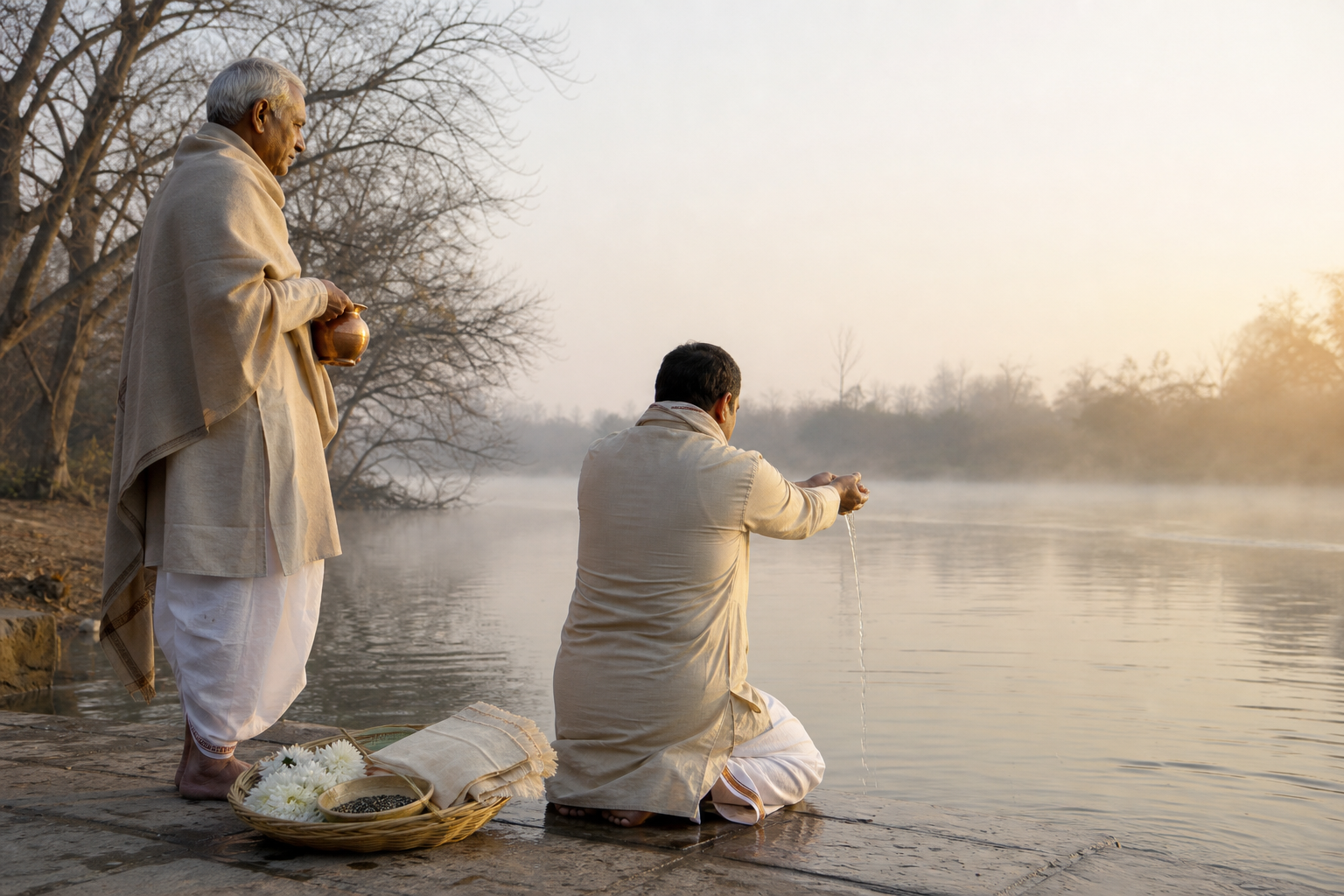
Bhishma Ashtami falls on Magha Shukla Ashtami and honours Bhishma Pitamaha, also remembered as Devavrata, Shantanu-putra, and Ganga-putra. The observance joins tarpana with remembrance of the dharmic counsel Bhishma entrusted to the world, especially the Vishnu Sahasranama. Its centre is not ritual display but gratitude, disciplined attention, and a renewed willingness to uphold dharma when doing so is difficult.
- Complete Sandhya Vandana or the nitya karma established in your household. Clean the place of worship and arrange a clean seat.
- Prepare clean water in a copper or steel vessel, black sesame, darbha if used in your tradition, akshata, flowers, and Tulasi where appropriate. A lamp and incense can be added, but they are not the core of the tarpana.
- After achamana and quieting the breath, take sankalpa with the date, place, gotra as required by your practice, and the intention to honour Bhishma. If you do not know the correct lineage wording, obtain it from an elder or priest rather than constructing a formula from fragments.
- Remember Bhishma and recite or listen to the Vishnu Sahasranama. A reading from the Shanti Parva or Anushasana Parva can connect the rite to the ethical teaching it commemorates.
- Perform the water offerings according to your transmitted vidhi. A common form uses water mixed with black sesame, a darbha pavitram on the ring finger, and libations poured from the palms while facing east in the morning, unless family custom directs otherwise. The number of libations may be 8, 12, or 108 depending on parampara; the count and mantra you were taught take precedence.
- Conclude with a Shanti patha, pranam to elders and teachers, quiet reflection, and prasada if naivedyam was offered.
If black sesame, darbha, or a full set of implements is unavailable, clean water alone may be offered with sincere attention. Do not turn limited materials into a reason to abandon remembrance. Conversely, simplicity is not permission to improvise restricted mantras or ignore a vidhi you have received. Women and men may participate as their family customs direct, and a competent guide should settle questions about ritual eligibility or gesture.
Fasting or simplified food may accompany the day, but it should be adapted to health, age, and established vrata discipline. If fasting is unsafe for you, keep the devotional and ethical observance without treating physical strain as proof of sincerity.
End the rite by naming a present duty that requires Bhishma-like steadiness. It may be keeping a promise, correcting an avoidable delay, speaking truth without cruelty, or fulfilling an obligation to an elder. Write the action into the same calendar entry. That is how remembrance crosses from water and mantra into conduct.
Use Shyamala Navaratri to discipline speech and creativity

Several Sri Vidya lineages honour Rāja Mātaṅgī, also revered as Rāja Śyāmalā and Mantrīṇī, on the ninth day of Shyamala Navaratri in Magha. Her association with shabda, vāg, mantra, learning, music, and creative intelligence makes the day particularly relevant to anyone who teaches, writes, performs, manages people, studies, or communicates in public. In the Lalitopakhyana of the Brahmanda Purana, this power of speech belongs to an ordered sacred vision: expression is meant to be governed by discernment.
A home observance can remain simple while retaining that centre:
- Light a lamp and offer flowers or green leaves according to household custom.
- Recite an appropriate stotra or nama. Use a specific mantra only as instructed by your lineage or teacher.
- Treat study, music, recitation, writing, or another disciplined art as sacred activity rather than entertainment squeezed around the puja.
- Offer creative seva: help a student, prepare accurate educational material, support kirtan or community learning, or use a professional skill for a constructive purpose.
The most demanding offering is control of speech. For the day, do not forward a claim you have not checked. Correct an error without humiliating the person who made it. Refuse the small exaggeration that would make your argument more impressive. Before a consequential message or conversation, ask whether the words are true, necessary, kind in manner, and likely to improve the situation. This turns reverence for the sovereignty of speech, sound, learning, and the arts into a practice you can actually observe.
This discipline also creates an honest meeting point within the wider Dharmic family. Buddhist right speech, Jain commitments to ahimsa and satya, and Sikh devotion expressed through shabad, kirtan, simran, and seva share an insistence that words and knowledge carry moral consequence. The traditions should not be collapsed into one theology. In a mixed Dharmic gathering, let shared recitation, music, ethical reflection, and seva provide common ground while mantra and puja remain faithful to each lineage.
Key takeaways for your Magha 2026 calendar
- A Gregorian date is only a label until you attach the local tithi interval, sunrise, observance rule, and completion or parana instruction.
- Use a city-specific Panchang, cross-check it independently, and distinguish a temple’s public programme from the underlying tithi window.
- Separate established family duties, deliberately chosen practices, and community events so that Magha does not become an unsustainable checklist.
- Keep festival observance and shubh muhurta selection separate; a sacred day is not automatically the correct time for every household milestone.
- On Bhishma Ashtami, give transmitted vidhi priority and connect tarpana to a concrete duty. On Shyamala Navaratri’s ninth day, make truthful and constructive speech part of the offering.
Open your calendar with your local Panchang beside it. Enter the tithi interval, the practice you will actually perform, and the way it concludes in the same record. Then contact your temple, family elder, or teacher about the lineage-specific details before the observance arrives. Begin with the next confirmed tithi; steadiness across Magha matters more than building a perfect-looking schedule.
References
- Hindu Pad — Raja Matangi on Shyamala Navaratri Day 9 (Magh): Sovereign of Speech, Arts, and Mantras
- Hindu Pad — Bhishma Tharpanam on Bhishma Ashtami: Step-by-Step Vidhi, Mantras & Slokas to Honor Bhishma
- Hindu Pad — Hindu Festivals in February 2026: Essential Magha-Falgun Guide to Auspicious Days & Tithis
- Hindu Blog — January 29, 2026 Panchang: Auspicious Guidance for Shukla Paksha Ekadashi, Nakshatra & Rashi
