
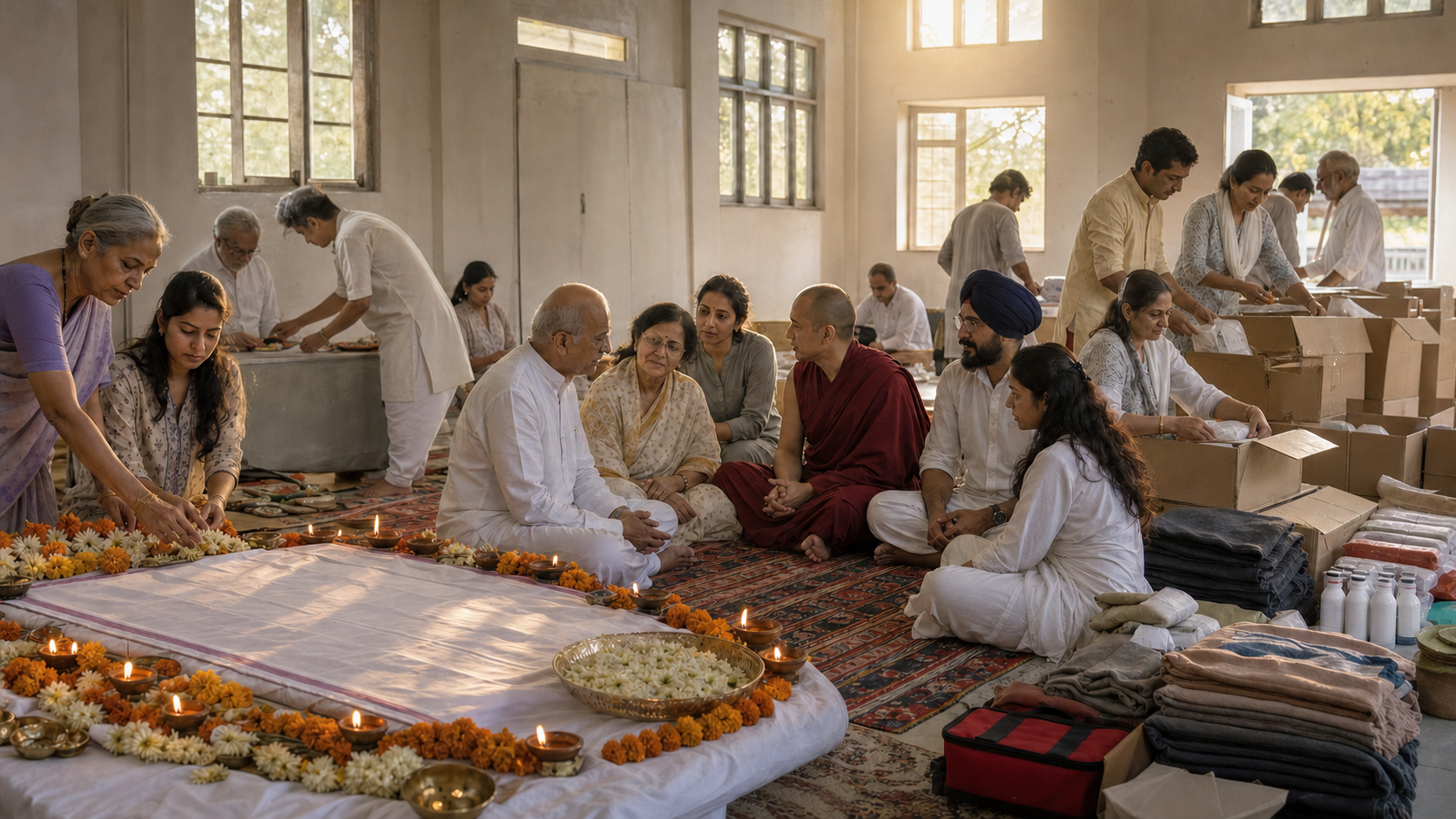
Someone in your community has shared news of a death, an attack, or damage to a sacred place. By evening, people are asking for a prayer gathering, a public statement, and a fundraiser. Your problem is no longer whether the community cares. It is how to act without spreading an unverified claim, turning grief into spectacle, or letting concern expire with the news cycle.
Whether you help lead a mandir, vihara, derasar, or gurdwara, or simply want your family to respond meaningfully, use a three-part discipline: dignified remembrance, truthful witness, and accountable seva. Each part corrects a weakness in the others. Ritual without follow-through can become ceremonial closure. Advocacy without care can use the suffering of others. Relief without remembrance can meet an immediate need while allowing the people and the cause to disappear from communal memory.
Key takeaways
- Confirm what is known, distinguish it from what remains uncertain, and remember people as people rather than as statistics.
- Ask an appropriate religious leader to guide any shraadh, tarpan, path, kirtan, abhishekam, metta, or other observance.
- Do not collect money until you can name the need, recipient, steward, and method of reporting what happens next.
- Build Dharmic solidarity through shared ethical commitments, not by pretending Hindu, Buddhist, Jain, and Sikh teachings or rituals are identical.
- Before people leave an observance, give them a concrete next action and identify who will report back to the community.
Decide what your solidarity is meant to accomplish
Remembrance answers, “Who must not be forgotten?” Solidarity answers, “Who will stand with the living?” Seva answers, “What burden will we actually help carry?” These duties reinforce one another, but they are not interchangeable. A lamp does not distribute relief. A donation does not preserve a name. A public statement does not by itself create safety.
Start by writing a short response brief for your organizing group. It should state what has been verified, what remains unconfirmed, who or what is being remembered, which religious leader will guide the observance, what affected people are understood to need, and who will own the seva commitment. This brief is not publicity. It is the discipline that prevents a gathering from being built around assumptions.
- Dignity: Use confirmed names where they are available. Check spelling and pronunciation. If names are not known, acknowledge that honestly instead of circulating a guessed or copied list.
- Truthfulness: Separate verified facts from reports that are still developing. Do not use graphic images as decoration for a flyer, and do not let the urgency of an event become an excuse for careless claims.
- Continuity: Decide where the names, prayers, resolutions, and seva updates will be preserved after the gathering. Memory becomes communal when people can return to it.
- Protection: Ask what the living need, rather than assuming that the loudest response is the most useful one. Assistance may involve relief, restoration, documentation, education, or careful civic engagement.
- Responsibility: Put a person’s or institution’s name beside every promised action. A promise assigned to “the community” usually belongs to nobody.
If you cannot identify a credible recipient and a responsible steward, do not collect money yet. Prayer, remembrance, and fact-finding can proceed while the practical channel is verified. Delaying an unstructured fundraiser is not indifference; it protects donors, intended beneficiaries, and the credibility of future appeals.
This distinction matters when responding to Hindus reported killed in Bangladesh because of their identity. Public grief can affirm that those lives belong in our communal memory. It must not reduce them to interchangeable symbols of persecution. Speak their names when they are known. Preserve the person before promoting the cause.
Build an observance that honors rather than performs
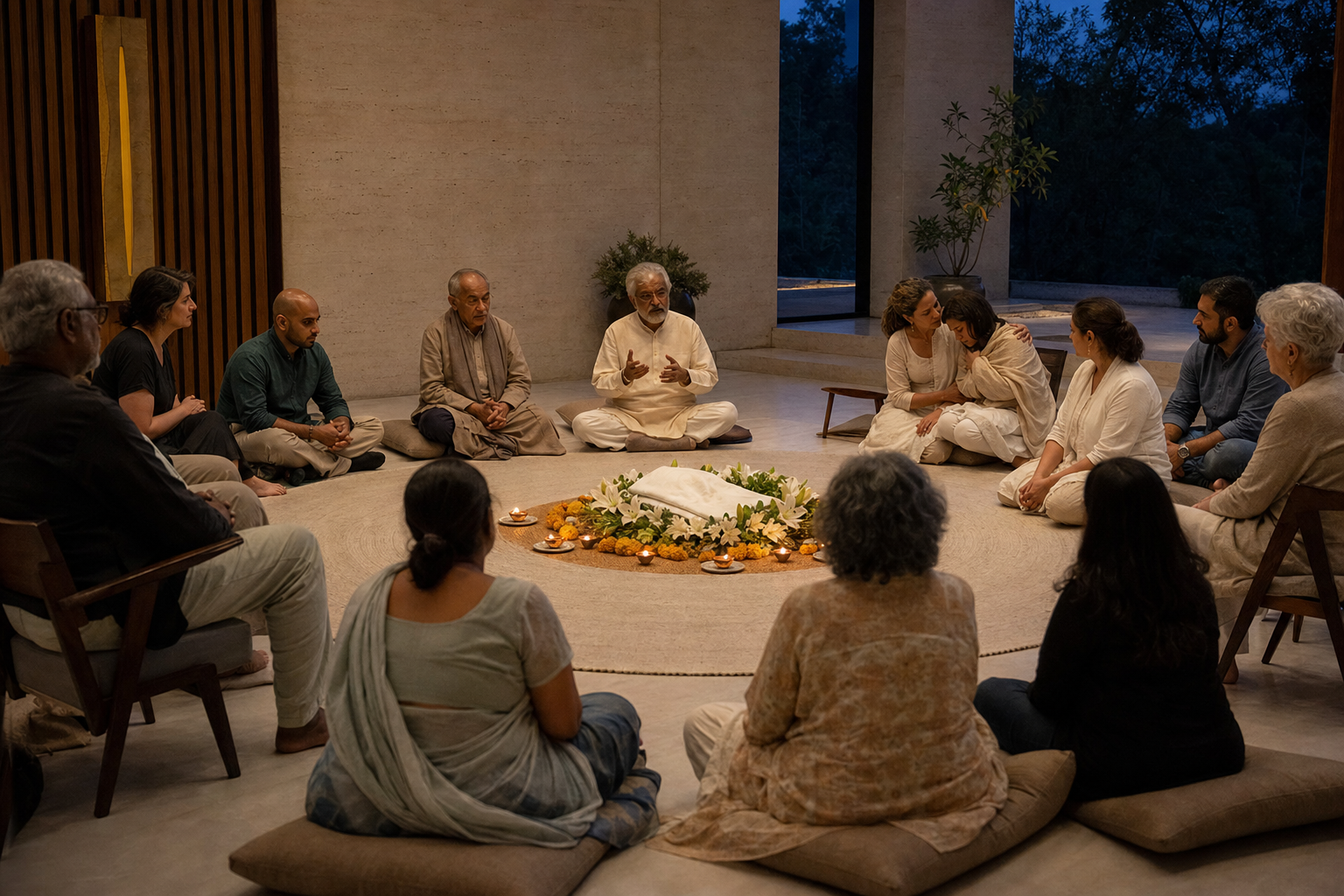
Ritual gives grief a form. In many Hindu families, recitation of the Bhagavad Gita may accompany the threshold of death, the Garud Purana may be read in the days that follow, and shraadh or tarpan may carry remembrance through offerings of water, rice, and sesame. Practice varies by region, sampradaya, lineage, and family. That variation is a reason to seek guidance, not a reason to improvise a generic ceremony from fragments found online.
Family rites and public remembrance also do different work. A communal observance can witness a loss, refuse erasure, and mobilize support, but it should not claim to replace rites that belong to a family or particular lineage. When families are absent, dispersed, afraid to grieve publicly, or unable to conduct a farewell, the community should proceed with special humility.
- Establish whom you are remembering. Prepare confirmed names when possible. Where identities remain unknown, use language that preserves their humanity without pretending certainty.
- Choose qualified ritual guidance. Ask a priest, granthi, monk, nun, acharya, or other appropriate tradition-bearer to determine what form is suitable. Give that person the verified context before asking for a program.
- Explain participation before the rite begins. Tell attendees what the observance means, when they should respond, whether they may make an offering, and how members of other traditions can participate respectfully.
- Protect the dignity of the moment. Decide in advance whether photography is appropriate. Do not place a camera between mourners and an offering, and do not publish identifiable images of vulnerable families without permission.
- Allow grief without inflaming the room. A truthful account of harm can be direct. It does not require dehumanizing language, collective blame, or slogans that place uninvolved people at risk.
- Connect the rite to a named duty. Before closing, state what seva will follow, who is responsible, and where the community will receive an update.
A Hindu observance might include shraadh, tarpan, Gita recitation, Chandi path, kirtan, or Rudrabhishekam under appropriate guidance. A wider Dharmic gathering need not make every participant perform a Hindu rite. Buddhist participants may offer metta or prayers for peace; Jain participants may center ahimsa and reverence for life; Sikh participants may contribute kirtan and seva. Parallel offerings can express a common intention while keeping each practice intelligible and authentic.
This is more honest than manufacturing a blended liturgy that belongs fully to nobody. The host should name each practice, identify the tradition from which it comes, and let its own custodian guide it. Guests can stand in respect, offer silence, or participate in a way permitted by their conscience and tradition.
Public shraadh for victims of anti-Hindu violence has a particular moral force because it says that a person denied public mourning will still be received into public memory. Yet its power depends on restraint. Avoid branding the ritual around an organization, placing speeches in the middle of sacred actions, or treating mourners as an audience for unrelated announcements. Let the religious act remain an act of religious duty.
Turn communal grief into an accountable seva chain

A fundraiser is not yet a seva program. Money becomes accountable service only when it moves through a defined chain from need to recipient, from recipient to responsible steward, and from steward to a report that the community can understand.
- Need: Describe the burden being addressed in plain language. Do not use a general crisis as permission to collect for an undefined purpose.
- Validation: Identify how the need was confirmed and whether affected families, local institutions, or credible community representatives were consulted.
- Recipient: State who will receive funds, supplies, volunteer labor, or professional assistance. If privacy or safety prevents public identification, explain the verification process without exposing sensitive details.
- Steward: Name the person or institution responsible for custody, disbursement, records, and questions.
- Scope: Say what the campaign will and will not support. This prevents a focused appeal from quietly becoming an unrestricted pool.
- Evidence: Retain receipts, transfer records, delivery confirmations, or service logs appropriate to the work. Protect personal information while showing that the commitment was fulfilled.
- Closure: Report what was completed, what remains open, and what will happen to any unused resources. Silence after collection weakens every later appeal.
The same structure works beyond emergency relief. Gau seva, for example, becomes more than a declaration when it supports humane shelter care, fodder banks, veterinary outreach, sustainable agriculture, reduced food waste, or temple-based education about ecology and ethics. Those were among the practical pathways associated with the planned Gau Mata Rashtra Mata gathering in Delhi. Each pathway gives a sacred commitment a visible field of work.
Ask the same operational questions of every cause. A cow-protection campaign should be able to show what care was provided, which shelter or veterinary effort was supported, and who kept the records. A remembrance campaign for persecuted Hindus should be able to state what followed the ceremony: assistance to families, support for damaged sacred spaces, responsible documentation, civic education, or another defined form of care.
Do not force every volunteer into the same task. Some people can organize ritual logistics. Others can verify information, keep accounts, prepare meals, translate family requests, coordinate with temples, or document commitments. Seva becomes durable when the work is divided by competence and every handoff is explicit.
Keep legal and security work within qualified hands. When assistance touches legal claims, personal safety, charitable compliance, or the handling of sensitive information, consult appropriate local professionals before advising families or volunteers. Public urgency does not remove jurisdictional rules or the risk of exposing a vulnerable person.
Practice Dharmic unity without demanding sameness
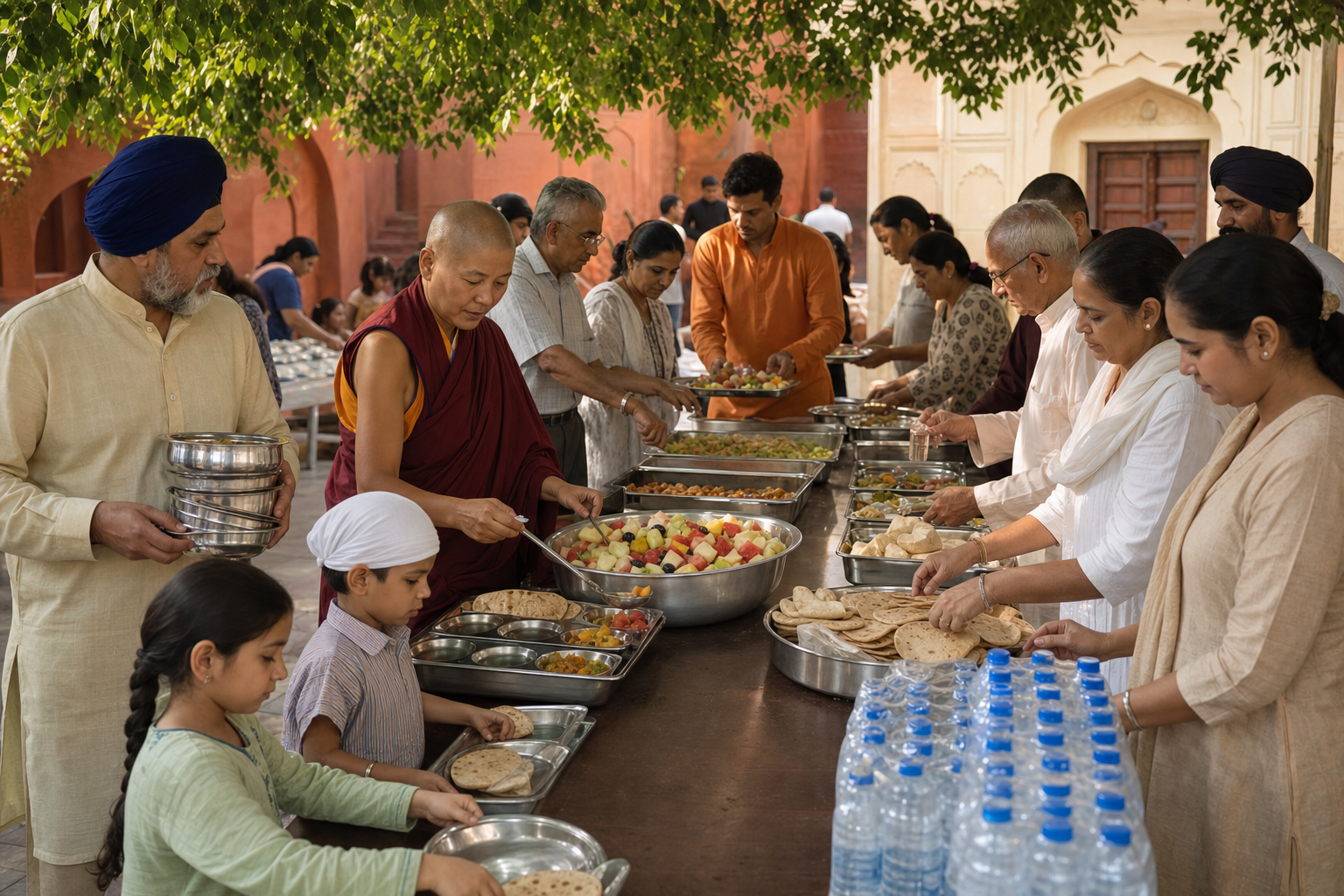
Solidarity becomes credible when the common moral commitment is clear and theological boundaries remain honest. Hinduism, Buddhism, Jainism, and Sikhism are not four labels for an identical system. Their understandings of authority, liberation, ritual, community, and discipline differ. Cooperation does not require those differences to be minimized.
Common ground is strongest around duties that can be stated and enacted: honoring the dead, protecting the vulnerable, practicing ahimsa and karuna, serving without humiliation, caring for living beings, preserving sacred spaces, speaking truthfully, and keeping public commitments. These are working commitments, not claims that every tradition reaches them through the same theology.
A Delhi conference announced for January 2026 drew significance from the expectation that four Shankaracharyas would share a platform after a reported interval of 19 years. The useful lesson for a local community is not that a shared stage automatically creates consensus. It is that rare moments of visible unity should be prepared carefully enough to produce guidance, relationships, and work that continue after the gathering.
Use a simple covenant when several Dharmic institutions organize together:
- The tradition responsible for a rite retains authority over how that rite is conducted.
- Every participating institution reviews the shared public statement before its name is attached.
- The statement is limited to commitments the participants actually share; it does not declare doctrinal agreement that has not been established.
- Representatives of affected communities are given a real role in defining needs, not merely a ceremonial place on the program.
- Disagreements are addressed through a designated private process before they become public spectacle.
- No organizer uses the gathering to recruit from another tradition, promote an unrelated campaign, or claim sole ownership of the response.
- The group names a seva commitment, a steward, and a reporting channel before the event closes.
This covenant guards against two opposite failures. The first is flattening: speaking of Dharmic unity so vaguely that each tradition becomes decorative. The second is fragmentation: allowing a genuine difference to become an excuse for abandoning people who need help. Parallel ritual, shared ethical language, and joint service provide a practical middle path.
You do not need to wait for a crisis or a gathering of senior religious leaders to build this capacity. Temples and other Dharmic institutions can establish relationships through food service, animal welfare, ecological work, study circles, remembrance observances, and transparent relief efforts. Ordinary cooperation creates the trust that an emergency response later requires.
Before your next communal observance is announced, put the verified facts, religious guidance, seva commitment, responsible steward, and reporting path in the same brief. If one of those elements is missing, name the gap and keep working. That discipline is how a moment of grief becomes continuing care, and how Dharmic solidarity becomes a habit rather than a slogan.
References
- Hindu Existence – Historic Unity: Four Shankaracharyas to Grace Delhi’s ‘Gau Mata Rashtra Mata’ Summit After 19 Years
- CoHNA – Shraadh Across the World for the Dead in Bangladesh
