
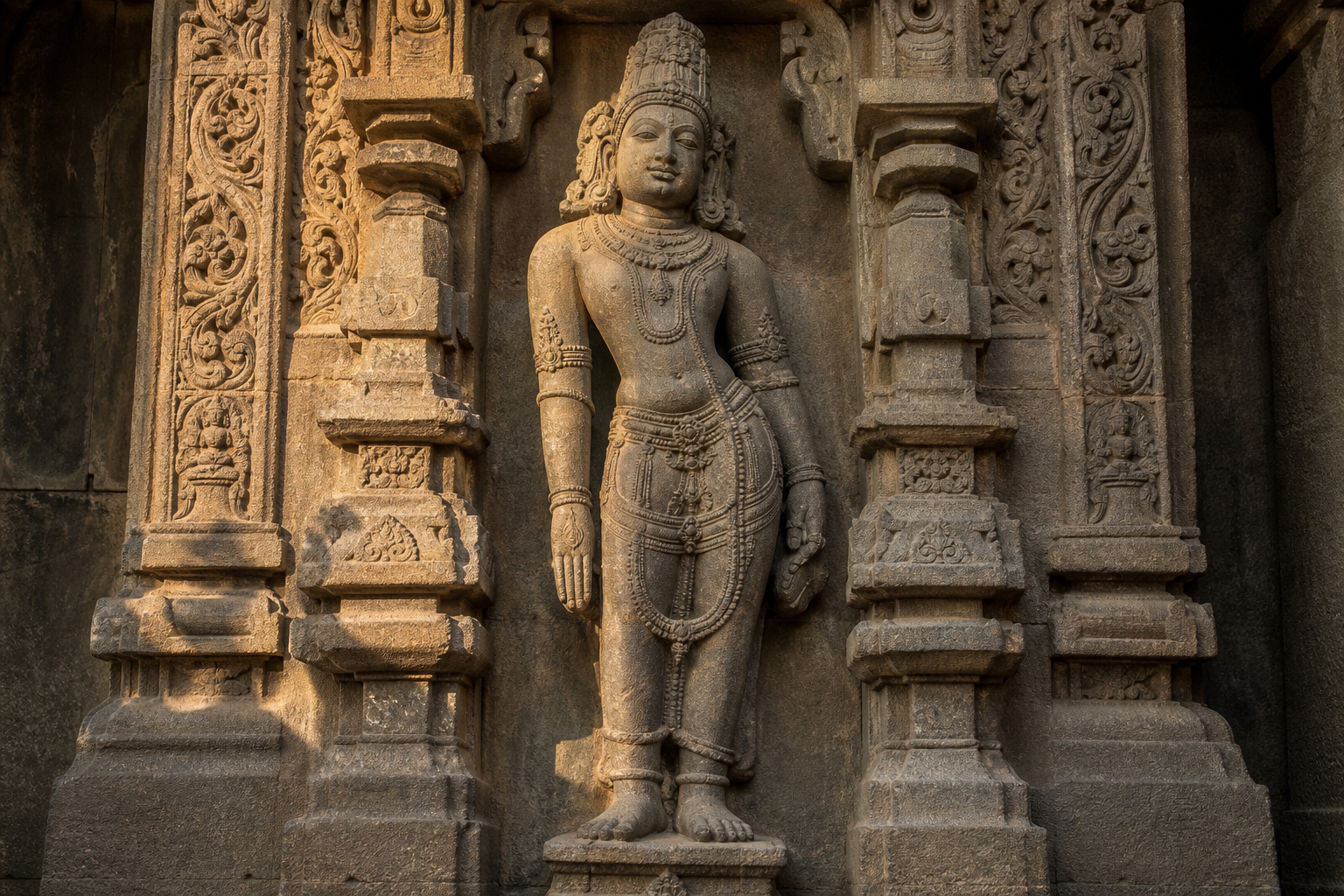
You are standing before a temple sculpture, and one hand seems almost too restrained to matter. It carries no obvious weapon or flower. It does not make a conspicuous blessing. Yet its controlled position changes the bearing of the entire figure. If that hand is Danda Hasta, the restraint is precisely what you are meant to notice.
The useful question is not merely, What is this mudra called? It is, What kind of authority does this image ask me to see? Danda Hasta becomes much easier to read when you move from the word, to the carved form, to the complete iconographic setting.
Begin with the hand, but read the whole image
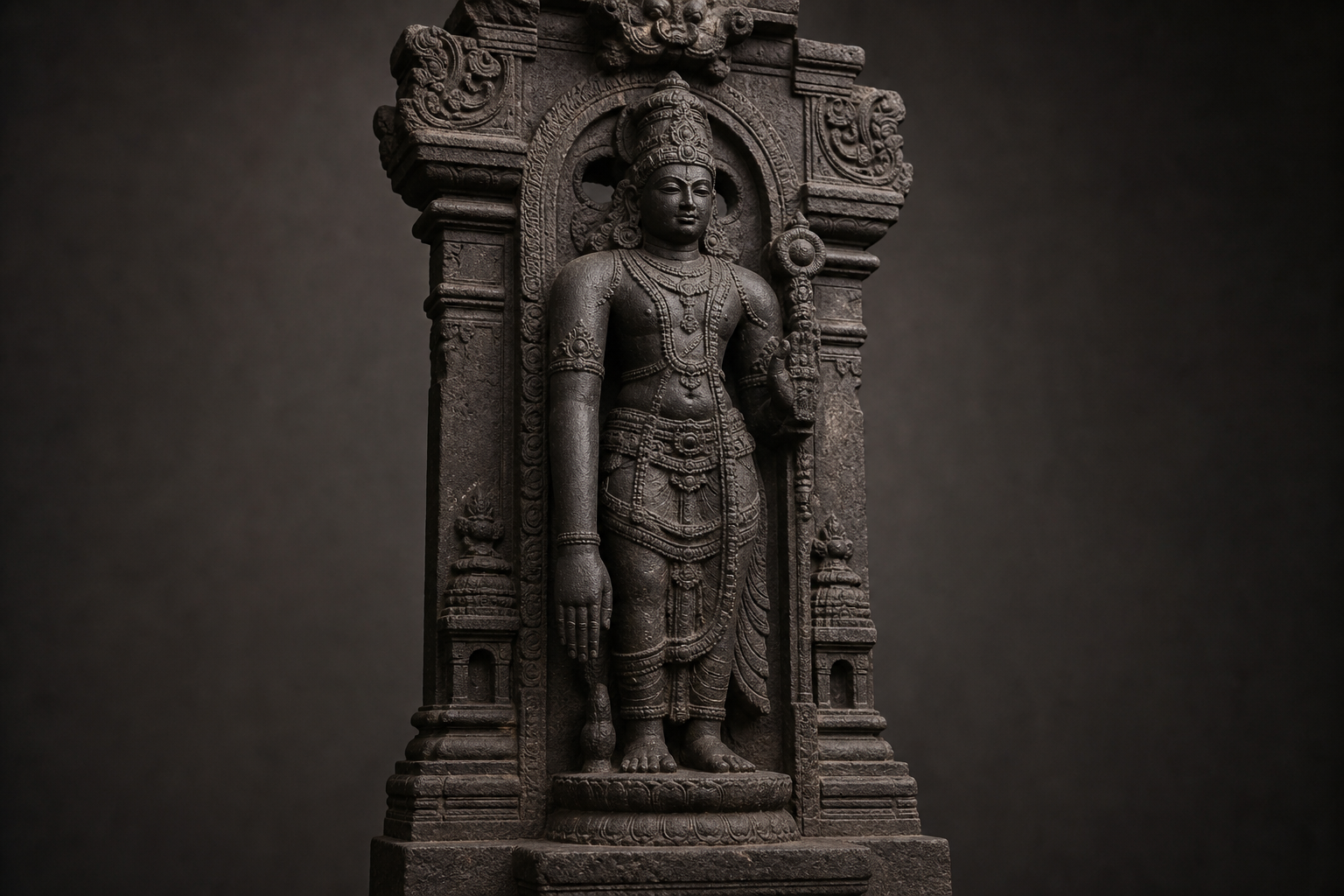
At its root, danda can mean a staff or rod and can also carry the ideas of discipline and righteous order, while hasta means hand. Danda Hasta can therefore be approached literally as a staff-like hand and interpretively as a gesture of controlled authority.
It belongs to a classical vocabulary of twenty-eight single-hand gestures. That classification tells you the pose is intentional, but it does not turn the hand into a self-contained symbol. Temple iconography is relational. The gesture works with the arm, shoulders, stance, gaze, attributes, other hands, and identity of the sacred figure.
This is the first rule for identification: never name Danda Hasta from a blurred close-up of the fingers alone. Begin with the complete figure. A hand that looks firm and vertical in isolation may be holding a missing attribute, following the contour of the body, or simply completing a larger stance. The label becomes credible only when form, placement, and context converge.
You also should not expect the gesture to communicate through theatrical movement. Its power is composure. The limb appears governed rather than agitated. The figure does not need to swing a rod or enact punishment; the ordered bearing is itself enough to indicate that discipline is present.
What danda adds to the meaning of the gesture
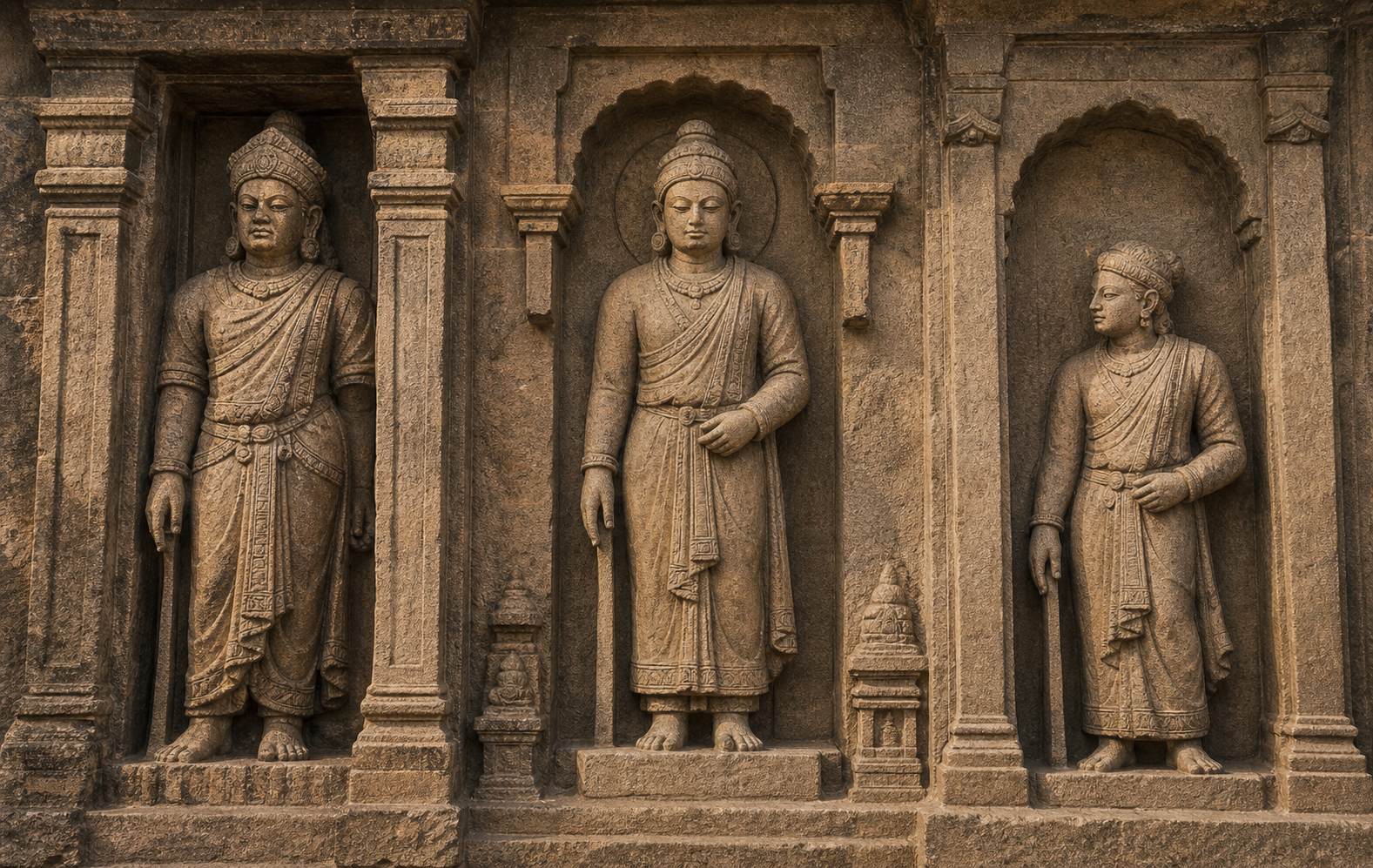
Translating danda only as punishment makes the image harsher and narrower than it needs to be. Its semantic range gives you three connected levels on which to read the pose:
- Staff or rod: the physical image suggests firmness, straightness, support, and an unmistakable line of command.
- Discipline: power is held under control. It is neither slack nor impulsive.
- Righteous order: authority serves an ordering principle rather than personal anger or arbitrary force.
These levels reinforce one another, but they are not three separate dictionary definitions that must appear equally in every sculpture. The surrounding image decides which level comes forward. A stable posture and serene bearing strengthen the reading of composed authority. A narrative scene filled with movement may place greater weight on the action taking place around the hand.
The distinction between authority and aggression is especially important. Aggression spends force. Danda Hasta holds force in reserve. It presents command as something already established, not something the figure must prove through agitation. That is why an apparently simple hand can exert such influence over the image’s emotional tone.
A devotional viewer may go one step further and see self-command within the gesture: the capacity to govern others begins with mastery of one’s own impulses. That is a legitimate spiritual reflection on the meanings of discipline and order, but it should be presented as reflection, not as an inflexible iconographic formula. A museum caption and a meditation need not make the same kind of claim.
A six-step method for identifying Danda Hasta
When you are examining a temple image, photograph, or catalogue entry, use the following sequence. It prevents the name from outrunning the visible evidence.
- Start with the complete figure. Note the number of arms, the overall stance, the direction of the torso, and the role of each visible hand. Do not crop the image mentally before you understand its composition.
- Separate the gesture from a held object. Follow the carving through the fingers. If the hand closes around a visible shaft, identify the staff or other attribute first. Do not infer Danda Hasta merely because danda can mean staff.
- Describe the geometry before naming it. Record which arm is involved, how much the elbow bends, where the wrist points, how the palm is oriented, and how the fingers relate to the body. This neutral description remains useful even if the final identification changes.
- Look for intentional composure. Ask whether the arm forms a controlled, staff-like line that contributes to the figure’s authority. Distinguish that line from a casually lowered limb, an arm pulled by the weight of an object, or an irregularity caused by damage.
- Read the iconographic ensemble. Other hands may bless, offer, hold attributes, or balance the figure. The face and stance may be tranquil, commanding, protective, or active. Let these features determine whether disciplined authority is a convincing interpretation.
- Verify the local classification when possible. An Agamic description, temple record, reliable collection catalogue, or established regional identification can resolve what visual inspection cannot. Do not make handedness, deity, or finger placement part of a universal definition unless the applicable tradition supports it.
Your final label should reveal how strong the evidence is. Use definite when the pose is clear and a reliable iconographic identification supports it. Use probable when the visible form and context agree but no local label is available. Use possible when damage, angle, restoration, or a missing object leaves a genuine alternative. This small discipline makes temple documentation more trustworthy.
Common misreadings that change the image’s meaning
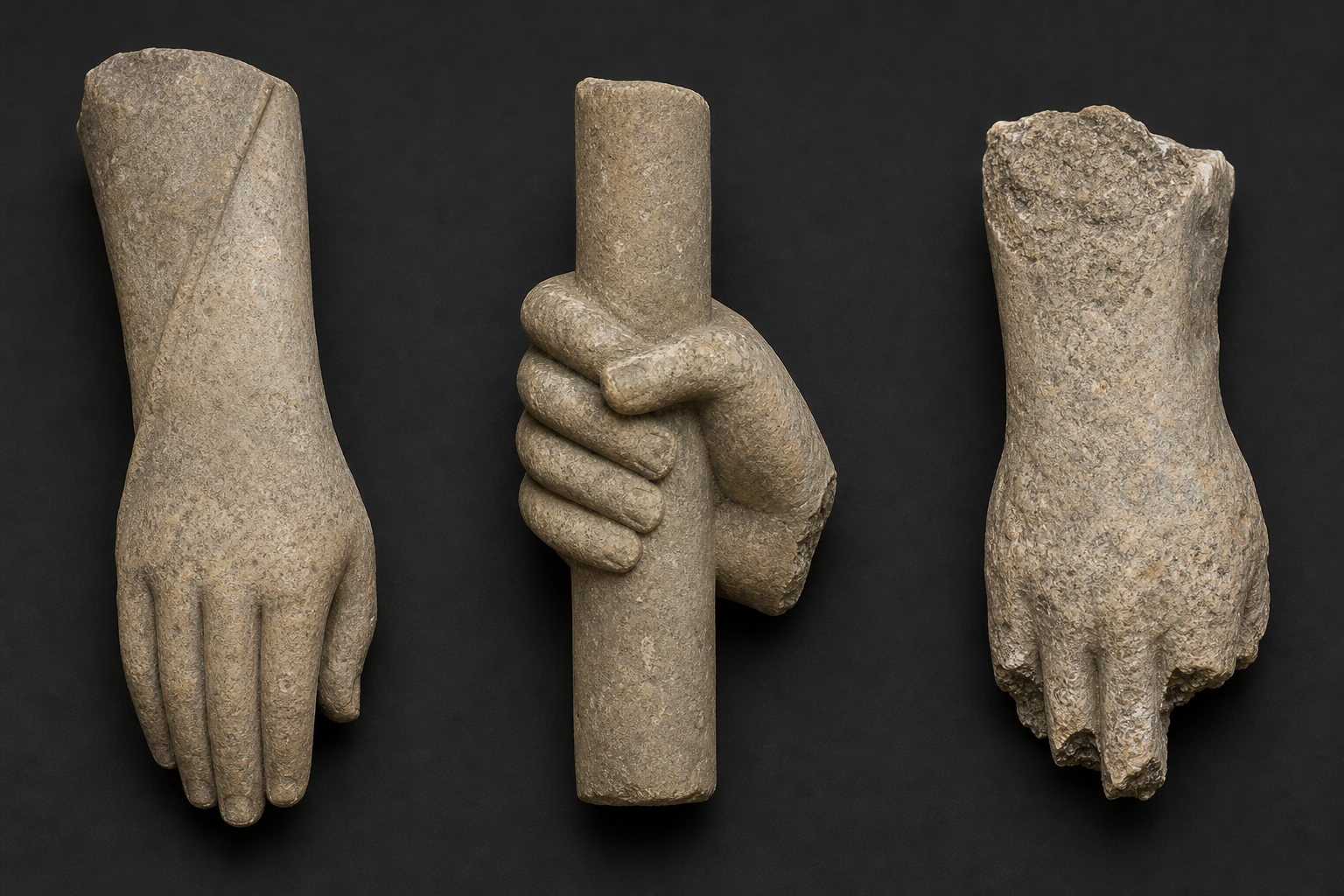
Most errors come from treating one feature as decisive. Watch for these five shortcuts:
- Equating Danda Hasta with every staff-bearing figure. A staff is an attribute; Danda Hasta is a convention of the hand or limb. Name what is visibly held before assigning a mudra.
- Calling every lowered hand Danda Hasta. Position alone is not enough. Look for controlled alignment and a meaningful contribution to the figure’s bearing.
- Reading danda as uncontrolled violence. The word carries a corrective edge, but the gesture’s composure points toward discipline and ordered command, not necessarily an enacted blow.
- Reconstructing an exact finger formula from damaged stone. Missing fingertips, erosion, shadow, and restoration can create false certainty. Record what survives and lower the confidence of the identification.
- Copying a flat performance diagram directly onto sculpture. Abhinaya vocabulary can help with terminology, but a temple image is three-dimensional and fixed within a larger iconographic program. Shoulder, torso, attributes, and viewing angle remain part of the evidence.
A responsible caption can be both concise and honest: Possible Danda Hasta: the lower hand forms a controlled, staff-like line that reinforces the figure’s composed authority; the identification remains tentative because the fingers are damaged. That wording tells the reader what you observed, what it may mean, and why certainty is limited.
If you are photographing a sculpture for later study, take one full-length image before the hand close-up. Then photograph the hand from an angle that shows whether an object passes through it. Record the temple, the figure’s location within the temple, the identity traditionally given to it, and any visible damage. Those details will often be more valuable than a highly magnified but contextless image.
Key takeaways
- Danda Hasta joins the meanings of hand, staff-like firmness, discipline, and righteous order.
- Its central visual effect is composed authority rather than dramatic or uncontrolled force.
- Identify it from the whole figure, not from finger shape or arm direction alone.
- Distinguish a hand gesture from an actual staff or another held attribute.
- Use qualified labels when erosion, restoration, or missing context prevents certainty.
- Treat self-mastery as a devotional interpretation, not automatically as a fixed catalogue definition.
When you next encounter a hand that appears quiet beside a richly ornamented temple figure, resist the urge to pass over it. Trace its line through the arm and body, inspect what it does not hold, and ask whether its stillness establishes order. That careful look is how a modest carved gesture begins to disclose the authority of the whole image.
References
