
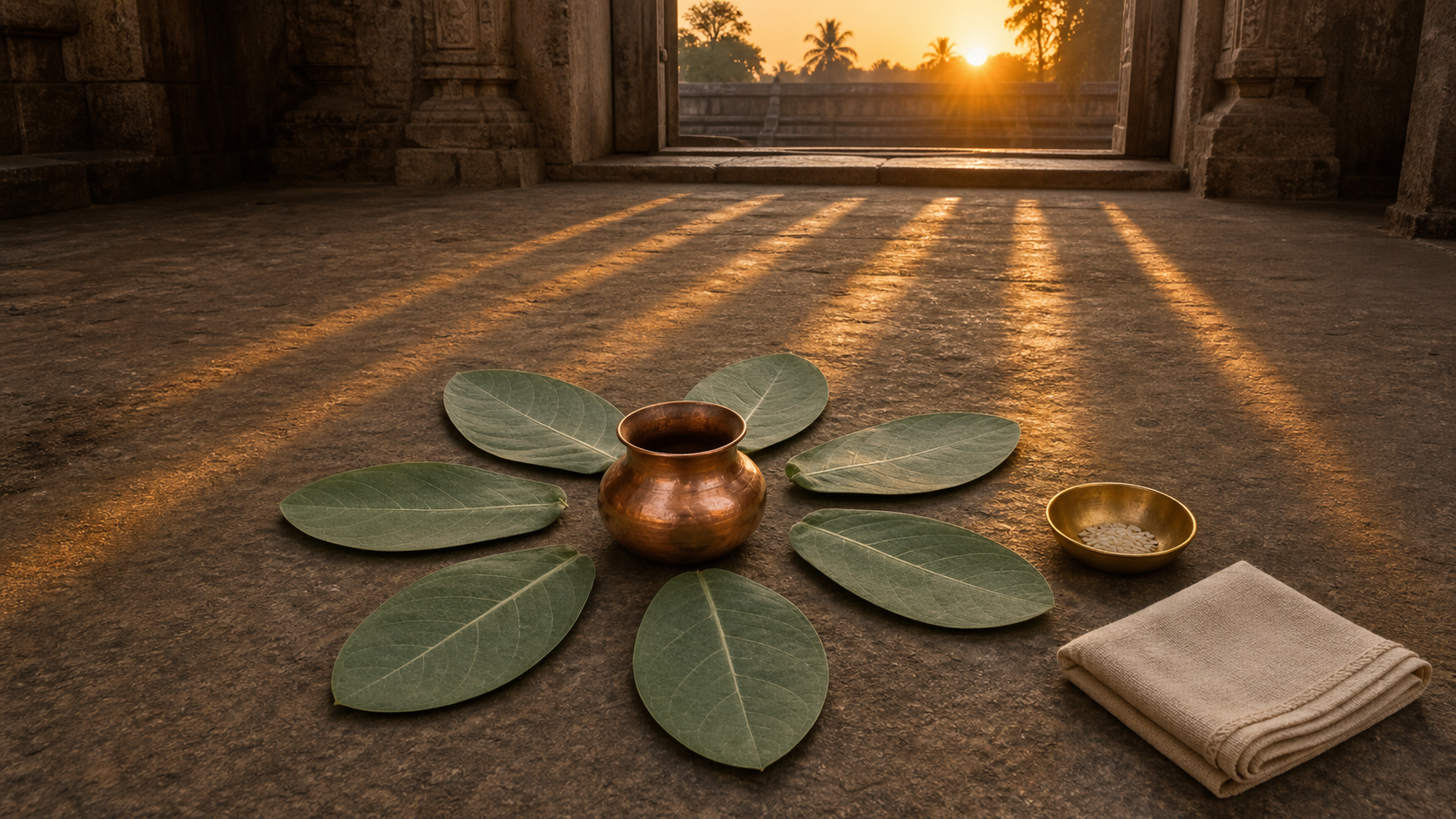
If you are preparing for Ratha Saptami with seven erukkai leaves in hand, the uncertainty is usually practical: Where do the leaves go, when should you bathe, and what should you hold in mind while doing it? The ritual becomes clearer when you treat the leaves not as decorative accessories, but as seven physical reminders of how you intend to live.
You do not need an elaborate ceremony. You need the correct morning, seven safely handled leaves, a simple sunrise sequence, and enough attention to connect each gesture with dharma. This guide gives you that working structure while leaving room for the customs of your family, sampradaya, or temple.
Begin with the calendar, not the leaves
Ratha Saptami is observed on Magha Shukla Saptami, the seventh lunar day of the waxing fortnight in Magha. Sunrise is the ritual anchor. Because the tithi and the local sunrise do not line up identically in every place, confirm the observance with a Panchang prepared for your location. Do this the evening before, not while trying to assemble the bath at dawn.
The festival falls in the broader Uttarayana season, after Makara Sankranti and near the gradual transition from winter toward spring. Its central image is Surya’s chariot moving decisively onward. For you, that movement is the first interpretive key: Ratha Saptami is not merely a request for light; it is a commitment to move with light through disciplined action.
The seven horses of Surya’s chariot are one important explanation for the seven leaves. The seven days of the week provide another association with the ordered passage of time. Other dharmic patterns of seven include the sapta rishis, sapta dhatus, sapta lokas, and sapta swaras. These resonances do not have to be forced into a single code. Together, they make seven an appropriate ritual structure for bringing different parts of life under one clear intention.
Prepare the bath simply and handle erukkai safely
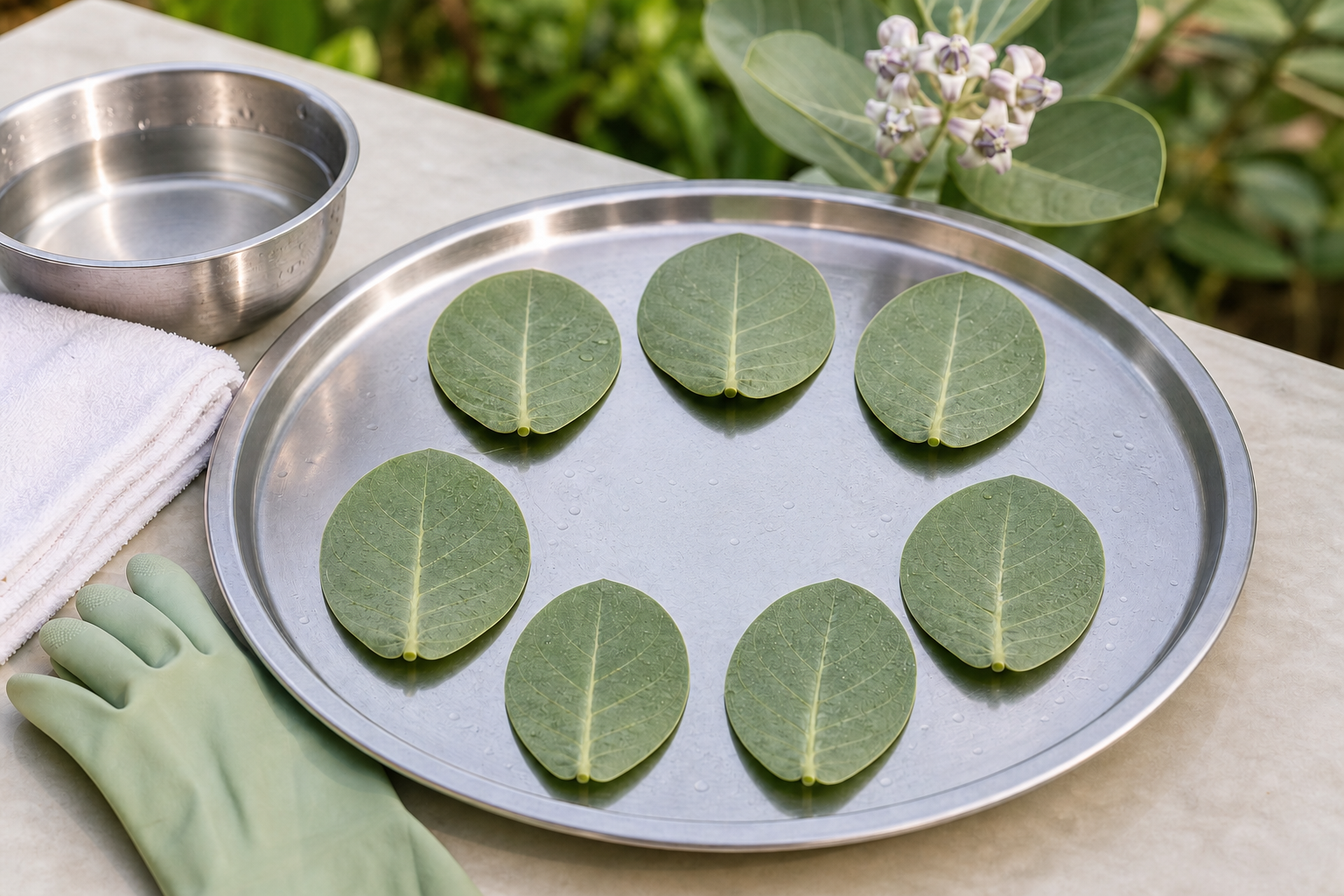
Erukkai, also known as arka, is Calotropis gigantea. The ritual bath is therefore called arka-patra snana. Gather what you need before sleeping so that the sacred part of the morning is not consumed by searching for vessels, leaves, or a text.
- Seven clean, intact erukkai leaves.
- A small amount of turmeric and akshata, or uncooked rice, if these are part of your custom.
- Water and a suitable vessel for offering arghya after the bath.
- A clean, safe place from which you can face east.
- One recitation you know or can follow attentively, such as the Surya Gayatri, Suryashtakam, or Aditya Hridayam.
- A plan for the day’s satvik food, restraint, charity, or service.
Take only the leaves you will use and avoid needless damage to the plant. Examine each leaf before placing it on your body. A damaged erukkai leaf can release milky latex, which may irritate sensitive skin and eyes. Handle the leaves gently, do not crush or cut them, keep them away from your eyes, and stop using them if irritation begins.
If you already know that your skin reacts to the plant, do not make direct contact a test of devotion. You can place seven leaves before Surya and contemplate the same seven intentions without putting them on your body. The leaf bath is a ritual means, not the purpose of the observance. In the same way, prayers for health and vitality are devotional commitments and are not substitutes for medical care you may need.
A workable sunrise sequence for arka-patra snana
The exact order can vary by region and lineage. If you have received a family or temple procedure, follow it. If you have not, the following sequence preserves the central elements without turning the morning into an unnecessarily complicated performance.
- Before sunrise, arrange the seven leaves, bathing water, arghya vessel, and recitation in one clean place. Remove damaged or leaking leaves.
- At sunrise, face east and steady your breathing. Bring to mind Surya as the giver of light, order, time, and the conditions that sustain life.
- If it belongs to your custom, place a little turmeric and akshata on the leaves as signs of purity, gratitude, and auspicious intention.
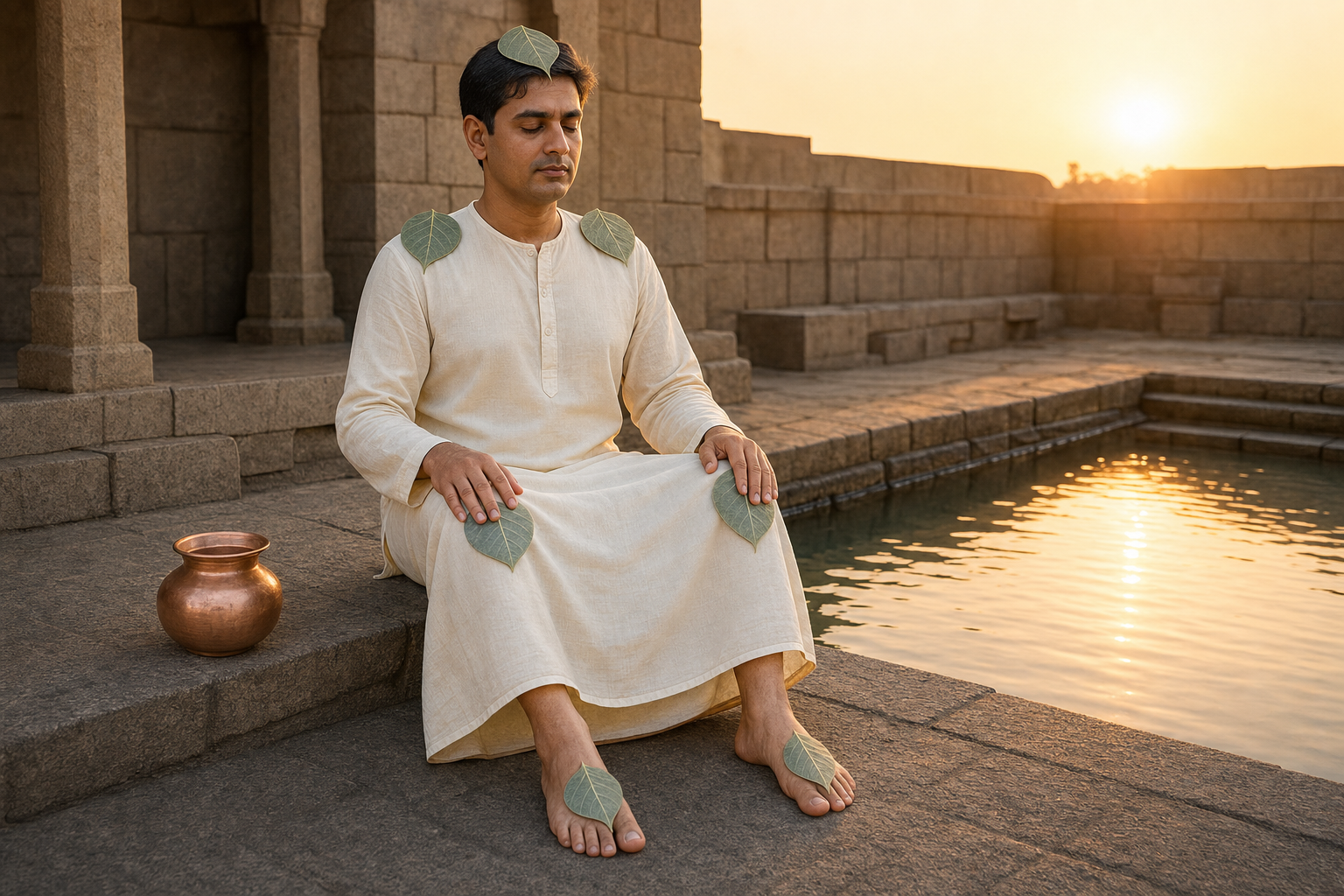
- Place one leaf on the head, one on each shoulder, one on the chest, one on the back, and one on each knee. This gives seven leaves across seven placements: one plus two plus one plus one plus two.
- Pause before bathing. Move your attention from the head to the shoulders, chest, back, and knees, attaching a clear ethical intention to each location.
- Complete the bath according to your household practice. If reaching the back or balancing the leaves is difficult, ask for help or use a safe local variation rather than straining or risking a fall.
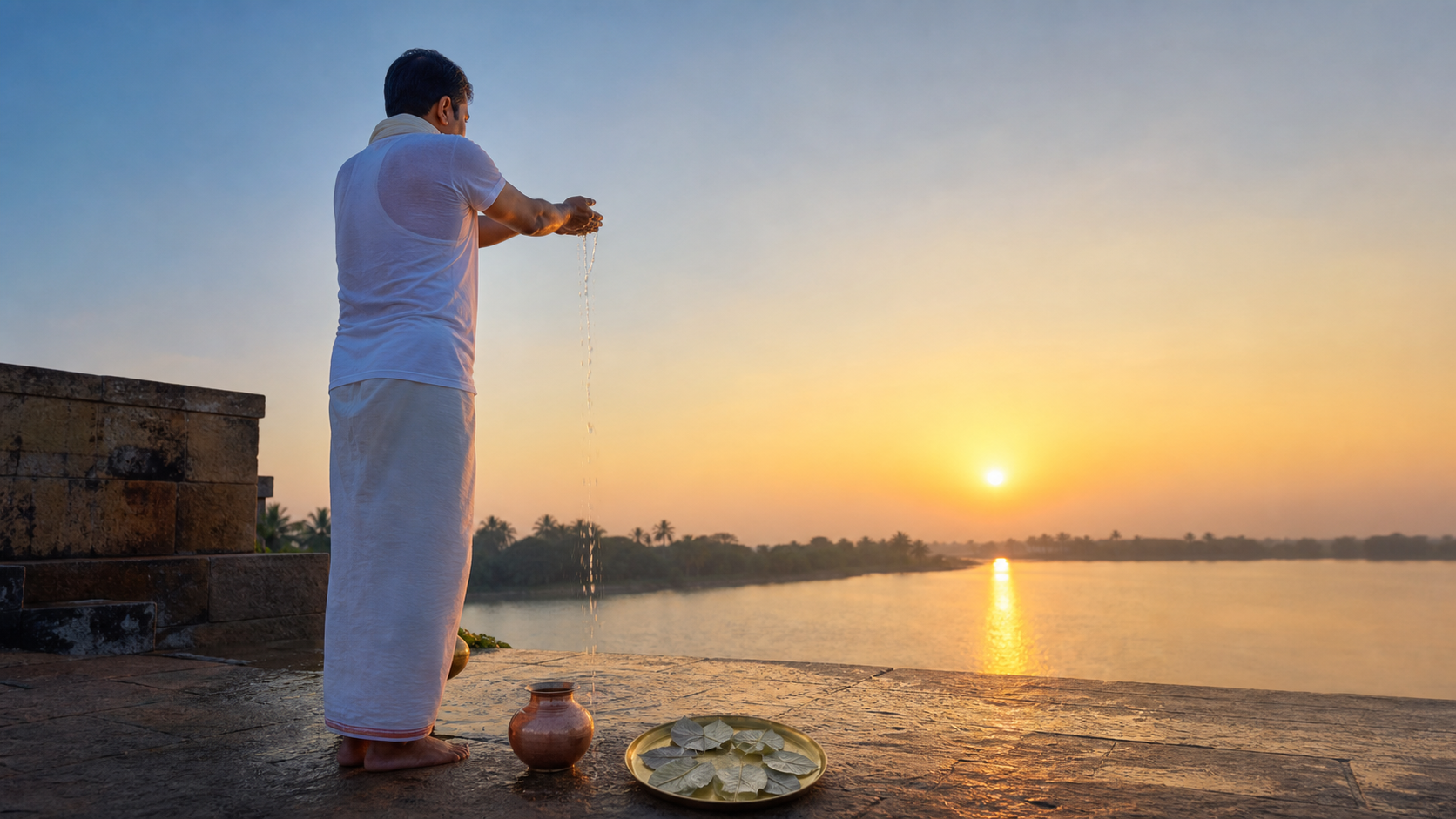
- After the bath, offer arghya while facing east. Let the offering express gratitude, not a transaction in which worship is expected to purchase a particular result.
- Recite one chosen mantra or stotra with attention. If physically suitable for you, follow with mindful Surya Namaskar, coordinating breath and posture without rushing.
- Close with one specific vow for the day: fulfil a neglected duty, correct an untruth, offer food, serve someone, or relinquish a habit that clouds judgement.
Do not worry if a regional observance emphasizes the shoulders or connects the leaves primarily with the seven horses of the solar chariot. The full-body arrangement is a coherent and widely used form, but it is not a reason to dismiss a transmitted family practice. In dharmic ritual, continuity of a sincere tradition matters more than forcing every household into one choreography.
Use each placement as a vow, not just a symbol
The body’s locations turn an otherwise abstract prayer into a contemplative map. The meanings below are not medical claims or a rigid anatomy of spiritual power. They offer a disciplined way to connect the outer bath with inner purification and, crucially, with conduct after the bath.
| Leaf placement | Contemplative meaning | Action to carry into the day |
|---|---|---|
| Head: one leaf | Clarity, knowledge, and discernment | Approach one decision without self-deception, haste, or convenient omission. |
| Shoulders: two leaves | Dharma, responsibility, and the proper bearing of duty | Complete one obligation without resentment, while refusing burdens that do not rightly belong to you. |
| Chest: one leaf | Courage, devotion, compassion, and moral resolve | Do the kind but difficult thing that fear or indifference has made you postpone. |
| Back: one leaf | Recognition and release of the weight of the past | Make a repair where one is owed, learn the lesson, and stop using yesterday as an excuse for inaction. |
| Knees: two leaves | Humility, reverence, steadiness, and forward movement | Bow without self-abasement, then take one concrete step on the path you have chosen. |
This reading also explains why the leaf on the back is as important as the leaf on the head. Clear ideas are not enough if the past continues to govern your next action. Likewise, humility at the knees is not passivity. Knees allow both bowing and movement; the symbol joins reverence with the willingness to proceed.
You do not need to assign a particular rishi, realm, bodily constituent, musical note, horse, or weekday to each leaf unless your tradition teaches such an arrangement. Symbolism should deepen attention, not become a puzzle that distracts from worship. If the bath does not alter even one decision in the day ahead, the outer sequence has remained incomplete.
Carry Surya worship beyond the bathing place
Arka-patra snana establishes the direction of the morning, but the rest of the observance gives that direction duration. Arghya, recitation, Surya Namaskar, satvik restraint, and charity translate the image of Surya’s onward-moving chariot into a day governed by steadiness rather than impulse.
Choose depth over quantity in recitation. One familiar prayer offered with attention is more useful than racing through several texts merely to finish a checklist. The Surya Gayatri can center the mind on illumination. Suryashtakam offers devotional praise. Aditya Hridayam can support a longer, more concentrated observance. Use the form you can sustain sincerely.
Surya Namaskar should likewise remain mindful. Coordinate movement with breath and respect your physical limits. If standing postures are not suitable for you, seated prayer, attentive breathing, or quiet recitation can preserve the devotional intention. Ratha Saptami is not a competition in flexibility or endurance.
A vrat may take the form of a partial fast or simple satvik meals. If fasting is unsafe for your health, choose another restraint: avoid excess, speak truthfully, reduce distraction, or give up one indulgence for the day. The discipline should make you more attentive and compassionate, not leave you unable to meet legitimate responsibilities.
Complete the movement from worship to service. Offer food, give what is useful, or spend time on a duty that benefits another person. Surya’s light is not selective; it becomes an ethical model when your own conduct is less possessive, less indifferent, and more reliable.
Key takeaways
- Observe Ratha Saptami on Magha Shukla Saptami and use a local Panchang to confirm the relevant sunrise and tithi.
- The common seven-leaf arrangement is one on the head, two on the shoulders, one on the chest, one on the back, and two on the knees.
- Handle intact erukkai leaves gently because their milky latex may irritate the skin or eyes; omit direct contact when it is unsafe.
- Let inherited family or temple practice take precedence when its placement or sequence differs.
- Connect every leaf with an ethical action so that purification continues after the water has dried.
On the evening before your observance, choose one action from the placement table and write it down beside the seven leaves. At sunrise, you will then know what your worship is asking of you. When the bath is finished, begin that action before the intention has time to fade.
References
- DharmaRenaissance Blog – Ratha Saptami’s Seven Erukkai Leaves: Ritual Symbolism, Inner Purification, Surya’s Grace
- DharmaRenaissance Blog – Ratha Saptami 2026 (January 25): Auspicious Sun Worship for Health, Vitality, and Renewal
