
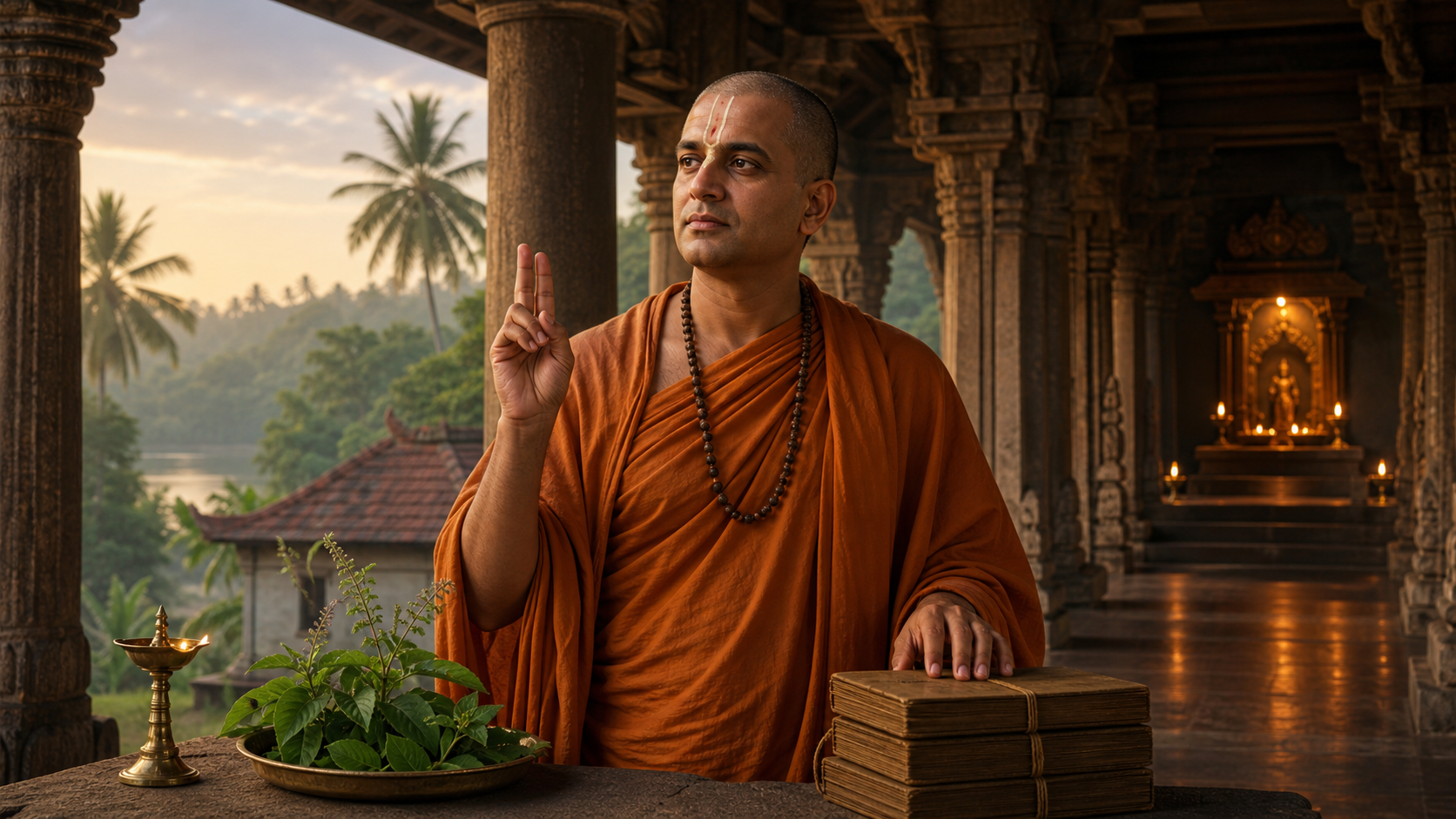
If you came to Madhvacharya after hearing that every Hindu school teaches the same final metaphysics, Dvaita asks you to slow down. Its central claim is not a minor variation in vocabulary. It changes how you understand yourself, how you approach Vishnu, and why devotion and duty matter.
The useful question is therefore not simply, “What is Dvaita?” Ask instead: if the individual self really remains distinct from the Supreme, what should change in the way you pray, study, serve, and make ethical choices? Madhvacharya, also honored as Purna Prajna and Ananda Tirtha, gave this dualist vision a clear place within Vedanta and helped shape enduring conversations about bhakti.
The distinction that holds Dvaita together
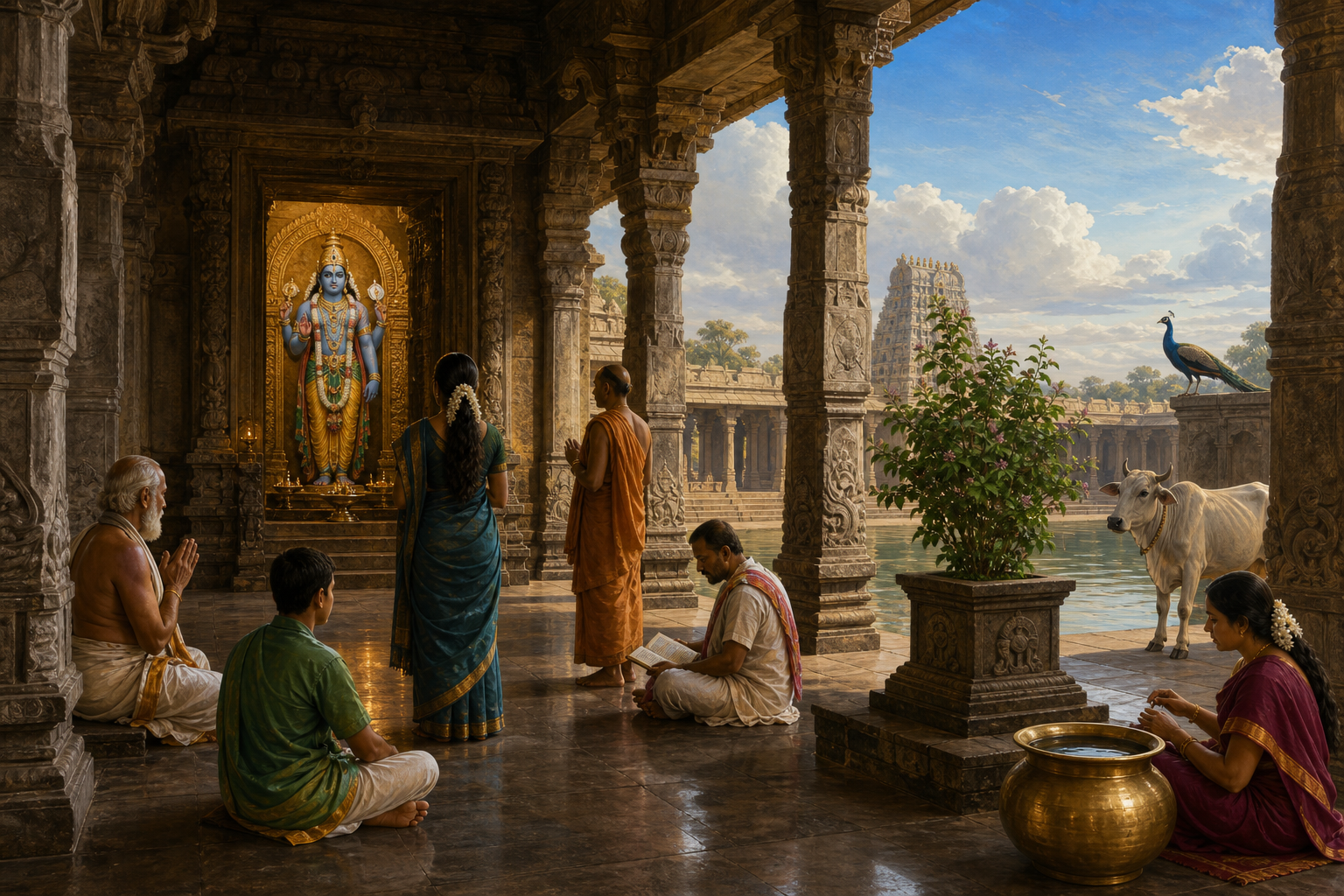
The decisive term is bheda: real distinction. The jiva, or individual self, is not Paramatman, the Supreme identified in this tradition as Vishnu. The two cannot be collapsed into a single identity without abandoning the central claim of Dvaita.
This does not mean that Dvaita proposes two equal gods or two rival ultimate powers. The relationship is not symmetrical. Vishnu is Supreme; the jiva is the individual who knows, worships, chooses, and bears responsibility. Calling the teaching “dualism” is useful only if you retain that structure.
The distinction also explains why bhakti has such seriousness in Madhvacharya’s thought. Devotion expresses a real relationship between the worshipper and the One worshipped. Vishnu is not merely a symbol for the devotee’s own highest identity, and the language of surrender is not empty religious theatre. The devotee can offer love, gratitude, obedience, and service because the two terms of the relationship are real.
When you hear an explanation of Dvaita, test it with three questions:
- Does it preserve the distinction between jiva and Paramatman, or quietly erase that distinction at the end?
- Does it identify Vishnu as Supreme, rather than treating the Divine as an undefined idea?
- Does it treat bhakti as a truthful response to a real relationship, rather than as religious emotion detached from metaphysics?
If an explanation fails these checks, it may belong to another Vedanta framework. That does not make it worthless, but it does mean you should not attribute it to Madhvacharya. Accuracy begins by allowing a school to state its own claim before comparing it with its neighbors.
How Dvaita changes devotion, duty, and service
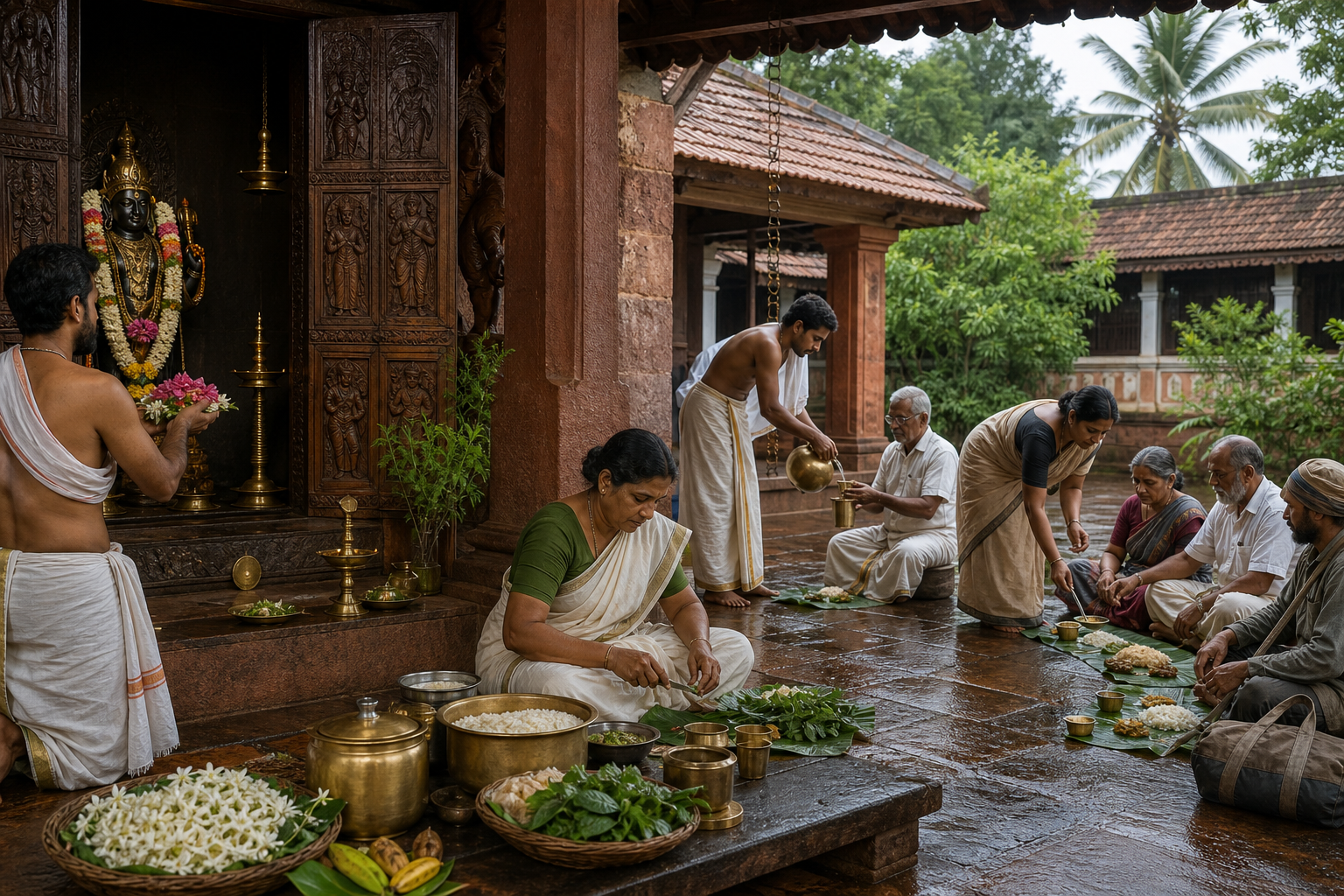
Bhakti becomes relational, not self-referential
In Dvaita practice, prayer is directed toward Vishnu as Supreme. That orientation guards against turning spiritual practice into self-magnification. You are not using the Divine merely to confirm your preferences; you are placing yourself in a relationship that calls for humility, attention, and response.
Before prayer, japa, kirtan, or quiet meditation, establish the relationship plainly: you are the devotee, Vishnu is the One worshipped, and the practice is an offering. Then bring three kinds of material into that offering: something for which you are grateful, a duty you have neglected, and an act of service you are prepared to undertake. This keeps bhakti connected to life rather than confined to devotional feeling.
Ethical discipline cannot be dissolved into abstraction
A real individual must make real choices. Dvaita therefore gives ethical discipline a firm footing: your conduct matters, other beings are not props in your spiritual story, and responsibility cannot be escaped by repeating a metaphysical slogan.
When a decision feels spiritually ambiguous, ask concrete questions. Who will be affected? What duty is already yours? Are you calling an action devotional because it serves Vishnu, or because religious language makes the action easier to justify? What would honesty require if nobody praised you for it? These questions turn doctrine into discernment.
Seva tests whether devotion has entered conduct
Seva gives bhakti an outward form. Choose a real need and perform a useful act without making yourself the center of it. Dana can support that service, but giving should not become a substitute for attention, reliability, or respect. If the recipient’s dignity disappears from view, the act needs correction even when its religious language sounds impressive.
This is also where firm conviction and dharmic fellowship can meet. Hindu, Buddhist, Jain, and Sikh traditions do not need to be declared metaphysically identical in order to share disciplined inquiry, ethical living, truthfulness, nonviolence, and compassionate service. You can recognize civilizational kinship while naming genuine differences. Respectful dialogue becomes more credible when nobody is asked to surrender the distinctiveness of a tradition merely to produce a superficial unity.
How to study Madhvacharya without flattening his teaching

The most common study error is beginning with comparison. If your first question is only how Dvaita differs from another school, you may learn a list of contrasts without understanding why its claims fit together. Begin inside the system. Compare only after you can explain its own logic in plain language.
Use this reading method with a Dvaita teaching, a lecture, or a discussion led within the guru-shishya parampara:
- Create four headings in your notes: “Self,” “Supreme,” “Relationship,” and “Practice.”
- Under “Self,” record what is being claimed about the jiva. Do not replace the claim with a vague statement about consciousness.
- Under “Supreme,” record what is said about Vishnu. Notice whether supremacy is stated clearly or blurred into generic spiritual language.
- Under “Relationship,” identify how bheda makes devotion intelligible. Ask what would stop making sense if the distinction were removed.
- Under “Practice,” record the consequences for bhakti, ethical discipline, svadhyaya, and seva.
- Only then compare the teaching with another Vedanta school or another Dharmic tradition. Compare specific claims, not slogans.
This method prevents technical Sanskrit from becoming decorative. You should be able to translate every term into a consequence. If bheda is real, prayer addresses a Supreme who is not the jiva. If bhakti is relational, humility is more than a mood. If the devotee remains morally responsible, spiritual language cannot excuse careless conduct.
Misreadings worth correcting immediately
- “Difference means hostility.” A metaphysical distinction does not authorize contempt. You can defend Dvaita precisely while treating people of other schools and traditions with dignity.
- “Devotion replaces thought.” Madhvacharya’s legacy joins rigorous inquiry with lived devotion. Study without practice becomes sterile; practice without careful understanding becomes easy to distort.
- “Dharmic unity requires one metaphysical conclusion.” Cooperation can rest on shared ethical and civilizational commitments while philosophical disagreement remains visible.
- “Dvaita is only an answer to another school.” It offers a positive account of the self, the Supreme, devotion, discipline, and service. Learn that account before treating Dvaita as one side of a debate.
A dependable teacher or discussion should be able to answer direct questions without dissolving them into “all paths are ultimately the same.” Ask what remains distinct, who receives devotion, why ethical conduct matters, and how knowledge should affect service. Clarity on those points is more valuable than collecting unfamiliar terminology.
How to observe Madhvacharya Jayanti with substance
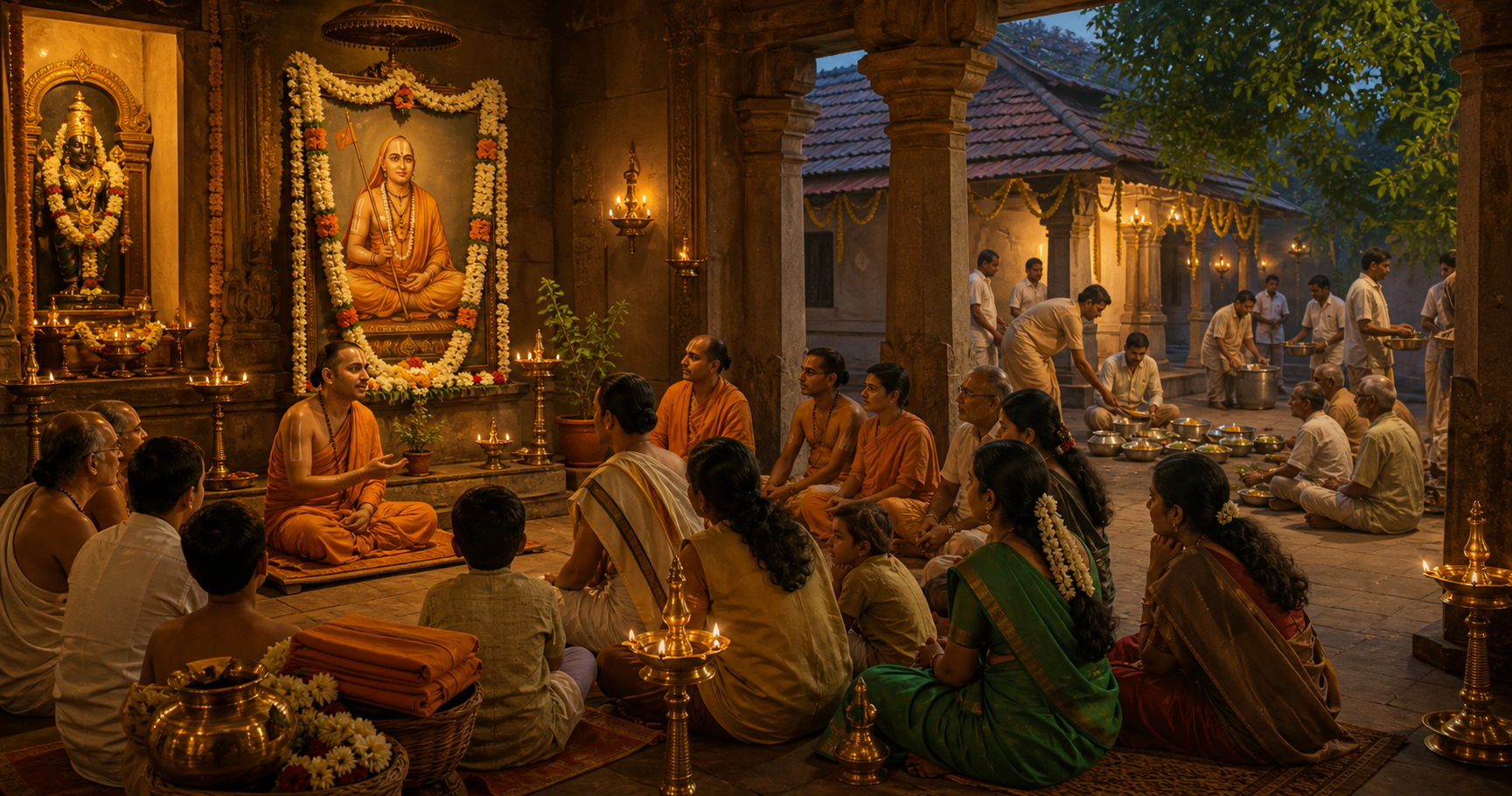
Madhvacharya Jayanti marks the acharya’s birth anniversary and gives devotees a natural occasion to renew study and practice. In 2026, the widely referenced civil date is October 21. Regional calendars and lunar calculations may produce local differences, so consult the panchang followed by your temple or community before fixing ritual times or publishing an event schedule.
A meaningful observance does not require an elaborate program. It needs a clear relationship between remembrance, teaching, worship, and conduct. A family or community can use the following sequence:
- Begin with a lamp and prayer, orienting the gathering toward Vishnu rather than treating it as a purely biographical commemoration.
- Introduce Madhvacharya by the names Purna Prajna and Ananda Tirtha, and explain why he is honored as the teacher who articulated Dvaita Siddhanta.
- Define jiva, Paramatman, and bheda in ordinary language. Keep the distinction between the individual and Vishnu at the center.
- Read from suitable Vedanta material associated with Dvaita. Pause after the reading and ask what it changes about devotion or duty.
- Include collective prayer or kirtan so that philosophical reflection leads into bhakti.
- Connect the observance to seva or dana. Choose a definite need rather than making a general promise to serve someday.
- Share prasad and close by identifying a practice the household or community will continue after the Jayanti.
If you are organizing a public event, resist turning the occasion into a rushed survey of every Vedanta school. Give Madhvacharya’s teaching enough space to be heard on its own terms. Comparative discussion is useful after the central Dvaita claims are clear; before that point, it often creates more labels than understanding.
For a home observance, reduce the scale without losing the structure: light a lamp, read a carefully chosen passage, discuss the relationship between jiva and Vishnu, share prasad, and commit to a concrete act of seva. The point is continuity between the teaching honored during the observance and the conduct that follows it.
Key takeaways
- Dvaita begins with bheda, the real distinction between the individual jiva and the Supreme, Vishnu.
- The relationship is not one between equal ultimate powers: Vishnu is Supreme, while the jiva is the devotee and morally responsible individual.
- Bhakti is not detached sentiment. It expresses the real relationship between the worshipper and the One worshipped.
- Ethical discipline and seva are practical tests of whether devotion has shaped conduct.
- Study Dvaita from inside its own framework before comparing it with another Vedanta school.
- For Madhvacharya Jayanti in 2026, use October 21 as the civil planning date but confirm local observance details with the appropriate panchang.
Your next step need not be a large philosophical project. Take a prayer you already use, a duty you have been postponing, and a need you can serve. Approach all three with the Dvaita relationship clearly in view: you are the jiva, Vishnu is Supreme, and devotion must become visible in the quality of your response.
References
