

You may want a simpler devotional life and still be unsure what you should actually give up. Must you withdraw from ordinary responsibilities, reject every comfort, or imitate the austerity of an advanced renunciant? In Gaudiya bhakti, none of those outward acts is a reliable test by itself.
The practical question is sharper: what repeatedly takes your attention, time, speech, or resources away from remembrance of Krishna and loving service? Renunciation begins there. Its purpose is not to make your life look severe. Its purpose is to make your heart more available for bhakti while keeping you faithful to dharma.
Renunciation begins with purpose, not appearance
Vairagya is often translated as renunciation or dispassion. It does not mean that every possession is impure or that discomfort is automatically spiritual. It means that a possession, preference, status, or pleasure no longer governs your relationship with Krishna.
This distinction matters because attachment and ownership are not identical. You may own something without being ruled by it, or give something away while remaining absorbed in recognition, comparison, and pride. Pundarika Vidyanidhi’s life directs attention to sincerity of heart rather than external status. His example makes it difficult to judge devotion by clothing, wealth, social position, or visible austerity.
| What you notice | What it may mean | What to do |
|---|---|---|
| A habit repeatedly displaces hearing, prayer, service, or duty | The habit is functioning as an attachment | Set a clear boundary and give the recovered capacity to a devotional practice |
| A possession supports honest work, care of dependents, hospitality, or seva | It may be responsible use rather than indulgence | Keep it under discipline instead of discarding it for appearances |
| You can relinquish something without resentment, display, or neglect | Dispassion may be maturing naturally | Let it go quietly and continue serving |
Before giving something up, ask three questions:
- Does this thing obstruct bhakti, or does it merely conflict with my image of what an austere devotee should look like?
- Will relinquishing it improve my service and conduct, or transfer avoidable burdens to someone else?
- Would I still make this change if nobody knew that I had made it?
The third question exposes ahankara especially well. A sacrifice that needs an audience may be feeding the identity it appears to renounce.
Do not copy the outer life of an advanced renunciant
Raghunatha Dasa Goswami presents one of the Gaudiya tradition’s most demanding examples. Born into great affluence, he left worldly security to serve Lord Chaitanya and later lived in Jagannatha Puri and at Radha-kunda in Vrindavan. His disciplined austerity cannot be separated from his sustained devotion and service.
His life gives you a direction, not a costume. The direction is freedom from claims of comfort, privilege, and self-importance when they compete with service. The costume would be an attempt to reproduce his visible austerity without his realization, formation, or devotional absorption.
Two other Gaudiya lives help prevent that mistake:
- Vishnu Priya Devi tests renunciation by fidelity. Her life is remembered as a disciplined union of devotion, restraint, and faithfulness to dharma. Ask whether your restraint makes you more dependable in the service already entrusted to you.
- Pundarika Vidyanidhi tests renunciation by inward sincerity. Ask whether you have become less proud and less eager to classify other devotees by appearances.
- Raghunatha Dasa Goswami tests renunciation by wholehearted service. Ask which privilege or excess you can place at Krishna’s service without turning the act into a personal drama.
These tests lead to an important boundary: renounce excess, not responsibility. If a contemplated austerity would endanger necessary food, sleep, medicine, housing, employment, education, caregiving, or the legitimate needs of your dependents, do not make an abrupt change and call the resulting harm vairagya. Preserve the obligation, reduce what is genuinely optional, and seek guidance from mature devotees who understand your circumstances.
Householders, students, caregivers, and renunciants do not carry identical duties. Their outward practices therefore need not look identical. Gaudiya renunciation is measured by the surrender expressed through your actual station, not by how closely your life resembles somebody else’s.
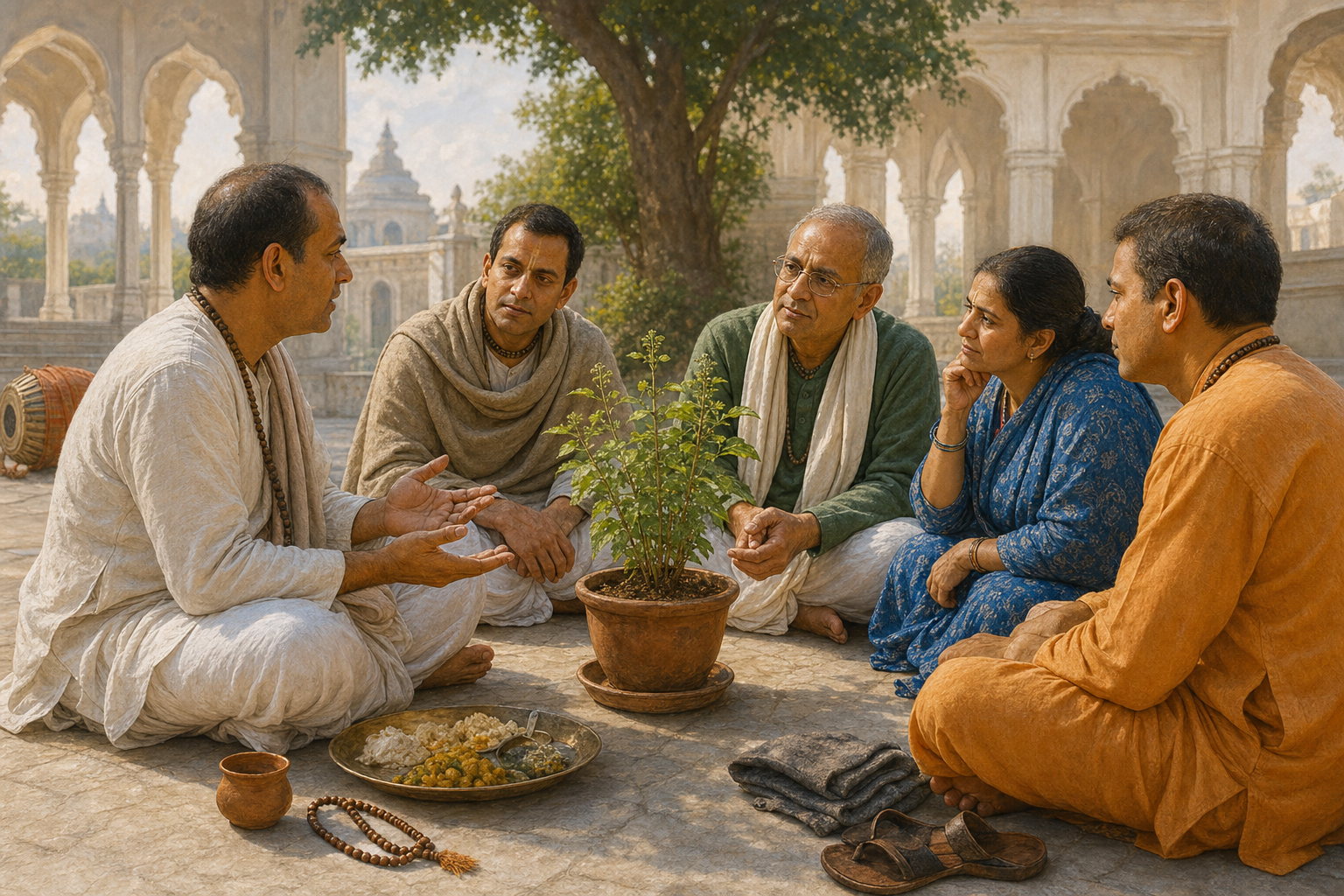
Let sadhu-sanga grow your strength to let go
Forced deprivation is a weak foundation for lasting renunciation. The stronger Gaudiya sequence begins with relationship. Srimad-Bhagavatam 3.25.25-37 traces a progression from sadhu-sanga and enlivened Krishna-katha to shraddha, rati, and mature bhakti. Association nourishes hearing; hearing changes what the heart values; changed value gradually weakens attachment.
Notice what this sequence does not require at the entrance: a public display of severity. You begin by seeking the company of devotees whose speech, conduct, and service make Krishna-katha credible. In such company, knowledge stops being merely conceptual. You see how patience, humility, restraint, and service operate under ordinary pressure.
Use sadhu-sanga as a safeguard against both indulgence and imitation:
- Hear and discuss Krishna-katha with practitioners whose conduct supports their words.
- Describe the attachment in concrete terms instead of announcing a grand plan to renounce the world.
- Explain any duties that a proposed change could affect, including obligations to family, work, health, or study.
- Invite correction if your plan is dramatic, irresponsible, or built around comparison with another devotee.
- Return to association after beginning the practice. Accountability matters after enthusiasm fades, not only when a vow is made.
Good association does not simply tell you to keep everything or abandon everything. It helps you distinguish use from dependence, discipline from repression, and genuine surrender from spiritual theatre. This is why living contact with devotees is central to character formation, not an optional supplement to private study.
Use a replacement rule instead of a deprivation contest
A vague intention to become less materialistic is difficult to practise. A useful act of renunciation names an attachment, identifies what it consumes, and assigns the recovered capacity to bhakti. Work through the following sequence with one recurring excess rather than attempting a complete reinvention of your life.
- Name the behaviour. Avoid a sweeping label such as being too attached. Identify what you repeatedly do: postpone hearing for optional screen use, spend impulsively for status, enter conversations that inflame pride, or preserve a comfort that prevents needed service.
- Name its devotional cost. Decide whether it is consuming attention, time, money, emotional steadiness, truthful speech, or willingness to serve. If you cannot identify the cost, you may be reacting to an austere image rather than a real obstruction.
- Choose a fitting replacement. Give recovered attention to Krishna-katha, recovered speech to kirtan or constructive conversation, recovered resources to responsible seva, and recovered time to study, meditation, or service. Removal creates space; replacement gives that space a devotional direction.
- Write a boundary you can observe. For example, optional screen use begins only after your established morning practice; a recurring nonessential purchase is removed and the resources are assigned deliberately; or a habitual argument is replaced by silence and later discussion when speech can remain truthful and respectful.
- Judge the practice by its fruits. Look for steadier hearing, more reliable service, gentler speech, less comparison, and greater integrity in duty. Do not measure success merely by how uncomfortable the practice feels.
Some discomfort may accompany a new boundary, but irritation is not proof of purification. If the practice makes you chronically contemptuous of others, preoccupied with your own sacrifice, or unreliable in service, pause and examine it with trusted guidance. The boundary may be too severe, poorly directed, or secretly serving pride.
You can also audit an established practice with a few concrete questions:
- Did the hearing, kirtan, study, meditation, or seva for which I made space actually occur?
- Has the attachment weakened, or have I merely changed its outward form?
- Is my speech becoming humbler and more compassionate?
- Am I fulfilling dharmic obligations more faithfully?
- Can I maintain the boundary without advertising it or judging those whose circumstances differ?
This review keeps renunciation connected to transformation. Reducing possessions or pleasures can be useful, but the decisive movement is from self-centred use toward loving service.
Key takeaways
- Renounce what obstructs bhakti; do not abandon responsibilities merely because they look worldly.
- External comfort does not prove attachment, and external hardship does not prove surrender.
- Receive the lives of advanced renunciants as standards of devotion, not scripts for premature imitation.
- Let sadhu-sanga and Krishna-katha change what your heart values before attempting severe austerity.
- Pair every meaningful reduction with a devotional replacement and evaluate it by service, humility, steadiness, and fidelity to dharma.
Choose one attachment whose cost you can already see. Name the devotional activity it will make room for, discuss the boundary with a mature practitioner, and begin without spectacle. The point is not to possess less for its own sake. It is to become less possessed by whatever prevents loving service to Krishna.



References
- Dandavats – Vasant Panchami’s Sacred Radiance: Vishnu Priya, Pundarika, and Raghunatha’s Renunciation
- Dandavats – From Sadhu-Sanga to Perfection: SB 3.25.25-37’s Transformative Map of Krishna Bhakti
