

If you are deciding whether to join, support, or organise a youth self-defense programme in Durg, ask a harder question than whether it teaches fighting: will it make young people safer without making them eager for confrontation? A responsible programme should leave you better able to notice danger, create distance, summon help, protect someone vulnerable, and answer honestly for every action you take.
That is where self-defense becomes civic dharma. Courage is necessary, but courage without restraint can become recklessness. Discipline, lawful conduct, seva, and concern for the whole community are what turn personal capability into public trust.
What Durg’s youth mobilisation should produce next
At Mahesh Colony in Durg, the two-day Shaurya Jagruti Prashikshan Shivir brought together more than 1,000 youth from Durg, Rajnandgaon, Raipur, and Khairagarh. Hindu Janajagruti Samiti and Vedic Gurukul Welfare Foundation jointly organised the gathering around self-defense, civic responsibility, and the protection of nation and dharma.
That scale matters because preparedness is more useful when it is shared. A young person who knows how to call for help, guide others toward an exit, or remain calm during confusion becomes more effective when friends and neighbours follow the same discipline. Regional participation can therefore create a network of mutual support rather than a collection of isolated trainees.
Scale alone, however, does not prove that a programme is sound. The real test begins after the gathering ends. Participants pledged to protect themselves, their communities, and the constitutional fabric of the nation. To honour that pledge, enthusiasm must become repeatable conduct: regular practice, clear boundaries, service to vulnerable people, cooperation with lawful authorities, and refusal to use dharma as a licence for aggression.
If you attended such a camp, do not measure its value by how forceful you felt on the final day. Ask what you can still do calmly when surprised, whether you know when to withdraw, and whether the people around you trust your judgement. Those are better measures of readiness.
Civic dharma puts firm boundaries around bravery
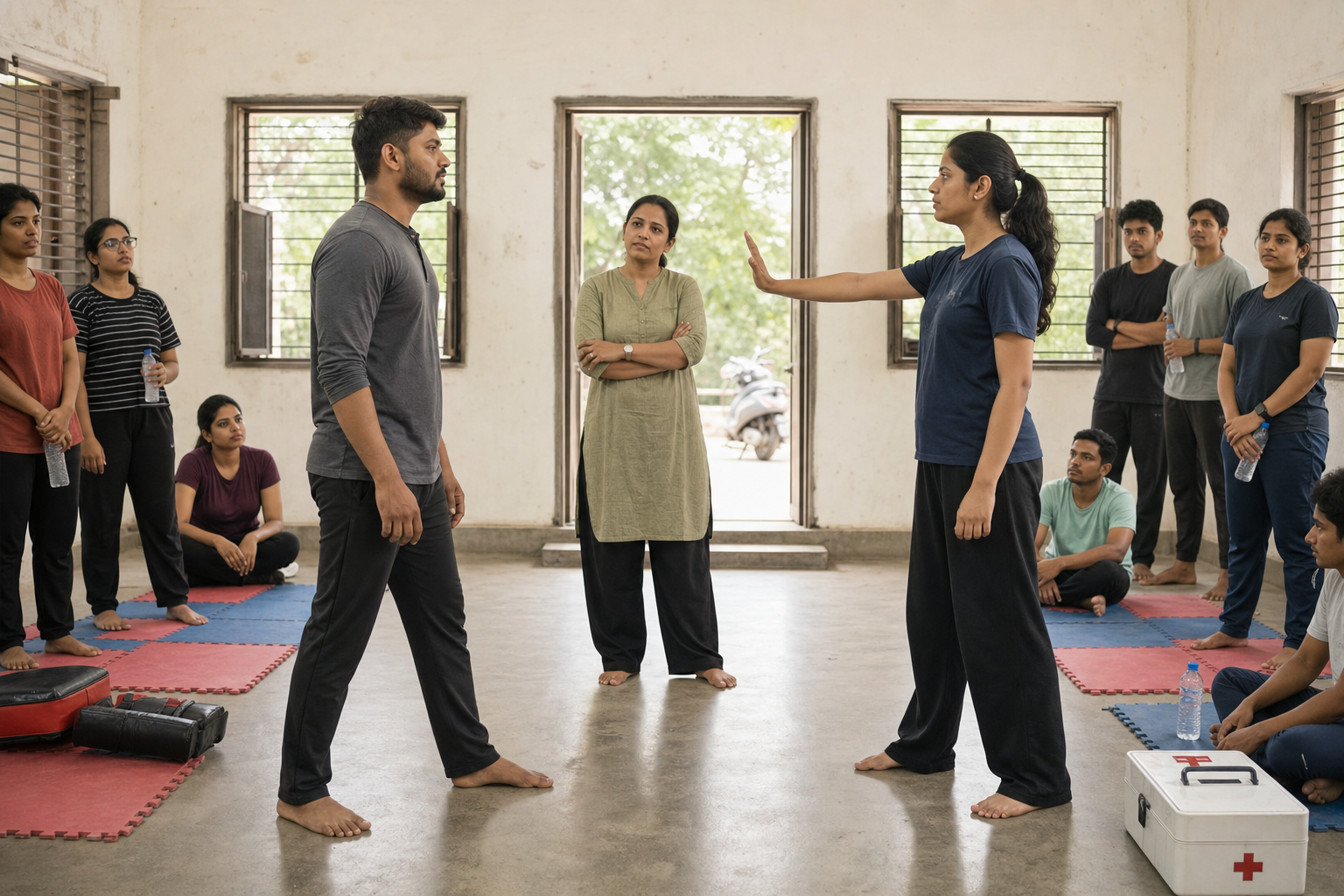
A useful dharmic balance joins ahimsa with abhaya: non-aggression with freedom from paralysing fear. This does not mean that Hindu, Buddhist, Jain, and Sikh traditions are interchangeable. They have distinct teachings and histories. Yet seva, self-mastery, ethical conduct, restraint, and protection of the vulnerable provide substantial common ground for civic action.
- Before danger, dharma asks you to cultivate awareness, sound judgement, and non-aggressive habits.
- During danger, it asks you to protect life, make escape possible, and avoid increasing the harm.
- After danger, it asks you to tell the truth, obtain appropriate help, cooperate with lawful processes, and accept scrutiny of your conduct.
This sequence prevents a common mistake: treating willingness to fight as proof of courage. A taunt, insult, political disagreement, or criticism of your beliefs is not automatically a physical threat. A disciplined person can distinguish wounded pride from imminent danger. If there is a safe exit, taking it is not cowardice; it is control.
As an ethical rule for youth training, defensive action should be limited to what is necessary to make people safe. It should stop when the immediate danger has ended or escape has become possible. Chasing someone, retaliating after separation, or gathering a crowd to punish a suspected offender changes protection into vengeance.
The constitutional dimension matters just as much as the cultural one. Defending the nation cannot mean assuming the powers of police, courts, or elected authorities. Civic dharma works through lawful order. Vigilantism replaces due process with suspicion and force, placing innocent people, trainees, and the wider community at risk.
Use these tests before trusting a self-defense programme
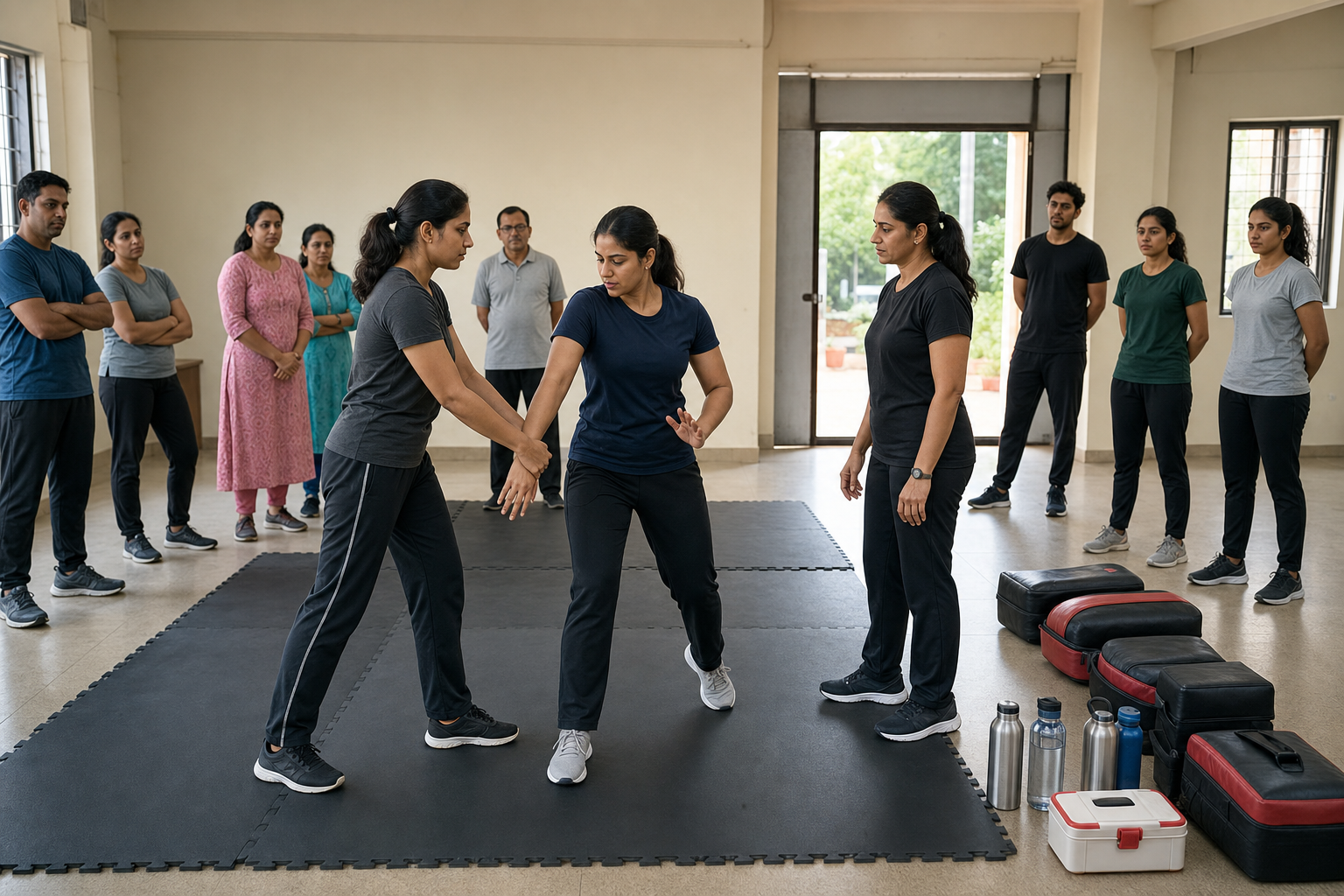
A parent, participant, school, temple committee, gurudwara committee, or neighbourhood group should examine more than demonstrations and slogans. Ask the organiser how the programme handles prevention, supervision, injury, complaints, and legal limits. A credible answer will be concrete enough to inspect.
- Check the stated purpose. The programme should name awareness, de-escalation, escape, protection of vulnerable people, and lawful reporting as core outcomes. If dominance, punishment, or humiliation is the attraction, do not treat it as civic training.
- Check instructor competence. Ask what qualifies the instructor to teach the physical material being offered, how practice intensity is controlled, and how techniques are adapted for age and ability. Physical drills can cause injury when taught carelessly.
- Check safeguarding. Training involving minors needs responsible adult oversight, guardian communication, appropriate boundaries, a clear complaint channel, and a plan for responding to injury or misconduct.
- Check the practice environment. Participants should know the rules before contact begins. Protective equipment, controlled speed, adequate space, and permission to stop a drill are signs that discipline is being practised rather than merely preached.
- Check the legal framing. Exact rights concerning force, restraint, detention, and weapons depend on applicable law. Insist that organisers separate ethical guidance from legal instruction and obtain qualified local guidance where necessary. A slogan is not legal advice.
- Check what happens after training. A serious programme should have a way to review conduct, receive concerns, correct unsafe behaviour, and remove anyone who repeatedly intimidates others.
Some warning signs are visible immediately: instructors encouraging anger before drills, uncontrolled sparring, ridicule of participants who choose to disengage, claims that one technique works in every situation, or suggestions that trainees should patrol for enemies. Another warning sign is identity-based suspicion. Religion, caste, language, political opinion, or place of origin is not a substitute for observing actual conduct and an actual threat.
No physical course can guarantee safety. Stress changes perception, surfaces create hazards, multiple people can become involved, and even a seemingly simple intervention can cause serious injury or legal exposure. Qualified instruction and supervised practice reduce avoidable risk, but judgement and escape remain central.
Turn a camp pledge into a neighbourhood practice

You do not need to recreate a gathering of more than 1,000 people to continue the work. A local youth group can begin with a written charter and a small set of observable practices. The charter should say whom the group serves, what it will never do, who supervises it, how concerns are reported, and when authorities or trained professionals must take over.
- Write the boundary first. State that the group exists for prevention, assistance, preparedness, and lawful service, not retaliation, coercion, surveillance of neighbours, or partisan enforcement.
- Map ordinary risks. Identify well-used routes, poorly observed exits at community venues, trusted public places, responsible adults, and the local emergency contacts participants should use. Do not publish sensitive personal information.
- Practise communication. Rehearse clear verbal boundaries, calling for help, directing people toward an exit, and giving authorities a concise factual account.
- Learn physical skills only under qualified supervision. Keep them oriented toward disengagement and escape. Do not circulate improvised techniques as if a video or enthusiastic peer can replace instruction.
- Add service. Help organisers improve entry and exit arrangements at community events, assist elders or people with mobility needs, and make sure emergency access is kept clear. This is how strength becomes visible as seva.
- Review conduct after every activity. Record hazards, injuries, complaints, and corrective actions. Accountability protects participants and gives the community a reason to trust the programme.
When an incident actually occurs
Immediate danger is not the time to prove a group’s reputation. Move toward safety, alert nearby people, and contact the appropriate emergency service or lawful authority. Physical intervention carries a real risk of injury and legal consequences; it should never be undertaken for pride, punishment, or spectacle.
- Create distance and a path out whenever possible. Help others leave without crowding the danger.
- Assign one person to summon emergency assistance and give the location, the visible hazard, and the help required.
- Do not chase a suspected aggressor after people are safe. Note directly observed details and let lawful authorities handle identification and investigation.
- Give first aid only within your training and obtain professional medical help when an injury may be serious.
- Separate observation from inference when reporting. Say what you saw and heard, not what you assume about motive or identity.
- Do not circulate names, faces, accusations, or dramatic fragments online. Misidentification can endanger innocent people and compromise a lawful process.
This is a civic framework, not individual legal or medical advice. When an incident raises questions about lawful force, detention, injury, or liability, the safe course is to involve the relevant authorities and appropriately qualified professionals.
Key takeaways
- Responsible self-defense is measured by awareness, restraint, escape, protection, and accountability, not eagerness to fight.
- Civic dharma joins courage to seva, non-aggression, lawful order, and respect for human dignity.
- Before joining a programme, inspect instructor competence, safeguarding, practice controls, legal framing, and the complaint process.
- A youth group serves Durg best through preparedness and practical assistance, not patrols, punishment, or identity-based suspicion.
- After an incident, prioritise safety, emergency help, factual reporting, and privacy; do not pursue suspects or conduct an online trial.
Before your next training session, put the group’s purpose and limits on one page and ask every organiser and participant to accept them. A pledge becomes credible when neighbours can see its discipline in ordinary conduct long before any crisis tests its courage.
References
