
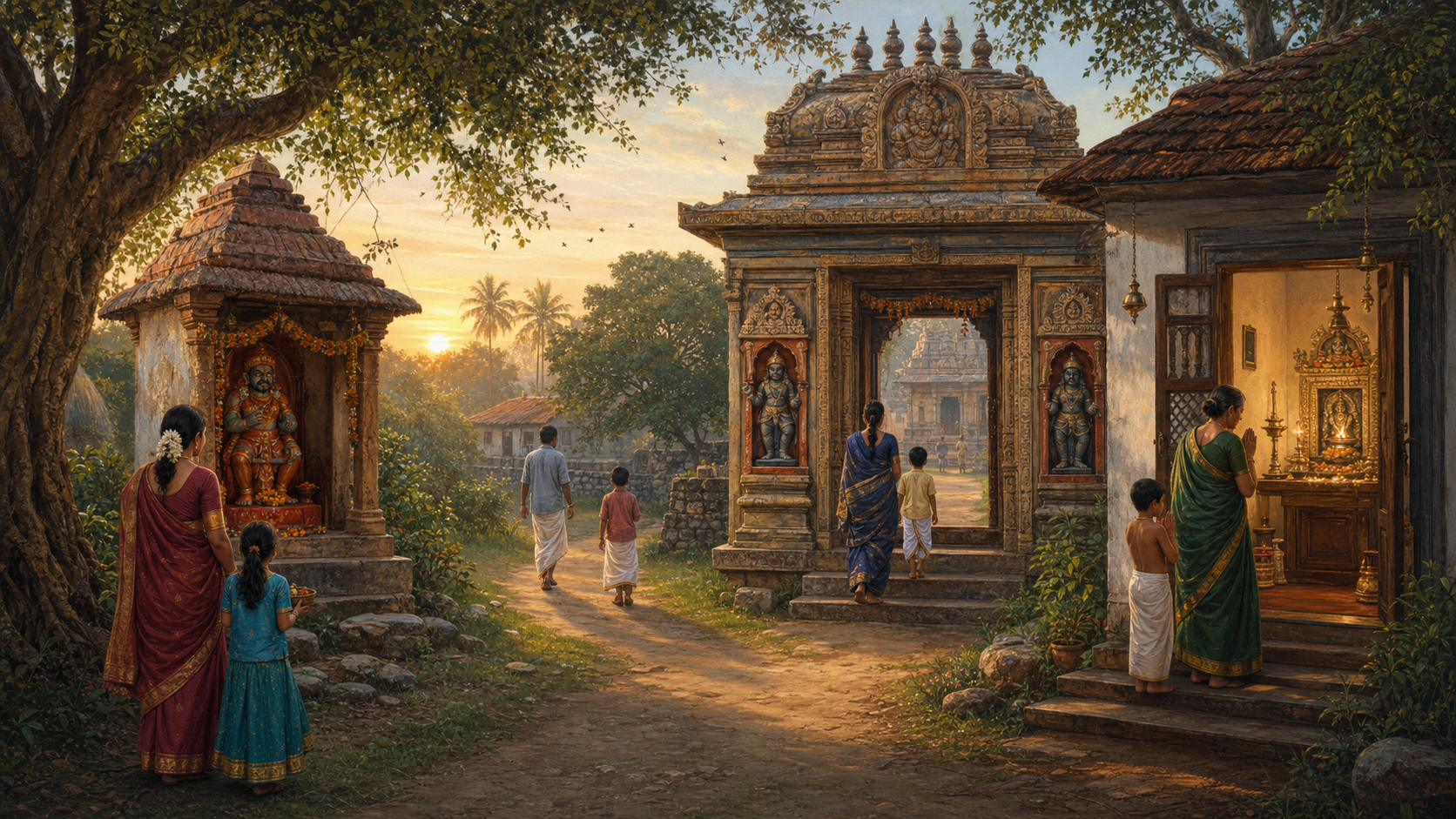
You may have inherited a deity’s name from a grandparent, noticed a fierce figure at the edge of a village shrine, or encountered Kubera through a prosperity ritual. Calling each one a guardian is not wrong, but that label alone cannot tell you what the relationship requires.
Start with three questions: What is being guarded? Whose relationship is it? Which community preserves the practice? These questions keep you from dismissing a living tradition as superstition or turning it into a generic ritual detached from place, lineage and dharma.
Begin with the boundary, not the deity’s apparent rank

Guardian deity is a useful English umbrella, not one uniform office across all Hindu traditions. Names, ritual forms and theological explanations vary by region and lineage. The deity’s protective scope is therefore more informative than any attempt to place every guardian in a single hierarchy.
- Directional guardianship: A Dikpala protects a quarter of the ordered cosmos. Kubera is associated with the north, so his guardianship includes direction, sovereignty and the responsible custody of wealth.
- Lineage guardianship: A kula-devata or kula-devi belongs to the inherited religious life of a family or clan. This relationship is received through lineage; it should not be replaced merely because another deity has become more popular.
- Guardianship of place: A grama-devata or another local deity may be inseparable from a particular settlement, shrine and body of community memory. Moving the name into a different setting does not automatically carry the entire tradition with it.
- Guardianship of a threshold: Some deities protect places or transitions where ordinary order feels vulnerable, including boundaries associated with death and ancestral remembrance.
- Personal devotion: An ishta-devata may certainly be experienced as a protector, but a chosen focus of devotion is not automatically the same as a hereditary, local or directional guardian.
Kubera makes the directional category especially clear. Also called Vaisravana, he is Lord of Wealth, King of the Yakshas and guardian of the northern direction. His money-bag or treasury key signifies custody, while his mace signifies the authority to protect. His abundant form does not teach acquisition without limit. It portrays prosperity placed under governance.
This changes how you read an image or ritual. Do not ask only, “What can this deity give me?” Ask, “What must be kept in order under this deity’s protection?” In Kubera’s case, the answer includes the ethical use of material resources. In a family tradition, it may be continuity and duty. At a village shrine, it may be communal memory and responsibility for a shared place.
Fierce appearance can express protection rather than hostility
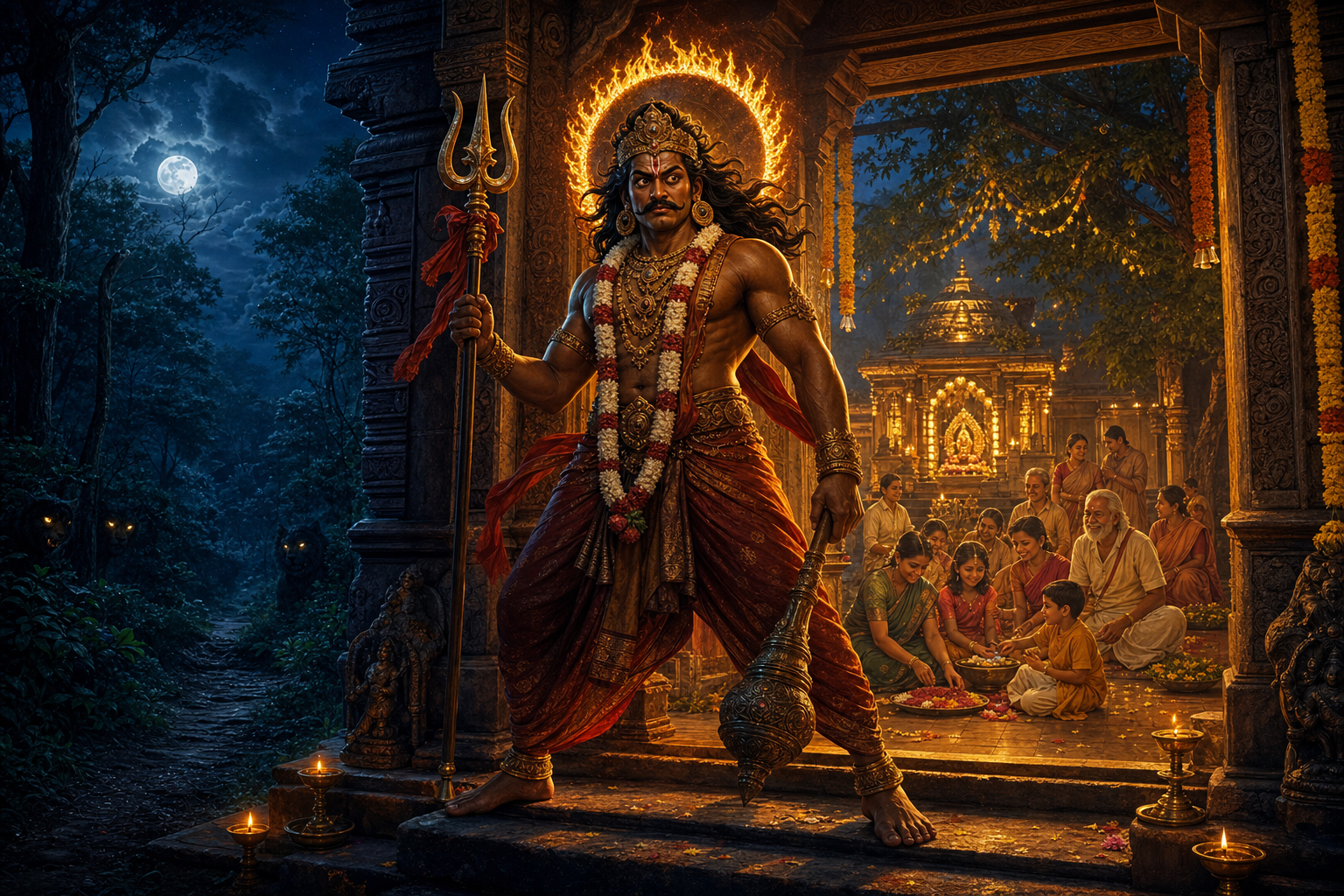
A serene face is not the only Hindu visual language of benevolence. A guardian stationed at a dangerous boundary may need to embody vigilance, authority and the power to confront disorder. Fierceness can therefore describe the deity’s work rather than the deity’s moral character.
Masan Thakur is a strong regional example. North Bengal folk traditions remember him as a fearsome yet protective offspring of Kali, associated with the liminal world of the dead. The word masan evokes the cremation ground in eastern Indic usage, locating his guardianship at the boundary between the visible community and the realm of death. His awe-inspiring character makes sense within that setting: he guards a threshold that people approach with humility, not casual familiarity.
The regional qualification matters. In many parts of North Bengal, Masan Thakur is worshipped on Tuesdays, Saturdays and especially Amavasya. Oil lamps, incense and modest prasad reflect the locally grounded character of the observance. These details help you recognize the tradition, but they do not establish a timetable or ritual formula for every Hindu guardian deity. If your family’s observance differs, do not overwrite it with a schedule copied from another region.
Oral traditions may describe neglect of the guardian as inviting misfortune and mindful observance as restoring balance. That belief should be handled soberly. It is not a reason to attribute every illness, accident or setback to divine punishment. Its constructive force lies in reminding a community not to abandon its shrines, ancestral obligations or standards of conduct. No one should use fear of a guardian deity to coerce payment, demand obedience or prevent sensible action in the ordinary world.
When you meet an unfamiliar fierce form, inspect the context before making a judgement. Where is the shrine situated? Which transition or boundary appears in the stories? Who maintains the observance? What behaviour does the tradition encourage or restrain? These clues reveal more than the frightening surface of the icon.
Kubera’s lesson travels across traditions, but the rites do not
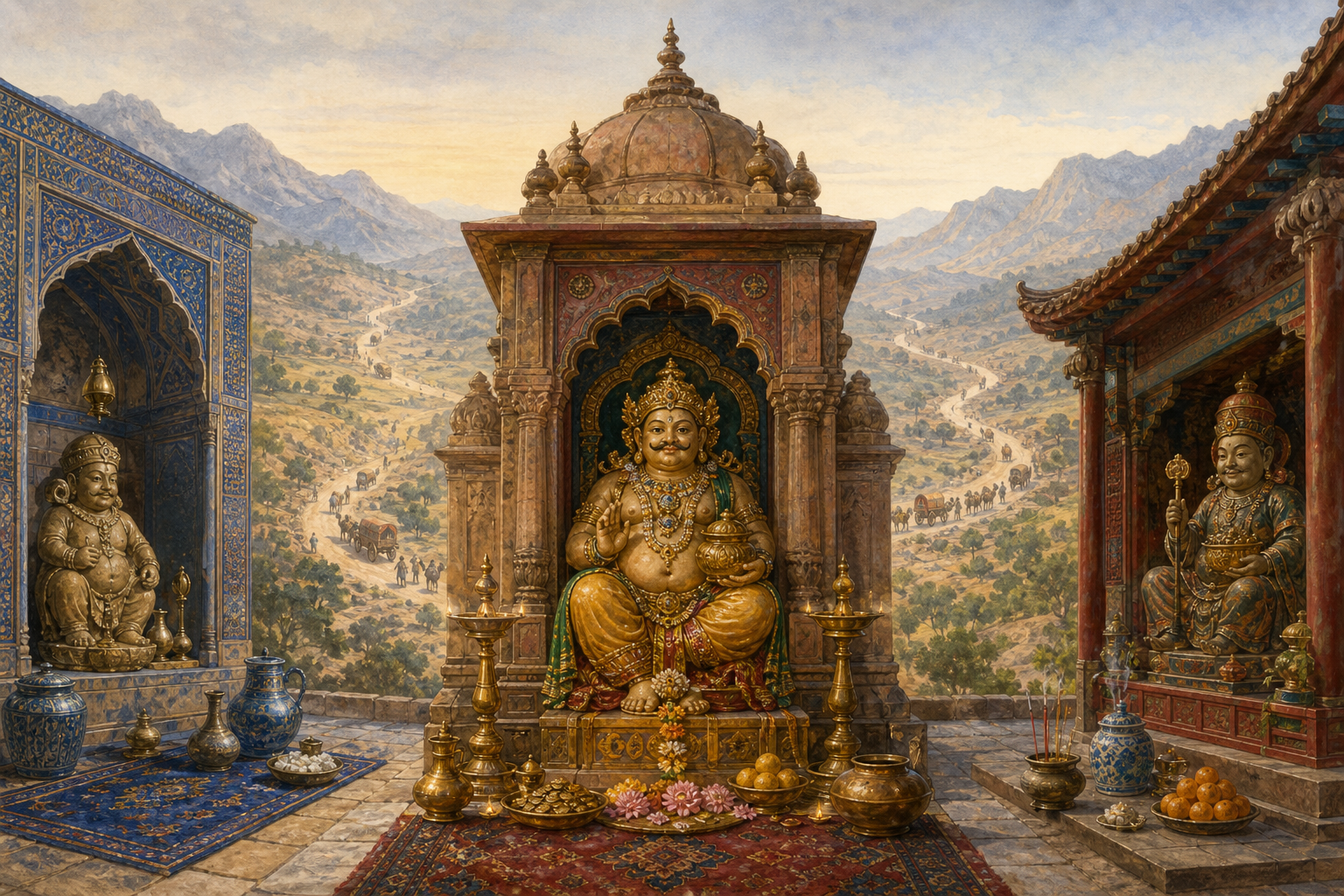
Kubera’s guardianship corrects a common misunderstanding about religious approaches to prosperity. Wealth is not condemned, but neither is it morally self-justifying. Artha belongs within dharma. The guardian of wealth therefore represents accountability as much as abundance: resources should sustain rightful duties, support social well-being and protect the vulnerable.
Dhanteras observances, the placement of a Kubera-yantra and simple reflection on gratitude and responsibility are among the practices associated with him. None should be treated as a mechanical guarantee of income. Before adding a prosperity observance, use a short ethical audit:
- Are you seeking stability with responsibility, or a magical bypass around effort and duty?
- Does your use of resources protect household and community obligations?
- Does the practice increase gratitude, restraint and generosity, or merely intensify craving?
- If a yantra or specialized observance is involved, does it come from a tradition you can identify, or from a seller promising certain results?
The same figure also helps us discuss relationships among Dharmic traditions without erasing their differences. Vaisravana is honoured in Buddhist traditions as a northern guardian and protector of the faithful. Jain contexts include Yakshas as attendant deities connected with protection and auspiciousness. Sikh teachings on honest labour, sharing and remembrance of the Divine offer a complementary ethic for the use of prosperity, but this ethical resonance does not turn Sikh practice into a version of Kubera worship.
When you encounter a proposed parallel, separate three questions. Is there a shared or related name? Is there a similar protective function? Is there only a shared ethical value? Evidence for one does not prove all three. Dharmic kinship becomes clearer, not weaker, when we acknowledge affinity without pretending that every theology and ritual is interchangeable.
Use this method before adopting or reviving a guardian practice
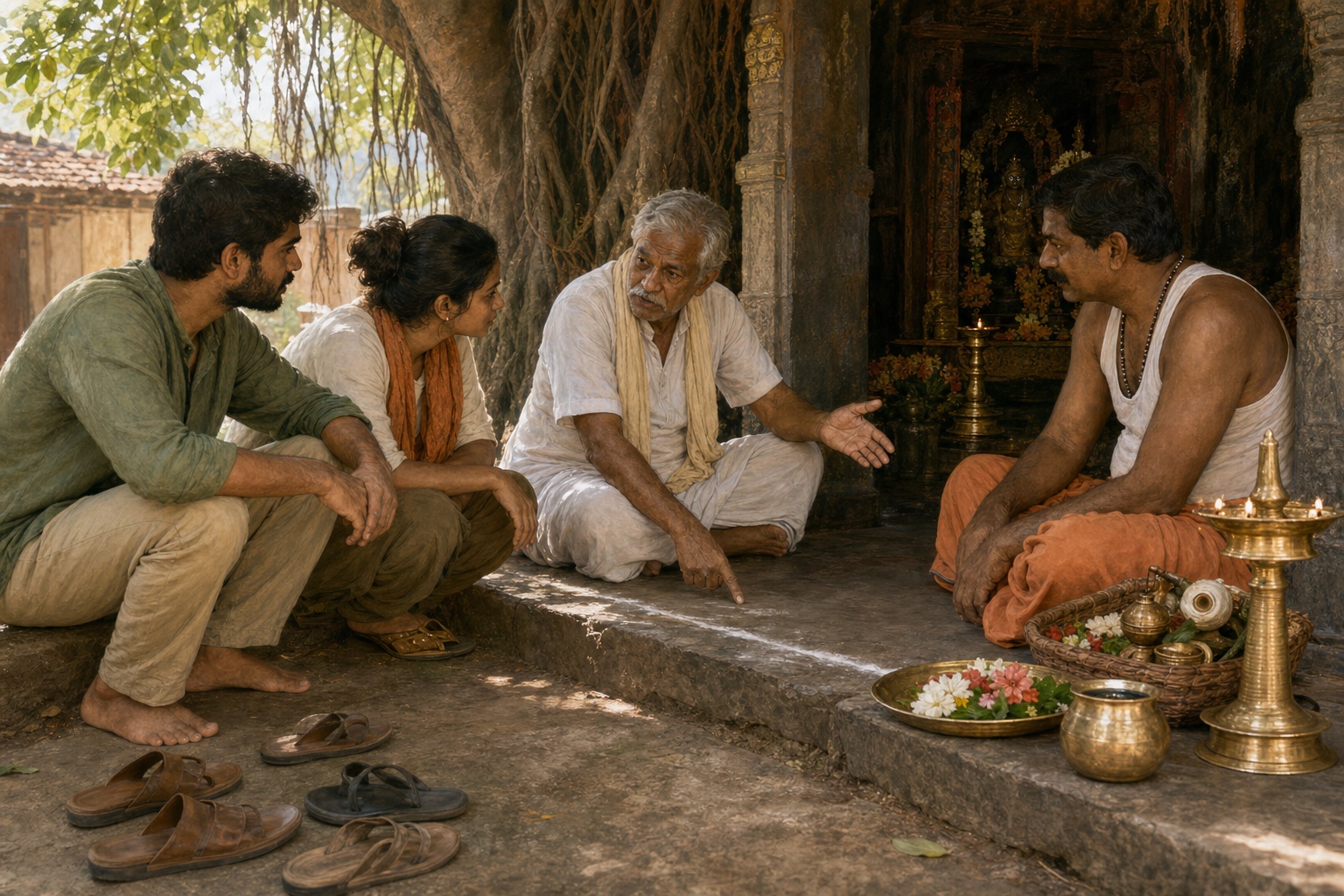
If you are trying to understand a family name, restore a neglected observance or approach a local shrine respectfully, resist the urge to assemble a ritual from scattered similarities. Work from the relationship outward.
- Preserve the exact identity. Record the deity’s local name, pronunciation, form, associated story and shrine location. Do not immediately replace the name with that of a better-known deity. A theological relationship may exist, but equivalence must not be assumed.
- Identify the protected domain. Determine whether the guardianship concerns a family, village, direction, sacred site, ancestral bond, resource or difficult transition. This tells you why particular stories and symbols matter.
- Find the living custodians. Ask knowledgeable relatives, shrine caretakers or community practitioners what is actually done, on which days, with which offerings and for what purpose. Ask what varies between households. Local testimony should be preserved as local testimony rather than announced as a universal Hindu rule.
- Separate the core from later additions. A remembered name, a shrine and a simple calendar observance may have firm continuity even when an elaborate mantra, commercial object or online explanation does not. Mark uncertain elements as uncertain. An honest gap is better than invented continuity.
- Begin with the smallest verified observance. Follow the simple practice your tradition can support, then examine its effect on conduct. Do not combine vows, yantras, mantras and offerings from unrelated guardians merely because each is labelled protective.
A one-page record is often enough to prevent another generation of confusion. Include the deity’s name and titles, the boundary or duty being protected, the relevant family or place, customary days, customary offerings, the people who confirmed each detail and any unresolved differences. Keep disagreement visible instead of forcing several memories into a false consensus.
Watch for four warning signs: guaranteed wealth or protection in exchange for money; threats that an unfamiliar rite must be performed immediately; a regional custom presented as the only authentic Hindu form; or an instruction that weakens honesty, compassion and ordinary responsibility. A guardian relationship that supposedly requires adharma has been misunderstood or misused.
This method also protects regional heritage. Masan Thakur remains intelligible as a guardian of North Bengal’s liminal and ancestral world precisely because his name, place, calendar and community memory stay connected. Kubera remains intelligible when wealth and northern guardianship remain connected to stewardship. Stripping away those relationships leaves little more than a frightening image in one case and a prosperity charm in the other.
Key takeaways
- Understand a guardian deity by asking what boundary, relationship or duty is being protected.
- Do not confuse fierce appearance with evil intent or abundant appearance with permission for excess.
- Keep regional timings and offerings regional unless your own lineage or community confirms them.
- Compare Dharmic traditions through shared names, protective functions and ethical values without assuming identical rites.
- Before reviving an observance, document its exact identity and begin with the smallest practice that living custodians can verify.
Your next step can be modest: speak with one knowledgeable elder or shrine custodian and write down the deity’s exact name, protected domain, customary day and simplest offering. That single record can preserve more dharma than an elaborate ritual built on guesswork. When guardianship deepens duty, remembrance, generosity and courage, you are beginning to understand the tradition on its own terms.
References
- DharmaRenaissance Blog – Story of Masan Thakur: Kali’s Fearsome Folk Son and Guardian of North Bengal’s Dead
- DharmaRenaissance Blog – Majestic Legacy of Kubera: Guardian of the North and Lord of Wealth Revealed
