

You may understand why Kali is worshipped and still pause when a Yogini appears beside her. Is she an attendant, a separate power, a perfected practitioner, or a clue to how the puja should change you? The most useful answer is not to force the symbol into only one of those roles.
Read the Yogini as the disciplined awareness that can receive Kali’s transforming force without turning fierceness into anger, devotion into excitement, or spiritual attainment into pride. That reading gives you a practical way to contemplate the image, participate in Kali Puja, and carry its meaning into conduct after the ritual ends.
Read the Yogini as disciplined Shakti, not decoration

In this understanding of Kali Puja, companion does not mean subordinate. The pairing of Kali and the Yogini expresses one Shakti through complementary functions. Kali is the force of transformative liberation, confronting fear, ignorance, attachment to identity, and the grip of time. The Yogini embodies the mastery needed to remain clear while that transformation unfolds.
This distinction matters because spiritual intensity is not the same as spiritual maturity. A powerful emotion during puja may open the heart, but emotion alone does not establish steadiness. The Yogini directs your attention toward mastery of prana, mind, and senses. She represents power that has passed through practice and become lucid rather than reactive.
The word Yogini points toward realized Yoga: not simply knowing techniques, but assimilating them until awareness, action, and the highest aim are no longer pulling in different directions. Within Kali symbolism, Yogini can therefore indicate a realized being, an attained state, and a guiding principle within the practitioner. You do not have to reduce these dimensions to one literal definition in order to use the symbol well.
When you encounter a Yogini in an image, narration, or ritual setting, ask a sharper question than Who stands beside Kali? Ask: What quality allows transformative power to operate without confusion? The answer is disciplined awareness. That is the inner companionship the symbol asks you to cultivate.
Use three tests to understand what the symbol asks of you
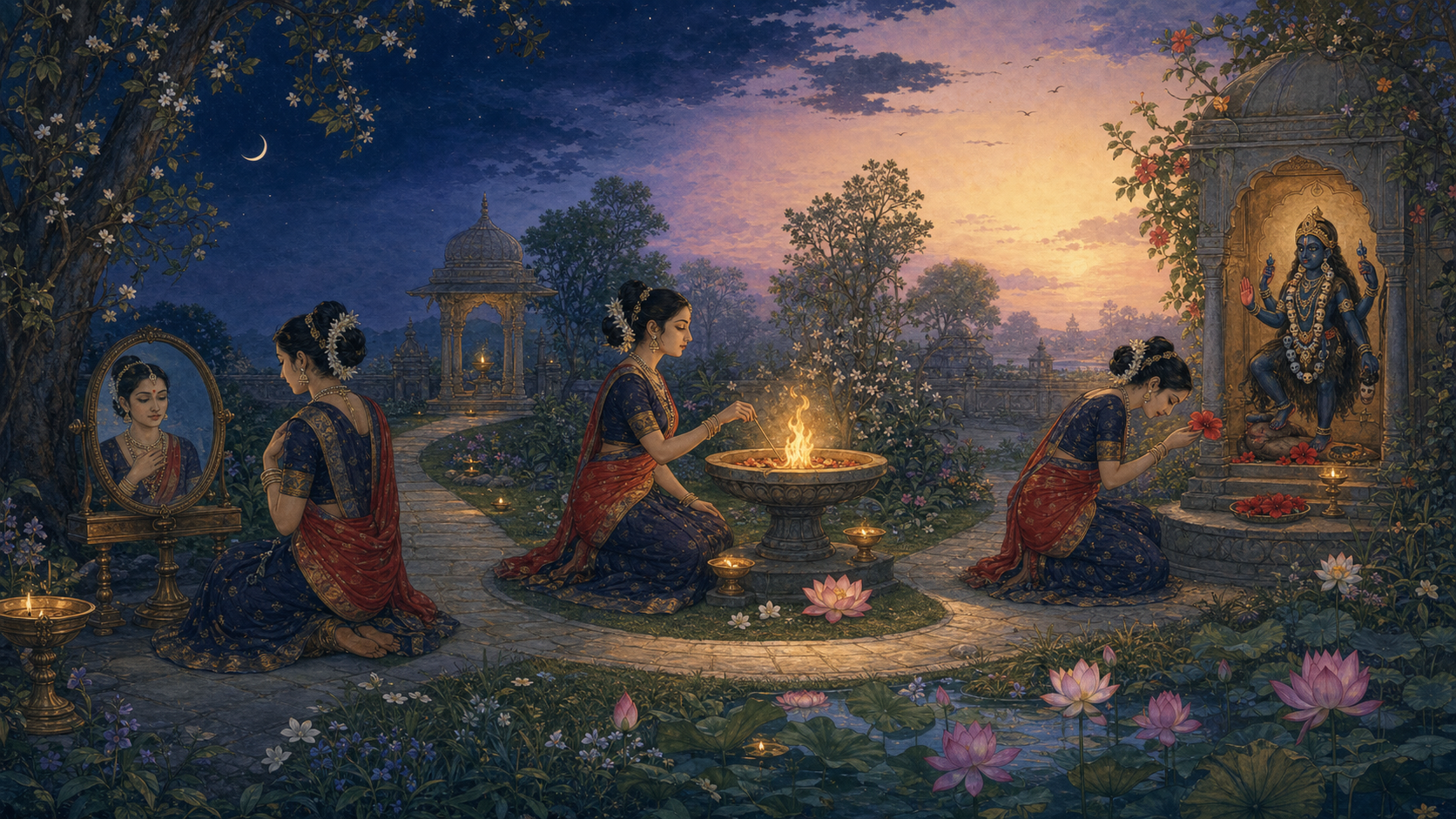
Yogini symbolism becomes practical when you test it against your own state. The following three tests keep the interpretation grounded in sadhana rather than leaving it at the level of imagery.
Does power remain joined to awareness?
Kali’s fierceness should not be mistaken for uncontrolled aggression. Her transforming power dissolves what binds consciousness. The Yogini shows how that power is held: through internalization, contemplation, and discernment. In Yogic terms, these qualities are expressed through pratyahara, dhyana, and viveka.
Pratyahara asks you to stop feeding every sensory demand. Dhyana asks you to sustain attention instead of chasing each new thought. Viveka asks you to distinguish what liberates from what merely gratifies or agitates. If devotion leaves you more impulsive, more contemptuous of others, or more attached to a dramatic spiritual identity, the power-awareness pairing has not yet become complete in practice.
During puja, notice what happens immediately after a distraction. Do you follow it, fight it, or calmly return to mantra and presence? That return is a small but concrete expression of the Yogini principle. Mastery is visible in the return, not in the fantasy that distraction will never arise.
Does attainment make the ego quieter?
Siddhi in this context is disciplined attainment arising from sustained sadhana. It need not be interpreted as a spectacular or supernatural display. A more immediate measure is whether you can direct attention, regulate reaction, observe the movement of breath and mind, and remain faithful to a chosen discipline when novelty has faded.
This corrects a common misreading. Yogini symbolism does not invite you to perform spiritual superiority. It asks whether practice has reduced the rule of ahankara, the habit of arranging every experience around the defended self. If an apparent attainment increases arrogance, manipulation, or hunger for recognition, it fails the ethical test contained in the symbol.
Does worship become conduct?
The Yogini’s realization is expressed through humility, integrity, compassionate strength, and seva. These are not decorative virtues added after an esoteric experience. They are evidence that inner discipline has become stable enough to shape relationships and responsibilities.
You can also observe the movement of the gunas without turning them into labels for other people. Tamas appears as inertia, avoidance, or dullness. Rajas appears as agitation, compulsion, or the need to act merely to discharge tension. Sattva brings clarity and proportion. The aim is not to construct a flattering identity as a sattvic person, but to recognize your present condition and choose the discipline that restores clear action. The path ultimately points beyond attachment even to a refined self-image.
After Kali Puja, look for the first ordinary test: a difficult conversation, an inconvenient duty, a desire to retaliate, or an opportunity to help without receiving credit. That moment reveals whether fierce grace has been joined to Yogini-like steadiness.
Turn the symbolism into a grounded Kali Puja practice
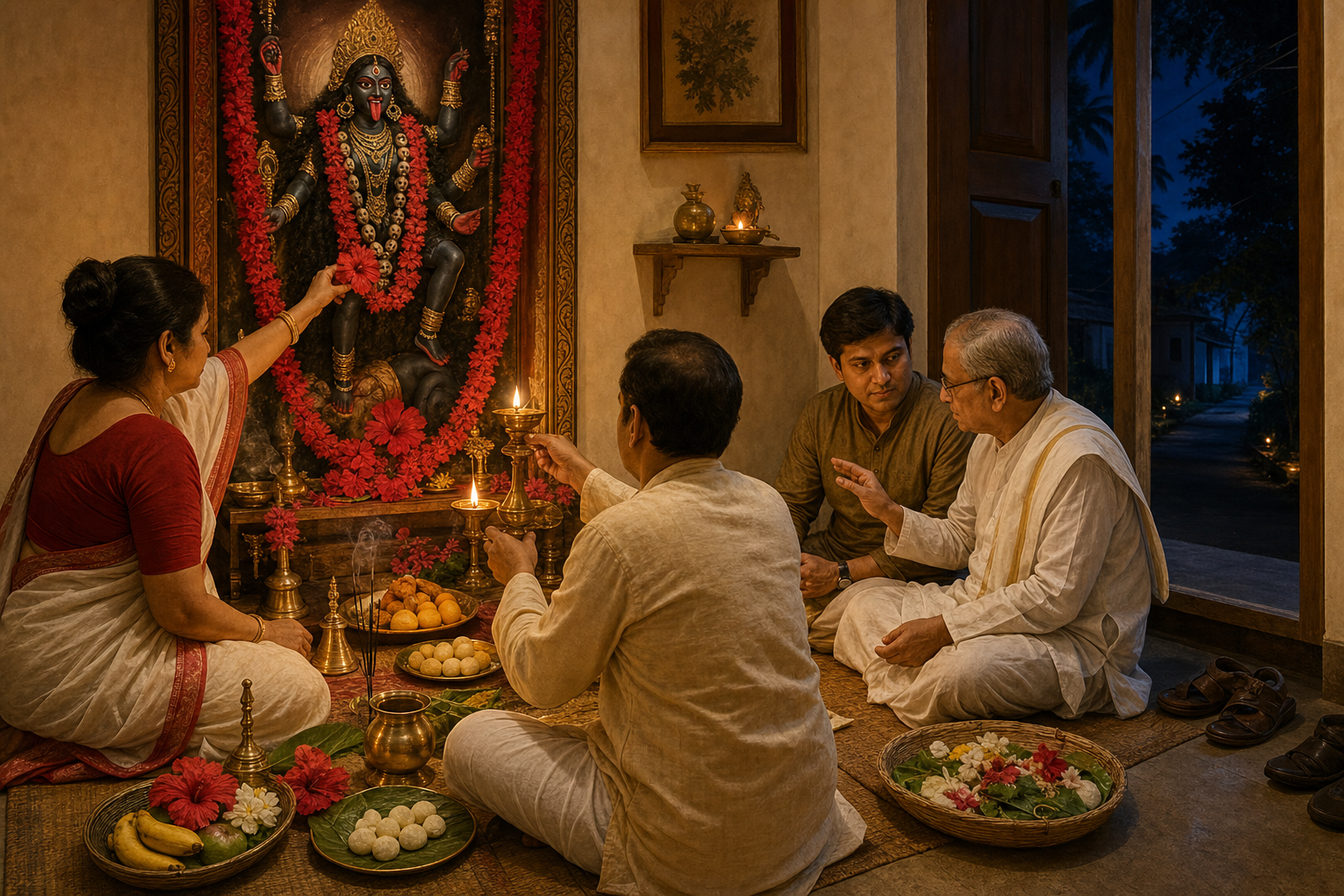
You can add the following contemplative layer to your observance without pretending it replaces the procedures of your family, temple, or lineage. Formal mantras, mudras, offerings, and initiatory practices should follow the tradition in which you actually worship.
- Before beginning, name one bond you are willing to face. Choose something concrete: fear of losing approval, habitual distraction, resentment, avoidance of duty, or attachment to a fixed identity. Do not make a sweeping promise to eliminate it. Simply place it honestly within the field of worship.
- Settle through unforced breath awareness. Notice the breath as it is before trying to control it. Let this mark the movement from scattered attention toward inwardness. Advanced breath control is not required for this reflection and should not be improvised from symbolism alone.
- Use mantra as a discipline of return. Recite the mantra received or customarily used in your tradition. When attention wanders, return without irritation. The important movement is from dispersion to recollection, repeated as often as necessary.
- Connect ritual gesture with an inner action. If your observance prescribes a mudra or offering, let it remind you to withdraw attention from compulsive reactions and offer the defended identity they protect. If you have not been taught an esoteric gesture, do not invent one; namaskara and an attentive offering are sufficient for this contemplative purpose.
- Allow quiet contemplation after the active portion of worship. Instead of searching for an unusual vision, notice what becomes clearer when recitation and movement cease. Ask what must be released and what discipline must continue after the puja.
- Choose one act of seva before the next observance. It may be fulfilling a neglected responsibility, repairing harm, helping someone without display, or giving sustained attention where you usually offer only haste. Make it specific enough that you will know whether you completed it.
A short written reflection can prevent the experience from dissolving into mood. Complete three lines: Kali asks me to release; the Yogini asks me to sustain; seva will make this visible through. Each answer should name one action or habit, not an abstract aspiration.
This sequence integrates bhakti, jnana, and Yoga. Bhakti gives the heart a sacred relation to transformation. Jnana helps you see what is actually binding you. Yoga supplies the repeated discipline through which insight becomes steadiness. None of the three has to compete with the others.
Keep the interpretation precise across Dharmic traditions
Yogini symbolism in Kali Puja belongs to a Hindu Shakta and Tantric setting. It should not be used to claim that Hinduism, Buddhism, Jainism, and Sikhism share identical theology, deity worship, or ritual forms. They do not. Their distinctive teachings and disciplines deserve to be understood in their own terms.
There is still a meaningful civilizational resonance. Self-mastery, mindfulness, moral courage, compassionate conduct, and reverence for sacred wisdom are recognizable across the Dharmic family, even when their philosophical explanations differ. The careful formulation is that Kali-Yogini symbolism illuminates values that can enter respectful conversation with other Dharmic paths. It does not make Kali Puja their common rite.
The same precision is needed within Hindu practice. Yogini can indicate realized wisdom, a practitioner, a state of attainment, or a sacred power, and particular traditions may emphasize these dimensions differently. Do not impose a private interpretation over the ritual understanding of a temple or lineage. If a Yogini is specifically named or worshipped in the observance you attend, ask a knowledgeable practitioner or teacher how that presence is understood there.
This restraint does not weaken the symbol. It keeps contemplation accountable to living tradition while allowing you to recognize its inward demand: Shakti must be accompanied by clarity, and liberation must become responsible conduct.
Key takeaways for your observance
- The Yogini is not merely a decorative attendant. She represents realized awareness and the disciplined mastery that accompanies Kali’s transforming power.
- Kali confronts fear, ignorance, time-bound identity, and egoic fixation; the Yogini shows how to meet that confrontation without losing steadiness.
- Siddhi is best tested through self-mastery, humility, and constancy in sadhana, not through a dramatic spiritual persona.
- Mantra, mudra, pratyahara, dhyana, and viveka are connected movements from scattered reaction toward integrated awareness. Use only the formal practices appropriate to your tradition and level of instruction.
- The ethical result matters: integrity, compassionate strength, and seva reveal whether ritual insight has entered daily life.
- Shared Dharmic values can support respectful dialogue, but they should never be used to erase differences among Hindu, Buddhist, Jain, and Sikh traditions.
At your next Kali Puja, carry one question from the altar into the first demanding moment that follows: What would fierce truth guided by disciplined awareness require from me now? Then answer through the next action you take.
References
