

If messages about the Chamarajapete attack are reaching you through neighbourhood groups or social media, the pressure is to choose a side immediately. Resist that pressure. You can stand firmly with affected Hindu families, demand accountability, and still refuse rumours or collective blame.
The useful question is not whether justice or communal harmony matters more. It is how Bengaluru can secure both through evidence, due process, responsible public communication, and practical cooperation between residents and civic authorities.
Justice and harmony are one civic demand
At Freedom Park, a public demonstration convened by the Hindu Rashtra Samanvay Samiti condemned the Chamarajapete attack, expressed solidarity with affected Hindus, and called for an impartial investigation and timely prosecution of those found responsible. Those demands belong together. Solidarity recognises the injury; investigation establishes facts; prosecution holds proven offenders accountable.
Two opposite mistakes can derail that sequence. The first is to assign guilt to an entire community before investigators establish individual responsibility. The second is to invoke harmony as a reason to minimise the attack or discourage legitimate questions. The former punishes innocent people. The latter weakens confidence that lawful institutions will protect citizens.
Use precise language whenever you discuss the incident:
- Distinguish what is confirmed from what is alleged. Do not add identities, motives, numbers, or affiliations that have not been established.
- Ask for the people actually responsible to be identified through evidence. Avoid language that treats a religious, linguistic, ethnic, or residential group as a substitute for a suspect.
- Stand with affected Hindu residents without making their pain serve as permission for retaliation against uninvolved neighbours.
- Measure progress by visible process: a credible investigation, responsible public updates, protection against further violence, and prosecution where evidence supports it.
Timely justice does not mean rushed justice. A rushed process can misidentify people, weaken a case, or appear politically directed. Timely means that authorities do not allow avoidable delay, confusion, or silence to erode public trust. Citizens should press for movement while preserving the integrity of the investigation.
This is also where a dharmic outlook becomes practical rather than ceremonial. Dharma does not require passivity toward wrongdoing. Ahimsa does not require denial of harm. Non-violence, compassion, and mutual respect discipline the pursuit of justice so that anger does not produce another injustice. The Bengaluru platform connected these principles with unity among Hindu, Buddhist, Jain, and Sikh traditions, while affirming the dignity and safety of every community.
Use an evidence ladder before you speak or share

Communal escalation often begins when a claim acquires certainty each time it is forwarded. A message that started as speculation becomes a declaration, then a communal accusation, and finally a reason for confrontation. You can interrupt that progression by sorting information before acting on it.
- Confirmed public information: Share it accurately, retain the original context, and link to the full communication where possible.
- First-hand material awaiting verification: Preserve the original file, time, place, and circumstances. Give it to investigators or an authorised contact rather than publishing an accusation.
- A claim received from someone else: Ask who directly observed it, what evidence exists, and whether a responsible authority has confirmed it. If those questions have no answer, do not forward the claim as fact.
- Interpretation or opinion: Label it as such. An inference about motive is not the same as evidence of motive.
- A claim about an entire community: Reject the shortcut. Criminal responsibility and legal status must be assessed individually.
A useful neighbourhood update follows a simple format: confirmed information, unverified claim, and safe action. For example, state what authorities or direct evidence have established, identify what remains uncertain, and tell readers where verified information or evidence should go. Do not fill an information gap with a theory.
Claims about unlawful cross-border migration require the same discipline. The Freedom Park gathering raised border and residency concerns while calling for stricter but humane enforcement based on evidence, transparency, and Indian legal standards. That position permits firm policy advocacy. It does not permit citizens to guess a neighbour’s legal status from a name, accent, religion, occupation, clothing, or locality.
The distinction is decisive. If you possess relevant documentary or incident-specific information, route it to the authorised officials who can examine it. If you do not, keep your intervention at the level of policy: ask whether verification procedures are functioning, whether decisions are evidence-based, and whether enforcement is applied consistently. Vigilante labelling is neither strict enforcement nor justice.
Be especially careful with images and short videos. A genuine recording can still be paired with an incorrect location, date, description, or identity claim. Preserve the original, look for the full sequence, and separate what the recording visibly shows from what the caption asserts. If a clip may be evidence, public circulation can expose individuals, provoke retaliation, or complicate fact-finding; send it through an official channel instead.
Turn neighbourhood concern into disciplined cooperation
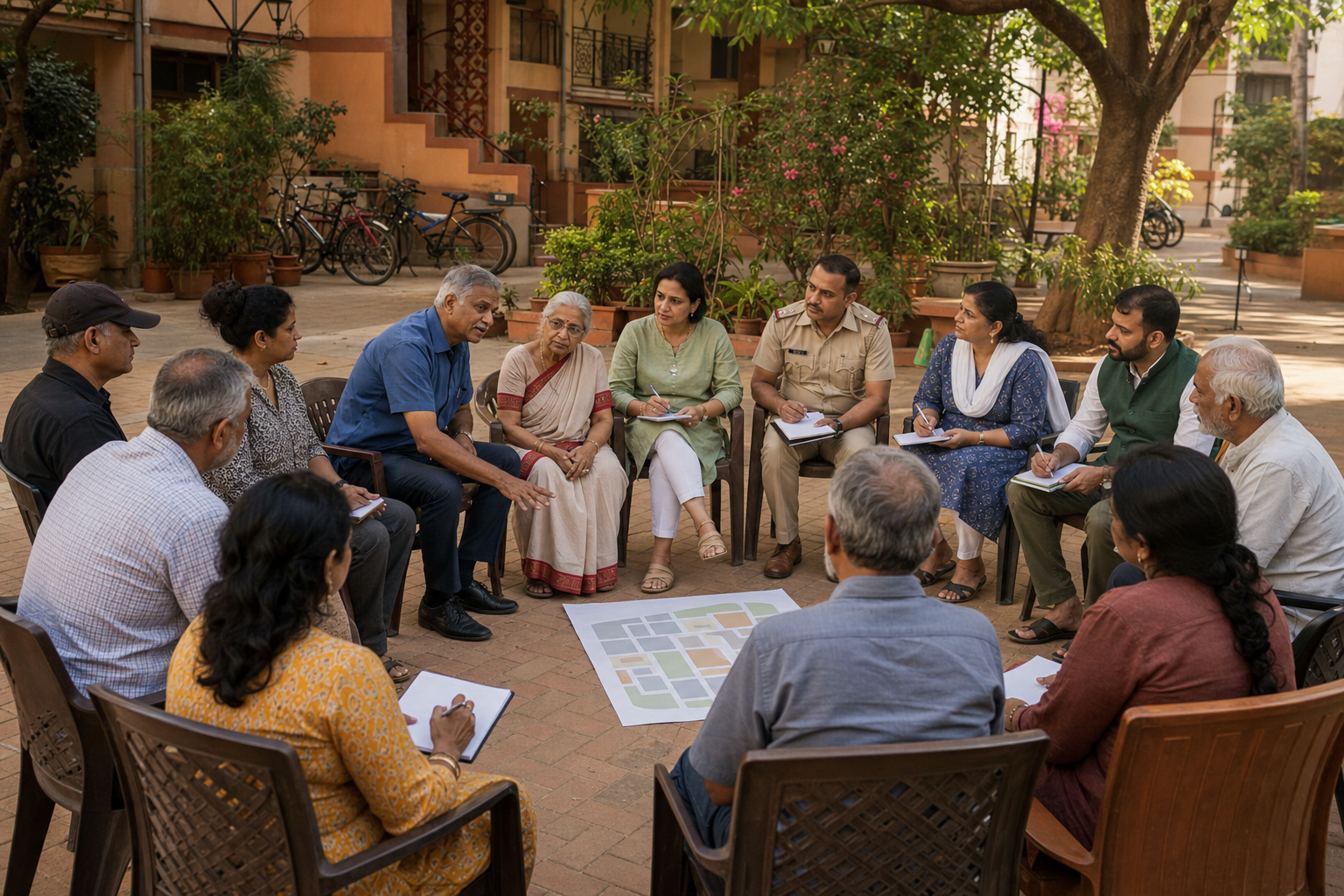
Community vigilance is useful only when it means attention to specific conduct, rapid reporting, and care for vulnerable residents. It becomes dangerous when it turns into identity-based surveillance, informal interrogation, or confrontation.
A responsible local arrangement should include:
- A verified update channel: Designate responsible administrators who post confirmed information, correct errors openly, and keep political arguments out of urgent safety notices.
- A clear escalation path: Immediate danger goes to emergency services. Credible evidence goes to investigators. Welfare needs go to trusted local coordinators or civic bodies. A social-media group should not attempt to perform all three functions.
- Observation without profiling: Record the conduct, place, and circumstances that created concern. Do not replace those facts with a communal label.
- Support directed by affected people: Ask Hindu families or local residents what practical help they need instead of deciding for them or circulating their personal details.
- Rumour correction: Remove false claims, publish a clear correction, and ask members not to recirculate screenshots after the correction has been made.
- No private enforcement: Do not confront suspected individuals, conduct identity checks, or organise patrols that target people by appearance or community. Report concrete threats to lawful authorities.
Dialogue also needs a practical purpose. A meeting that merely asks everyone to be peaceful will not resolve distrust. A useful local forum agrees on how leaders will verify urgent claims, whom they will contact when tension rises, how they will reject retaliation publicly, and how residents can raise unresolved safety concerns without being dismissed.
Interfaith outreach does not require anyone to dilute a Hindu concern or pretend that every grievance is symmetrical. It requires participants to distinguish solidarity from collective punishment. You can say plainly that affected Hindus deserve protection and justice while also saying that uninvolved members of another community must not be threatened. Those positions reinforce each other because both reject impunity.
The same standard should apply across the dharmic family. Hindu, Buddhist, Jain, and Sikh communities have distinct histories and teachings, but a shared civic response can rest on non-violence, compassion, truthful speech, mutual respect, and lawful resistance to wrongdoing. Unity becomes credible when it produces reliable communication and help on the ground, not merely a slogan on a stage.
Ask authorities for process, not political theatre

Public confidence does not require investigators to disclose sensitive evidence prematurely. It does require authorities to explain what residents can expect, how information will be corrected, and which arrangements are in place to prevent further disorder. Ask questions that can produce an answer rather than demands designed only to display anger.
- What information about the investigative process can be released without compromising the case or the rights of those involved?
- Which official contact should receive witness material, original recordings, or incident-specific information?
- How will authorities correct a damaging rumour quickly and in a form residents can share?
- What community-policing and rapid-response arrangements are active in areas where tension may rise?
- How can affected Hindu residents communicate continuing security concerns and receive a documented response?
- Will a standing dialogue forum include affected residents, civic officials, and responsible representatives from local communities?
- How will border or residency enforcement remain individual, evidence-based, transparent, and humane?
Clear public communication, improved community policing, rapid-response protocols, and institutionalised dialogue forums were among the practical measures associated with the Bengaluru appeal. These proposals are useful because citizens can track whether they exist and whether they function.
Keep a simple public record of each question: the office approached, when it was submitted, the reply received, and the next lawful follow-up. This prevents repeated speculation and makes institutional silence visible without inventing a motive for it. If no timeline has been announced, say that plainly. Do not turn the absence of an update into either a promised result or proof of a conspiracy.
A peaceful rally has already placed concern in public view. The next phase is less dramatic but more consequential: evidence must reach the right officials, authorities must communicate responsibly, affected people must remain protected, and citizens must keep pressure focused on lawful outcomes. That is how democratic assembly becomes accountability rather than a temporary release of anger.
Key takeaways
- Justice means an impartial investigation followed by timely prosecution of the individuals found responsible; it does not mean assigning guilt by community.
- Solidarity with affected Hindus and protection of uninvolved neighbours are compatible obligations.
- Before sharing a claim, classify it as confirmed information, first-hand material awaiting verification, hearsay, or opinion.
- Preserve original evidence and send it to authorised investigators instead of publishing unverified accusations.
- Immigration and residency enforcement should be firm where the law requires it, but individual, evidence-based, transparent, and humane.
- Community vigilance should focus on observable conduct and safe reporting, never profiling or private enforcement.
- Ask authorities for process visibility, rumour correction, rapid-response arrangements, community policing, and a functioning dialogue forum.
Start with the next message you receive. Verify it before forwarding, correct it if it is false, and direct genuine evidence or safety concerns to the proper channel. Then put a concrete process question to the relevant authority. That is how Bengaluru can carry the demand beyond Freedom Park: accountability without collective blame, and harmony without silence.
References
