

You may have a temple full of goodwill, a satsang ready to volunteer, or a youth group asking how it can help. The difficult part is rarely awakening concern. It is turning that concern into service that remains dependable after the festival, speech, or burst of enthusiasm has passed.
Bhakti offers more than a reason to serve. It can shape how you choose the work, how you treat the person receiving it, how you handle responsibility, and how you cooperate across dharmic traditions. The practical aim is simple: make devotion visible as competent, dignified, and accountable civic seva.
Bhakti changes both the motive and the method

The bhakti inheritance associated with Nammalvar, Ramanuja, Vishnusvami, Madhvacarya, Nimbaditya, and Caitanya joins disciplined spiritual practice to humility, grace, and service. Ramanuja’s Visishtadvaita is especially useful here because it gives devotion philosophical depth through participation in divine reality rather than reducing it to private emotion.
That orientation changes civic work at its root. A person receiving food, instruction, companionship, or practical assistance is not raw material for your organisation’s publicity. The encounter has spiritual weight. The quality of your attention, the cleanliness of the meal, the accuracy of the information, and the reliability of the promise all become part of the offering.
This gives you a clear test for whether a project is really guided by bhakti:
- Would you still do the work without photographs or public praise? If visibility is necessary for fundraising or accountability, document the work with consent and restraint. Do not turn another person’s hardship into devotional theatre.
- Does the recipient retain dignity and choice? Help should not depend on joining a prayer, accepting a theological claim, or performing gratitude.
- Is the service competent? Good intentions do not excuse unsafe food, confusing instructions, missed commitments, or careless handling of donations.
- Can correction be heard? Humility becomes operational when a guest, volunteer, or partner can report a problem without being treated as disloyal.
Bhakti and professionalism are therefore not rival approaches. Professional discipline protects the offering from negligence; bhakti protects professionalism from becoming cold, self-promotional, or merely transactional.
Choose a service promise your community can keep

Communities often begin with a mission that is too broad: serve society, uplift youth, feed everyone, or protect dharma. Such language can inspire, but it cannot schedule volunteers or tell a neighbour what help will actually arrive. Convert the aspiration into a bounded promise before announcing the project.
Our service promise: On the chosen cadence, we will provide a defined form of help at a named place for a clearly identified group, according to an agreed standard, with a named person responsible for confirming delivery.
The right project sits where a real local need meets a capacity your community already possesses. A prasadam or annadana programme makes sense when you have cooks, a suitable preparation space, ingredient management, distribution capacity, and people who can maintain cleanliness. Mentoring makes sense when volunteers have useful knowledge and can return consistently. Assistance for elders makes sense when the tasks and boundaries have been agreed with the people being served. A public clean-up makes sense when someone can coordinate materials, permissions where needed, and disposal rather than merely assembling a crowd.
Before committing publicly, answer these questions in writing:
- Need: Who has asked for this help, and how do you know the proposed service matches the need?
- Scope: What will you provide, and what will you explicitly not provide?
- Standard: What must be true before the service is considered ready for the public?
- Capacity: Which people, materials, skills, and facilities are already confirmed?
- Continuity: Who takes over if the founder, priest, speaker, or most energetic volunteer is absent?
- Accountability: Who records what was promised, what was delivered, what was spent, and what went wrong?
Keep the first commitment small enough for the current team to fulfil without heroics. Expansion should follow demonstrated reliability, not precede it. A modest service that appears when promised builds trust; an ambitious launch followed by silence teaches the public not to rely on you.
Build seva into the operating system

A community kitchen is a particularly clear model because ideals become visible in ordinary details. The prasadam initiative at Govinda’s Kitchen in Copenhagen connects spiritual hospitality with care, cleanliness, gratitude, volunteer coordination, and accessible engagement. Those disciplines apply well beyond food service.
Give every act of service a complete workflow
- Begin with sankalpa and a service standard. State whom the work is for, what you have promised, and which conduct is expected. A short remembrance or prayer can orient volunteers, but it should clarify the work rather than delay it.
- Assign roles before activity begins. Name the service lead, operations lead, guest contact, supplies custodian, communications contact, and person keeping the financial or delivery record. One person may hold more than one role in a small team, but no essential duty should remain assumed and unnamed.
- Prepare for the guest’s experience. Make the location easy to identify. Explain what is being offered. For meals, communicate ingredients and religious context clearly. Make devotional participation voluntary, and decide in advance how volunteers will respond when someone needs help outside the project’s scope.
- Deliver without improvising away the standard. If demand exceeds capacity, say what is available and what is not. Do not promise a later delivery unless someone has accepted responsibility for it.
- Record facts while they are still clear. Note what was prepared, what was delivered, what remained, which supplies ran short, which complaints arose, and which commitments remain open. Recordkeeping is not a lack of faith; it prevents memory and status from replacing truth.
- Close with reflection and correction. Ask what inconvenienced guests, where volunteers lacked guidance, who carried invisible work, and what must change before the next service. End with gratitude, but do not let gratitude erase an unresolved problem.
Make accountability part of sadhana
Devotional communities can become vulnerable when trust in a respected person substitutes for a transparent process. The remedy is not suspicion. It is a structure that protects volunteers, donors, leaders, and recipients from avoidable confusion.
When donations are involved, keep a simple ledger of money received, authorised spending, receipts, and the remaining balance. Give another responsible person access to the record. When goods are donated, record quantities and their use. When the project collects contact details or images, explain why and obtain permission before publication. If someone objects to being photographed, service should continue without penalty.
Review both devotional purpose and civic performance. The devotional question is whether the work cultivated humility, steadiness, and care. The civic question is whether people received what was promised with dignity. You need both answers. A moving kirtan cannot compensate for a disorderly queue, and an efficient distribution can still lose the spirit of seva if guests are treated as numbers.
Cooperate across dharmic traditions without erasing difference
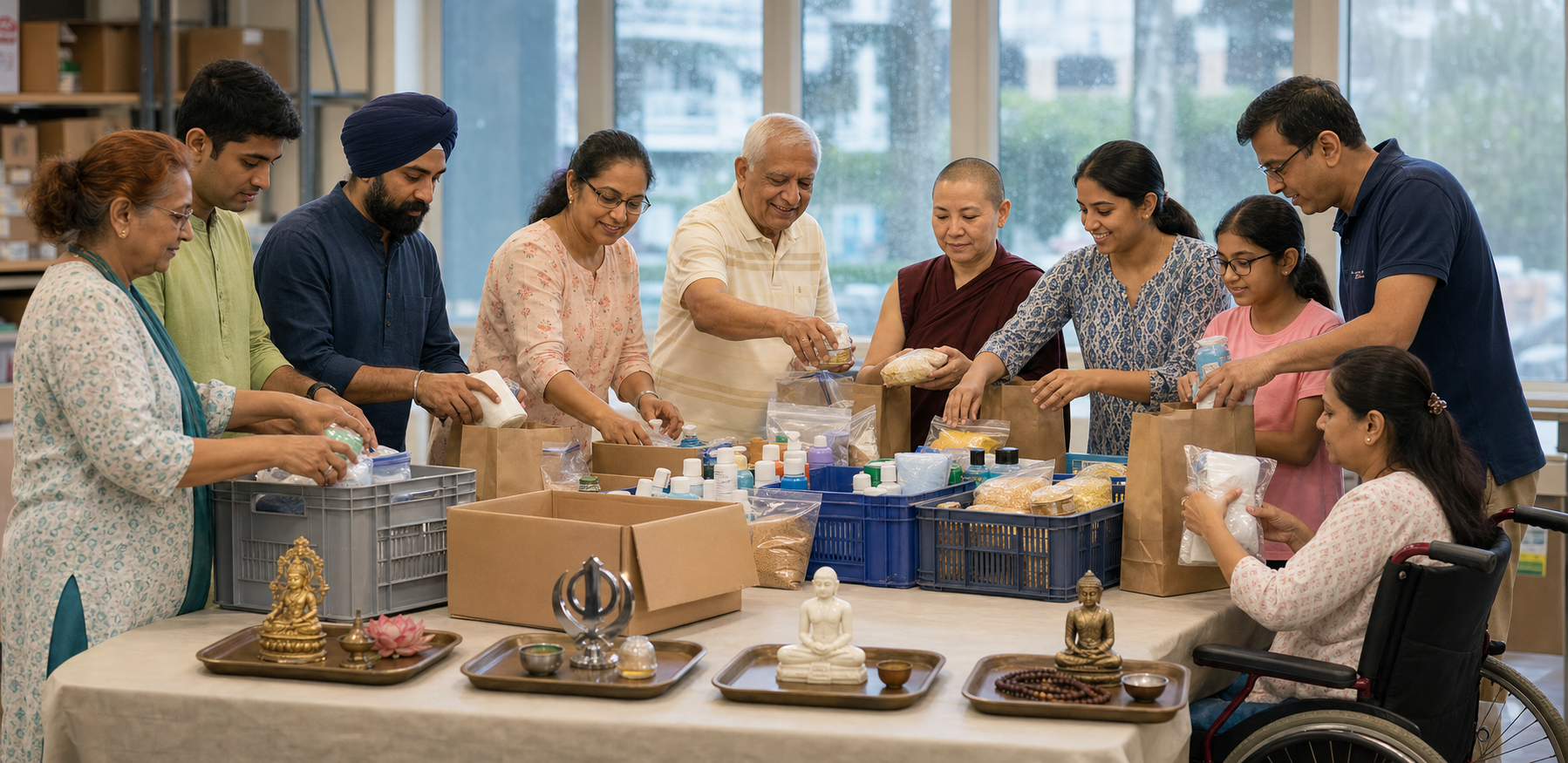
Hindu, Buddhist, Jain, and Sikh communities can work together through shared commitments to compassion, ahimsa, seva, truthful conduct, and human dignity. Food service offers an immediate point of contact: prasadam, annadana, and langar express a shared ethic of offering and nourishment.
Shared ethics do not make these practices interchangeable. Each belongs to a distinct theological, ritual, and institutional setting. Durable unity does not require a synthetic ceremony or a claim that all teachings are identical. It requires honesty about difference and cooperation on a task everyone has freely accepted.
For a joint project, agree on the civic ground before discussing branding:
- Let each participating tradition describe its own practice in its own words.
- Write a common code covering dignity, non-coercion, truthful communication, responsible use of donations, and a process for complaints.
- Agree on food, prayer, participation, and communications arrangements before inviting the public.
- Tell guests clearly when food or another offering has a religious character and which activities are optional.
- Credit every partner accurately. Do not place all traditions beneath the identity of the largest or best-funded organisation.
- Resolve operational disagreement through the agreed service standard, and theological disagreement through respectful dialogue outside the service queue.
This approach creates unity through shared responsibility rather than vague language. It also lets each community bring a genuine strength: kitchens, teaching capacity, volunteer networks, contemplative care, local knowledge, or experience organising hospitality.
Give young volunteers responsibility, not slogans
Youth participation becomes formative when young people receive real duties with guidance. A Vivekananda-inspired approach to civic formation connects character, disciplined study, skill-building, physical vigour, responsible digital conduct, and selfless service. The movement from inspiration to institution-building happens through responsibility.
Do not limit young volunteers to carrying banners, repeating slogans, or supplying social-media reach. Let them manage a defined part of the work: registration, inventory, route planning, volunteer reminders, educational support, or the first draft of a public service report. Pair authority with review. A senior volunteer should check the work, explain corrections, and gradually widen responsibility as reliability develops.
Digital citizenship matters especially when service involves vulnerable people. Teach volunteers not to post a person’s face, name, hardship, or location merely because the image appears inspiring. Communications should show the work without appropriating the recipient’s story. This is where restraint becomes both civic maturity and dharmic character.
Key takeaways for your next community project
- Translate devotional intention into a bounded public promise: a defined service, recipient group, place, cadence, standard, and responsible lead.
- Treat reliability, cleanliness, truthful records, and respectful correction as parts of the offering rather than as administrative burdens.
- Protect dignity by keeping religious participation voluntary and obtaining consent before using personal details or images.
- Track delivery, resources, open commitments, complaints, and corrections so that enthusiasm becomes an institution people can trust.
- Build dharmic unity around shared service while allowing Hindu, Buddhist, Jain, and Sikh traditions to retain their distinct teachings and practices.
- Give young people meaningful operational roles, guided review, and growing responsibility instead of symbolic participation alone.
Before your next festival, lecture, or satsang ends, write one service promise your present team can keep. Name the operational and accountability leads, confirm the resources, and announce the first service only when those foundations are real. That is how bhakti moves from admiration to habit, and from habit to a civic institution worthy of trust.
References
- Dandavats – Sri Ramanujacharya’s Magnificence: How Bhakti Masters Illuminate Kali-yuga and Inspire Unity
- Dandavats – Govinda’s Kitchen in Copenhagen: Inspiring Prasadam Initiative Unites Dharmic Communities
- Hindu Jagruti Samiti – Galvanizing Youth: Dhanashri Kelshikar on Vivekananda’s Ideals at NKES, Wadala
