
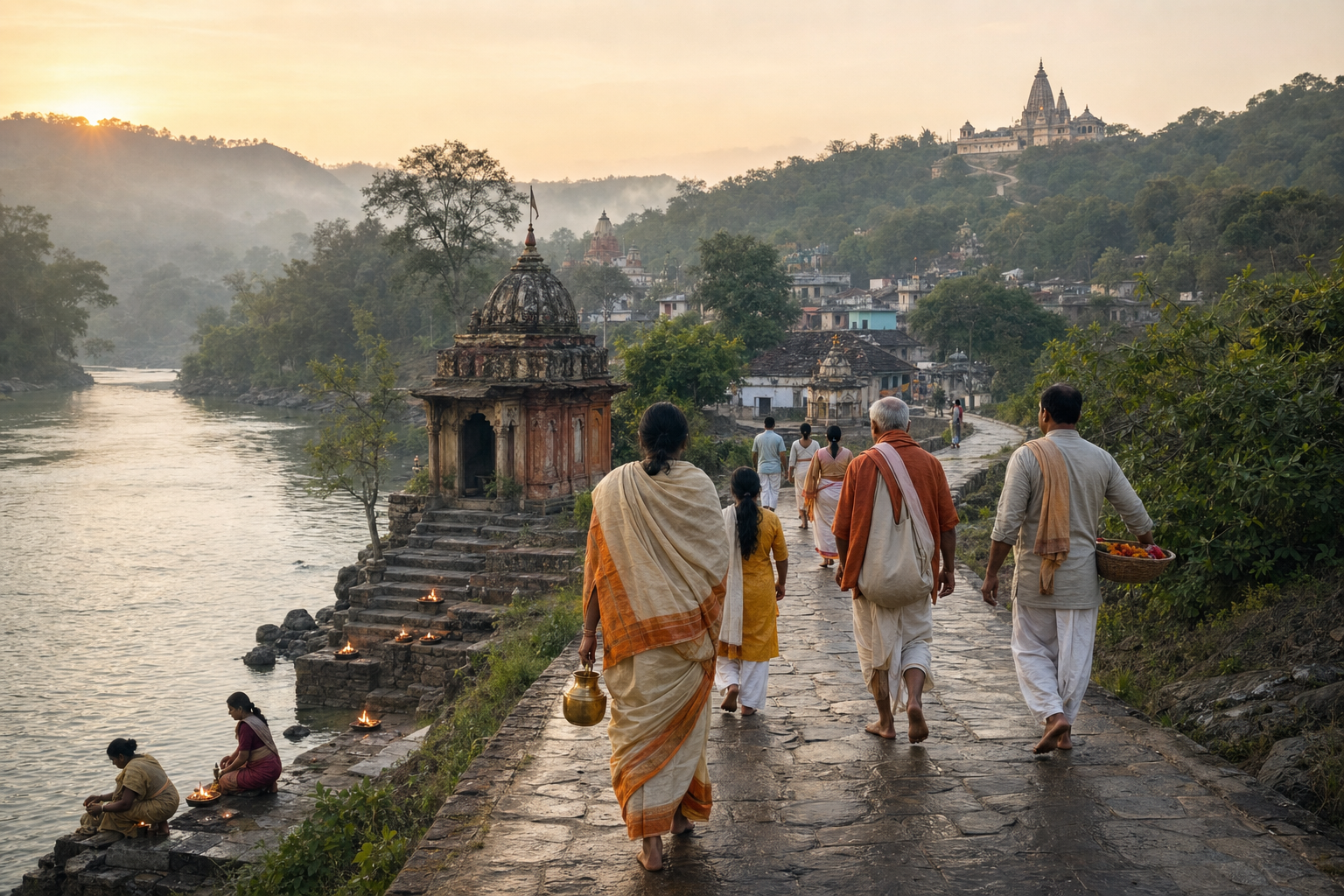
You may be planning a yatra and wondering how many temples you can fit into the day. A more revealing question is what connects those temples. If you reach every sanctum but overlook the river, path, direction, neighboring shrine, local memory, and daily rite, you have visited sacred points without fully entering the pilgrimage.
A living pilgrimage treats movement as part of worship. The land teaches through relationships: one river entering another, two shrines understood as facing each other, a route followed across generations, or an evening rite that gathers water, sound, light, and community into one moment. Learning to notice those relationships will change how you plan the journey, how you behave at the site, and what you bring home.
Key takeaways
- Before choosing stops, identify the relationship that makes the route sacred: a confluence, a paired shrine, a sequence, a direction, or a remembered event.
- Build the day around one meaningful ritual rhythm rather than maximizing the number of places covered.
- Keep physical geography, community memory, theological interpretation, and personal experience distinct. Each matters, but they do not make the same kind of claim.
- Walk part of a short connecting route when it is permitted and safe. The ground between shrines may carry as much meaning as either destination.
- Leave with one repeatable discipline – dana, restraint, ecological care, daily worship, or respect for another Dharmic form – instead of relying on a fading spiritual mood.
The route is part of the teaching
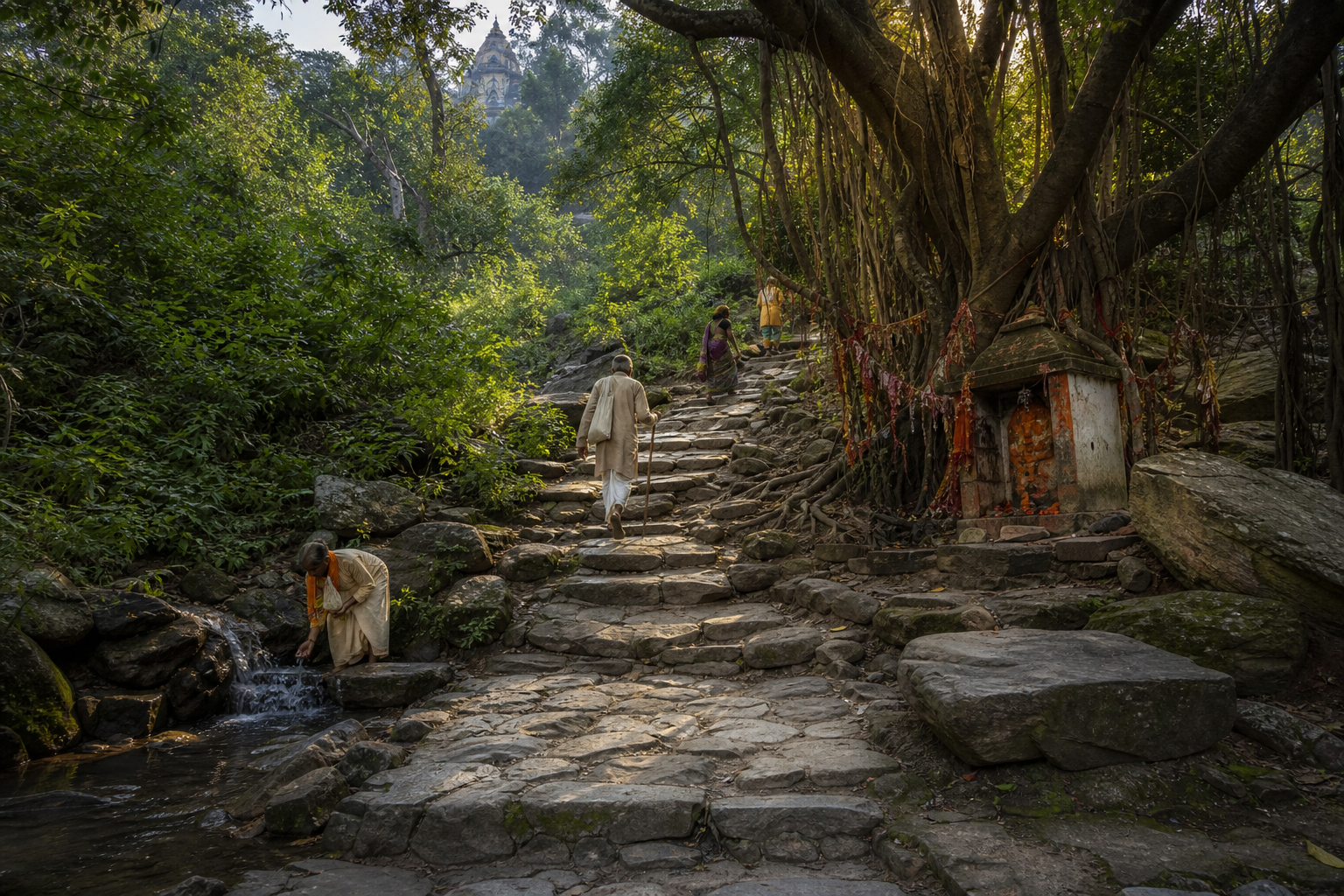
Sacred geography is not attractive scenery surrounding an otherwise self-contained temple. It is the way land, water, movement, memory, and worship form a meaningful whole. A river meeting, a pair of shrines, or a sequence of sacred places can function like a text that you read with your feet.
Consider Tarapith and Udaypur in Bengal. The two shrines stand scarcely a krosh apart, approximately two miles. Local tradition understands them as facing one another and as complementary manifestations within a single field of Shakti. The important feature is therefore not proximity alone. It is relationship. Visiting only the better-known shrine may give you a powerful darshan, but walking or consciously traveling between both reveals the local grammar of the yatra.
Karnaprayag offers a different grammar. There, the Pindar enters the Alaknanda. You do not have to imagine the underlying relation; you can see and hear the waters meet. Karnaprayag also belongs to the Panch Prayag sequence with Devprayag, Rudraprayag, Nandprayag, and Vishnuprayag. Following that sequence allows hydrology, sacred memory, temples, and regional identity to be encountered together rather than as unrelated attractions.
Before leaving home, make a route map that answers four practical questions:
- What is the central relationship? It may be between two rivers, two forms of the Devi, a shrine and a mountain, or several places in a prescribed sequence.
- Where does that relationship become visible? Mark the confluence, walking path, ghat, line of approach, or second shrine instead of marking only the main sanctum.
- What does local tradition say about it? Record the tradition in its own terms. Do not embellish it to make the destination sound more dramatic.
- Where should you slow down? Protect time for the connecting space. A packed vehicle itinerary can erase precisely the feature that made the route a yatra.
This approach also prevents a common planning mistake: adding every nearby temple simply because it is nearby. Proximity is not the same as sacred relationship. Ask why one place follows another. If the answer is only convenience, treat it as an optional visit. If the second place completes a pair, reveals a confluence, or continues a remembered route, give it real time.
Plan around ritual rhythm, not maximum coverage
A pilgrimage loses depth quietly when every pause begins to feel like a delay. The day becomes a contest between traffic, queues, photographs, meals, and departure times. You may complete the itinerary yet never stay long enough for the place to disclose its rhythm.
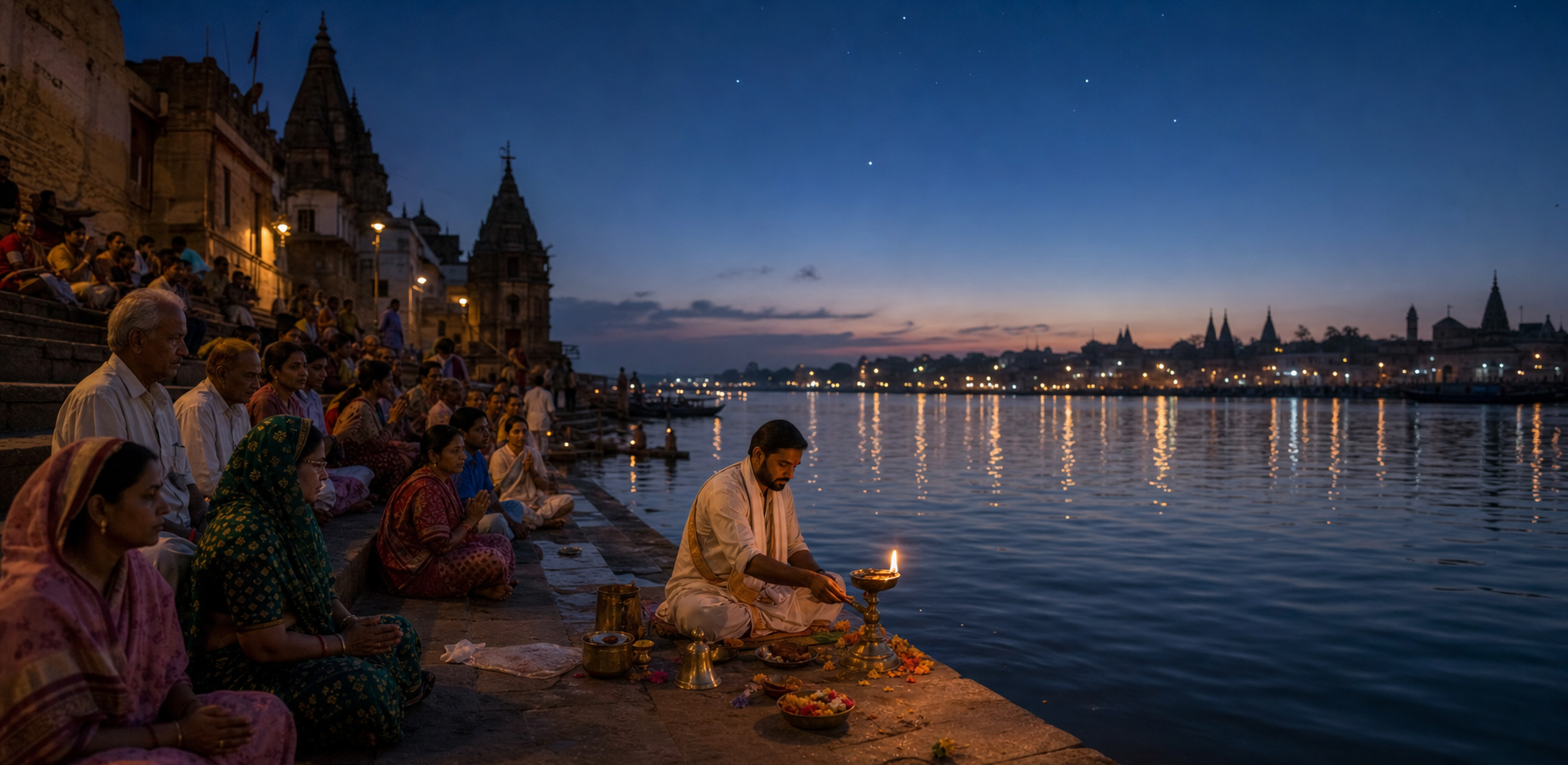
The short Tarapith-Udaypur journey is often made as a single yatra, with dawn and dusk giving the paired visit a contemplative rhythm. At Karnaprayag, daily temple worship and evening arti beside the confluence join bells, lamps, flowing water, and communal devotion. In both cases, time is not merely a scheduling constraint. It helps interpret the site.
A workable day can be arranged in the following order:
- Arrive with enough margin to notice the approach before entering the first shrine. Look for the river, path, orientation, soundscape, and movement of local worshippers.
- Receive darshan without trying to document everything. Notice the principal form of worship and the relationship the shrine has to its surroundings.
- Travel deliberately to the related place. If a short foot route is permitted and safe, walk some or all of it without turning the path into a photo session.
- Pause between the two principal encounters. A quiet meal or rest is better than inserting several unrelated stops into the interval.
- Attend one public daily rite, such as evening arti where it is offered. Let that rite anchor the schedule rather than squeezing it between transport commitments.
- Keep the period after the final rite open. Reflection becomes difficult when the next task is an immediate race to a vehicle.
Fewer stops are not automatically more spiritual. Some traditional circuits are dense because their sequence carries meaning. Use a sharper test: can you explain why the next stop belongs to the same pilgrimage? If you cannot, the extra visit may be consuming the attention needed for the central relationship.
Tarapith requires an additional distinction. Its devotional world includes cremation-ground symbolism and esoteric Tantric associations. Access to the place does not mean that every practice is public or that an uninitiated visitor should imitate specialist observances. Receive what is openly offered, follow local guidance, and do not turn another person’s sadhana into spectacle.
Keep geography, memory, theology, and experience distinct
Sacred places carry several kinds of truth at once. Confusion begins when a pilgrim treats them as interchangeable – presenting a local association as measured history, a theological interpretation as physical geography, or a private feeling as proof that everyone must experience the place in the same way.
| Layer | Example | Careful language |
|---|---|---|
| Physical geography | The Pindar and Alaknanda meet at Karnaprayag. | Describe what can be located, seen, or heard at the confluence. |
| Community memory | Local tradition associates Karnaprayag with Karna and remembers his courage, duty, and generosity. | Say that the place is associated with Karna in local tradition. Do not silently convert the association into a different kind of historical claim. |
| Theological interpretation | The Tarapith-Udaypur pair is understood as a sacred mirror of distinct yet united forms of Shakti. | Explain what the spatial relationship means within the devotional tradition. |
| Ritual rhythm | Darshan, walking, daily worship, and arti order the pilgrim’s encounter with the place. | Identify what is publicly practiced and how it shapes the yatra. |
| Personal experience | You may experience quiet, intensity, tenderness, discomfort, or no dramatic emotion at all. | Say what you noticed without making your response a universal spiritual test. |
Keeping these layers clear does not weaken faith. It protects sacred memory from careless exaggeration. The confluence at Karnaprayag is an observable geographic event. Karna’s connection is a living local memory. Reading a confluence as the union of ethical, contemplative, and devotional paths is a theological reflection. Your response beside the water is personal. Each can be honored without forcing it to do the work of the others.
The same discipline matters when you encounter connections across Dharmic traditions. The name Tara has resonance in both Hindu and Buddhist worlds. That overlap invites respectful inquiry, but it does not establish that every form, doctrine, mantra, or ritual is identical. Shared ground becomes more meaningful when difference is understood rather than erased.
Carry this principle into Hindu temples, Buddhist viharas, Jain tirthas, and Sikh gurdwaras. Reverence, restraint, compassion, ahimsa, and seva can create ethical kinship across Dharmic paths. The local theology and discipline still deserve to be learned on their own terms. Unity without sameness is stronger than a vague claim that all practices are interchangeable.
Protect the place, then carry its discipline home
At the sacred site
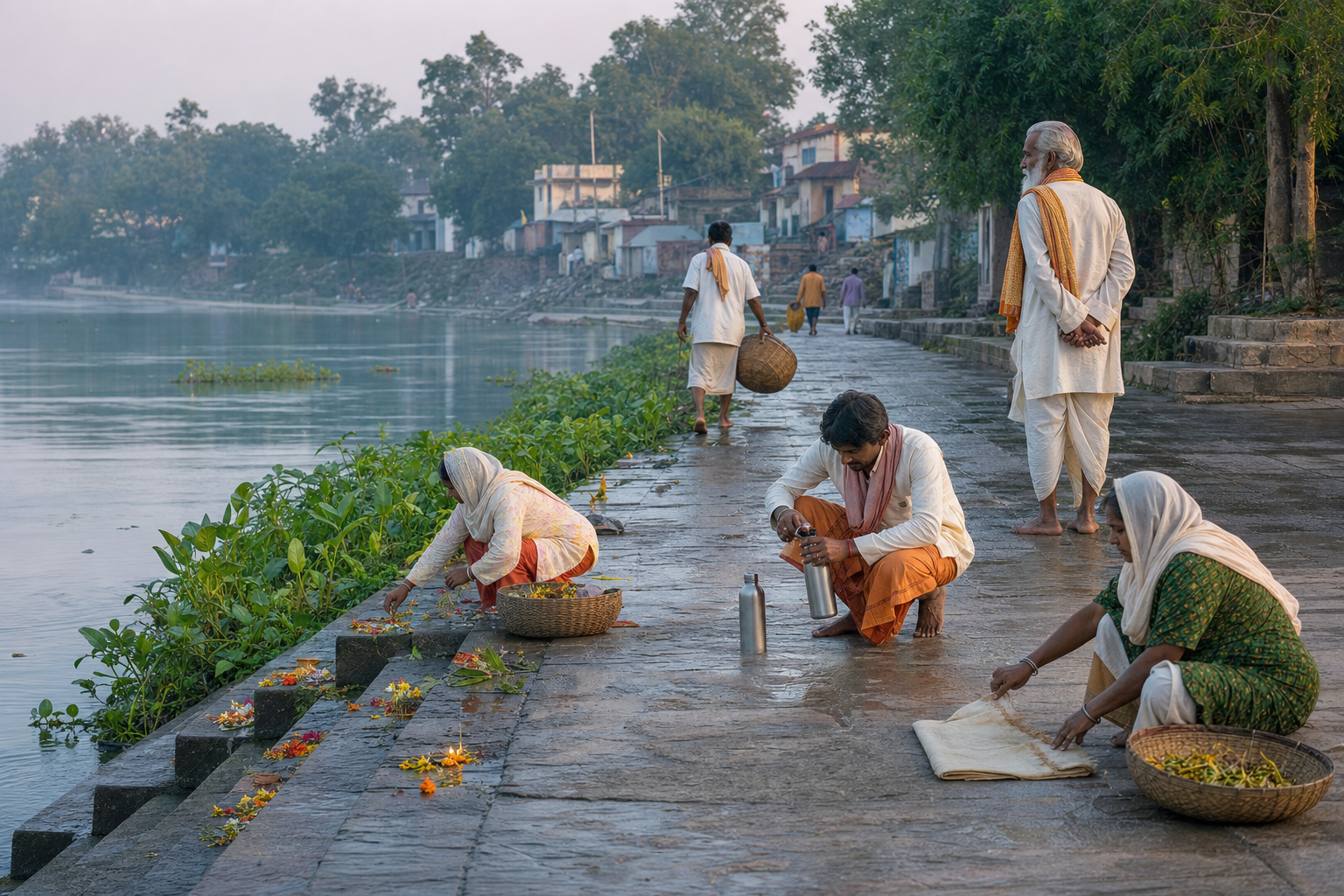
A living pilgrimage site is not a museum installation arranged for visitors. It is a place where people worship, work, remember, teach children, maintain buildings, manage crowds, and care for land and water. Your conduct either supports that life or adds to its burden.
- Follow the site’s actual instructions on clothing, footwear, queues, offerings, and access. Do not substitute habits learned at another shrine.
- Ask before photographing worshippers, ritual specialists, restricted spaces, or rites whose public status is unclear. The absence of a barrier is not automatic permission.
- Keep your voice and phone use subordinate to worship. A ghat, circumambulatory path, or temple courtyard is not merely a backdrop.
- At a confluence or riverbank, carry away packaging and other waste. Ask before placing any object in the water; devotional intention does not remove its ecological effect.
- When two shrines form a meaningful pair, resist giving all your time to the famous one. The quieter node may be what makes the relationship intelligible.
- Repeat local accounts accurately. Distinguish what you saw, what residents or custodians preserve as tradition, and what you concluded for yourself.
Ecological care is not an optional modern addition to sacred geography. When a river, bank, path, or surrounding landscape carries the sacred relationship, degrading it damages the conditions through which the tradition is practiced. At Karnaprayag, care for the ghats and riverbanks belongs to respectful engagement with the confluence. The same principle applies wherever land and worship form one field.
Seva can begin with restraint. Do not create avoidable cleaning, noise, obstruction, or conflict and then imagine that a donation cancels the burden. How you treat temple workers, local residents, other pilgrims, and the physical site is part of the yatra’s moral content.
After you return
A pilgrimage becomes portable only after you translate the place into a discipline. Trying to reproduce every external detail at home usually fails. Choose the relationship that addressed you, identify the virtue it demanded, and give that virtue a recurring form.
- Name what the land taught. Write a single precise sentence. For example: the confluence showed cooperation without erasing either stream, or the paired shrines showed unity without reducing distinct forms to one appearance.
- Choose a matching practice. If Karna’s remembered generosity stayed with you, establish a regular act of dana without demanding recognition. If the paired forms of Shakti corrected a narrow devotional attitude, stop belittling another family’s legitimate form of worship.
- Attach the practice to a cue. A daily lamp, a recurring visit to a local temple, care for a nearby water body, or a regular act of seva gives memory somewhere to live.
- Tell the story with precision. When speaking to children or friends, separate the geography you observed, the tradition you received, and the meaning you drew from it. Accurate transmission is itself a form of cultural preservation.
You do not need to recreate Bengal or the Himalaya at home. You need to let the discipline discovered there alter an ordinary choice. Before your next yatra, select one sacred relationship to follow and one ritual rhythm to protect in the schedule. Before returning, decide what concrete practice will travel back with you. That is how a visited place becomes a living pilgrimage.
References
- DharmaRenaissance Blog – Tarapith-Udaypur Tantric Axis: A Sacred Mirror of Bengal’s Unified Divine Feminine
- DharmaRenaissance Blog – Karnaprayag, Uttarakhand: Unveiling Karna’s Legacy, Sacred Confluence, and Living Temples
