
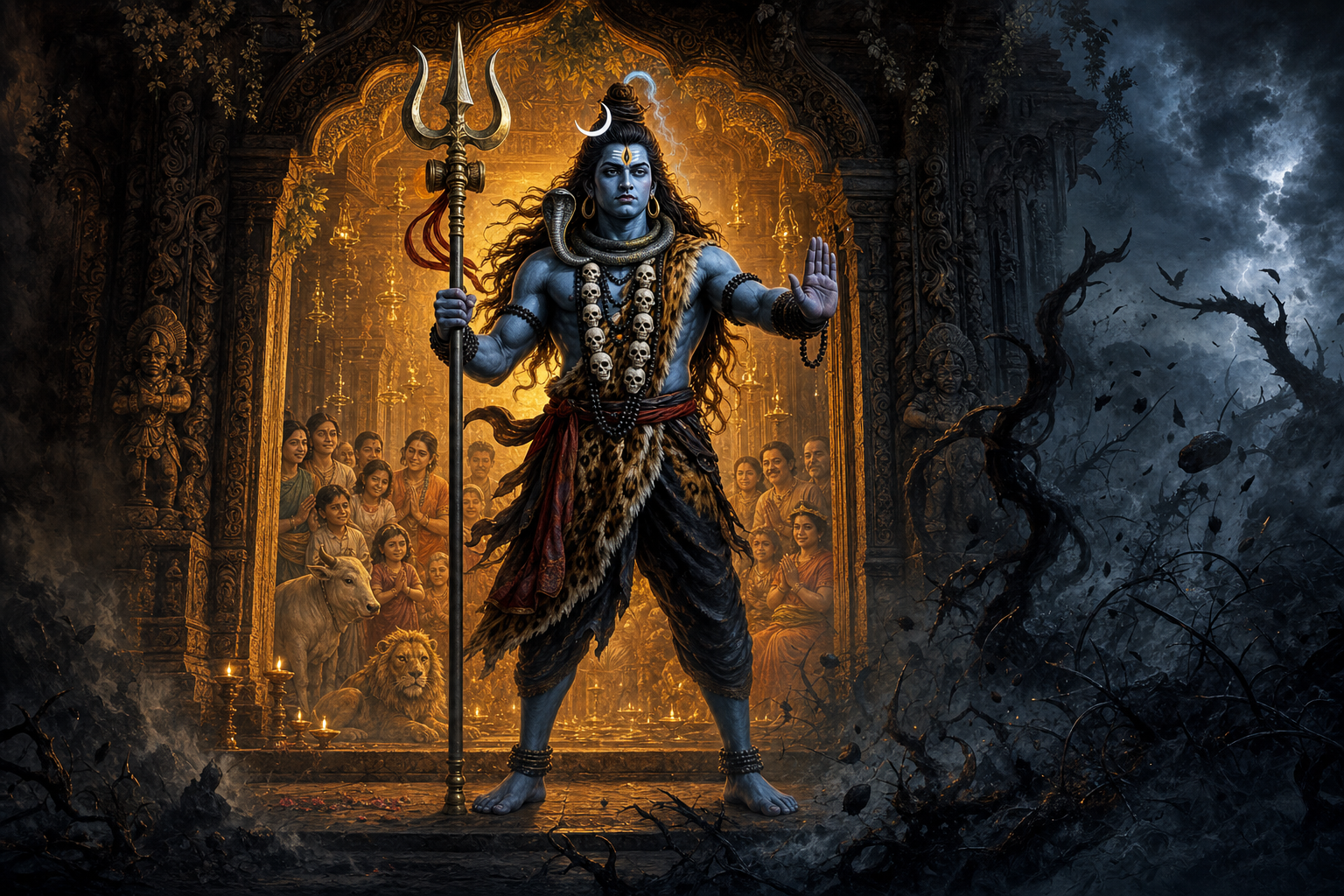
If Shiva’s blazing eyes, weapons, or garland of skulls have made you wonder how a protective deity can also appear terrifying, that tension is the place to begin. You don’t have to soften the imagery or pretend it is merely decorative.
Ugra, Raudra, and Samhara reveal compassion in its boundary-setting mode: the power that stops what is destroying dharma. Read carefully, these forms offer no romance of uncontrolled anger. They teach disciplined courage for moments when fear, arrogance, or injustice will not yield to passive goodwill.
The fierce face is a function, not a moral flaw
Human anger is often impulsive, self-protective, and distorted by wounded pride. It is therefore easy to project our own rage onto Shiva and assume that divine ferocity must be a larger version of human temper. The Shaiva understanding makes the opposite distinction: this fierceness is directed against disorder, not driven by personal resentment.
Ugra and Raudra convey terrible intensity. Samhara carries the sense of killing or decisive cessation: something obstructing dharma is brought to an end. These terms describe the force and work of the manifestation; they do not identify Shiva with cruelty or evil.
The larger framework matters. Shiva’s five cosmic acts are creation, preservation, dissolution, concealment, and grace. Samhara corresponds to dissolution, but dissolution is not the final act or the whole nature of Shiva. It clears the field in which renewal becomes possible. What ends is not ended for the pleasure of destruction. It ends because its continued existence prevents truth, balance, or life from flourishing.
This distinction protects you from two opposite errors. If you treat every forceful response as spiritually corrupt, you can become passive before adharma. If you treat every angry impulse as righteous, you can give ego a sacred costume. Fierce Shiva permits neither shortcut. The right question is not whether an action looks severe, but whether it removes disorder without creating another form of it.
Read the symbols in the right order

A fierce murti is meant to arrest casual attention. Its imagery makes the urgency of transformation visible before you have reduced the encounter to a comfortable idea. Yet fear is only the first response, not the interpretation.
- Blazing eyes: The gaze does not permit concealment. When you contemplate it, begin with the habit, fear, or injustice you would rather avoid naming.
- The trishula and other signs of decisive power: Transformation cannot remain a vague wish. An obstruction eventually has to be interrupted, relinquished, or removed.
- The damaru: Fierceness belongs to a larger process of transformation. The purpose is not mute ruin but a restored order in which life can continue truthfully.
- Tiger skin, matted locks, and untamed appearance: These features prevent you from reducing Shiva to a harmless ornament. Sacred power is not required to conform to human preferences for comfort.
- The garland of skulls: Mortality and impermanence expose the ego’s claim to permanence. What we defend most fiercely may be precisely what must be surrendered.
Do not treat this as a rigid code in which every feature has only one possible meaning. Use the whole composition as a sequence of questions: What is being protected? What is being stopped? What attachment is being exposed? What becomes possible after the obstruction ends?
If your reading ends with fright, you have missed the protection. If it ends with admiration for overwhelming power, you have missed the moral demand. The murti places you between the two: protected from adharma, but also examined for the adharma you may be carrying yourself.
Use five questions to test whether fierceness serves dharma
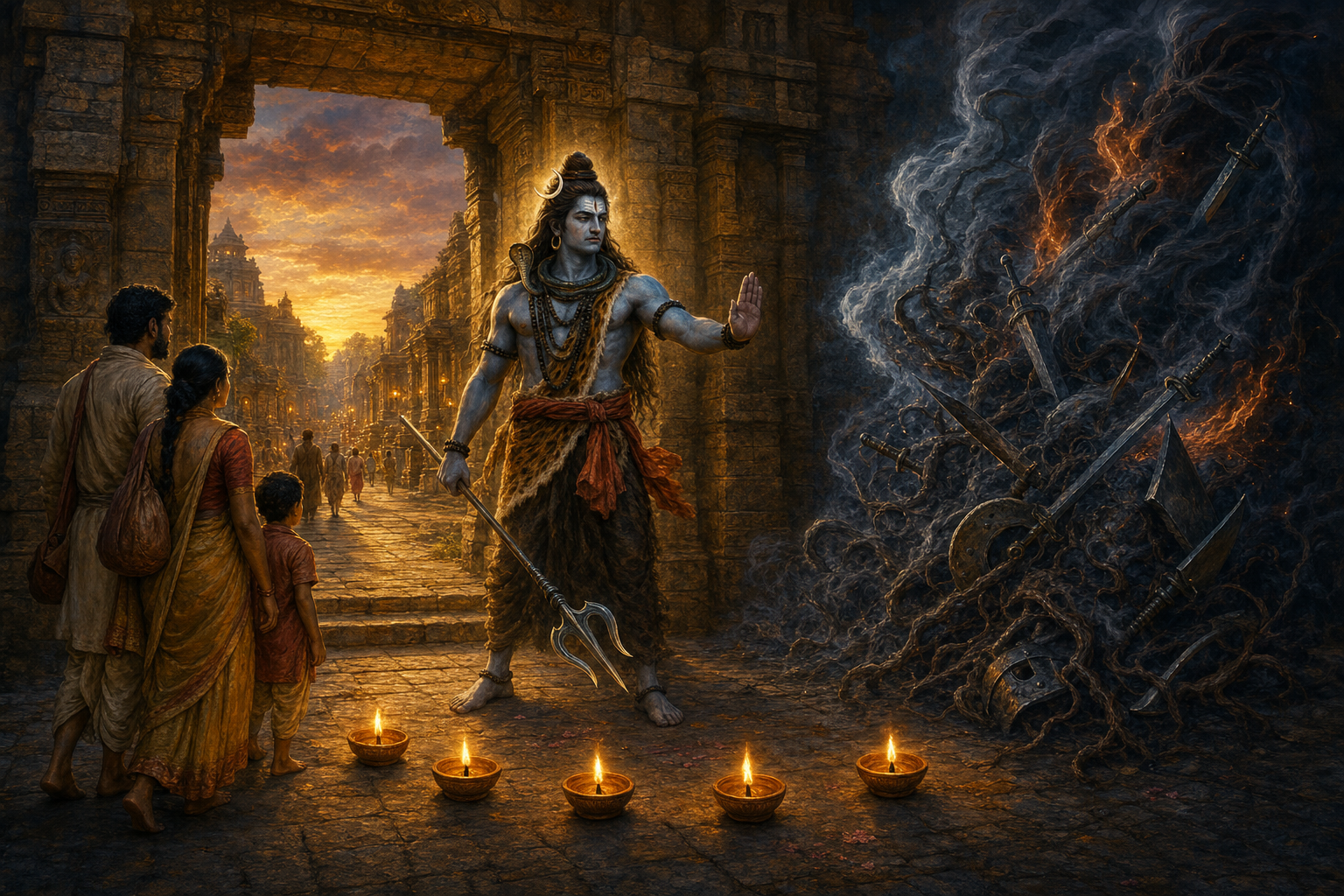
Sacred ferocity is not permission for humiliation, revenge, abuse, or private retaliation. Injured pride can borrow the language of cosmic justice while remaining injured pride. Before you call a forceful response dharmic, subject it to a stricter test than the response you would prefer emotionally.
- What exactly must end? Name the obstruction rather than beginning with a person you dislike. Anger, arrogance, fear, deception, or entrenched injustice can be confronted more clearly when the harmful pattern is specified.
- Have gentler remedies genuinely proved insufficient? Patience is not passivity, and firmness is not the first excuse for aggression. Truthful speech, correction, a clear boundary, or withdrawal of cooperation may stop the harm without escalation.
- Is the response proportionate? Protective power uses only the degree of force necessary to arrest disorder. Severity beyond restoration turns protection into domination.
- Is your own ego holding the weapon? If the proposed action promises emotional gratification, status, or revenge, pause. Let Shiva’s fierce gaze fall first on your motive.
- What will restoration look like, and when will you stop? A protective act needs an endpoint. Once the harm is stopped and a just boundary is restored, continued punishment becomes a new attachment to conflict.
You can also apply this test inwardly without inventing an elaborate ritual. Choose one pattern that feels immovable. Write down the behaviour that feeds it, one proportionate action that interrupts it, and one observable sign that balance is returning. For anger, that action may be delaying harmful speech. For arrogance, it may be accepting correction without composing an immediate defence. For fear, it may be taking the next necessary step instead of waiting to feel invulnerable.
When a conflict involves threats, coercion, abuse, or crime, disciplined protection includes seeking appropriate institutional or legal help. Spiritual symbolism never grants an individual unlimited authority to harm another person. The protective meaning of Shiva’s fierce form is lost the moment sacred language becomes a shield against responsibility.
The wider Dharmic lesson is disciplined courage

Hinduism does not stand alone in refusing to equate a fearsome appearance with hatred. Other Dharmic traditions preserve related ethical insights, even though their teachings, practices, and theological frameworks must not be collapsed into one another.
- Vajrayana Buddhism: Wrathful protectors subdue ignorance in order to preserve wisdom. The outwardly terrifying form is judged by the delusion and suffering it overcomes.
- Sikh thought: The sant-sipahi ideal joins devotion to righteous courage. Spiritual depth and the willingness to defend what is right are not treated as opposites.
- Jain practice: Ahimsa redirects ferocious determination inward as restraint and ethical discipline. The conquest sought is mastery over impulses that perpetuate harm.
The common lesson is not that all fierceness is holy. It is that energy becomes protective only when governed by wisdom, devotion, restraint, and responsibility. You can test your own response by asking three things: Will it reduce suffering or feed identity? Is courage still answerable to ethical discipline? Does the demand for justice include conquest of your own anger and pride?
This is why ahimsa and protective strength need not be reduced to slogans against each other. Ahimsa keeps force from becoming cruelty. Protective courage keeps concern for non-harm from becoming indifference to the harm already being done. Dharma requires discernment about both.
Key takeaways
- Ugra and Raudra express terrible intensity; Samhara names the decisive ending of an obstruction to dharma.
- Dissolution is one of Shiva’s five cosmic acts, so destruction must be understood within a movement toward renewal and grace.
- The fierce iconography directs attention to urgency, impermanence, ego, protection, and the necessity of transformation.
- A forceful response is dharmic only when its target is clear, gentler remedies are insufficient, its measure is proportionate, and it ends when balance is restored.
- The first proper object of fierce scrutiny is your own anger, arrogance, fear, and attachment to being right.
- Across Dharmic traditions, courageous energy remains protective only while it is governed by wisdom and ethical restraint.
The next time fierce Shiva unsettles you, neither look away nor imitate the rage. Name one obstruction plainly, test your motive, choose the least severe action capable of stopping it, and stop when balance returns. That is how terrifying grace becomes a practice of protection rather than a mask for anger.
References
