

You may revere Baba Lokenath and still wonder what his life asks you to do during an ordinary day. Devotion can preserve a saint’s presence, but a seeker also needs a method: what to study, how to practise, whom to trust and how to tell whether the practice is changing anything.
Baba Lokenath’s life offers a clear sequence: receive knowledge with humility, examine it carefully, embody it through disciplined sadhana and let compassion test the result. That sequence is more useful than collecting impressive stories because you can begin applying it where you are.
Read his life as a sequence, not a collection of legends

Born in 1730 into a Brahmin family in a village near Kolkata, Baba Lokenath entered the spiritual path in accordance with his father’s wish. Under a learned scholar, he studied the Vedas, the Shastras and related sacred learning. In his youth, he left home for sadhana within the guru-shishya parampara.
Those facts reveal an important order. Renunciation did not come before education. Practice did not begin with self-invented techniques. Scriptural learning, a teacher’s discipline and sustained sadhana belonged to the same formation.
- Foundation: he received sacred learning rather than treating spiritual intuition as sufficient by itself.
- Guidance: he learned under someone equipped to teach and correct him.
- Commitment: he moved from learning about a path to living it through sadhana.
- Integration: knowledge and austerity became the basis of a life remembered for serenity, strength and care for devotees.
This order corrects two common mistakes. The first is accumulating religious information without allowing it to govern conduct. The second is pursuing intense practices without the preparation needed to understand them. Baba Lokenath’s example places disciplined learning before spiritual ambition and lived transformation after it.
It also gives you a sensible way to approach uncertain devotional claims. Do not attach an unattributed saying to Baba Lokenath merely because it sounds profound, and do not make a miracle story carry the whole meaning of his life. Where historical detail is limited, keep the limit visible. Reverence does not require invented certainty.
Turn sacred learning into a practice that changes decisions

Baba Lokenath’s formation reflects a classical rhythm often expressed as shravana, manana and nididhyasana: receiving a teaching, reflecting on it and assimilating it through sustained contemplation. Svadhyaya, or disciplined self-study, supports the entire movement. These are not labels to admire. They describe different kinds of work.
Shravana: receive before reacting
Choose a short, identifiable passage from a trusted scripture or teaching in your tradition. Record where it comes from so that a memorable line does not become detached from its context. Read or hear it slowly. Your first task is accuracy: understand what is actually being taught before deciding whether it confirms what you already believe.
Manana: question without turning cynical
Restate the teaching in your own words. Then identify the part that unsettles, confuses or challenges you. Ask what assumption in your life it confronts. If you cannot explain the teaching plainly or name the question it raises, more reading may only add vocabulary rather than understanding.
Nididhyasana: carry it into conduct
Sit with the same teaching across repeated periods of practice instead of replacing it whenever novelty fades. Before leaving the practice, name the next real situation in which it matters: a difficult conversation, an obligation you have delayed, a temptation to speak harshly or a decision dominated by pride. Decide what the teaching requires there.
This makes study measurable without reducing it to a score. A passage has begun to enter your life when it changes what you notice before acting. If study only makes you quicker to correct other people, return to manana. The ego can use sacred language as easily as it uses status or possessions.
Keep tapas steady and the guru relationship discerning

Tapas is often translated as austerity, but discomfort alone proves very little. The useful question is whether a discipline steadies attention, purifies intention and improves your capacity to fulfil dharma. Severity that produces vanity, irritability or neglect of responsibility has missed the point.
Build discipline around a clear boundary
Choose a practice small enough to keep honestly and definite enough that you know whether you kept it. Attach it to a stable part of the day, place the phone outside the practice space and decide in advance what the session contains. A modest discipline repeated faithfully trains something that occasional intensity cannot: the ability to continue when enthusiasm is absent.
- Use a fixed trigger: begin after an existing daily duty rather than waiting to feel inspired.
- Keep the content narrow: work with a chosen passage, mantra, prayer or contemplative method instead of changing the programme mid-session.
- Protect your duties: do not use sadhana to avoid family, work or community responsibilities.
- Watch the after-effect: notice whether your speech and reactions become steadier once the formal practice ends.
Do not imitate severe austerities without qualified guidance. Fasting, intentional sleep loss, exposure to physical danger or changes affecting medication can cause real harm. Spiritual determination does not make the body exempt from medical reality; where health is involved, seek appropriate professional advice.
Know what guidance is supposed to do
Baba Lokenath’s study under a scholar and later sadhana within the guru-shishya tradition show that guidance was structural, not decorative. A capable teacher transmits a method, places teachings in context and notices the evasions a seeker may not see alone.
Respect, however, is not gullibility. Sound guidance should direct you toward dharma and disciplined understanding rather than making you dependent on a personality. Be cautious when a teacher discourages sincere questions, demands secrecy about harmful conduct, isolates disciples from family, claims exemption from ethical restraints or uses spiritual authority to obtain money, sexual access or unquestioning obedience. Those are reasons to create distance and seek trustworthy help, not tests of your devotion.
If you do not have a qualified guru, avoid pretending that solitary preference is the same as guidance. Begin conservatively with identifiable scriptures, reputable instruction and a stable community whose conduct you can observe. Keep difficult interpretations provisional. A sincere acknowledgement of what you do not yet know is itself part of humility.
Let compassion reveal whether the practice is working
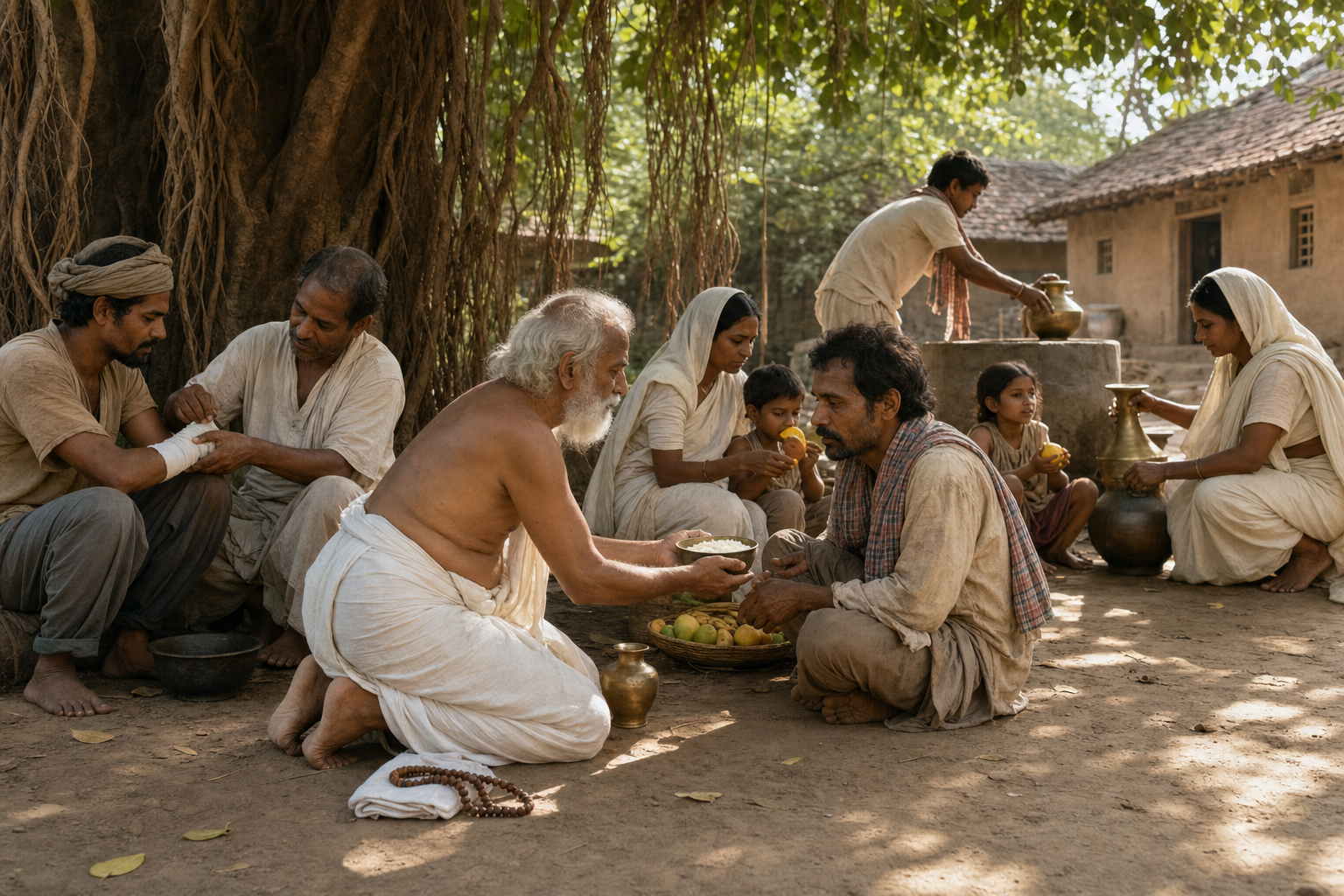
Baba Lokenath’s enduring appeal joins learning and tapas with compassion and service. This matters because inward practice can otherwise become self-absorption. The person nearest to you should not have to bear harsher speech merely because you are pursuing an elevated spiritual ideal.
Use seva as a diagnostic. After study or meditation, perform a duty that benefits someone without advertising your spirituality. Listen fully before replying. Complete an obligation you have postponed. Offer practical help without making the recipient manage your need for recognition. Compassion becomes credible through conduct, not sentiment.
This is also where Baba Lokenath’s life can speak across the dharmic family. Hindu, Buddhist, Jain and Sikh traditions are not interchangeable; they make distinct claims and preserve distinct disciplines. Yet ethical living, disciplined attention, service and reverence for wisdom provide genuine grounds for mutual recognition. Unity becomes shallow when it erases difference, but it becomes useful when it encourages communities to strengthen the virtues they actually share.
When evaluating your own progress, ask concrete questions. Are you less easily provoked? Do you keep promises more reliably? Can you admit an error without immediately defending yourself? Has your practice made you more available to a person in need? Mystical experiences may be difficult to interpret; changes in conduct are harder to fake over time.
Key takeaways: use this practice audit
- Study: Can you name the teaching and its textual or instructional context?
- Reflection: Can you explain it plainly and identify the assumption it challenges?
- Practice: Have you given it a stable place in your routine rather than relying on mood?
- Guidance: Is there a trustworthy person or tradition capable of correcting your blind spots?
- Tapas: Is the discipline producing steadiness without harming health or neglected duties?
- Compassion: Can someone other than you point to a practical benefit from your conduct?
Begin with a single teaching you can identify, a discipline you can keep and an act of service no one needs to applaud. At your next review, do not ask whether the practice made you feel spiritual. Ask whether it made you more truthful, steady and useful. That is where Baba Lokenath’s example stops being biography and becomes sadhana.
References
