
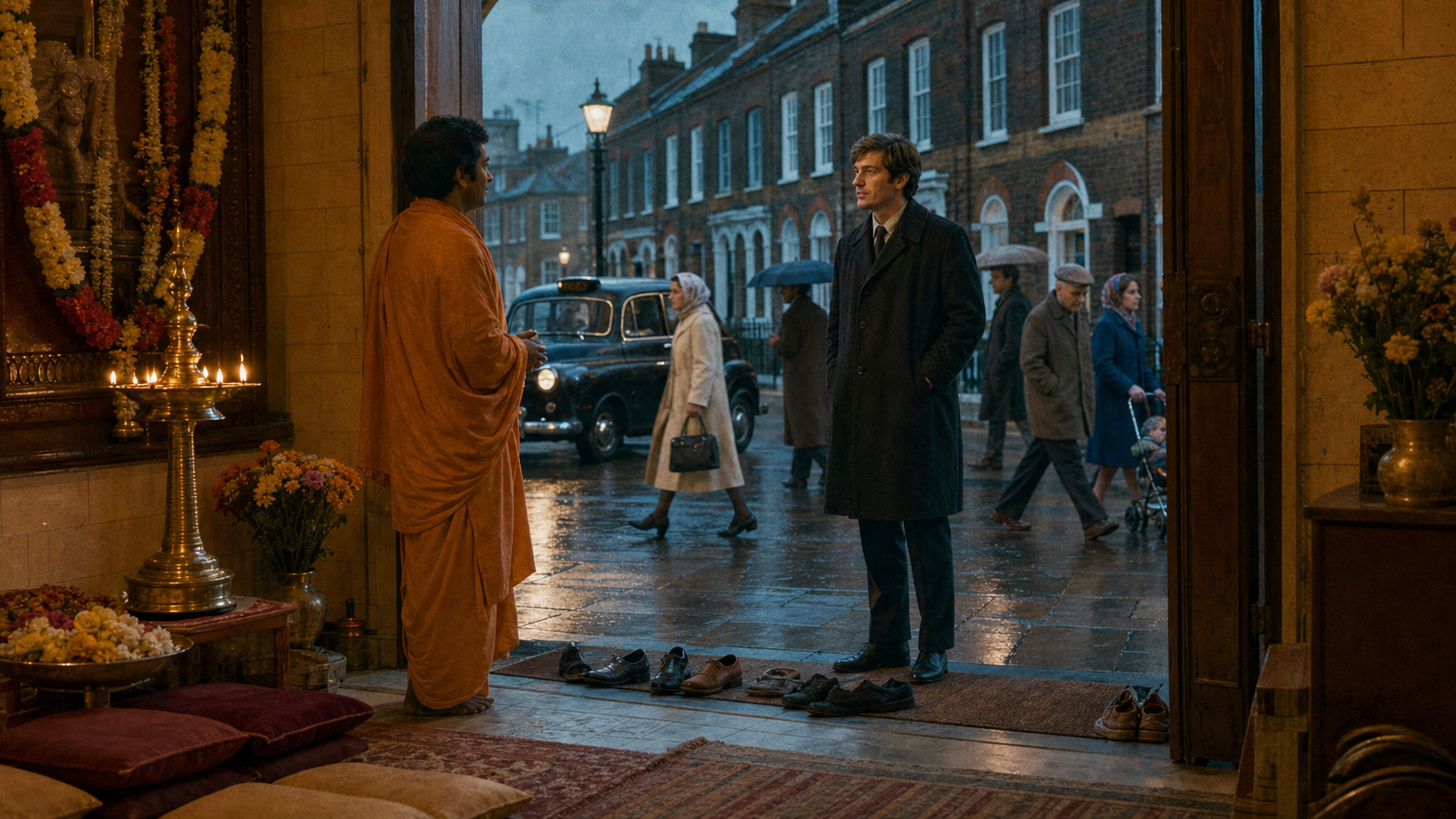
If someone with a worldview far outside your own walks into your temple, do you welcome him, debate him, or guard the boundary of the sacred space? That question can make courtesy and conviction look like opposites.
An unexpected meeting in London in 1970 points to a better approach. You can receive a person without adopting his beliefs, explain your tradition without belittling his, and preserve a sacred space without treating difference as contamination. This is spiritual pluralism in a dharmic key: openness governed by discipline.
A temple doorway became a map of London’s spiritual life
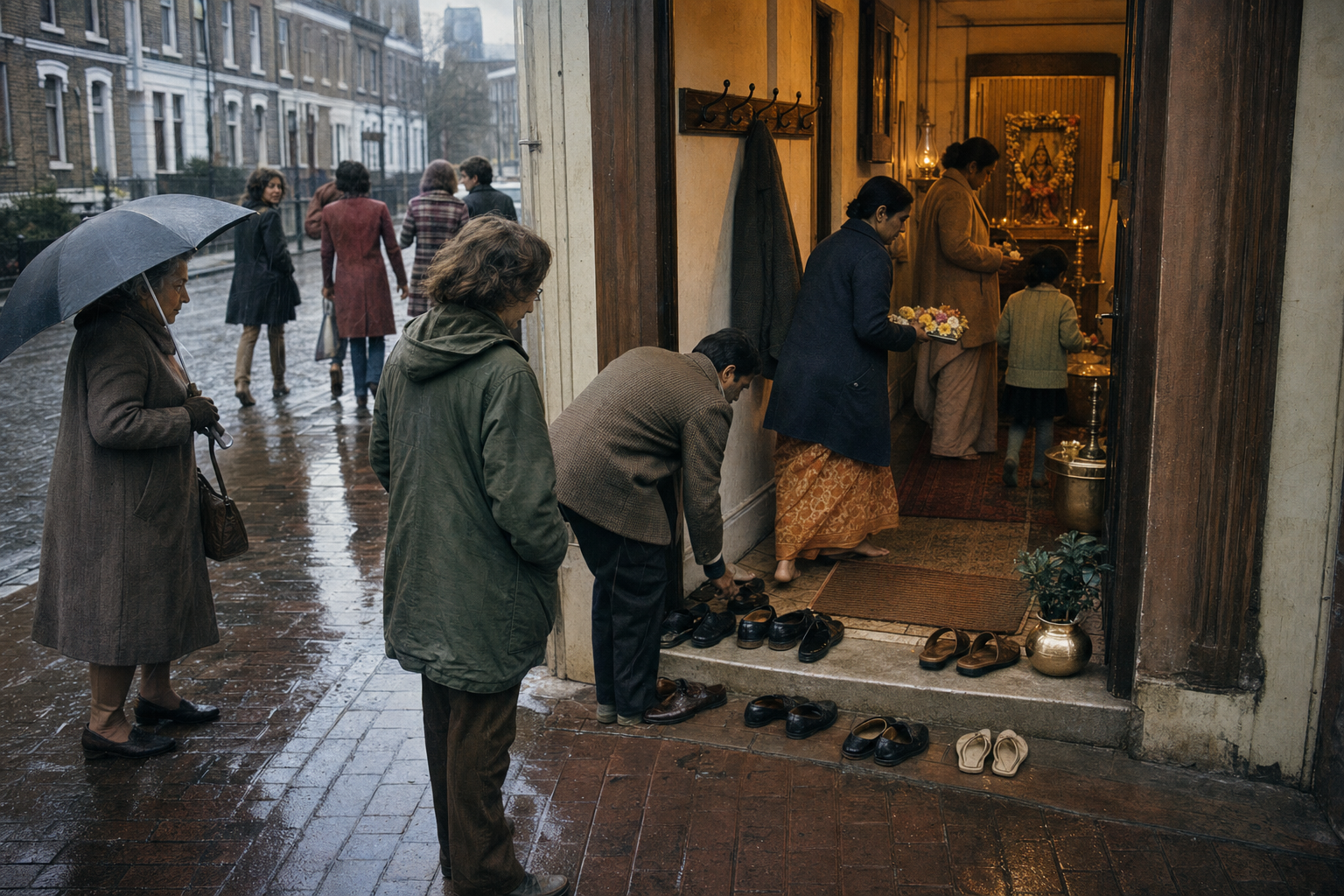
In February 1970, shortly after joining the Hare Krishna community in London, Yogesvara das recorded the visit of a man described as a warlock to its temple off Oxford Street. The contrast was striking: a practitioner associated with Western occultism had entered a young Gaudiya Vaishnava community centered on devotion to Krishna.
The encounter was unusual, but the proximity behind it was not accidental. London contained active occultist circles, an early ISKCON outpost, and the nearby Swedenborg Society, named for the eighteenth-century Swedish spirit-channeler Emanuel Swedenborg. Public kirtan, temple worship, esoteric experimentation, and secular city life could occupy the same urban landscape.
That physical proximity matters. Religious difference was not an idea discussed only at formal conferences. It could appear at the temple door. A community had to decide, in real time, whether an unfamiliar visitor was a person to be heard, a belief system to be examined, a disruption to be managed, or some combination of the three.
The word “warlock” should not do more work than the evidence permits. A label supplied by an observer does not tell you everything a visitor believes, why he has come, or how he will behave. When you meet someone from an unfamiliar tradition, separate three things: the label attached to the person, the beliefs the person actually expresses, and the conduct you can directly observe. Only the last two provide a sound basis for conversation and boundaries.
Pluralism does not require theological surrender

Spiritual pluralism means that people with distinct religious commitments can inhabit the same society, meet one another, and speak honestly without coercion or contempt. It does not require you to declare that incompatible claims are equally true. It also does not require a temple to turn every encounter into a blended ritual.
This distinction prevents four common confusions. Tolerance is the refusal to persecute or humiliate. Hospitality is the decision to treat a visitor with dignity. Dialogue is an exchange in which each person can state what he actually believes. Syncretism is the blending of elements from different traditions into something new. You may practice the first three without choosing the fourth.
That is especially important for a devotional community. If loving service to Krishna is the center of its life, honest dialogue should make that center intelligible rather than hide it behind vague language about universal spirituality. Respecting another person does not oblige a Vaishnava to pretend that every account of God, the self, worship, and liberation is interchangeable.
Unity therefore needs an object. People may unite in rejecting violence, defending freedom of worship, keeping a neighborhood peaceful, or protecting the dignity of visitors. They need not manufacture doctrinal agreement where none exists. Before calling an encounter a success, ask two questions: Was the other person treated justly? Was the tradition represented truthfully? If either answer is no, the dialogue has failed in an important way.
Use five disciplines when belief meets belief
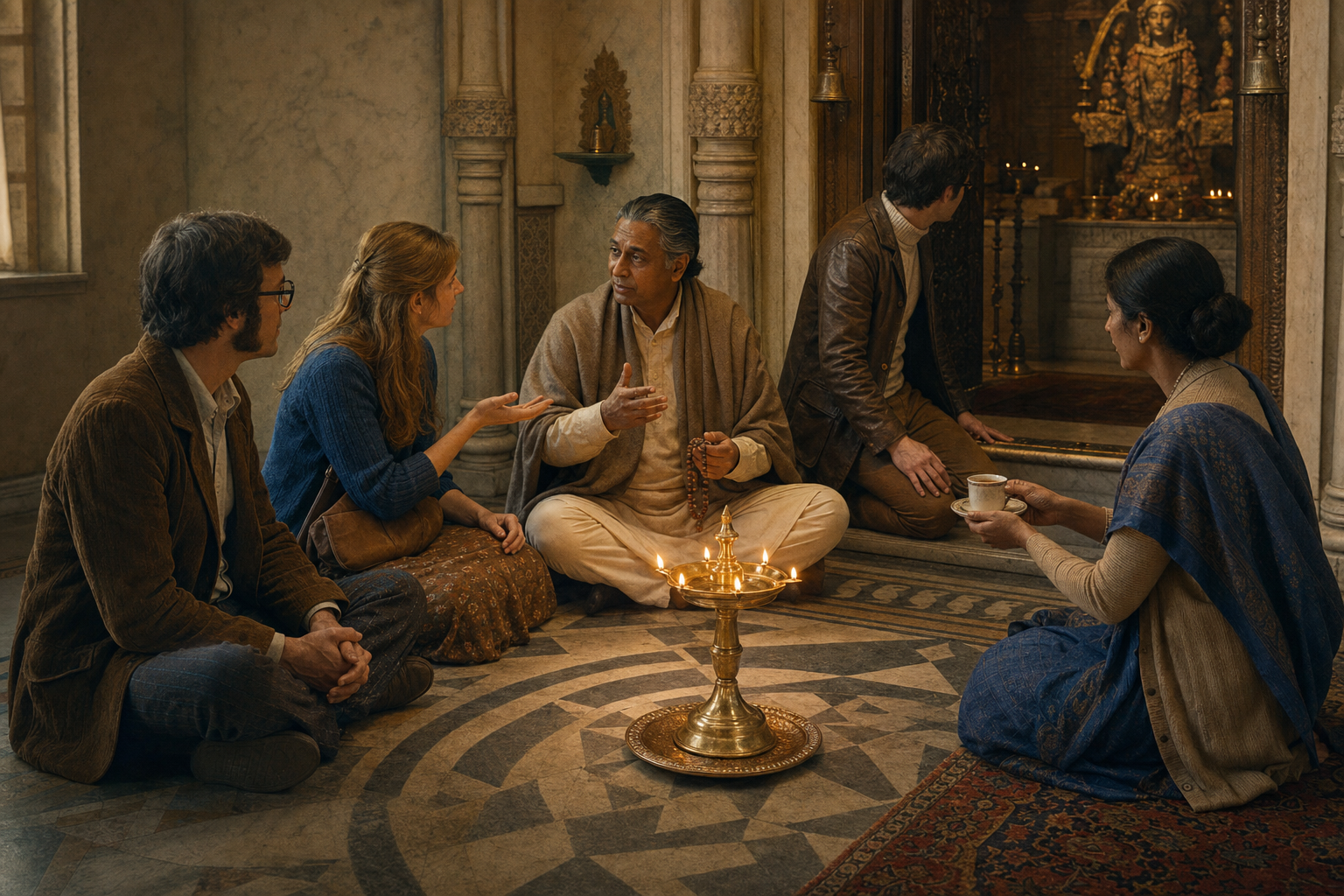
The order of an interfaith encounter matters. Establish the character of the space before comparing beliefs, invite self-description before applying labels, and state your own commitment before searching for common ground.
- Explain the space. A temple is a place of worship, not neutral event space. If there are rules about footwear, photography, restricted areas, interruptions, or participation in ritual, explain them calmly and apply them consistently. Hospitality does not give a visitor permission to disrupt worship.
- Ask why the person has come. “What brings you here?” is more useful than beginning with assumptions about the visitor’s label. A curious observer, a serious seeker, a debater, and someone seeking spectacle may require different kinds of conversation.
- Let the visitor describe his own beliefs. Ask what the person practices and how he understands it. You do not have to accept that account as true, but you should answer the belief actually presented rather than an imagined version assembled from a loaded name.
- State your own center plainly. Name the deity, teaching, discipline, or spiritual goal that gives your community its identity. A Gaudiya Vaishnava need not speak for every Hindu school or every dharmic religion. Clear first-person commitment is more honest than a claim that all traditions teach precisely the same thing.
- End with the real level of agreement. If you agree only that peaceful conversation is worthwhile, say so. If you disagree about the nature of the Divine or the legitimacy of a practice, say that without ridicule. A truthful disagreement is better than ceremonial agreement that neither side believes.
A useful opening might be: “You are welcome to observe. Our worship is centered on devotion to Krishna, and these are the customs we follow in this space. I would also like to understand how you describe your own practice.” That sentence welcomes the person, identifies the tradition, and establishes a boundary. It promises neither endorsement nor hostility.
Shared dharmic values are a method, not a merger
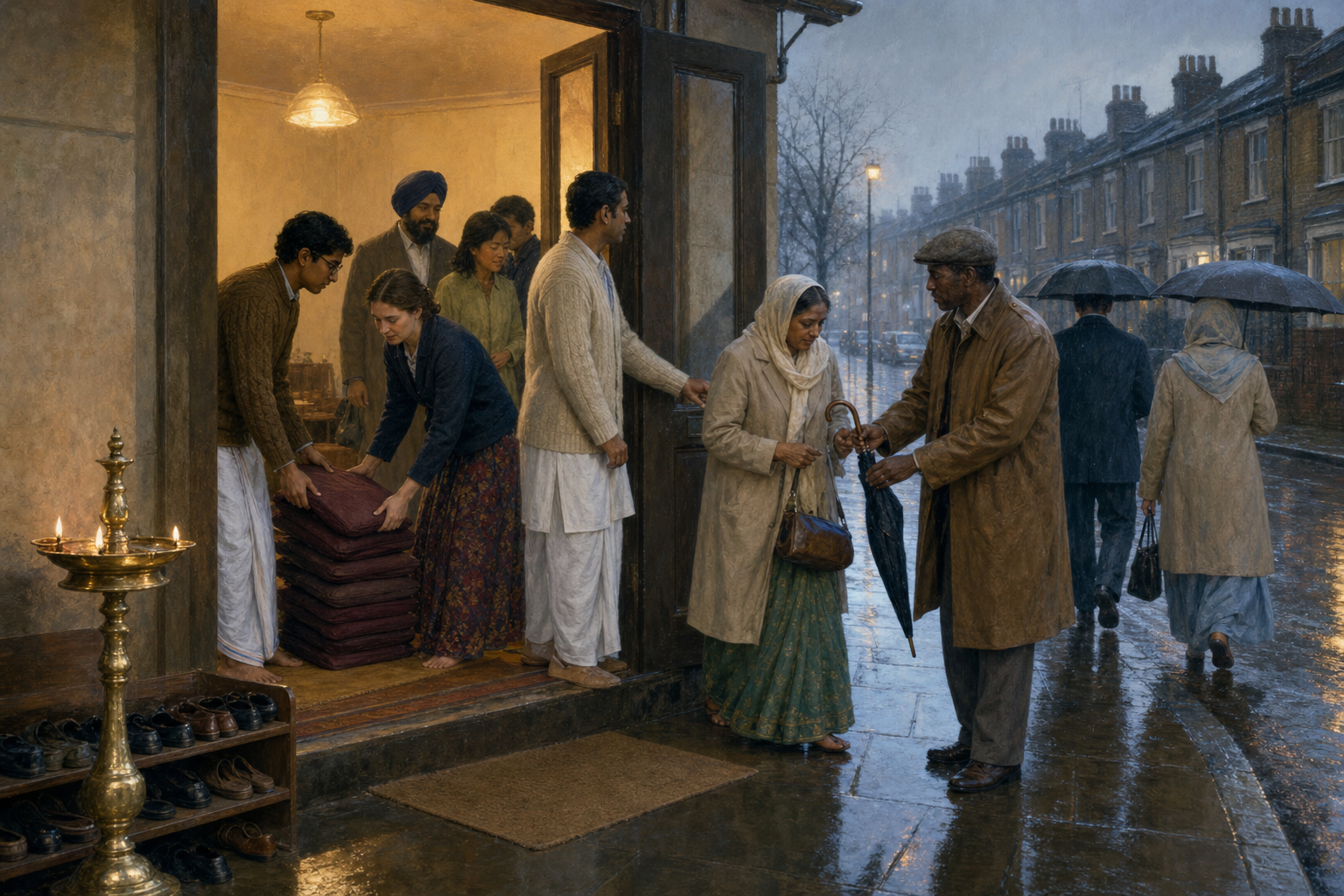
Hinduism, Buddhism, Jainism, and Sikhism are not four names for one doctrine. Their teachings about ultimate reality, the self, liberation, authority, and religious discipline cannot be flattened without misrepresenting them. Their internal schools also matter. A serious dharmic account of pluralism begins by respecting those differences.
Yet these traditions can offer a shared ethical grammar for meeting difference: non-harm, responsibility, respect, and disciplined mastery of one’s own reactions. These values do not dictate one theology. They govern how a person behaves while holding theological commitments.
- Ahimsa governs the manner of disagreement. It does not forbid you from challenging a claim. It asks whether your words seek understanding and truth, or humiliation and domination.
- Humility checks the ego of the speaker. It does not mean uncertainty about every conviction. It means refusing to confuse personal pride with defense of dharma.
- Responsibility protects the community. A host must care for worshippers as well as visitors. Clear rules, time limits, and restrictions on disruptive behavior can coexist with personal courtesy.
- Inner discipline creates room for listening. When an unfamiliar symbol or label provokes immediate fear or fascination, pause before assigning a motive. Ask a precise question and listen to the answer.
This method avoids two weak responses. One is defensive hostility, which treats every difference as an attack. The other is indiscriminate affirmation, which treats every boundary as intolerance. A mature community needs neither reflex. It can distinguish a peaceful guest from a disruptive actor and a sincere question from a demand that the temple dilute its worship.
The London encounter also corrects a modern temptation to turn unusual visitors into spectacles. The visitor should not become a prop in a story about how broad-minded the host is. Nor should the host community become an exotic object for the visitor. Genuine pluralism begins when both sides are allowed to be moral agents with convictions, questions, and responsibilities.
Key takeaways for your next spiritual encounter
- Welcome the person without automatically validating the belief.
- Explain the rules of a sacred space before beginning theological discussion.
- Ask people to describe their own practices instead of treating a label as a complete theology.
- Name genuine common ground, but do not conceal genuine disagreement.
- Judge dialogue by both dignity and clarity: no contempt for the guest and no dilution of the host tradition.
The next time an unfamiliar seeker enters your temple, classroom, home, or community meeting, do three things in order: explain the space, ask how the person understands his path, and state your own commitment plainly. If those three things can happen without coercion, mockery, or confusion, you are not weakening dharma. You are giving conviction the disciplined form that peaceful pluralism requires.
References
