
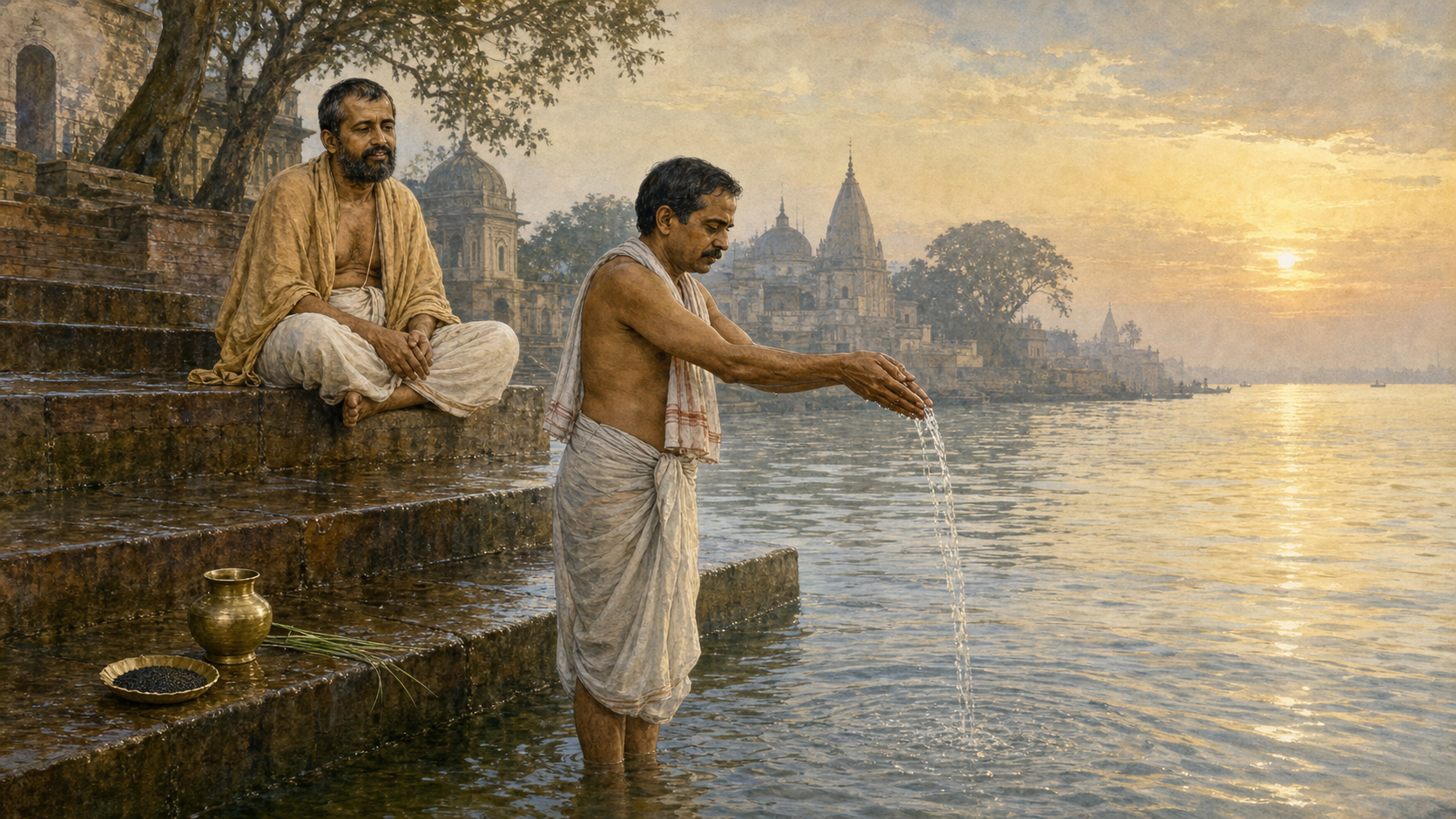
If you have missed a Shraddha observance, felt overwhelmed while remembering a parent, or wondered whether a ritual has meaning when your heart is elsewhere, Sri Ramakrishna’s encounter with tarpana can seem to offer an easy exemption. It does not. It offers a more demanding distinction: ritual form deserves fidelity, but the purpose of that form must continue into the way you live.
That distinction matters whether you are preparing to offer tarpana or simply trying to understand why an offering of water carries spiritual weight. The rite gives gratitude a visible form. Sri Ramakrishna’s experience shows what may happen when grief, devotion, and awareness become too full for the usual distinction between giver and recipient.
Tarpana makes gratitude a duty rather than a passing feeling
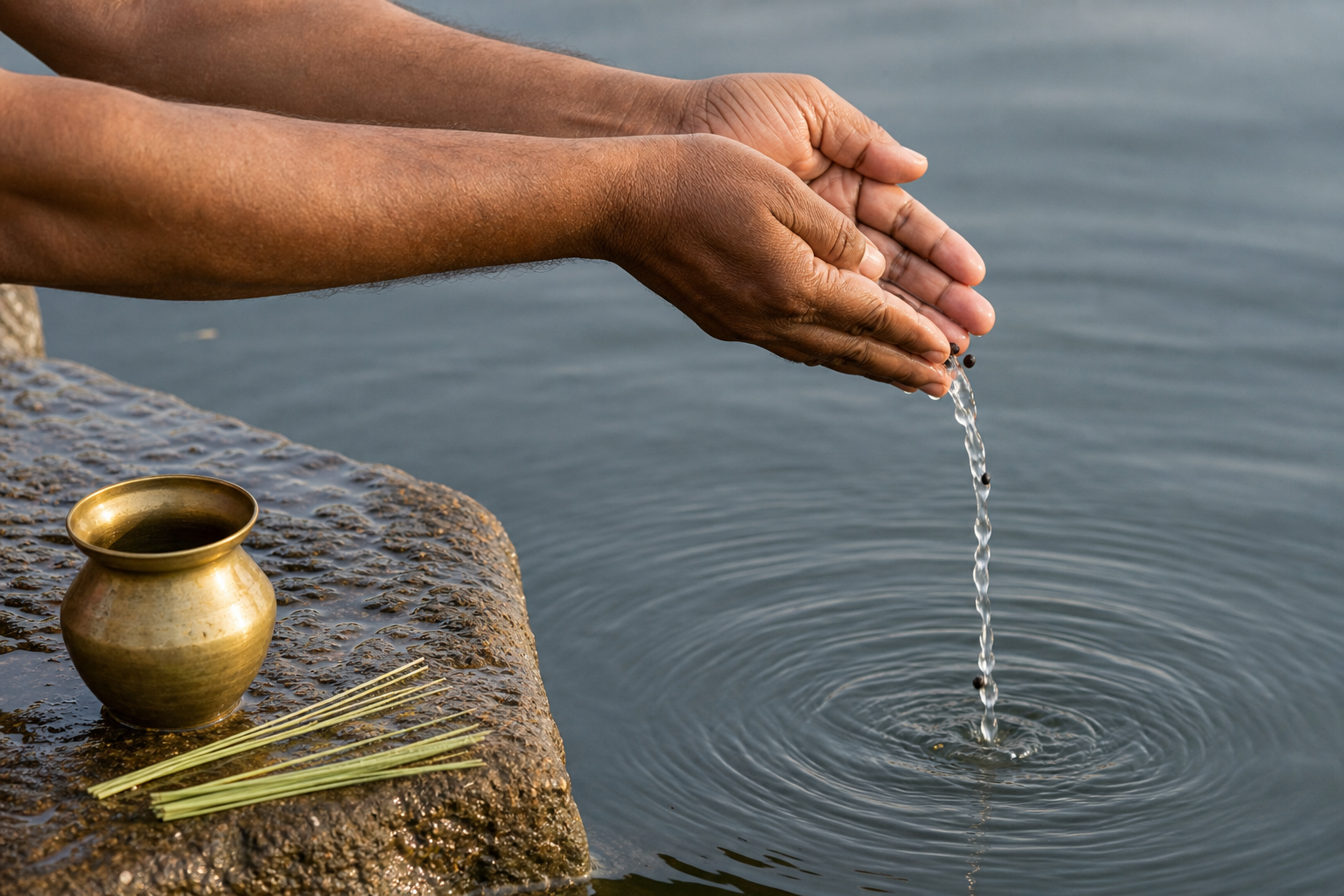
Tarpana, especially in connection with Shraddha and Amavasya, expresses gratitude, remembrance, and continuity with one’s ancestors. Water, food, prayer, and recollection become more than private sentiment when they are placed within an inherited discipline. You stop merely feeling thankful and deliberately acknowledge that your life did not begin with you.
The rite asks you to notice dependence. Your body, language, family memory, opportunities, burdens, and responsibilities all arrived through a chain of lives. That lineage need not have been flawless to deserve honest remembrance. Honouring ancestors does not require pretending that every inherited habit was wise. It means receiving what was worthy, correcting what was harmful, and refusing to waste what others sacrificed to preserve.
This is why inward feeling and outward form should not be set against each other. Feeling without discipline can fade as soon as the day becomes busy. Form without attention can become a task completed by the hands while the mind remains absent. Tarpana joins the two: the form summons attention, and attention gives the form its moral seriousness.
Before you perform the rite, ask yourself three plain questions. Whom am I remembering? What sacrifice, virtue, warning, or unfinished responsibility came to me through this person? What will I do differently because I remember? You do not need to insert these questions into the formal procedure. Use them to arrive at the procedure awake.
Sri Ramakrishna’s inability was not a rejection of ritual
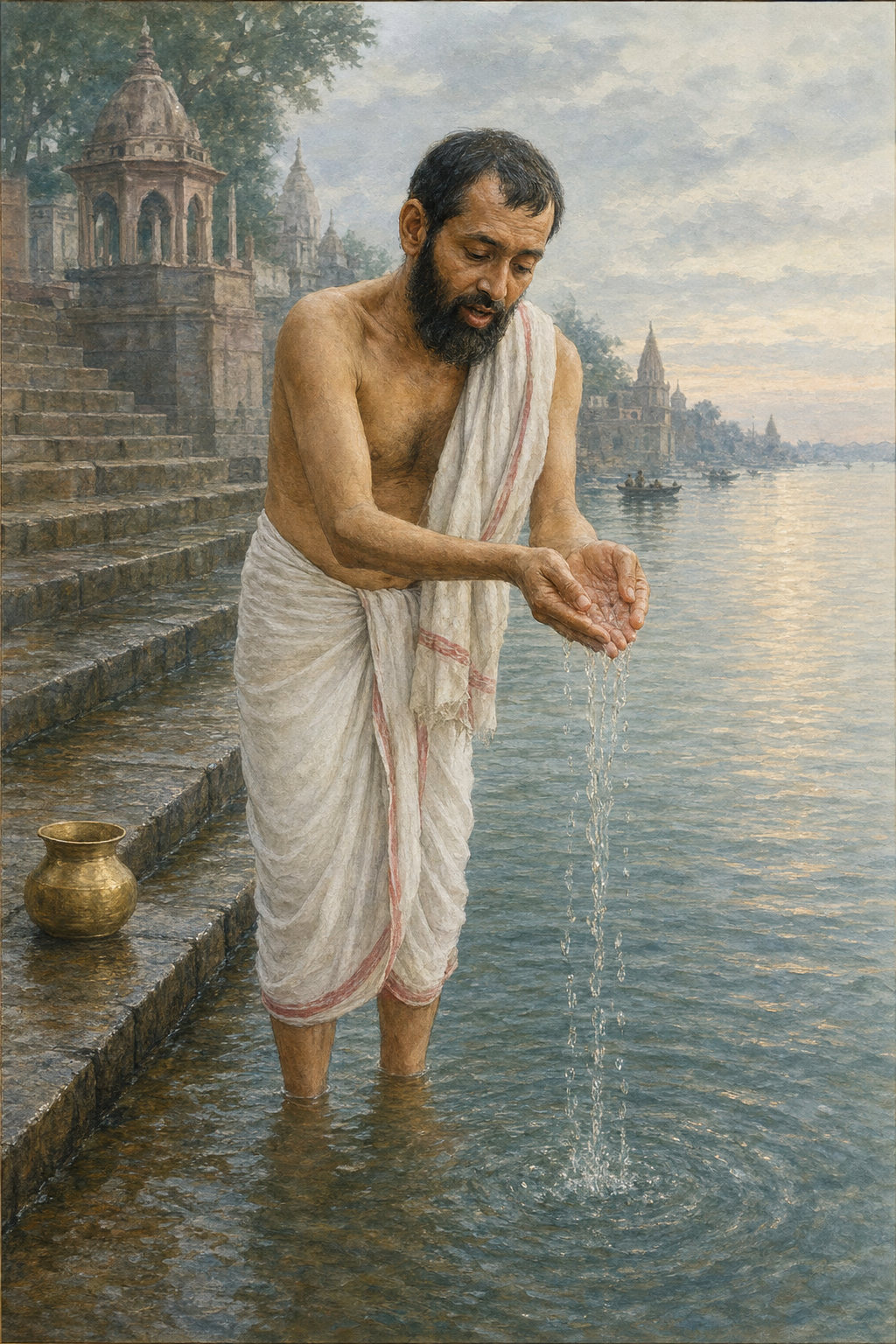
Traditions recount that when Sri Ramakrishna approached tarpana for his mother, he became intensely aware of the Divine Mother pervading existence. The distinction between his personal mother and the universal Mother appeared to dissolve, and he could not complete the conventional offering.
The word “could not” is crucial. He is not presented as arguing that tarpana was useless, scorning an ancestral obligation, or casually deciding that inward spirituality was superior to inherited practice. His inability arose within an overwhelming devotional experience. The intended recipient of the offering was no longer present to him as a separate, bounded individual. Personal love had opened into an awareness of the Mother in all beings.
The episode can therefore be read on several levels at once. On the human level, grief and tenderness exceeded the capacity of ordinary action. On the devotional level, love for his mother became inseparable from worship of the Divine Mother. On the non-dual level, the familiar structure of one person giving, another receiving, and an object passing between them ceased to feel adequate.
None of these readings requires us to dismiss the rite. The interruption has meaning precisely because tarpana already mattered. If the form had been regarded as empty, failing to perform it would carry no spiritual tension. The dilemma appears because reverence for the obligation and an extraordinary interior state met at the same moment.
This is better understood as karma-kanda being filled by bhakti and jnana, not defeated by them. Ritual action gives devotion a vessel; devotion keeps ritual from becoming mechanical; insight reveals the sacred reality toward which both are directed. These are not necessarily rival stages in which a supposedly advanced person earns permission to despise the earlier one.
Do not turn a saint’s exceptional state into a convenient exemption
The most tempting misreading is also the least useful: “If inner sincerity is what matters, I can omit the rite.” That conclusion reverses the lesson. Sri Ramakrishna was not distracted, indifferent, embarrassed by tradition, or unwilling to make time. The conventional act became impossible because the reality signified by it had flooded his awareness.
For most practitioners, ritual is one of the means by which such attention is cultivated. You should not claim the fruit in order to avoid the discipline that helps produce it. If your obstacle is unfamiliarity, learn. If it is inconvenience, make room. If it is family disagreement, ask a knowledgeable elder or priest how your tradition handles the situation. If grief overwhelms you, seek guidance on whether to pause, receive assistance, or observe an appropriate alternative. Name the obstacle honestly before deciding what it means spiritually.
A second misreading is that emotion itself cancels obligation. Strong feeling can disclose love, but it can also make action difficult. The presence of grief does not automatically prove mystical realization, just as completing every gesture does not automatically prove inward reverence. You do not need to classify your experience grandly. You need to respond truthfully and preserve the intention to honour.
A third mistake is to flatten the Dharmic traditions into one interchangeable teaching. Buddhism’s emphasis on cetana, Jainism’s stress on ahimsa and inner purification, and Sikhism’s disciplines of simran and seva can help us notice a shared concern with intention, self-transformation, remembrance, and service. They are not substitutes for the particular theology or procedure of Hindu Shraddha. Their resonance clarifies a principle without erasing real differences: outward religious action should shape consciousness and conduct.
How to honour both the ritual form and its living purpose
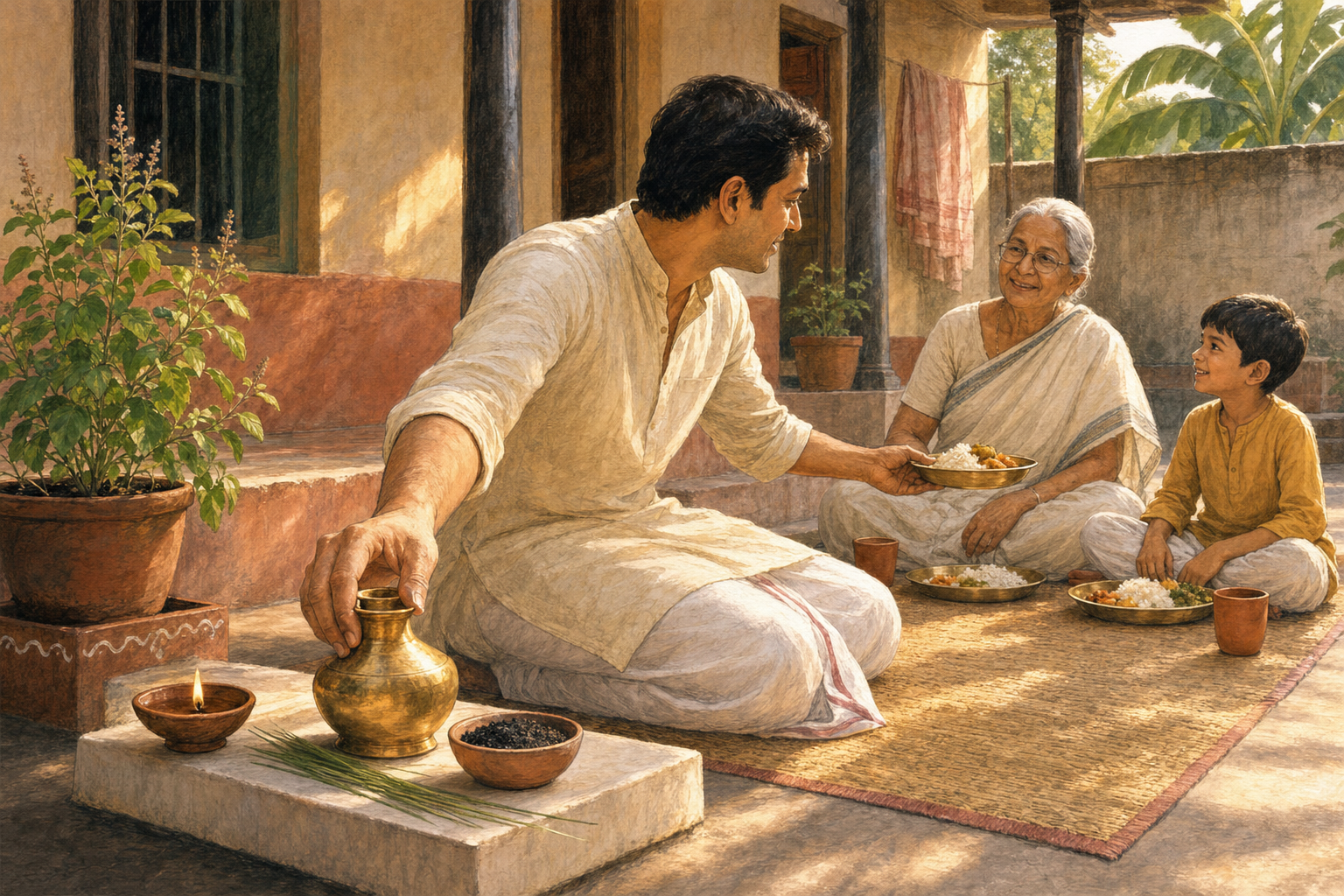
If you are responsible for an ancestral observance, begin with the practice that actually belongs to your family, region, or sampradaya. Procedures and ritual roles can differ, so a general reflection on spiritual meaning should not be treated as a manual. Ask a trusted elder or competent priest about the required form rather than assembling one from fragments.
- Confirm the observance before you improvise. Find out what your inherited practice requires, who normally performs it, and what preparation is expected. If circumstances make the usual form impossible, ask what recognised accommodation exists.
- Give your intention a clear sentence. Before beginning, say inwardly whom you are remembering and what gratitude you are carrying. A precise remembrance is less likely to dissolve into a vague performance.
- Perform the rite with undivided attention. Do not hurry merely to mark it complete. Let each offering remind you that your present life rests on gifts, sacrifices, and responsibilities received from others.
- Distinguish emotional difficulty from indifference. If grief interrupts you, do not treat the interruption as failure. Pause, acknowledge what is happening, and obtain guidance about completing the observance. If the real obstacle is avoidance, call it avoidance and correct it.
- Extend remembrance into service. Feeding someone in need, caring for elders, offering kindness, and fulfilling a neglected family responsibility can carry ancestral gratitude into daily life. Do not declare these actions technically equivalent to a prescribed rite without guidance; treat them as the ethical continuation of the offering.
- Choose one virtue to transmit. Identify something worthy in the person or lineage you remember, then practise it deliberately. Memory becomes spiritually fertile when another person’s generosity, courage, patience, or devotion gains a new life through your conduct.
This approach also helps when a formal observance truly cannot be performed. You can preserve remembrance through prayer, compassionate action, care for elders, and service while seeking tradition-specific guidance about the rite itself. Inability need not become neglect, and sincerity need not make unsupported claims about ritual equivalence.
The deeper measure comes after the water has been offered. If resentment remains unexamined, elders remain abandoned, inherited duties remain ignored, and generosity ends at the ritual space, the rite has not yet penetrated daily life. The point is not to earn perfection in one day. It is to let remembrance expose the next duty that is already yours.
Key takeaways
- Tarpana gives gratitude and ancestral remembrance a disciplined, visible form.
- Sri Ramakrishna is remembered as being unable to complete the offering, not as rejecting it or teaching others to abandon it.
- His experience can hold grief, devotion to the Divine Mother, and non-dual awareness together without reducing one to another.
- An extraordinary spiritual interruption should not become an ordinary excuse for neglecting inherited duties.
- Service, care for elders, feeding those in need, and the cultivation of virtue extend the spirit of tarpana into life, though they should not be declared formal substitutes without tradition-specific guidance.
Before your next ancestral observance, choose one person to remember clearly and one inherited responsibility you will carry more faithfully. Learn the form that belongs to your tradition, perform it as attentively as you can, and then make its gratitude visible in conduct. The offered water returns quickly to the earth; the obligation it represents should remain in your hands.
References
