
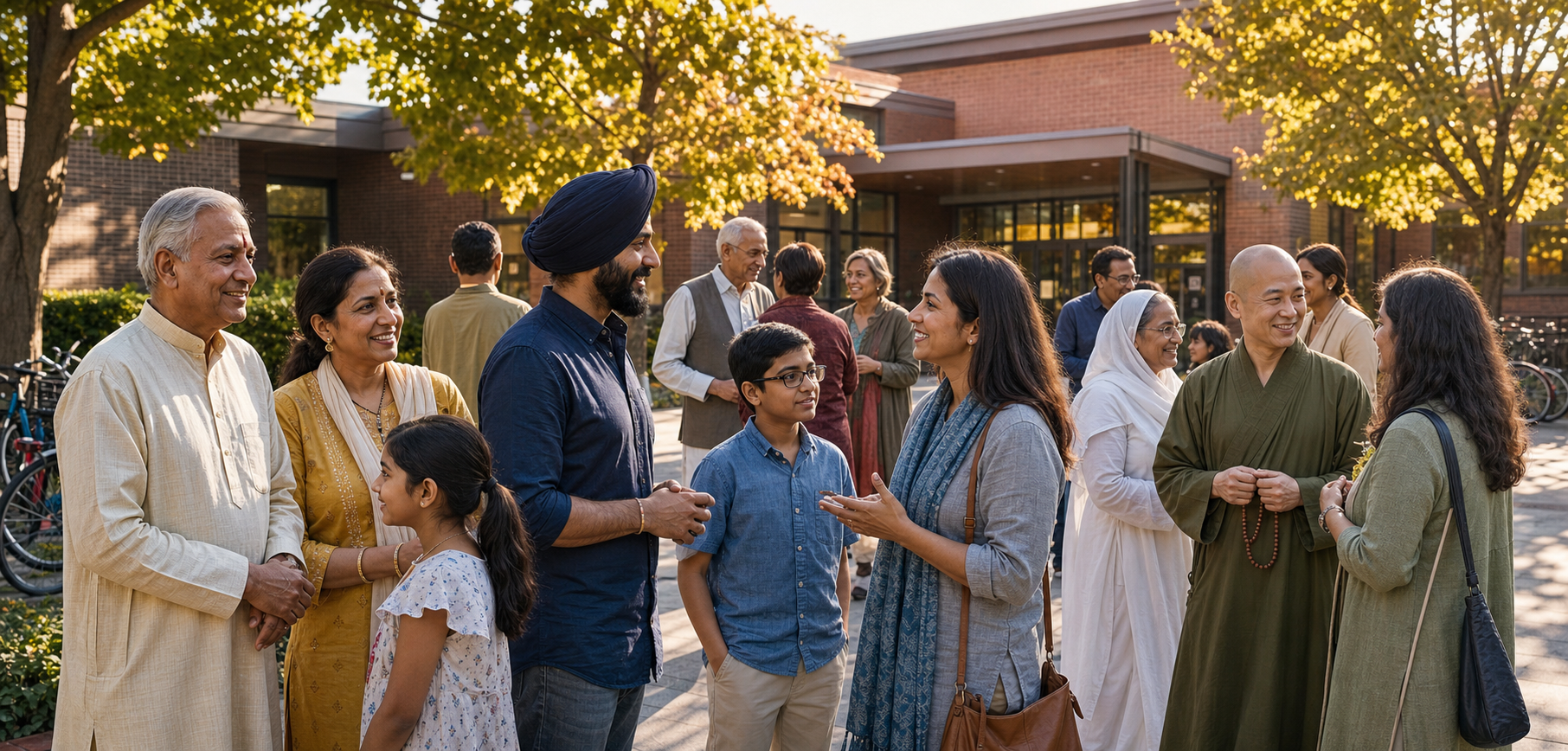
If you are trying to live your dharma openly in North America, you may feel pushed toward one of two unsatisfying choices. You can make your identity so generic that nobody objects to it, or make it so defensive that every encounter becomes a test of loyalty. Neither choice gives you the rootedness, confidence or relationships you need.
A better approach is to know your own tradition precisely, describe neighboring traditions fairly, and defend the civic dignity of all without pretending that all paths are identical. That approach works at the family table, in a classroom, at work, inside a community institution and when hostility becomes a safety concern.
Pluralism needs roots, not a blended identity
Religious pluralism does not require you to believe that every tradition makes the same claims. It requires equal civic dignity, freedom of conscience and enough intellectual honesty to let each community explain itself in its own terms. You can respect another path without borrowing its identity, rewriting its teachings or hiding your disagreements.
In this sense, Dharmic identity is a relationship among distinct traditions, not a fifth religion placed over them. Hindu, Buddhist, Jain and Sikh communities have their own scriptures, authorities, practices, histories and theological debates. They also meet around recognizable concerns: inner transformation, disciplined conduct, compassion, human dignity, inquiry and the possibility of more than one mode of spiritual realization.
This distinction matters in the diaspora. A racial or national label such as Indian or South Asian cannot explain what you worship, what vows you follow, what authority you recognize or how you understand liberation. Young people can consequently be treated as representatives of a vast population while receiving little vocabulary for their actual religious lives. In some American classrooms, that pressure is intensified when Hindu identity is compressed into a rigid account of caste that students do not recognize as a complete description of their families or practices.
You can prevent that confusion by making a three-part identity map. Write it for yourself first, and then invite older children to create their own:
- What is specifically mine: Name your tradition, sampradaya or lineage if applicable, the practices you actually observe, and the teachings that guide you.
- What is genuinely shared: Identify ethical or philosophical concerns that help you converse with other Dharmic communities. Do not claim a common doctrine where only a related question exists.
- What I honor without claiming: Name a teaching, scripture, observance or institution belonging to a neighboring tradition that you respect but do not present as your own.
Then reduce the map to one public sentence. A Hindu might say: I am Hindu, my practice is shaped by this tradition, and I work with Sikh, Buddhist and Jain neighbors where our ethical commitments and civic concerns meet. The sentence should be specific enough to resist erasure and open enough to make cooperation possible.
Use a simple test whenever a school, workplace or cultural organization invokes Dharmic identity: does each participating community retain the right to name itself? If the answer is no, the event is displaying diversity while practicing homogenization.
Turn inherited practice into knowledge you can explain
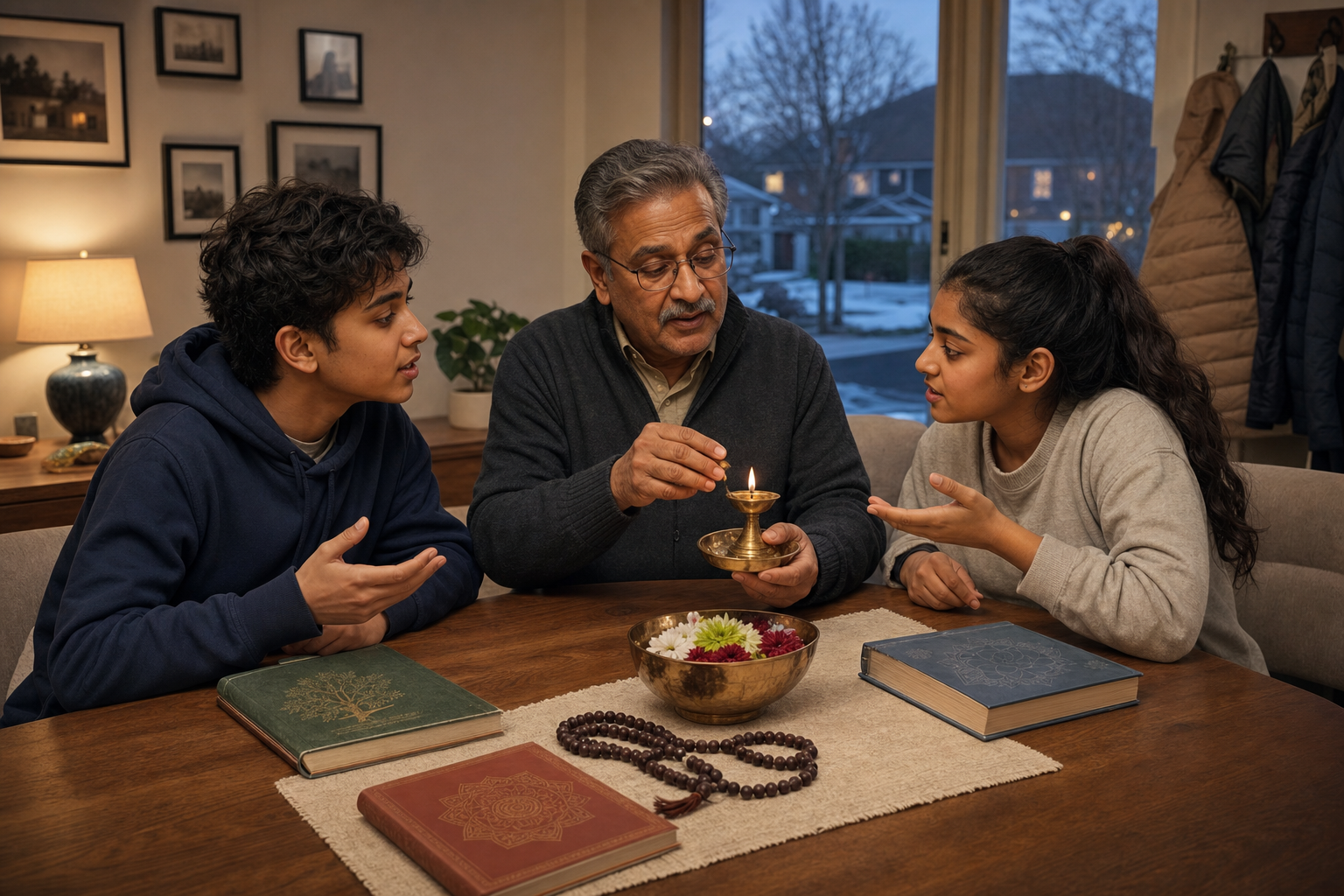
A ritual performed without comprehension can feel like a costume to a young person. Abandoning it is not the only alternative. Treat inherited practice as an invitation to study, question and assume responsibility.
For each observance your family considers important, work through four questions:
- What is the form? Describe what is done, by whom and in what setting. Separate the essential act from one household’s custom.
- What meaning does the family give it? Ask a parent, grandparent, teacher or knowledgeable practitioner. Record uncertainties instead of filling them with guesses.
- What discipline does it ask of you? Study, restraint, generosity, devotion and service are different obligations. Name the one the practice is meant to cultivate.
- What changes after the ceremony? If nothing is expected of your conduct, keep studying before treating the ritual as complete.
This method is especially useful for a rite such as yagnopavita sanskar. A Hindu considering that rite should not ask only how to perform it. The more searching questions concern the learning, discipline and moral accountability it signifies. That turns ritual from a badge of status into a commitment that can be examined and lived.
Guru Ravidas Ji offers a powerful example of why inquiry need not weaken devotion. Born into the Chamar community in northern India, he pursued devotion to the formless Brahman, confronted exclusionary practices and affirmed the dignity of every person. He is revered within the Bhakti tradition, while his verses are preserved in the Guru Granth Sahib. His life therefore illuminates both principled reform within a tradition and meaningful connection across communities.
That example also gives you a better way to handle caste discussions. Denial leaves a young person defenseless when the subject arises. Shame leaves somebody else free to define the whole tradition. A more capable response has four moves:
- Acknowledge exclusion honestly and affirm that inherited social rank does not determine a person’s spiritual worth.
- Refuse to let one social category become a complete definition of Hindu thought, practice or history.
- Ask for specificity: which period, region, community, text, institution or practice is being discussed?
- Bring internal voices of devotion, criticism and reform into the conversation. Guru Ravidas Ji is not an escape from the difficult question; he is part of the tradition’s own answer to it.
Parents can practice this at home before a school assignment makes the conversation urgent. Ask a teenager to give a ninety-second explanation covering four points: what I practice, what I am still learning, what injustice I reject, and which teaching gives me grounds to reject it. The goal is not a memorized defense. It is a composed answer that combines belonging with moral agency.
Build solidarity without erasing real differences
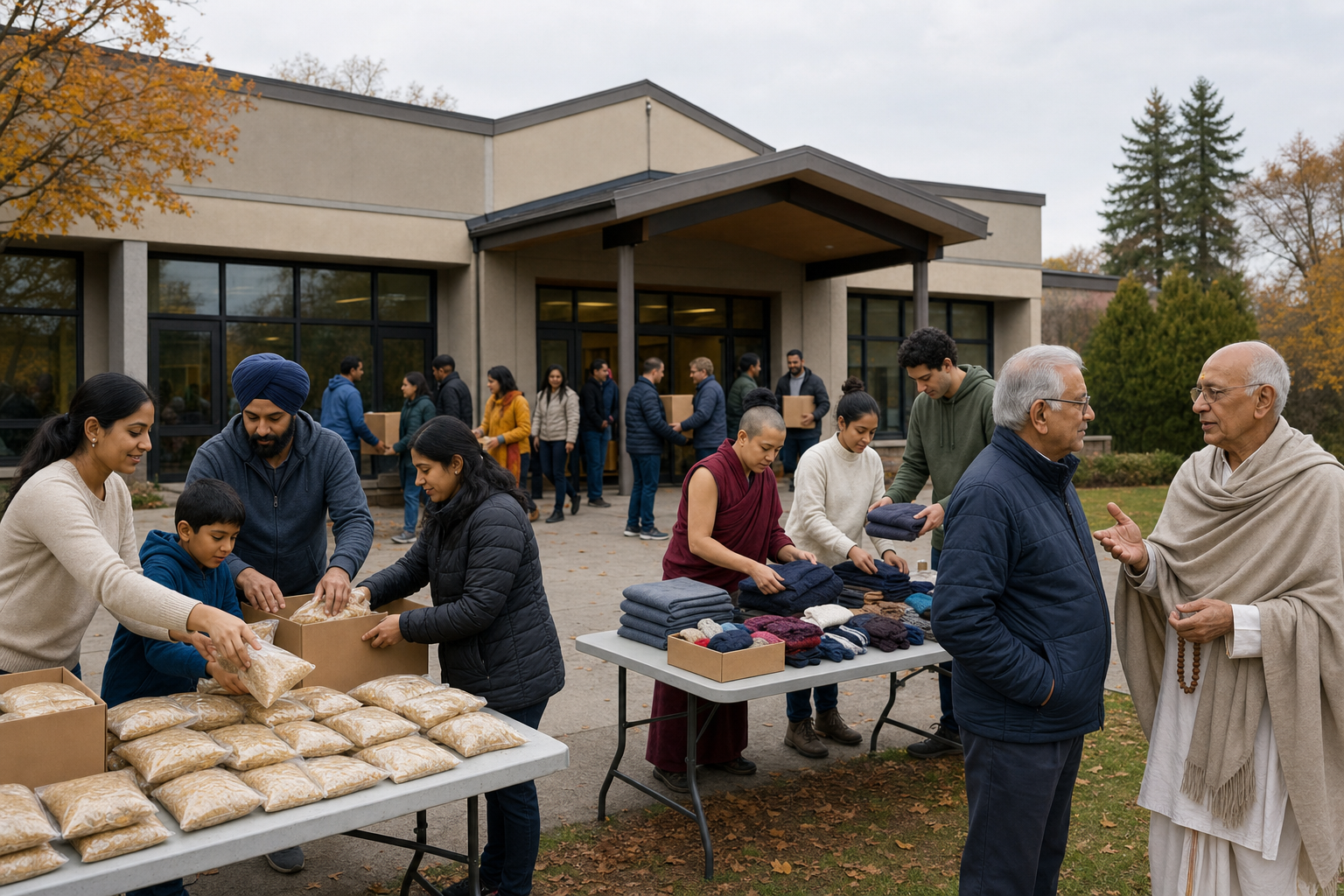
Dharmic unity becomes credible when it produces reciprocal protection and serious learning. It becomes empty when it asks everyone to dissolve into a vague spiritual culture. The practical rule is simple: cooperate at the level where you truly agree, and remain precise where you do not.
Guru Ravidas Ji provides a natural bridge because his legacy is present in Bhakti devotion and in verses preserved by the Sikh scripture. The bridge is meaningful precisely because the surrounding traditions remain identifiable. Connection does not require appropriation.
A well-designed inter-Dharmic gathering should therefore include four elements:
- Self-representation: Let a Hindu, Sikh, Buddhist or Jain participant explain a practice from within the relevant tradition rather than assigning an outsider to summarize it.
- A focused shared question: Choose one theme such as disciplined action, compassion, service or human dignity. Do not announce that every tradition supplies the same answer.
- Parallel practices where needed: Participants can witness one another’s observances without manufacturing a blended ceremony that belongs to nobody.
- A concrete civic outcome: End with a joint service effort, educational session, youth program or plan to support a community facing intimidation.
The same precision should govern public solidarity. If a mandir is threatened, name anti-Hindu hostility rather than hiding it inside a generic statement about intolerance. If a gurdwara, vihara or Jain center is targeted, name the affected community accurately. Then defend the wider principle: no one should be intimidated for worshipping, gathering or contributing to public life.
This gives you a reliable sequence for responding to prejudice: name the target, reject the conduct, defend the common civic right, and offer a specific form of support. It avoids two recurring failures. One is selective concern, in which a community notices hatred only when its own members are affected. The other is imprecision, in which solidarity becomes so general that the injured community disappears from the statement.
You also need short language for ordinary encounters. Long lectures usually sound evasive when the question itself is simple. Adapt these responses to your situation:
- When somebody says all Dharmic religions are the same: They are related through long civilizational conversations, but they remain distinct traditions with different authorities and teachings.
- When Indian is used as your complete identity: Indian describes a national or cultural relationship; Hindu, Sikh, Buddhist or Jain identifies a religious tradition. One label does not replace the other.
- When Hinduism is reduced to caste: Caste and exclusion deserve honest examination, but they do not exhaust Hindu philosophy or practice. Which period, text or community do you mean?
- When hostility is disguised as policy debate: Immigration policy can be debated. Collective blame, racial intimidation and threats against people of Indian heritage are not policy arguments.
Pluralism also means refusing to outsource your conscience to a political camp. You can advocate firmly for Hindu dignity and still oppose white supremacy. You can defend your own community without minimizing hatred directed at another. A coalition built on reciprocal rights is sturdier than one built on temporary partisan convenience.
Pair an open hand with civic and physical preparedness

A pluralist disposition does not require naivety about organized hatred. Canadian events show how quickly a seemingly social identity can acquire violent political content. Second Sons Canada has presented itself through fitness and heritage while promoting "Remigration Now". In a June 2024 podcast, its president described forced removal using explicit gun violence. Steven Rai of the Institute for Strategic Dialogue called the group’s use of remigration a "euphemism for ethnic cleansing."
The racial target is not theoretical. On January 17, 2026, the group displayed an Orillia, Ontario, overpass sign reading "Indian Trucks Kill Canucks". Such collective blame reaches Hindu, Sikh, Buddhist and Jain people of Indian heritage even when the attacker knows nothing about their actual beliefs.
The network is also wider than one Canadian organization. The Global Project Against Hate and Extremism identified at least 187 related active clubs across 27 countries in the Americas and Europe, with at least half targeting teenagers from 15 to 18. That age focus changes the work a community must do. Security at the front door matters, but so do belonging, mentoring and digital literacy before a young person reaches an extremist meeting.
Create an incident plan before you need it
A mandir or community center should not improvise after a threat arrives. Establish a short written procedure that volunteers can actually follow:
- Name two responsible contacts. One receives incident reports; the other communicates with venue leadership, school officials or law enforcement. Publish a dedicated contact route instead of relying on rumors in group chats.
- Preserve the original evidence. Record the date, time, location, account name, link, exact wording and witnesses. Keep screenshots, but do not circulate threatening material more widely than necessary.
- Separate offense from danger. An insulting remark, repeated targeted harassment, vandalism and a specific threat of violence require different responses. If a threat identifies a weapon, person, place or time, or appears immediate, contact emergency services rather than attempting to investigate or confront the sender.
- Request a venue assessment. Coordinate with local authorities on entrances, exits, lighting, locks, cameras, gathering procedures and emergency contacts. The useful plan is the one matched to the actual building and local reporting system.
- Keep one incident log. Record reports, actions, official reference numbers and follow-up dates. A pattern can be missed when each volunteer holds only one fragment.
- Communicate verified facts. Tell the community what it needs to act safely, protect personal information and avoid naming minors or unconfirmed suspects.
Do not turn a suspected extremist encounter into a public confrontation for social media. The immediate priorities are distance, documentation, safety and lawful reporting. Public advocacy can follow when the facts and the affected people’s wishes are clear.
Interrupt the recruitment pipeline with real belonging
Extremist recruitment often begins with an offer that does not look ideological: fitness, fraternity, heritage and a place to belong. Closed online circles and social pressure can then normalize racist narratives. Telling teenagers simply to stay away leaves the original need for purpose unanswered.
A credible youth program should combine four things: a recurring activity that creates friendship, an adult mentor who knows participants by name, meaningful service, and guided discussion of online claims. Digital literacy should be practical. Take one inflammatory post, trace where its image or statistic came from, identify what was omitted, and ask what action the account is trying to provoke.
Watch for patterns rather than treating one offensive joke as a diagnosis. Repeated dehumanizing language, fascination with forced ethnic removal, demands for secrecy, celebration of political violence and withdrawal into a closed ideological circle warrant a calm conversation. Ask what need the group is meeting and keep a non-shaming route back into ordinary relationships. If there is a specific threat, move from mentoring to the incident plan immediately.
The governing principle is security without isolation. Work with law enforcement where safety requires it, and with educators, civil-society groups and other faith communities where prevention requires trust. A fortified building cannot substitute for strong relationships, just as warm relationships cannot substitute for a plan when violence is threatened.
Key takeaways
- Use Dharmic as a framework for relationship and cooperation, not as a replacement for Hindu, Sikh, Buddhist or Jain identity.
- Build confidence through understood practice: name the form, meaning, discipline and expected change in conduct.
- Answer caste questions with honesty and specificity rather than denial, shame or the reduction of an entire tradition to one issue.
- Design inter-community work around self-representation, a focused shared concern and a concrete civic outcome.
- Name anti-Hindu, anti-Sikh, anti-Buddhist or anti-Jain hostility accurately while defending equal safety and freedom for everyone.
- Prepare institutions for both physical threats and youth radicalization through documentation, lawful reporting, mentoring and digital literacy.
Start this week with three small acts: write your one-sentence identity statement, ask someone from another Dharmic tradition one sincere question without trying to merge the answers, and verify who receives a threat report at your local institution. Repeated across families and communities, those habits make identity more knowledgeable, pluralism more reciprocal and public life more secure.
References
- CoHNA – Hindus Must Confront Rising White Supremacy in Canada
- CoHNA – Seeking, Challenging and Finding Guru Ravidas
