
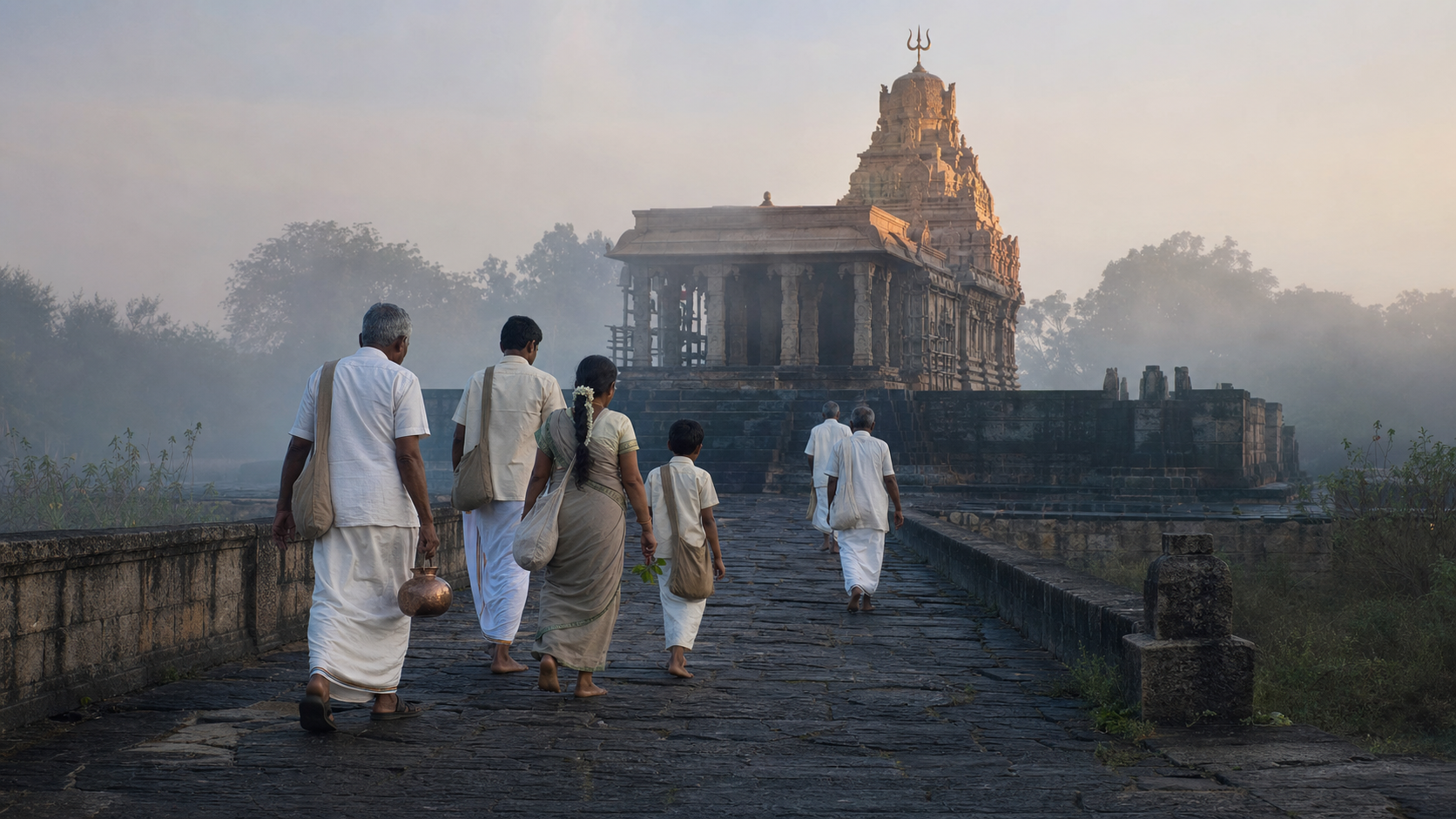
You may know which Shiva temple you want to visit and still be unsure how to make the journey a yatra rather than a rushed stop. Which day matters? Should you undertake a named pooja? How much of a sacred circuit should you attempt? What should you carry home besides prasada?
Start with purpose. In a Shaiva pilgrimage, the kshetra, route, calendar, physical effort, ritual, and conduct belong to one discipline. Once you let the temple tradition set the terms, the practical decisions become clearer and worship becomes less transactional.
Choose the form of yatra from your sankalpa
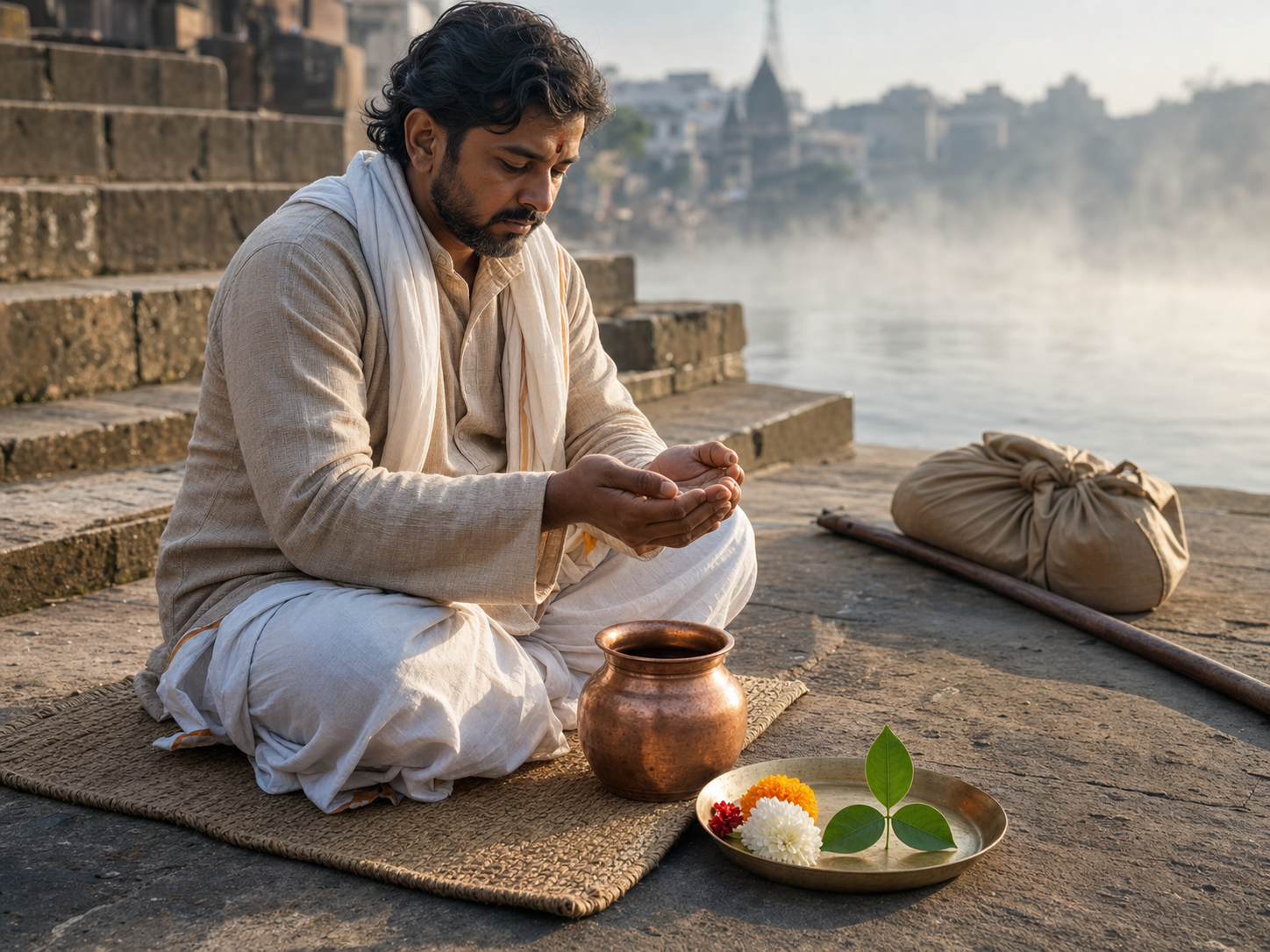
Your sankalpa is the intention with which you undertake the pilgrimage. It need not be elaborate. Before choosing dates or transport, write it in one sentence: you may be seeking atonement, steadiness, worship through a sacred circuit, or the disciplined completion of a particular rite.
That sentence should determine the form of your yatra. A demanding Himalayan ascent, a circuit linking several manifestations of Shiva, and a temple visit centred on one prescribed pooja are not interchangeable experiences.
Tungnath belongs to the Panch Kedar tradition. It is the kshetra where Shiva’s arms, or bahu, are worshipped, while Kedarnath, Rudranath, Madhyamaheshwar, and Kalpeshwar complete the sacred network. The circuit is rooted in the account of the Pandavas seeking atonement after the Mahabharata war. At Tungnath, therefore, the ascent, the mountain, and the Panch Kedar connection are not incidental scenery around darshan. They give the pilgrimage its penitential form.
Draksharamam offers another pattern. Sri Bhimeshwara Swamy is one of the Pancharama Shiva Kshetras, traditionally visited with Amararama at Amaravathi, Somarama at Bhimavaram, Ksheerarama at Palakollu, and Kumararama at Samarlakota. Draksharamam also houses Manikyamba, revered as a Shakti Peetha. A visit can therefore be approached as a Pancharama pilgrimage, a Shaiva-Shakta encounter, or a focused visit to Bhimeshwara. Decide which of those intentions governs your itinerary before trying to fit every possibility into one day.
Sri Kalahasti represents a more focused ritual journey. Devotees commonly undertake Rahu Ketu Pooja there in response to perceived Rahu, Ketu, Kalasarpa, Naga, or related doshas, especially when confronting persistent obstacles, marriage or family concerns, career difficulties, or emotional unrest. If this is your purpose, the prescribed pooja and its local timing should take priority over sightseeing or an overfilled temple circuit.
| Pilgrimage form | Example | What it asks you to prioritise |
|---|---|---|
| Sacred circuit | Panch Kedar or Pancharama | The relationship among the kshetras, realistic travel time, and continuity of intention |
| Single kshetra with layered traditions | Bhimeshwara and Manikyamba at Draksharamam | Attention to both Shaiva and Shakta worship without treating subsidiary shrines as hurried additions |
| Named remedial rite | Rahu Ketu Pooja at Sri Kalahasti | The temple’s session, official procedure, ticketing, and locally calculated ritual time |
| Physically demanding mountain yatra | Tungnath | Season, access, physical capacity, weather, and enough time to walk without turning the route into a race |
Resist the urge to stack every possible benefit into the same sankalpa. A precise intention gives you a standard for deciding what belongs in the journey and what can wait for another pilgrimage.
Read the route and architecture as ritual instructions
A kshetra teaches partly through the way you must approach it. At Tungnath, the approach usually begins at Chopta and follows a stone path through rhododendron forest, alpine meadow, and open ridgeline. The steady ascent slows the body before darshan. Chandrashila may be nearby, but treating the temple as merely a waypoint to a summit reverses the order of attention. If your purpose is yatra, give the temple enough time that the trek does not consume the worship.
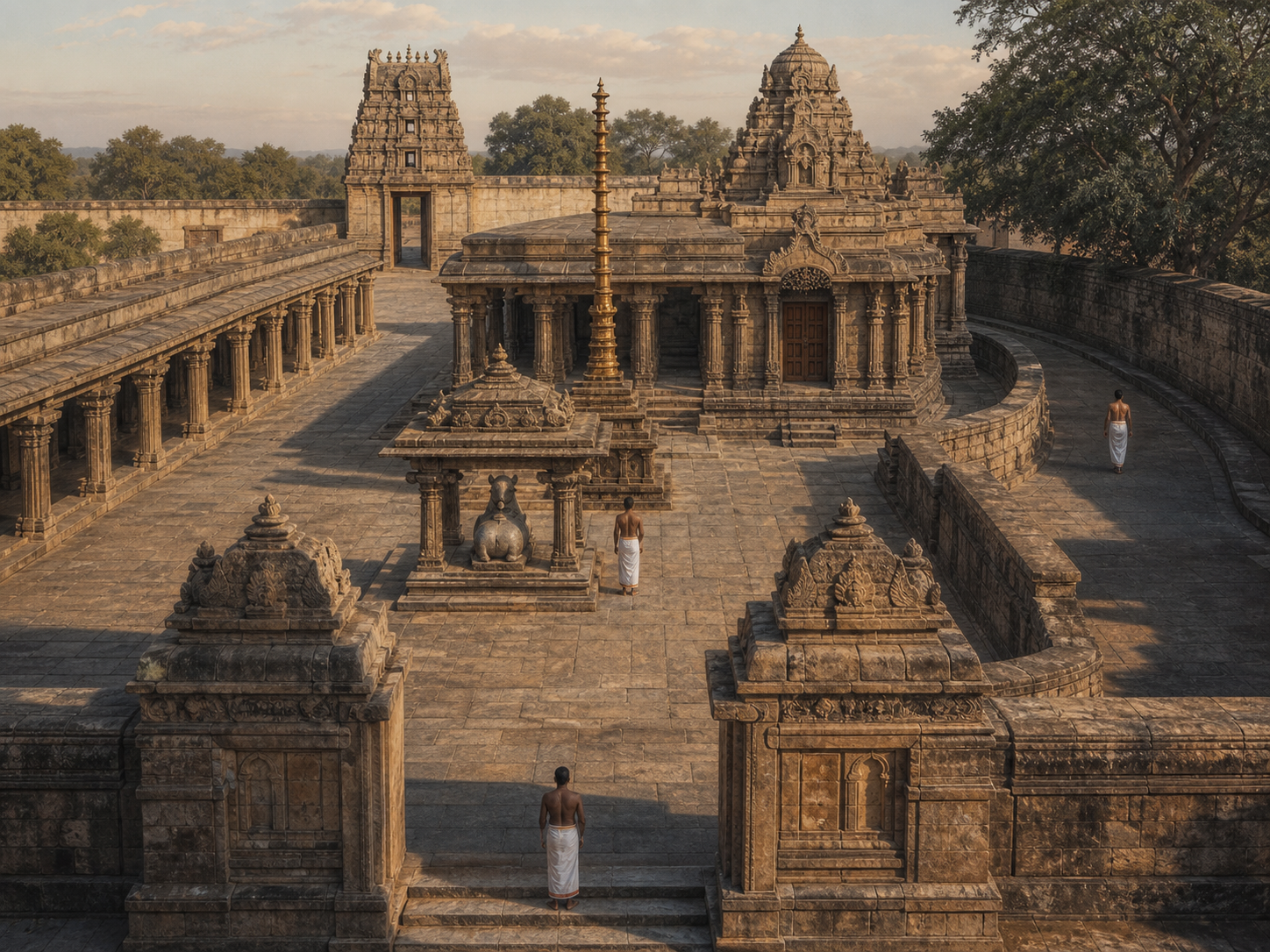
At Draksharamam, stone architecture performs a similar work without a mountain ascent. The Shiva Linga is traditionally described as rising through two sanctum levels, allowing worship from more than one vertical plane. The aligned Nandi, concentric prakaras, subsidiary shrines, and granite construction organise how the pilgrim approaches the deity. Major construction phases are associated with the Eastern Chalukyas, particularly King Bhima I in the 10th century CE, while Telugu and Sanskrit inscriptions preserve evidence of a long ritual and cultural life.
These details are not museum trivia. They tell you to notice axes, thresholds, enclosure corridors, companion deities, and the sequence in which worshippers move. The temple form disciplines attention before words or offerings do.
When entering a Shaiva temple whose customs you do not know, use this simple approach:
- Pause without blocking the entrance or queue. Notice the sanctum axis and Nandi where present.
- Identify the presiding deity and important companion shrines through temple signs or local guidance. At Draksharamam, Manikyamba is integral to the kshetra’s identity, not an optional afterthought.
- Watch how the local queue and ritual flow operate before stepping forward. A pan-Indian checklist should never override the temple’s own Agamic and customary discipline.
- Ask before presenting an offering, entering a restricted space, or taking a photograph. Permission in one temple does not establish permission in another.
- Move aside after darshan so that the next pilgrim can approach without pressure. Reverence includes protecting another person’s opportunity to worship.
This attentiveness also prevents a common mistake: measuring a temple only by scale, antiquity, altitude, or fame. Those distinctions may draw you there, but the living relationship among deity, place, ritual custodians, and worshippers is what makes it a kshetra.
Set your date by season, tithi, and local time
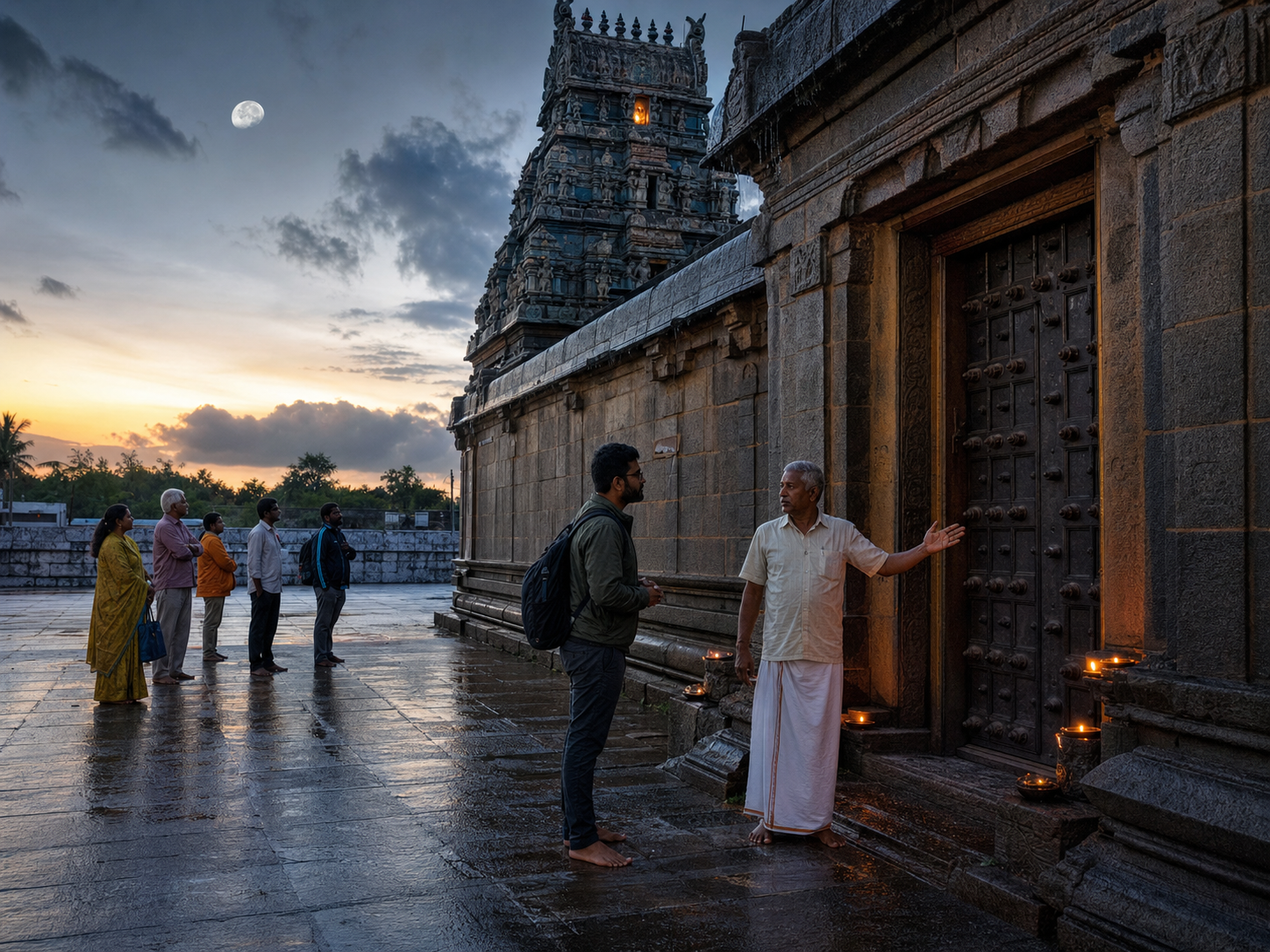
A pilgrimage date is not merely a transport decision. Yet there is no single rule for every Shaiva temple. Seasonal access controls one journey, a festival calendar shapes another, and a local Panchang may determine the session for a specialised pooja.
Tungnath generally remains open from late spring into autumn. During winter, worship of the presiding deity continues at Mukunath in Makkumath. That transfer matters: the continuity of worship does not depend on the high-altitude building remaining accessible throughout the year. Verify the current opening and local access conditions before travelling rather than relying on a generic map listing or an old itinerary.
At roughly 3,680 metres, Tungnath is widely described as the world’s highest Shiva temple. A route described as moderate in length can still involve sustained ascent and high-altitude exertion. Do not turn illness, poor conditions, or a local closure into a test of bhakti. If you have a health condition that may be affected by altitude or exertion, seek appropriate medical guidance before the journey and follow current local safety instructions.
Draksharamam’s ritual calendar is animated by Maha Shivaratri, Karthika Masam, and Pradosham. Early morning and evening darshan often attract more worshippers, while temple hours and ritual schedules can change with the season and observance. Choose a major festival when participation in the temple’s public liturgical life is central to your sankalpa. If your priority is unhurried architectural attention or a quieter family visit, do not assume the largest festival crowd will serve it best.
Sri Kalahasti conducts Rahu Ketu Pooja on all days, but Amavasya, Purnima, eclipse days, Tuesdays, Saturdays, and Sundays commonly attract heightened interest. The most important timing distinction is Rahu Kalam. Although Rahu Kalam is usually avoided for many new undertakings, it is deliberately sought for this pooja.
Rahu Kalam is not one universal clock time. It changes with the weekday and location because it is calculated from local sunrise by dividing the daytime into segments. Do not copy the time from a calendar set for your home city if you are worshipping elsewhere. Use a Panchang appropriate to Srikalahasti and confirm the actual temple sessions. Multiple sessions are generally offered, but the day’s onsite schedule governs the rite.
A workable planning sequence is:
- Choose the kshetra and write your primary sankalpa.
- Check seasonal access before booking transport, especially for a Himalayan temple.
- Identify whether your rite depends on a tithi, festival, weekday, or locally calculated period.
- Confirm the current opening time, pooja session, ticket category, and ritual flow through a reliable local channel or at the temple.
- Arrive early on Amavasya, Purnima, preferred weekdays, festivals, and eclipse days. A spiritually significant date also means greater demand on shared space.
- Leave a buffer between arrival and the main rite. A delayed journey should not force you to rush the sankalpa, argue in a queue, or abandon the temple’s procedure.
An ordinary day is not spiritually empty merely because a celebrated tithi attracts more people. If the temple conducts the rite daily, a date on which you can arrive composed, follow the procedure, and remain attentive may serve your pilgrimage better than an auspicious date approached in exhaustion and haste.
Carry the ritual into conduct after darshan
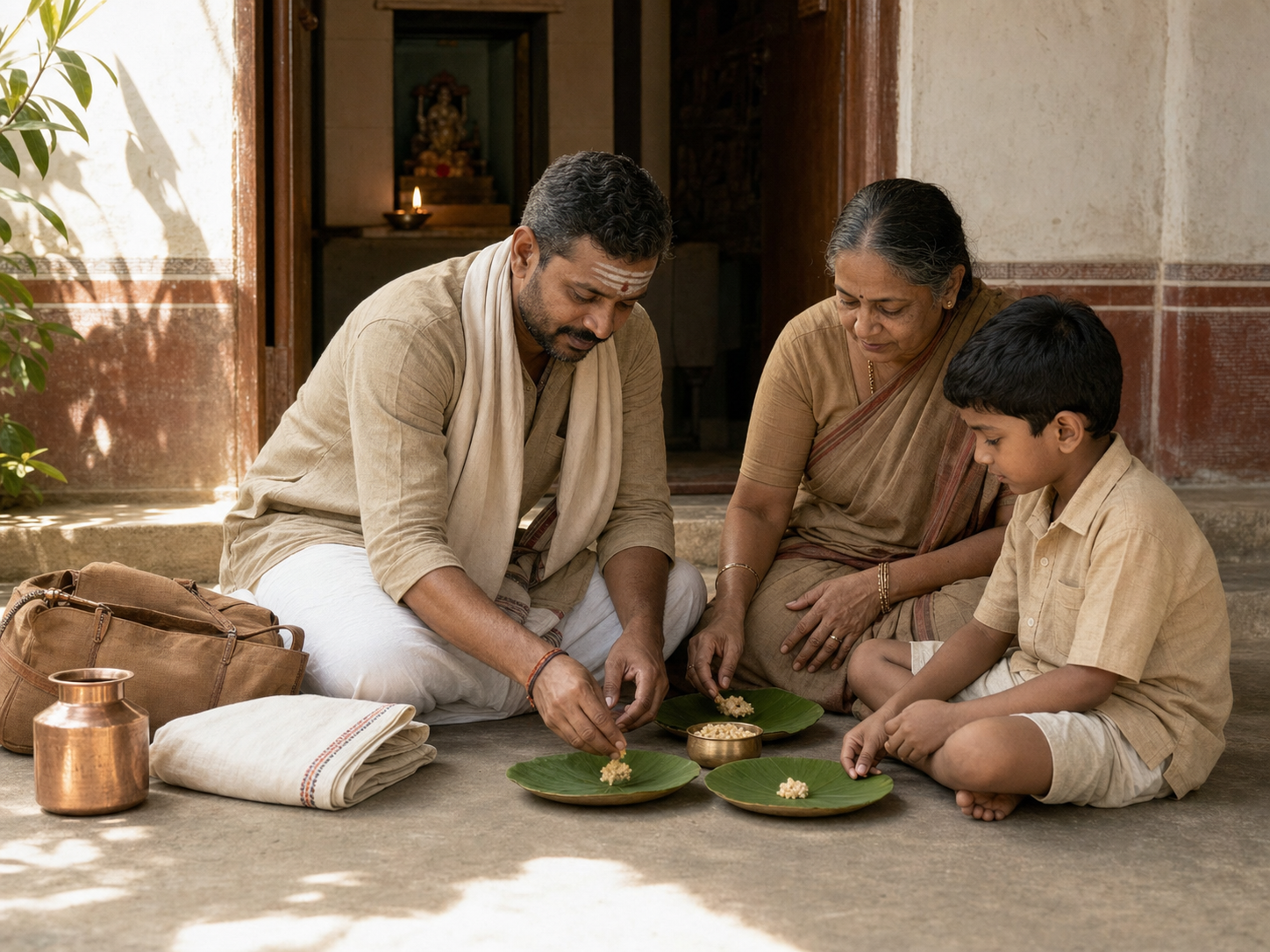
Ritual has a grammar; it is not a vending machine. Sankalpa gives the act direction, the temple procedure gives it form, and your subsequent conduct gives it credibility. Removing the last part turns pilgrimage into a request for results without a willingness to change.
Before the rite, wear modest, temple-appropriate clothing and learn the local rules. For Rahu Ketu Pooja at Sri Kalahasti, purchase the official ticket and kit through the temple counters, then follow the archaka’s guidance. Confirm what the selected ticket includes rather than relying on assumptions formed at another temple.
During worship, keep your sankalpa clear enough that anxiety does not become a demand for certainty. Follow the archaka, or temple priest, through the prescribed sequence. Do not improvise an abhishekam, offering, mantra, or movement inside the sanctum simply because it is familiar from home. Local authority protects both ritual coherence and the other pilgrims sharing the space.
Afterwards, avoid judging the rite solely by whether you felt an immediate emotional shift. Some devotees describe calm or release after Rahu Ketu Pooja, but such an experience is personal, not a guaranteed measure of ritual success. Nor can a pooja establish that a particular dosha caused a difficulty or promise a specific marriage, career, family, or financial outcome.
The disciplined response is to join devotion to right action. Depending on your tradition and the guidance of elders, that may include vrata, japa, dana, scriptural recitation, service, or the correction of conduct connected to your sankalpa. A spiritual remedy should support responsible effort. It should not replace medical care, mental-health support, legal advice, financial judgment, or necessary conversations with the people affected by your decisions.
The same principle governs your treatment of the temple environment. At Tungnath, the mountain is part of the sacred geography, not a disposable backdrop. Carry out what you carry in, limit avoidable waste, and do not leave offerings or packaging on the route. At a busy stone temple such as Draksharamam, restraint takes a different form: keep passages clear, lower your voice, respect queues, and do not monopolise a place intended for shared worship.
A confident Shaiva identity also has room for courtesy. Himalayan sacred spaces and the ethical disciplines of pilgrimage resonate beyond one sampradaya and are honoured by people across the Dharmic family. Respect for Buddhist, Jain, Sikh, Shakta, Vaishnava, or other fellow pilgrims need not flatten distinct teachings. It demonstrates that conviction and hospitality can occupy the same sacred space.
Key takeaways
- Write one primary sankalpa before choosing dates. It should decide whether you need a circuit, a single kshetra, a mountain yatra, or a named pooja.
- Treat the route and architecture as part of the ritual. The ascent to Tungnath and the vertically organised sanctum at Draksharamam ask for different forms of attention.
- Verify seasonal access and the temple’s current schedule locally. Old opening times and generic travel itineraries are not ritual authorities.
- For Rahu Ketu Pooja at Sri Kalahasti, calculate Rahu Kalam for the temple’s location and confirm the available session; do not reuse a timing calculated for another city.
- Use official counters, observe modest dress and quiet conduct, and follow the local archaka rather than importing a procedure from another temple.
- Measure the pilgrimage by the discipline it produces afterwards, not by a promised external result or a momentary feeling.
Your first act of pilgrimage can happen before you buy a ticket. Write the purpose of the yatra in one sentence, then verify three things: access, the actual ritual session, and the local participation rules. Once those are settled, leave enough room in the itinerary to approach Shiva without racing the clock.
References
- DharmaRenaissance Blog – Tungnath, World’s Highest Shiva Temple: Awe, Panch Kedar Legend, and Himalayan Serenity
- DharmaRenaissance Blog – Draksharamam Bhimeshwara Temple: Pancharama grandeur, Shakti Peetha grace in Andhra Pradesh
- DharmaRenaissance Blog – Unlock Blessings: Best Days and Auspicious Timings for Rahu Ketu Pooja at Sri Kalahasti Temple
