
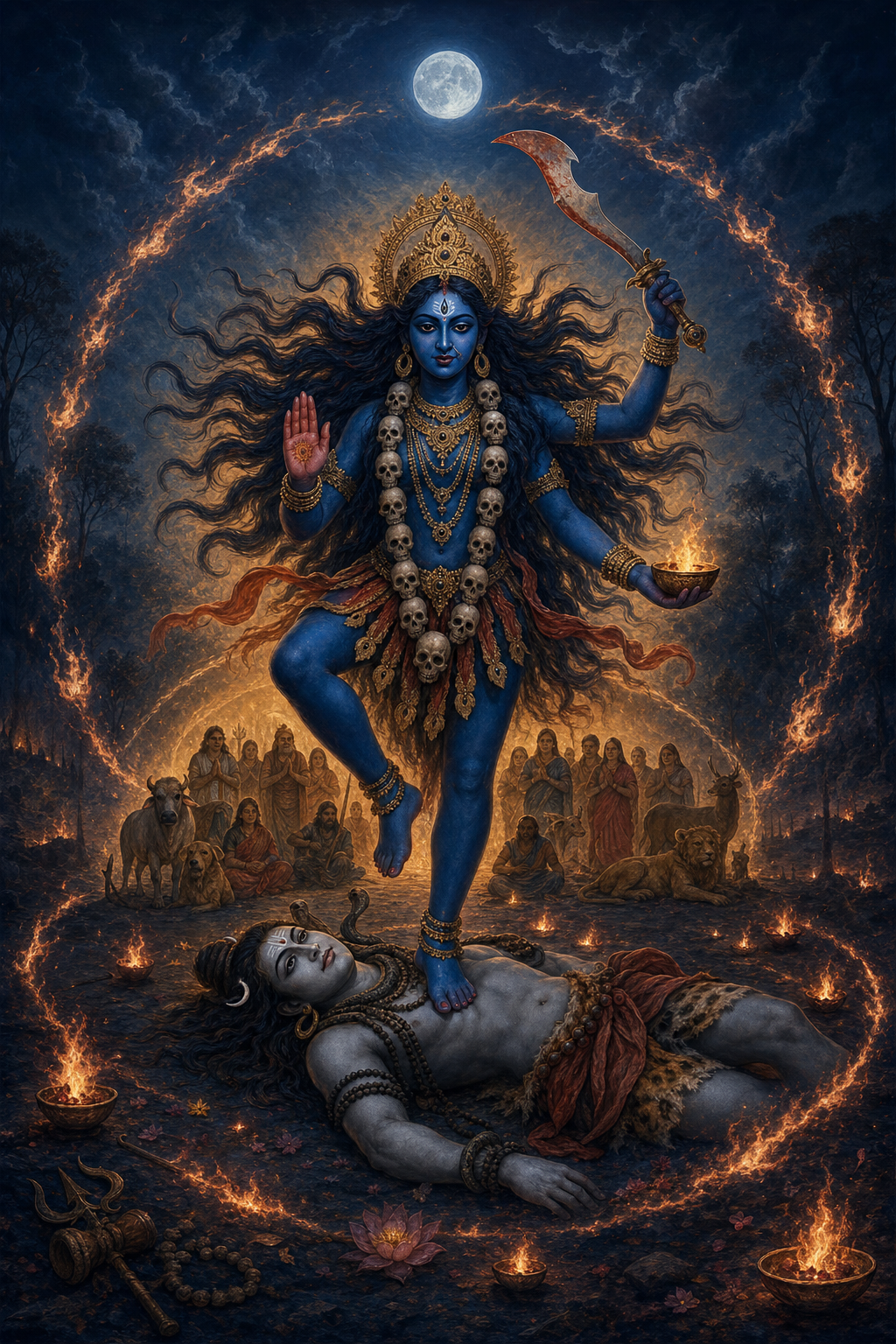
When you stand before an image of Kali or Durga, the serpent, blade, skulls, cremation ground and supine body can look like a catalogue of threats. Read that way, the imagery becomes either frightening or merely exotic. Its more demanding purpose is to show you what awakened power must cut, what it must contain, what supports it and whom it must protect.
You don’t need to pretend that every symbol has one fixed meaning. You do need a disciplined way to read the relationships within the image. Once you see the balance between movement and stillness, ferocity and refuge, dissolution and compassion, the icon becomes a practical lesson in governing your own energy.
Start with relationships, not isolated objects
A Tantric image works best as a visual grammar rather than a dictionary. A dictionary approach asks, “What does the serpent mean?” Visual grammar asks, “Who holds the serpent, what condition is it in, and what other gesture balances it?” The second approach is less likely to turn a complex murti into a collection of disconnected labels.
Use this sequence when you encounter Shakti iconography:
- Locate movement and stillness. Notice which figure acts, dances or raises a weapon, and which figure provides an unmoving ground.
- Distinguish cutting from containing. A blade ends something; a noose or grasp restrains something. Those are different spiritual operations.
- Look for the balancing gesture. Fierce imagery placed beside abhaya, the fear-dispelling gesture, combines transformation with refuge.
- Identify what supports the action. A body beneath a deity may represent an ontological ground rather than a defeated enemy.
- Ask what changes in your conduct. A plausible interpretation should lead toward clarity, restraint, courage or protection. If it merely flatters aggression, it has probably missed the image’s ethical structure.
This method avoids two common errors. The first is crude literalism: skulls become a celebration of death, the blade becomes violence, and Kali’s stance becomes a power contest. The second is unrestricted free association, in which a symbol means whatever the viewer wants. Tantric and Agamic schools can differ in emphasis, but the surrounding figures, gestures and ritual context still constrain a responsible reading.
Pay special attention to what is not destroyed. Durga holds the serpent rather than erasing it. Kali stands upon the still ground of Mahakala rather than existing independently of him. These relationships tell you that Tantra is often concerned with integration and transmutation, not the rejection of embodied energy.
Kali and Mahakala show motion resting in awareness
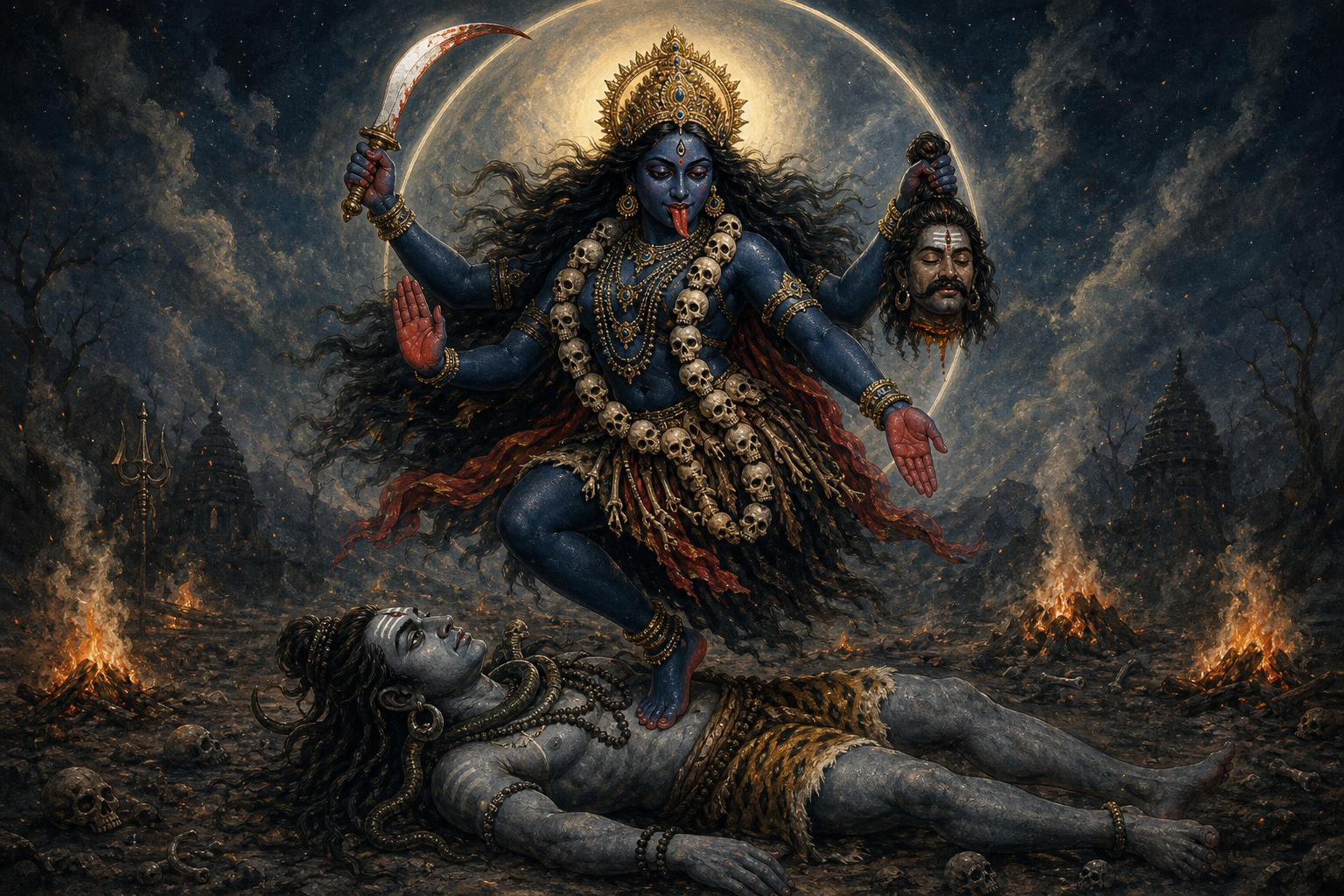
In the Kali-Mahakala image, the contrast is deliberate. Kali is dynamic, while Mahakala lies still. Kala carries the senses of time and darkness, and Mahakala is Great Time, the reality before which every changing form passes away. Kali is the creative and dissolving Shakti through which change actually occurs. The image therefore presents power in motion resting upon the ground of consciousness.
Calling Mahakala Kali’s vahana, or vehicle, need not imply an ordinary animal mount. Here, the vehicle is the subtle support that bears and reveals Shakti’s activity. The relationship is reciprocal: consciousness provides the ground, while Shakti makes that ground manifest as creation, transformation and dissolution.
This is why the scene should not be reduced to Kali defeating Shiva, woman defeating man, or energy dominating consciousness. In the Shaiva-Shakta frame, Shiva and Shakti are inseparable. Without Shakti, Shiva is inactive; without the ground represented by Shiva, Shakti has no stable anchoring. Non-duality here does not erase the visible distinction between stillness and motion. It reveals their distinction as an internal relationship within one reality.
The surrounding symbols reinforce the teaching. The cremation ground and skull garland confront impermanence and ahankara, the ego’s demand to make a temporary identity permanent. The blade indicates a decisive cutting of delusion. Abhaya prevents that cutting from being mistaken for cruelty: the same power that dissolves falsehood also offers freedom from fear. Fierceness and refuge belong together.
Turn the image into a simple contemplation
- Let the body become steady and follow the natural movement of the breath.
- Notice thoughts, sensations and emotions appearing and passing. Treat this movement as a small-scale reflection of Shakti’s dynamism.
- Notice that awareness can register those changes without becoming identical to any one of them. Let Mahakala’s stillness remind you of that ground.
- Bring one current difficulty to mind. Ask whether it requires Kali’s decisiveness, Mahakala’s patience, or both in sequence.
- End by choosing one concrete response that joins courage to compassion: speak a truth without humiliation, maintain a boundary without hatred, or release a claim that exists only to defend pride.
Don’t force an extraordinary state or treat passing emotion as a mystical attainment. The immediate discipline is simpler: recognize movement without being ruled by it, then act from the clearest awareness available to you. If you belong to a lineage, let its instructions govern mantra and ritual; visual contemplation is not a replacement for lineage-specific sadhana.
Durga’s serpent teaches containment before action
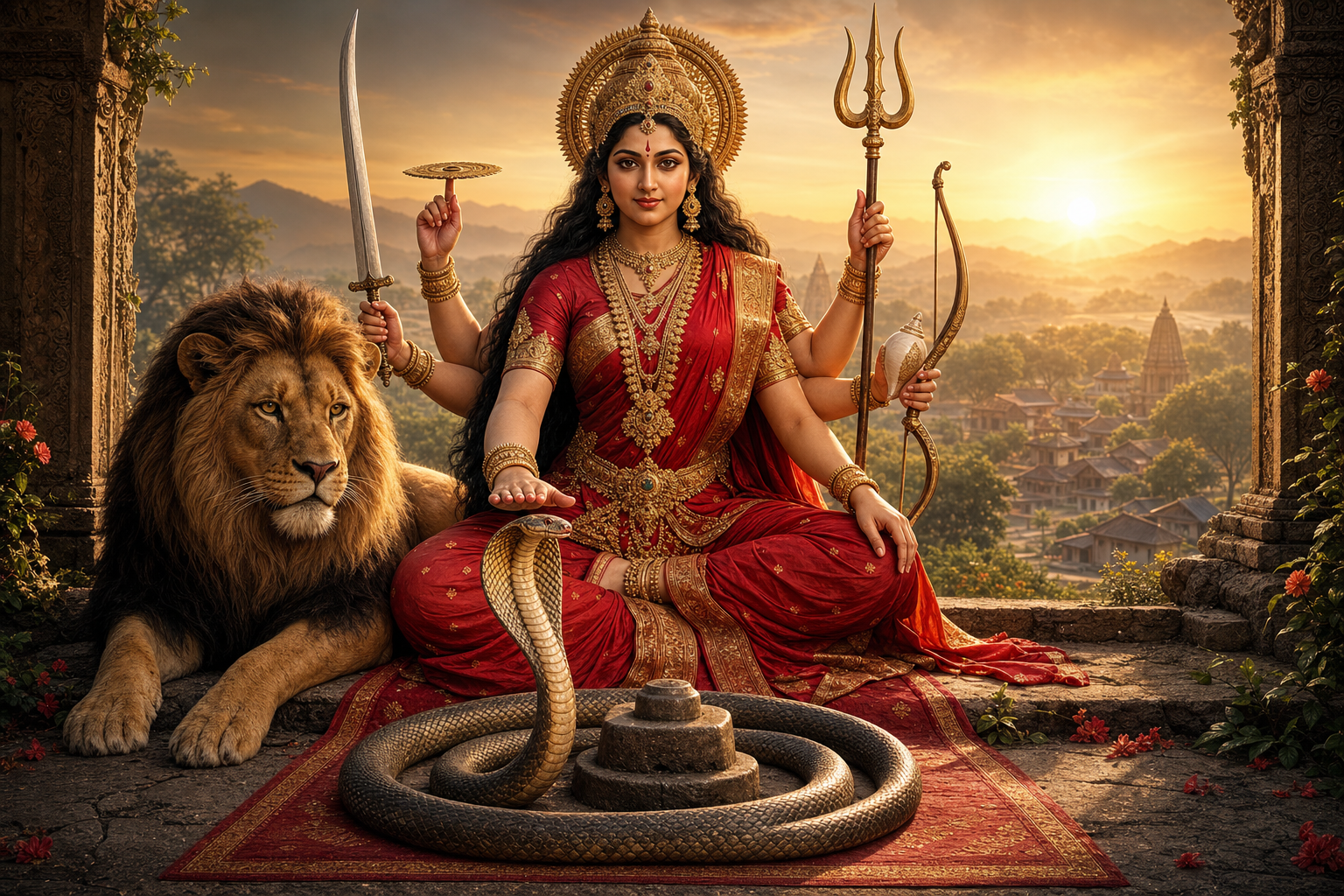
The most important detail of Durga’s Nagapasha is easy to overlook: the serpent is held, not annihilated. It represents force brought under conscious and ethical command. Fear, desire, anger and survival energy can cause disorder when they move blindly, but suppressing them is not the only alternative. Durga’s grasp shows a third possibility: contain the force, understand it and direct it toward dharma.
In the struggle with Mahishasura, the adversary can be read through tamas and avidya: inertia, obscuration and ignorance. Victory does not come from replacing weakness with uncontrolled aggression. It comes when energy is awakened, clarified and placed under sovereign awareness. That distinction matters whenever righteous anger risks becoming an excuse for vanity, vengeance or indiscriminate force.
A yogic reading connects the coiled serpent with Kundalini Shakti resting at the muladhara and ascending through the sushumna nadi. That reading emphasizes latent vitality becoming illumined consciousness. It should not, however, turn every serpent in Dharmic art into a single Kundalini formula. The figure holding the serpent, its posture and its function within the full scene remain essential.
You can apply the Nagapasha principle whenever a powerful impulse arrives:
- Name the force without becoming it. Replace “I am anger” with the more accurate recognition that anger is present.
- Hold speech and action until choice returns. Containment begins by preventing the first surge from deciding the whole encounter.
- Identify the dharmic aim. Decide whether you are protecting truth, a legitimate boundary, another person or merely your self-image.
- Choose the form of force that serves that aim. A firm refusal, a truthful statement and physical withdrawal are all different from retaliation.
- Release what is no longer useful. Once the boundary has been protected or the truth spoken, continuing to feed the emotion gives the serpent control again.
Containment is not passivity, and integration is not indulgence. Durga does not drop the serpent and call every impulse sacred. She holds it. The image asks for enough awareness to keep vital power from turning into adharma, and enough courage to use that power when protection genuinely requires it.
Test every fierce symbol by the ethics it produces
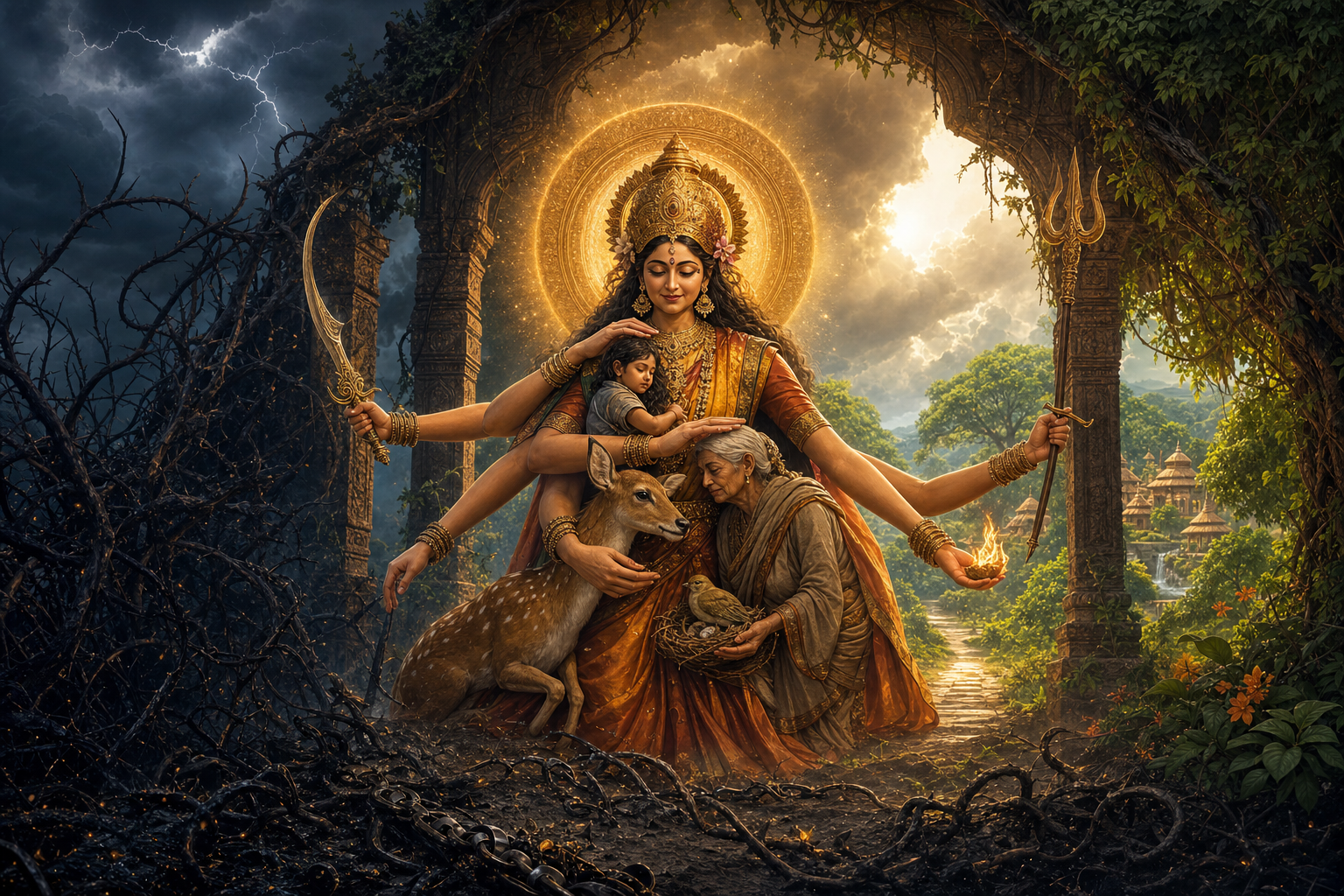
Tantric Shakti imagery can be misused when fierceness is detached from discipline. A sword, skull or wrathful form does not provide spiritual permission for cruelty. Its meaning has to be tested against the whole image and against the conduct it encourages. Strength without ethical direction is precisely the disorder these symbols ask you to overcome.
| Symbolic relationship | Shallow reading | Better question | Lived response |
|---|---|---|---|
| Blade and delusion | Power means destroying an opponent | What falsehood, attachment or self-deception must be cut? | End complicity with the falsehood without dehumanizing a person |
| Skulls and the cremation ground | Death is being glorified | What temporary identity am I treating as permanent? | Release the demand to control what time has already changed |
| Abhaya beside a fierce form | Fearlessness means intimidation | Whose fear should strength remove? | Use authority to protect, reassure or establish a just boundary |
| Serpent held by Durga | Instinct is evil and must be crushed | Which energy needs containment and direction? | Pause, clarify the aim and act without surrendering to impulse |
| Kali standing on Mahakala | One divine power has defeated another | What stable awareness must support decisive action? | Become steady before acting, then act without clinging to the result |
This test also guards against spiritualized ego. If your interpretation makes you feel inherently superior, excuses contempt or turns another person into a demon to be crushed, ahankara has appropriated the symbol. A sounder reading makes you more capable of confronting adharma while remaining responsible for the quality of your own action.
Compare Dharmic traditions by function, not by forced sameness
The serpent’s role elsewhere in the Dharmic family prevents a simplistic equation of serpent with evil. Mucalinda shelters the meditating Buddha, while Parshvanatha is represented beneath protective serpent hoods. These images give the serpent functions of guardianship, steadiness and protective wisdom. In Vajrayana Buddhism, Mahakala appears as a dharmapala, a protector, rather than merely as an abstract image of time.
Sikh teaching about overcoming kama, krodh, lobh, moh and ahankar likewise places the decisive struggle within the governance of desire, anger, greed, attachment and ego. Jain emphases on ahimsa and discipline illuminate the difference between mastering force and worshipping force. These resonances do not make Hindu, Buddhist, Jain and Sikh doctrines interchangeable. They offer a careful comparative method: first compare the ethical function of a symbol or teaching, and only then consider how far the underlying metaphysics agree.
This matters for your own reading. You don’t have to erase difference to recognize a shared civilizational concern with disciplined awareness. Protection, nonviolence, truthfulness and mastery of ego can converge in practice even when the theological languages remain distinct.
Key takeaways for your next darshan
- Where are movement and stillness? Read Kali and Mahakala as dynamic power and its conscious ground, not as rival deities in a contest.
- What is cut, and what is contained? The blade ends delusion; Nagapasha restrains and redirects vital force. Do not confuse the two operations.
- Which gesture balances the frightening object? Abhaya beside a blade makes protection part of the meaning of fierceness.
- What inner condition is being shown? Look for ahankara, tamas, avidya, fear or ungoverned desire before projecting the whole scene onto an external enemy.
- What action follows from the reading? The image should help you tell the truth, govern an impulse, accept change, defend a boundary or protect another being with greater clarity.
If you cannot answer the last question, remain with observation instead of manufacturing a grand interpretation. At your next darshan, choose one relationship within the image and follow it from outer form to inner condition to ethical action. When fierceness becomes disciplined courage rather than aggression, Shakti symbolism has begun to do its real work in you.
References
- DharmaRenaissance Blog — Nagapasha in Durga’s Hand: Unleashing Conscious Power and the Serpent’s Victory Over Evil
- DharmaRenaissance Blog — Mahakala as Kali’s Vehicle in Tantra: Unveiling Time, Power, and Non-Dual Wisdom
