

You may revere these narratives and still hesitate when someone turns a sacred episode into a ready-made command for a marriage, workplace dispute, community controversy, or political argument. That hesitation is useful. Reverence does not require you to pretend that every character, choice, and symbol supplies the same kind of instruction.
The practical question is how you can receive their wisdom without shrinking dharma into blind compliance, making symbolism mean anything you want, or using devotion to excuse avoidable harm. A disciplined ethical reading gives you a way through: identify the virtue, the context, the distribution of power, the human cost, and the action now required of you.
Key takeaways
- Do not reduce any character or episode to a single rule. First decide whether you are encountering an ideal, a warning, a dilemma, or a symbol.
- Read Rama, Sita, Lakshmana, Bharata, and Shatrughna as distinct ethical lenses: restraint, dignity, vigilant loyalty, non-attached stewardship, and quiet service.
- Approach Ganesha as the remover of obstacles through discernment, humility, disciplined effort, and compassionate action, not as permission to wait passively for difficulty to disappear.
- Apply the most demanding lesson inward before directing it at someone else. Sacred narratives become dangerous when they are used chiefly to judge rivals or demand another person’s sacrifice.
- Judge an interpretation by its fruit: greater truthfulness, less ego, reduced avoidable harm, more responsible service, and stronger accountability.
Begin by asking what kind of instruction you are seeing
A sacred narrative can work on several levels at once. One scene may present a virtue to cultivate. Another may expose a danger. A third may place duties in genuine tension. A symbol may train attention without functioning as a literal command. Misreading begins when all four are treated as interchangeable.
Use the following sequence before you draw a modern lesson:
- Describe before judging. State what is happening without immediately turning it into a verdict about your current dispute. Who holds responsibility? Who has power? Who bears the cost? Which promise or relationship matters?
- Name the central virtue. Choose one precise quality, such as satya, restraint, dignity, courage, loyalty, compassion, discernment, or service. A vague label such as goodness will not help you decide what to do.
- Name the possible distortion. Courage can become aggression. Loyalty can become complicity. Renunciation can become neglect. Endurance can be misused to justify another person’s suffering. Naming the shadow keeps a virtue from becoming a cover for preference.
- Test the distribution of consequences. Ask who benefits from your interpretation, who loses voice, and whether the less powerful person is being asked to carry the heaviest moral burden.
- Translate the lesson into conduct. Finish the sentence: because of this reading, I will now do this specific thing. If nothing observable changes, you have an interesting interpretation but not yet an ethical practice.
A Kaliyuga reading can understand exile as adversity, return as ethical renewal, Ravana as ungoverned ego, and the bridge to Lanka as the deliberate construction of understanding across a divide. These symbols are useful because they first direct your attention inward. If you use Ravana only as a label for a colleague, relative, political opponent, or community you dislike, the reading may feed the very ego it claims to diagnose.
Symbolic reflection does not require you to discard devotion, theology, or the narrative’s sacred character. It adds one disciplined question: what must this story change in your conduct here and now? Modern relevance comes from that accountable application, not from forcing every ancient circumstance into a present-day category.
Let the Ramayana’s characters question your decision

The central figures of the Ramayana do not have to be flattened into one moral slogan. You can approach them as a council of virtues. Each one asks something different of you, and the differences matter most when a decision feels morally simple because it happens to favor you.
- Rama asks what remains just under pressure. His restraint directs attention to the principle you will not violate even when anger, fear, status, or urgency makes violation convenient. Before acting, state that principle plainly. If you would be unwilling to explain it publicly or apply it to your own side, it is probably a preference rather than a standard.
- Sita asks whether dignity is being preserved. Her fortitude should sharpen your regard for the dignity of a person facing adversity. It should never become a demand that someone else silently endure humiliation. In a family or institution, ask whether the affected person retains voice, agency, and the ability to refuse what is being imposed.
- Lakshmana asks what faithful support requires. Vigilant devotion is more demanding than automatic agreement. Loyalty should make you more attentive to dharma, not less willing to notice error. When supporting someone you love or respect, distinguish protecting the person from defending every impulse, claim, or decision associated with that person.
- Bharata asks whether you are stewarding power or possessing it. His guardianship without attachment offers a demanding test for anyone entrusted with authority. Define the limits of your role, disclose conflicts between personal benefit and institutional duty, and make it possible for authority to return to its proper place rather than quietly becoming permanent possession.
- Shatrughna asks whose necessary work has become invisible. Quiet service sustains families, temples, associations, and public institutions long after ceremonial recognition has passed. Look for the person carrying maintenance, coordination, care, or follow-through. Give that person information, resources, credit, and rest rather than praising service while leaving its burden untouched.
When these virtues point in different directions, do not solve the tension by declaring one duty absolute. Write down your duties to truth, relationship, institution, and the person most exposed to harm. Separate a genuine promise from your preferred outcome. Then identify which option asks you to surrender ego or advantage rather than asking someone with less power to make the sacrifice.
A useful decision should survive more than one character’s question. Loyalty that cannot survive Rama’s test of justice is suspect. Restraint that ignores Sita’s dignity may merely protect comfort. Authority that celebrates service while refusing Bharata’s non-attachment or overlooking Shatrughna’s labor has not yet become dharmic stewardship.
Use Ram Rajya as a test of institutions
Ram Rajya becomes ethically meaningful when it raises the standard applied to power. Its aspiration toward justice, transparent conduct, public trust, and care for vulnerable people can be turned into concrete questions for a government, temple committee, charity, business, or household:
- Can the decision and its reasons be explained truthfully to the people affected by it?
- Does the rule bind leaders and insiders as well as ordinary members?
- Can a person challenge an error without being treated as disloyal?
- Is there a remedy when authority causes harm?
- Are burdens shifted toward people with the least status, information, or ability to refuse?
- What benefit are the decision-makers willing to renounce in order to protect the common good?
Invoking Rama in public life increases the duty to justify power; it does not reduce it. A slogan fails the ethical test when it sacralizes authority without disciplining the people who exercise it.
Let Ganesha reveal what kind of obstacle you face
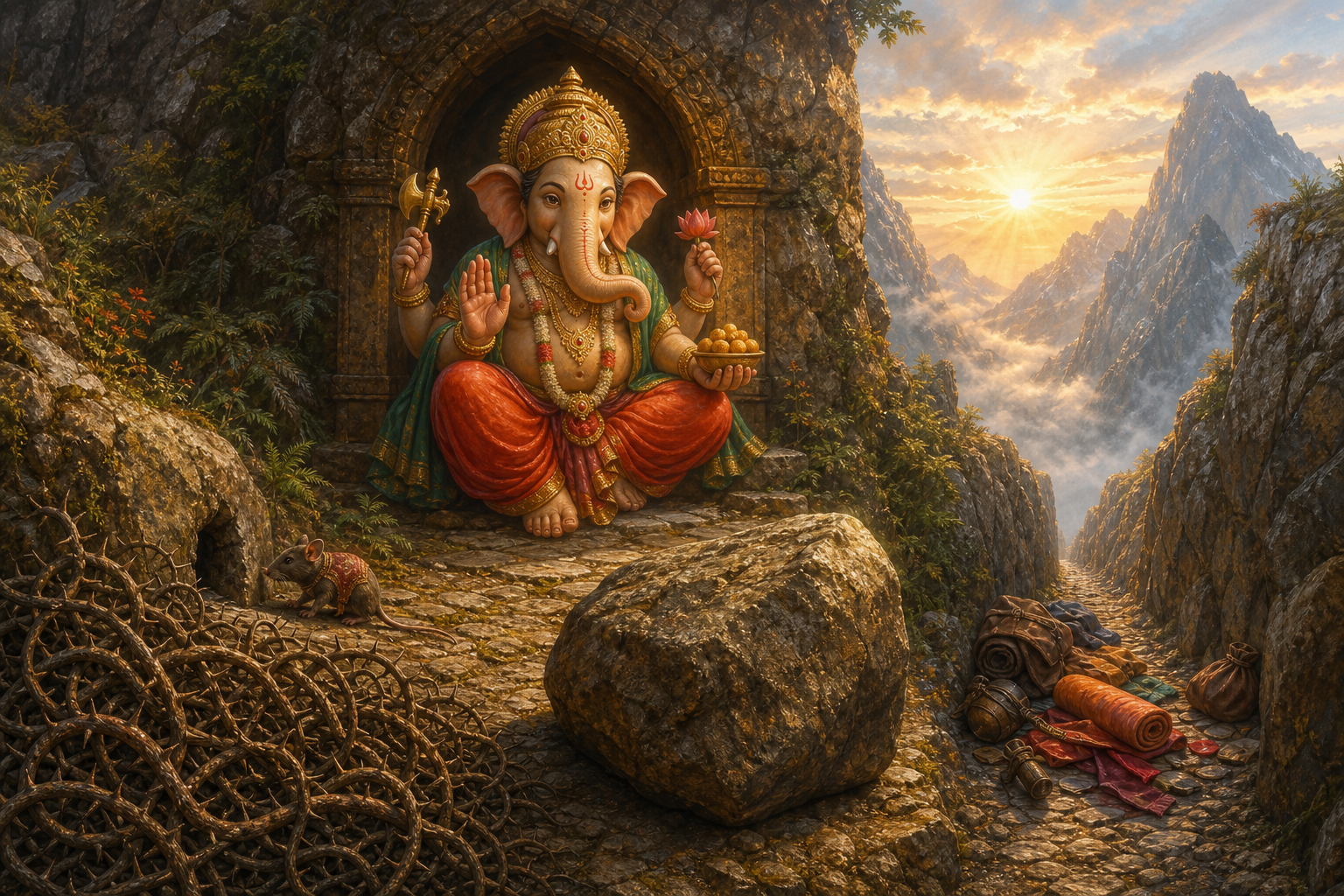
When an important undertaking stalls, the first impulse is often to push harder or blame whoever stands in the way. Ganesha offers a more searching beginning. Before asking for an obstacle to be removed, ask whether it is external, practical, relational, or rooted in your own restlessness and desire.
Ganesha-centered narratives join viveka, shraddha, and daya with human effort and humility. Discernment identifies the real problem. Devotional trust steadies you when the result remains uncertain. Compassion governs the means you use. Humility leaves room for the possibility that your plan, timing, or conduct needs correction.
Use this obstacle protocol before a new project, difficult conversation, community initiative, or major decision:
- State the intended beginning. Replace a broad wish such as make this succeed with a clear purpose: reach a fair decision, complete a necessary task, repair trust, or begin work without deception.
- Classify the obstruction. A factual obstacle requires better information. A practical obstacle may require skill, time, resources, or a smaller first step. A relational obstacle requires listening and coordination. An inward obstacle may involve fear, pride, distraction, resentment, or desire for approval.
- Check whether the obstacle is also a warning. Resistance is not always adharma. Another person’s objection may reveal a neglected duty, an unfair burden, or information your plan has ignored. Do not invoke obstacle removal as a reason to silence legitimate dissent.
- Choose the fitting quality. Use viveka when competing claims must be distinguished, shraddha when fear is preventing responsible action, and daya when your preferred method would treat people as instruments.
- Act after invocation. Prayer, recitation, and contemplation should be followed by one concrete act: obtain the missing fact, revise the plan, apologize, ask the unheard person to speak, complete the neglected preparation, or relinquish an unfair advantage.
- Review the result without self-flattery. An obstacle has not been ethically removed if the project advances through falsehood, humiliation, or needless harm. Sometimes the real removal is the surrender of a bad method or an ego-driven goal.
Ganesha’s iconography can serve as a compact examination of your state of mind:
- The elephant head suggests expansive intelligence and patient strength. Widen the field before deciding. Listen for information that does not fit your first explanation, and do not confuse quickness with clarity.
- Ekadanta, the single tusk, points toward sacrifice and refined knowledge. Ask what lower priority, cherished assumption, or personal convenience must be surrendered so that the essential purpose can remain intact.
- The mouse indicates mastery over restlessness and desire. Notice the small, darting impulse that keeps changing the goal, chasing recognition, or reacting to every provocation. Mastery does not mean denying desire; it means refusing to let desire choose the direction.
Suppose a community celebration is delayed because volunteers disagree about responsibilities. A shallow obstacle reading identifies the dissenters as the problem. A Ganesha-centered ethical reading asks whether the plan is clear, whether work has been distributed fairly, whether the quiet volunteers have been heard, and whether the organizer’s attachment to control is blocking cooperation. The next step may be a revised schedule, a smaller event, a transparent division of labor, or an apology. That is obstacle removal expressed as dharma.
Devotional observances such as Ganesh Chaturthi and Sankashti, as well as family recitation before a new beginning, can support this discipline. After contemplation, divide a journal page into two prompts: what I am asking Ganesha to remove, and what I am willing to change. If the second side remains empty, examine whether devotion has been separated from responsibility.
Share ethical ground without flattening Dharmic traditions

Hinduism, Buddhism, Jainism, and Sikhism are not interchangeable systems, and respectful dialogue does not require pretending otherwise. Ganesha remains a specifically Hindu form of devotion. The Ramayana also belongs within particular theological, literary, and devotional worlds even as its influence and ethical resonance travel widely.
Shared moral language can still support serious conversation. Mindfulness and karuṇa in Buddhism, ahiṃsā and self-mastery in Jainism, and seva and sat in Sikhism can converse with Hindu commitments to truth, compassion, discipline, and dharma. The purpose is not to absorb every tradition into one vocabulary. It is to recognize enough ethical ground to reason and serve together while preserving genuine differences.
When you face a decision that affects people across traditions, use this five-part audit:
- Truth: What claim am I making, and what am I concealing because disclosure would weaken my preferred position?
- Compassion: Whose fear, grief, or vulnerability have I treated as irrelevant?
- Non-harm: Which harms are unavoidable, and which are produced merely by haste, pride, punitive language, or refusal to consider another method?
- Service: Who is actually served by this action? Does the benefit reach the community, or mainly the status of the person performing it?
- Self-mastery: Would I choose the same course without applause, anger, rivalry, or the prospect of control?
These questions will not make every disagreement disappear. People can honor shared values and still weigh duties, consequences, and spiritual commitments differently. Their value lies in improving the disagreement. They force each participant to give reasons, acknowledge costs, and apply moral scrutiny to their own side.
This also sets a boundary against false unity. Harmony purchased by silencing a difficult question is not compassion. Unity that asks only one group to surrender memory, dignity, or conviction is not mutual respect. A Dharmic approach to plurality should make truthful dialogue more possible, not make truth unspeakable.
Turn each reading into a practice you can review

The surest way to keep ethical interpretation from becoming abstraction is to attach it to a live decision. Use one scene, one symbol, and one action at a time. You do not need to extract a complete moral system from every reading session.
- Select one episode, character quality, or symbol. Keep the field narrow enough to notice details rather than collecting inspirational themes.
- Record what you observe. Note the duty, virtue, pressure, sacrifice, and consequence without immediately turning them into advice for somebody else.
- Write the ethical tension. Use a form such as loyalty versus truth, urgency versus patience, authority versus non-attachment, endurance versus dignity, or ambition versus compassion.
- Bring one real decision into view. Choose something within your responsibility: a promise you may not be able to keep, a conflict you are avoiding, power you hold, work you have left to others, or an obstacle you keep blaming on another person.
- Choose an observable action. Name the conversation, correction, restraint, act of service, disclosure, preparation, or renunciation you will complete. Avoid intentions that cannot be checked, such as be more spiritual or try to be good.
- Return and review. Ask what happened, who was helped, who paid a cost, and whether ego decreased or simply adopted religious language. If your action caused avoidable harm, acknowledgement and correction are part of the practice.
Consider a request to defend a respected senior person before you have verified what happened. Rama’s lens asks whether your response remains just under pressure. Lakshmana’s lens distinguishes faithful support from automatic agreement. Bharata’s lens asks whether rank is being used as possession. Sita’s lens keeps the dignity of the less powerful person in view. Shatrughna’s lens notices who may be doing the unseen work of repairing the consequences. Ganesha’s mouse may expose your fear of disapproval.
A dharmic response might require you to verify the facts, refuse a false claim, raise the concern through an appropriate channel, and continue serving without hostility. The exact action depends on the situation. What should not change is the demand for truth, dignity, restraint, and accountability.
Keep five guardrails around interpretation
- Do not make another person pay for your spiritual ideal. If your lesson demands sacrifice, first identify what you are giving up.
- Do not mistake endurance for consent. Admiring fortitude does not authorize you to ignore another person’s refusal, pain, or dignity.
- Do not turn symbolic enemies into labels for whole groups. Use the diagnosis of ego, desire, and adharma to examine conduct, beginning with your own.
- Do not confuse inaction with surrender. Restraint can require patient, courageous intervention rather than withdrawal from responsibility.
- Do not call every successful outcome righteous. A goal reached through deception, humiliation, or exploitation remains ethically compromised even if the obstacle is gone.
At your next reading, keep three lines beside you: virtue, distortion, action. Fill in all three. Let reverence open your attention, let discernment test your preferred interpretation, and then perform the duty the reading has made harder to avoid.
References
- DharmaRenaissance Blog — Kaliyuga Ramayana: Timeless Dharma, Courage, and Compassion for Today’s World
- DharmaRenaissance Blog — Vinayaka Purana Mahatmyam: Timeless Ganesha Stories that Inspire Devotion and Unity
