
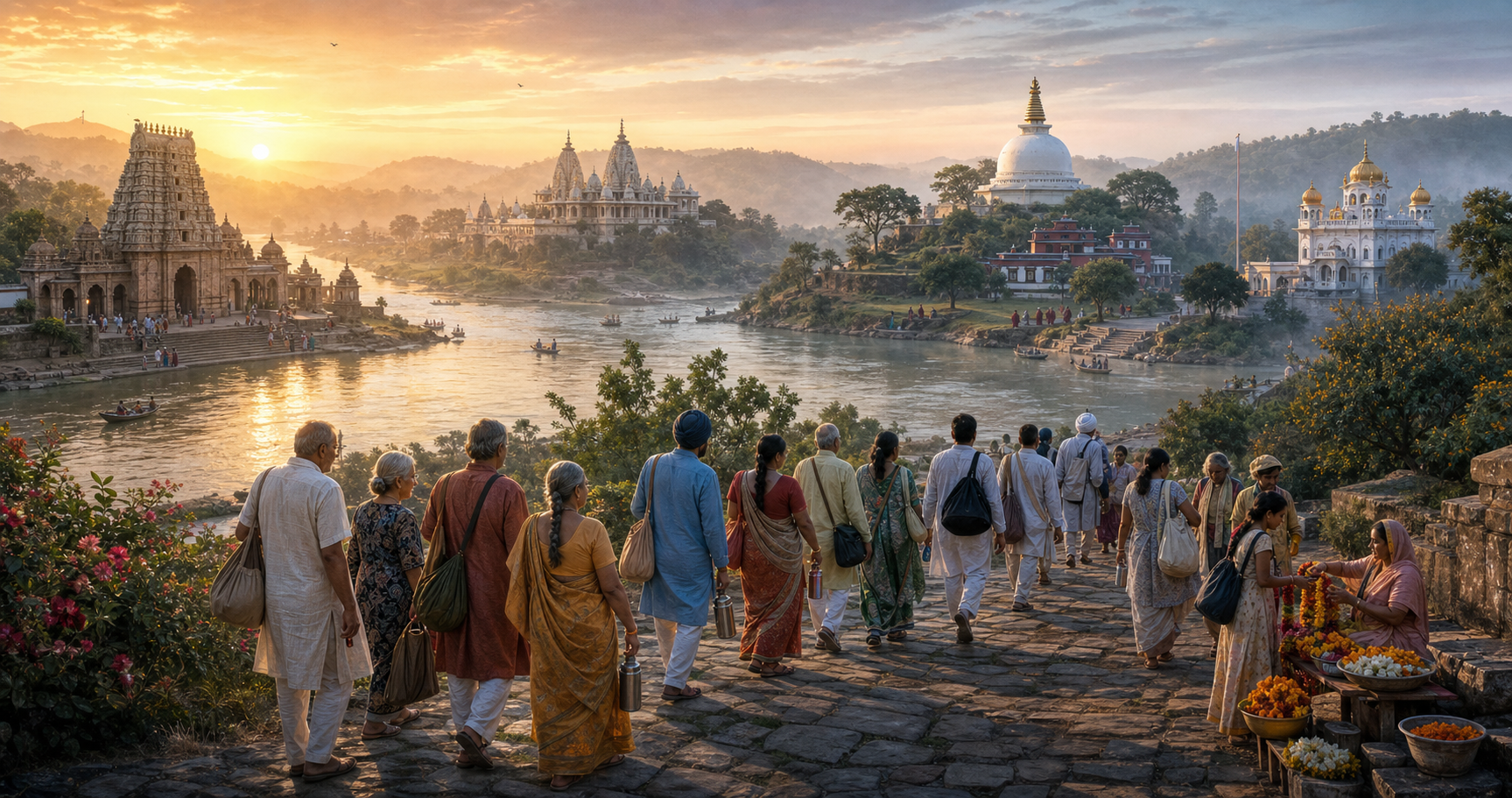
You may want a pilgrimage that does more than add sacred sites to a camera roll. Perhaps your family knows its own sampradaya well but understands neighboring Dharmic traditions only through fragments. Perhaps you are planning a youth tour, a school visit, or a community journey and do not want it to become hurried religious tourism.
A journey can deepen Dharmic unity when you treat every destination as a living community rather than a historical exhibit. Go prepared to learn how people worship, serve, remember, and transmit wisdom. Let local hosts define respectful conduct. Return with a concrete duty toward the relationships and heritage that received you.
Set a unifying question before choosing the route
Do not begin with the question, How are all Dharmic religions the same? It pressures every encounter toward a predetermined answer. Hinduism, Buddhism, Jainism, and Sikhism have distinct scriptures, doctrines, disciplines, institutions, and histories. Unity becomes more credible when it can accommodate those differences.
Ask a more useful question: How does this community turn dharma into daily conduct? That question directs attention toward practice without pretending that every tradition explains practice in the same way. It allows you to notice service, restraint, compassion, truthfulness, generosity, devotion, and contemplation while still asking what each means in its own setting.
Across Bharat, gurdwaras, temples, viharas, and derasars function as living institutions of worship, memory, meaning, and community life. Architecture matters, but a building alone cannot tell you who prepares food, teaches children, preserves a manuscript, maintains a ritual art, remembers a displaced community, or explains a practice to the next generation.
Before fixing the itinerary, write a short purpose statement that everyone in the group can understand. It might be: We are traveling to learn how different Dharmic communities cultivate ethical life, and to support the people who preserve their sacred inheritance. Use that statement to test every proposed stop. If a destination offers no opportunity for attentive learning, local conversation, worshipful silence, or responsible service, reconsider why it is on the route.
Give each traveler a preparation page with these prompts:
- What do I already know about this community, and where did I learn it?
- What am I merely assuming?
- Which practice or ethical idea do I want a local practitioner to explain?
- Who sustains this sacred place when pilgrims are absent?
- What contribution would be useful to the host community rather than merely satisfying to us?
The distinction between knowledge and assumption is especially important. A traveler who arrives certain that every tradition is basically identical will miss difference. A traveler who arrives certain that difference prevents fellowship will miss kinship. The disciplined position is curiosity: listen first, ask precisely, and let people describe their own practice.
Build the itinerary around encounters, not monuments
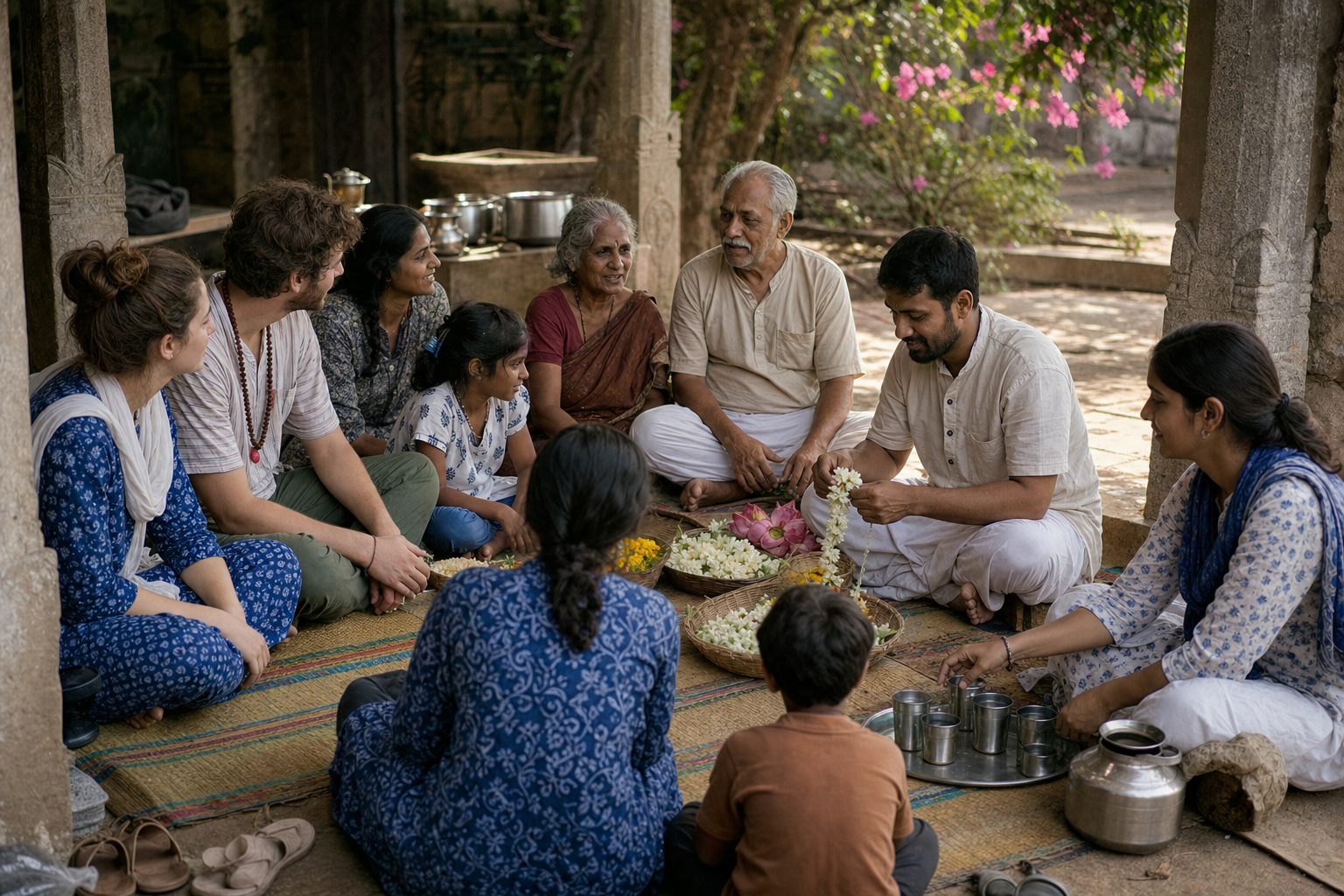
A long list of famous destinations can produce a shallow journey. The group rushes from gate to shrine to photograph, while the people who sustain the place remain nearly invisible. A better itinerary leaves room for encounter, participation where welcome, reflection, and follow-through.
Build each stop from the following elements:
- A living practice: Attend kirtan, aarti, contemplation, teaching, or a shared meal when the community welcomes visitors. These ordinary practices join inward discipline with communal belonging. Do not treat them as performances arranged for outsiders.
- A local voice: Ask a practitioner, elder, volunteer, educator, custodian, or tradition-bearer to explain what the place means to the people who use it. A polished historical lecture cannot replace lived memory.
- A material expression of heritage: Notice vernacular architecture, manuscripts, devotional music, ritual arts, kitchens, teaching spaces, and patterns of collective care. Ask how these are maintained and what pressures their custodians face.
- A service component: Let the host identify a suitable form of seva or support. Possibilities already practiced across Dharmic settings include community kitchens, inclusive langar, heritage clean-ups, tree planting near sacred precincts, and cross-tradition study circles.
- A period of reflection: Before moving on, ask each traveler to record what was directly observed, what the host explained, which assumption changed, and what responsibility follows.
Do not make every stop carry the same format. One community may invite participation in a meal; another may prefer quiet observation. One custodian may welcome documentation; another may restrict photography around worship or manuscripts. Unity is not produced by forcing every sacred place into a standardized visitor experience. It grows when you extend equal seriousness to different forms of hospitality and discipline.
If you are organizing a family or educational journey, distribute attention across generations. Invite elders to supply memory and context. Ask who performs the often-unrecorded work of devotion, education, hospitality, and care. Give young people meaningful responsibilities in research, organization, and digital documentation, but do not reduce them to photographers. The combined work of elders, women, and youth is part of how living heritage survives changing conditions.
These roles should be invitations, not rigid assignments based on age or gender. The practical lesson is to look beyond the most visible authority. Ask who teaches, cooks, cleans, sings, repairs, records, raises funds, welcomes strangers, and carries an oral history. A sacred institution is supported by an ecosystem of duty.
Use shared values as bridges without erasing their roots
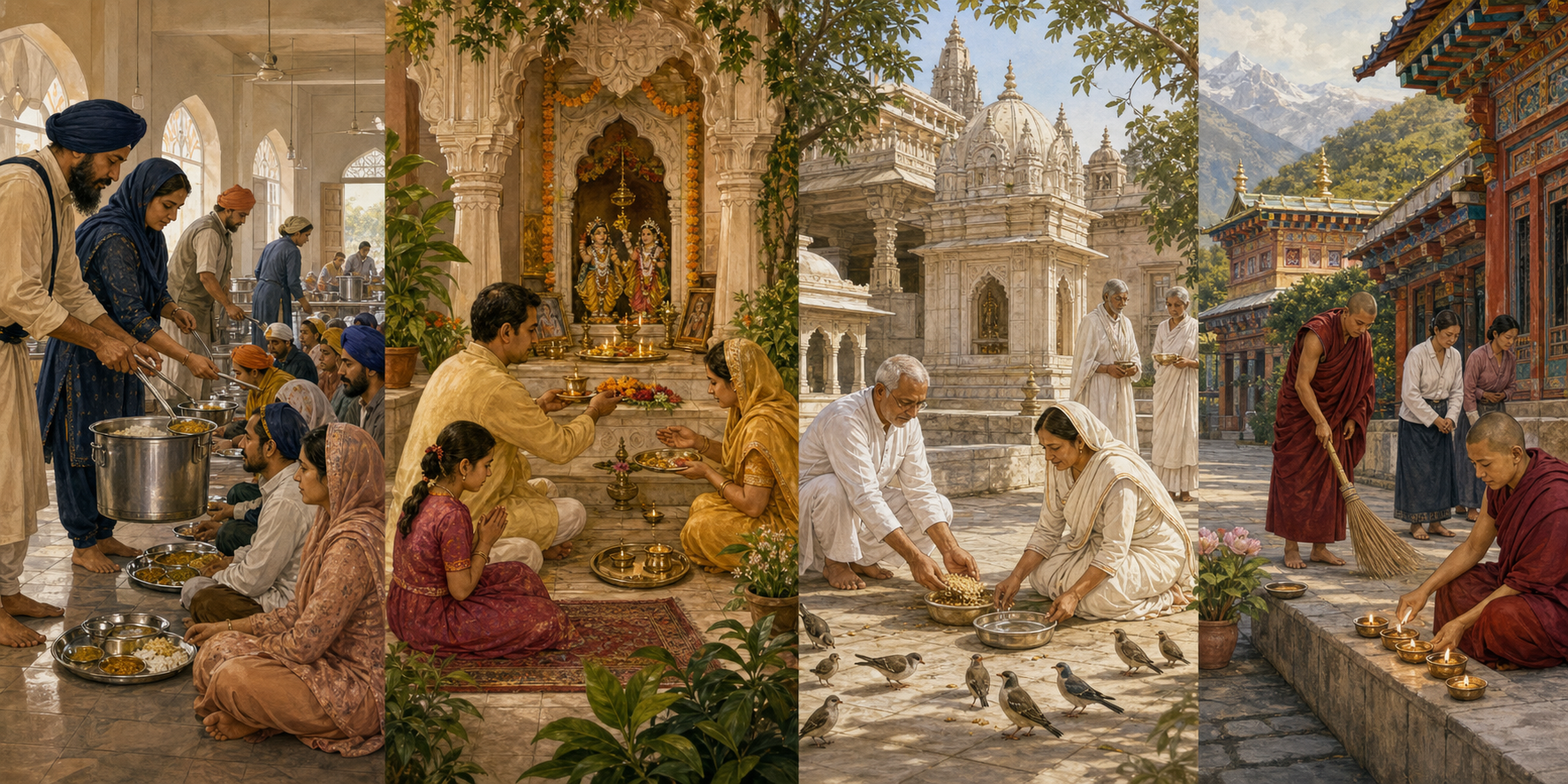
Dharmic unity becomes vague when reduced to the claim that everyone believes the same thing. It becomes useful when travelers learn an ethical vocabulary and then ask how each word is embodied, interpreted, and grounded within a particular tradition.
- Seva directs attention toward service performed without making the self the center. In Sikh life, it naturally accompanies the aspiration of sarbat da bhala, the welfare of all.
- Dana turns generosity into a discipline. On a journey, it raises a sharper question than how much to give: What form of giving actually strengthens the receiving community?
- Ahimsa asks how non-harm shapes conduct. It can guide how you speak about another path, treat animals and the environment, behave in a sacred precinct, and represent local people afterward.
- Maitri and karuna draw attention to friendliness and compassion, especially within Buddhist ethical cultivation.
- Aparigraha, strongly associated with Jain discipline, challenges possessiveness. It is particularly relevant to visitors tempted to treat sacred images, stories, or experiences as content they have acquired.
- Satya demands truthfulness. It requires you to distinguish what a host actually taught from your own interpretation of the encounter.
These concepts create a shared field of compassion, service, restraint, and truth-seeking, but they are not interchangeable labels. Sikh seva, Hindu approaches to ahimsa, Buddhist karuna, and Jain aparigraha emerge from their own bodies of teaching and practice. You honor unity by exploring the resonance. You honor truth by preserving the context.
At each visit, choose one ethical term and ask grounded questions:
- What does this principle mean within your tradition?
- Which daily practice gives it visible form here?
- What discipline or sacrifice does it require?
- How is it taught to children and newcomers?
- What would an outsider commonly misunderstand about it?
This approach is more fruitful than asking a host to confirm a slogan about universal sameness. It lets the host define the tradition from within. It also gives travelers a practical point of comparison: not whether doctrines can be collapsed, but how different paths train human beings to act responsibly.
A spirit of sarva dharma sambhava does not require indifference to theology. Equal regard is not the belief that distinctions are meaningless. It is the willingness to encounter another path without contempt, caricature, or a demand that it justify itself in your vocabulary.
Enter every sacred place as a guest and leave as a steward
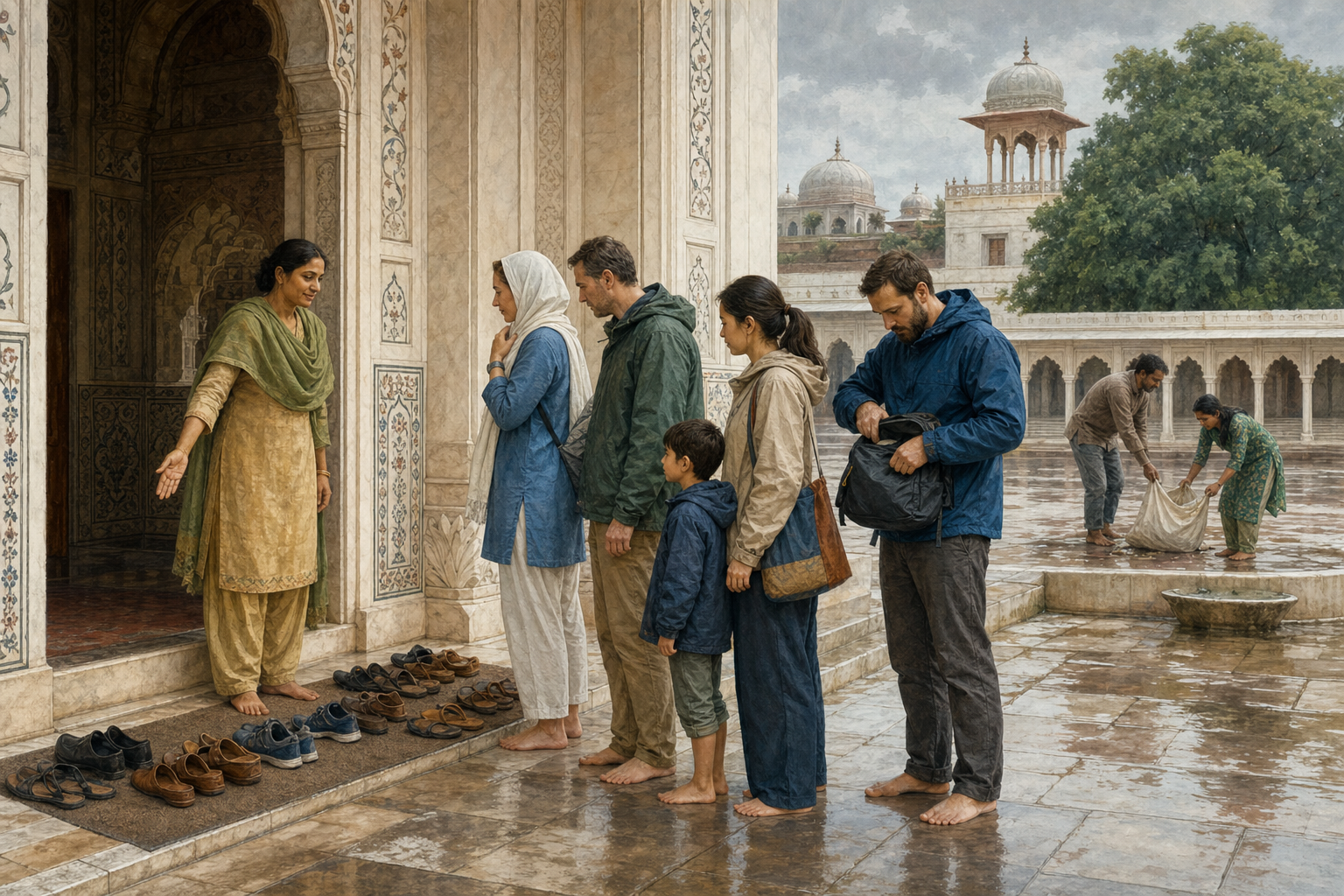
Respect cannot be reduced to good intentions. It must be visible in your conduct. Customs differ among traditions and even among institutions within a tradition, so ask before arriving rather than assuming that etiquette learned at one site applies everywhere.
Confirm local expectations concerning clothing, head covering, footwear, washing, food, seating, movement during worship, offerings, and access to restricted areas. If you are unsure in the moment, pause and follow the direction of the host. Quiet observation is more respectful than confident imitation performed without understanding.
Treat photography and recording as permissions, not entitlements. Approval to photograph a building does not automatically include worshippers, children, a private teaching, a manuscript, or a ritual. Ask before recording, and explain where the material may appear. If a moment is too sacred or vulnerable to interrupt with a request, put the device away.
Shared food deserves the same attention. Follow the kitchen’s practice, take only what you will eat, and help when invited. Do not turn langar or another community meal into an exotic backdrop. Notice the organization, labor, equality, and hospitality that make the meal possible.
Ethical sacred travel also means reducing the burden of your presence. The appropriate choices depend on the place, but the principle is consistent: minimize waste, do not damage or touch heritage material without permission, respect the rhythms of worship, and avoid creating congestion for the sake of a photograph. Humility, attention to local voices, and eco-conscious choices turn responsible travel into a form of practice.
If you collect an oral history, establish consent before pressing record. Ask how the speaker wishes to be identified, what may be shared, what must remain private, and whether the community wants a copy. Preserve the speaker’s context instead of cutting a sentence into a claim they did not make. When possible, return the finished transcript, recording, or edited material to the people who supplied it.
Apply the same discipline to manuscripts, architecture, and ritual arts. Record the name and explanation supplied by the custodian. Distinguish established information from your interpretation. Never handle, move, clean, or alter an object because it appears neglected; preservation decisions belong to those responsible for it and may require specialist knowledge.
Service must also follow local direction. An unsolicited clean-up can disturb a ritual arrangement. Tree planting can create maintenance obligations. Digitization can separate a community from control over its knowledge. Ask what is wanted, who will supervise it, and what happens after visitors leave. The most visible project is not necessarily the most useful one.
Bring the journey home through memory, service, and relationship
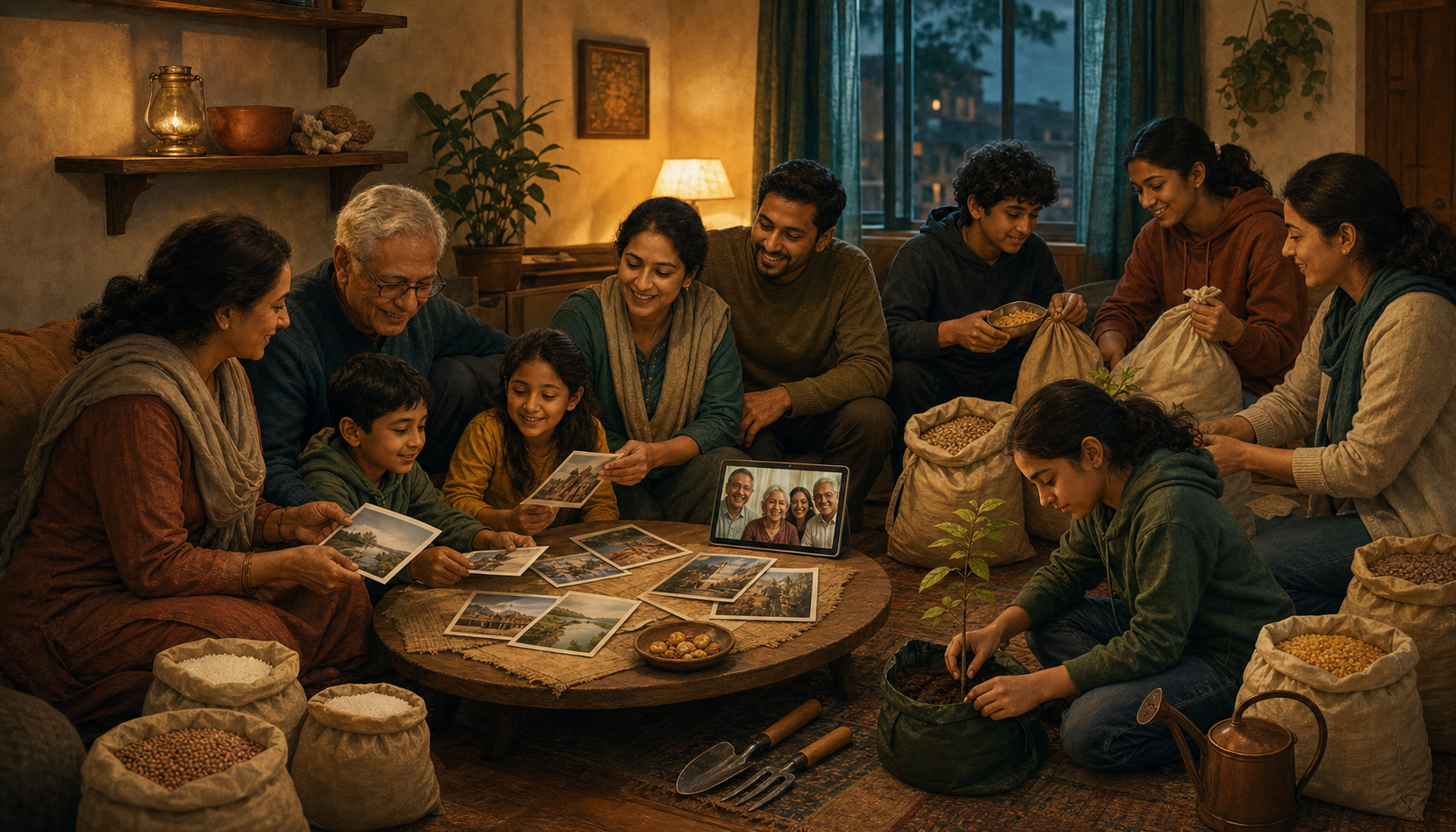
The return home is where sacred travel either becomes formative or dissolves into photographs. Hold a debrief while memories and commitments are still clear. Do not ask only which site people liked best. That converts hospitality into a consumer ranking.
Use questions that reveal learning and responsibility:
- Which assumption did a host correct?
- Which practice made an ethical teaching visible?
- Which difference do we now understand more accurately?
- Whose labor was easy to overlook?
- What did we promise to send, support, protect, or continue?
Then choose a follow-through action that matches what the hosts actually requested. Return copies of approved photographs or oral histories. Invite knowledgeable representatives to a cross-tradition study circle. Support a community kitchen or heritage project. Organize a supervised clean-up. Help document a ritual art. Create a visitor guide that explains etiquette in the community’s own terms. Continue a relationship instead of searching immediately for the next destination.
For parents and educators, turn the journey into participatory learning rather than a comparative-religion quiz. Ask learners to connect a witnessed practice with the community’s explanation of it. Let them reflect on both kinship and difference. Combine field visits with service and careful documentation so that cultural literacy is tied to conduct, not merely recall.
A useful evaluation is simple. Did travelers represent people truthfully? Were permissions honored? Did a local priority receive support? Did the group return promised material? Can participants explain a tradition more accurately without claiming to speak for it? Those outcomes say more about Dharmic unity than the number of sites visited.
Key takeaways
- Plan around a unifying question about lived dharma, not a claim that all traditions are identical.
- Treat every gurdwara, temple, vihara, and derasar as a living community before treating it as a destination.
- Use seva, dana, ahimsa, maitri, karuna, aparigraha, and satya as openings for inquiry while preserving their distinct settings.
- Let local hosts define etiquette, photography rules, documentation boundaries, and useful service.
- Include elders, less-visible care workers, tradition-bearers, and youth so that the full ecology of heritage comes into view.
- Complete promised follow-up before planning another journey.
You do not need a grand national itinerary to begin. Choose a sacred place outside your regular circuit, contact its community, explain that you want to learn respectfully, and ask what form of visit would be welcome. Arrive with one honest question. Leave with one clear commitment. Keep that commitment before choosing the next stop.
References
