

You finish your japa, yet you can barely remember hearing the Names you repeated. Your mouth completed the practice while your mind rehearsed plans, arguments, and unfinished duties. What troubles you is not only poor concentration. It is the fear that Nama should have changed you by now, and that your distraction proves something is wrong with either the practice or you.
Do not answer that fear by pretending the session was better than it was. Do not answer it by pushing Nama to the margins of spiritual life either. Doubt becomes useful when you turn it from a verdict into a precise question: what, exactly, needs to change in the way you approach, hear, and carry the Name?
Your discomfort is not proof that Nama has failed
The practices that matter most expose us most deeply. If chanting were merely an optional activity, an inattentive session would cause little concern. Once you accept Nama as central, however, the distance between what you honor and what you actually do becomes difficult to ignore. Publicly glorifying the Name can sharpen that discomfort because your own concentration suddenly appears unworthy of your words.
That tension has two possible interpretations. Shame says, ‘My distraction proves that I am unfit or false.’ Conscience says, ‘My attention, intention, pronunciation, or steadiness needs care.’ The first interpretation turns a correctable lapse into an identity. The second turns painful self-awareness into practical feedback.
This does not mean you should praise distraction or lower the standard. It means you should describe the lapse accurately. ‘I rushed until the syllables blurred’ is useful. ‘I am hopeless at chanting’ is not. ‘I kept repeating while following a chain of thoughts’ identifies a problem. ‘Nama does nothing for me’ makes a conclusion that the observed facts do not establish.
At the end of a difficult session, therefore, replace the question ‘Was I a good practitioner?’ with three narrower questions:
- Did I keep the appointment I had made with the practice?
- Could I distinctly pronounce and hear the sacred words?
- What repeatedly took my attention away?
These questions preserve dignity without protecting complacency. A session may be weak in concentration but strong in honesty. That honesty is not the final goal, but it is a sound beginning because it reveals where your next effort belongs.
Name the kind of doubt before trying to solve it

Doubt is not one problem. Different doubts require different responses, and confusing them leads to unnecessary struggle.
- Doubt about the truth of Nama asks whether sacred sound has the potency your tradition attributes to it. Technique cannot force an answer to that metaphysical question. What you can do is separate observation from conclusion. ‘I felt no change’ and ‘my mind wandered’ may be honest observations. ‘Therefore the Name has no potency’ is an additional judgement. Do not manufacture certainty, but do not let one mood impersonate a settled conclusion either.
- Doubt about your worth says that someone as distracted, inconsistent, or impure as you should not approach the Name. In bhakti, humility is not the same as self-contempt. Humility admits your present condition and still turns toward grace. Self-contempt keeps attention fixed on the self, even while appearing spiritually serious.
- Doubt about method appears when the words blur, the pace becomes careless, the breath is unsettled, or the practice has no stable place in your day. This is the most directly repairable kind. Work on pronunciation, listening, unforced breath, one-pointedness, and a consistent appointment before demanding a dramatic inner experience.
- Doubt produced by comparison arises when another person’s duration, discipline, emotion, or eloquence becomes evidence against you. Comparison can be converted into curiosity: instead of asking why you are not like that person, ask what concrete habit supports their steadiness and whether it belongs in your own discipline.
This distinction also protects the integrity of different Dharmic paths. Hindu japa and kirtan, Sikh Naam Simran, the Jain Namokar Mantra, and Buddhist recitations such as Namo Amitabha are not interchangeable formulations of one doctrine. Their theological settings and intended meanings matter. Yet they display a significant civilizational kinship: disciplined sacred sound can gather attention, sustain remembrance, and orient conduct toward clarity and compassion. That shared reverence for sacred recitation should encourage mutual respect, not careless mixing.
If you stand within a lineage, let that lineage determine the Nama, mantra, pronunciation, and commitments you follow. The useful common lesson is not that every mantra means the same thing. It is that transformation ordinarily asks for sincere repetition, attentive hearing, humility, and a life that begins to reflect what is remembered.
Use a repair protocol at your next chanting session
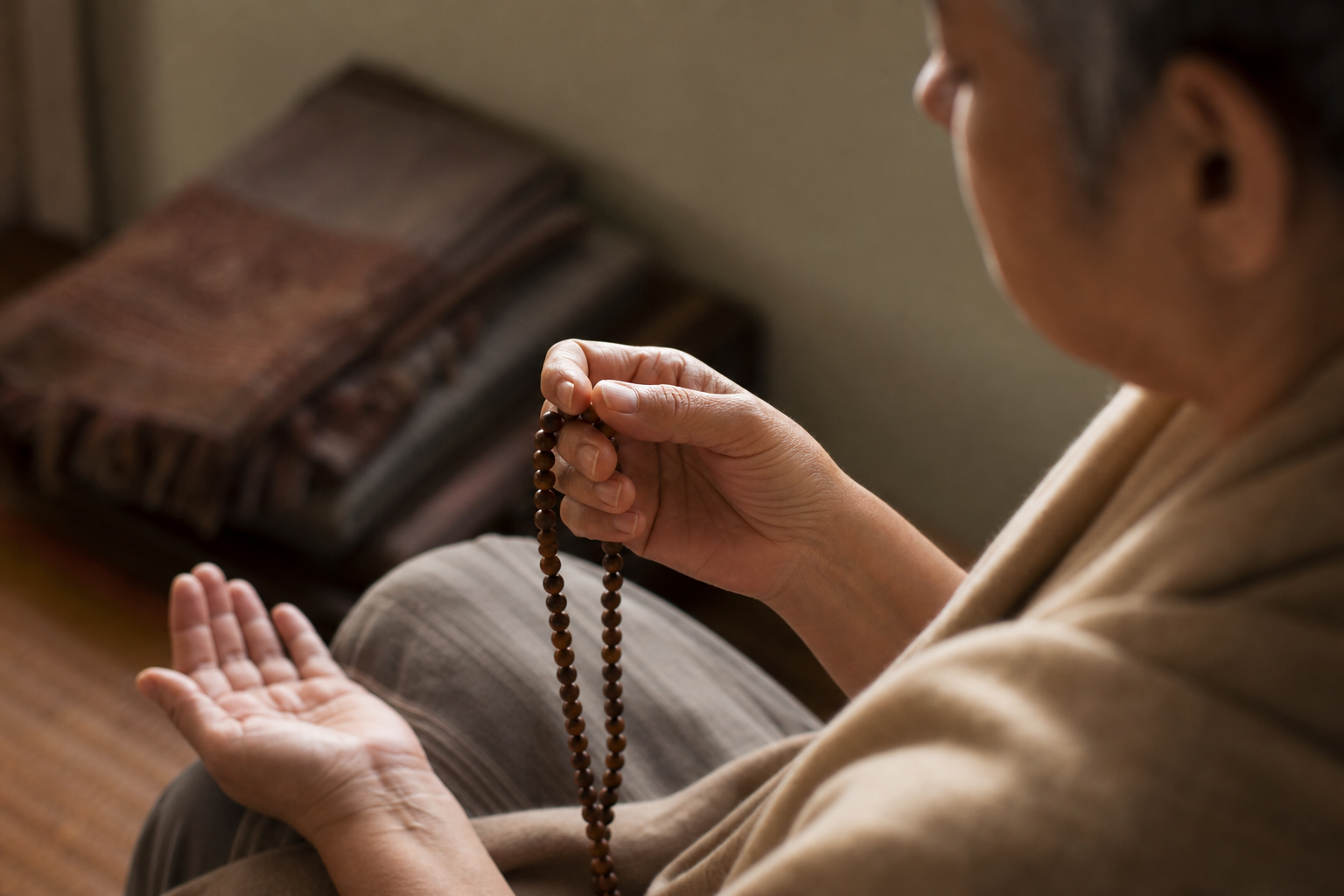
When chanting feels empty, a dramatic new vow is rarely the most intelligent response. Repair the point of contact between voice, hearing, attention, and intention. Use the following sequence without turning it into another performance to judge.
- Protect the appointment. Use a recognizable time and place so that beginning does not depend entirely on mood. If you already have a formal vow, honor it without renegotiating it during a discouraging session. If you do not have one, choose a commitment you can actually maintain and seek lineage-specific guidance before taking on a demanding vow.
- Remove obvious divided attention. Put away the device, conversation, or task that keeps asking for a second stream of awareness. You cannot cultivate one-pointedness while deliberately preserving an interruption channel.
- Let the breath settle. Do not make breath control a display or force an unnatural rhythm. A steady, unstrained breath supports careful speech and listening; it is a support for Nama, not the object of the session.
- Give the voice and the ear complementary work. Pronounce the sacred words carefully enough that the ear can receive them. Listen through the full Name or mantra rather than anticipating the next repetition. If the syllables lose definition, reduce the pace until clarity returns.
- Return without holding an inner trial. When you notice that attention has wandered, name the subject plainly if that helps: planning, memory, resentment, fantasy, or worry. Then come back at the next repetition. Do not spend several more repetitions prosecuting yourself for having missed the previous ones.
- Close with one honest observation. Identify the obstruction that recurred and choose one corresponding adjustment for the next appointment. If haste blurred the words, correct the pace. If a nearby device repeatedly pulled you away, move it out of reach. If self-accusation consumed more attention than the initial distraction, practice returning without commentary.
This protocol does not guarantee sweetness, absorption, or revelation. It gives sincerity a workable form. Technique serves devotion when it makes you more available to the Name; technique becomes vanity when perfect execution becomes another way to admire or condemn yourself.
Community can help when solitary practice has become brittle. Kirtan provides a shared current of remembrance, while a trusted practitioner can offer compassionate accountability. Ask one another about observables: Was the appointment kept? Did the words remain distinct? Where did attention repeatedly break? Avoid using emotional intensity as a score. A person’s visible feeling does not tell you the full condition of their practice, and their experience is not a timetable for yours.
A healthy community can honor a high standard without turning that standard into public humiliation. It makes room to speak honestly about fatigue, wandering attention, uneven zeal, and renewed effort. This changes comparison into learning and prevents spiritual image-management from consuming the energy meant for Nama.
Measure transformation during chanting and after it

It is easy to look for transformation only in extraordinary feeling. That expectation can make an ordinary but sincere practice seem barren. A more reliable assessment examines three connected fields: what happens while you chant, whether you return over time, and what remembrance does to your conduct.
During recitation: you return sooner and hear more clearly
The first change may be modest. You notice distraction earlier. You hear when pronunciation becomes careless. You recover the Name without extending the lapse through frustration. This is not uninterrupted absorption, but it is a genuine strengthening of attention. The mind’s wandering has become something you can notice and answer rather than something that silently owns the whole session.
Across repeated practice: sincerity becomes steadier than mood
Zeal and fatigue do not need to make every decision. A maturing relationship with Nama survives both. You stop treating an inspired session as proof of spiritual arrival and a dry session as proof of rejection. You keep the commitment, observe the quality honestly, and make the next appropriate correction.
This steadiness also changes how you receive correction. Because your identity is no longer tied to appearing advanced, you can admit that the pace was careless, the attention scattered, or the routine unstable. Accountability becomes assistance rather than threat.
Beyond recitation: remembrance becomes seva
In the Gaudiya account of Sarvabhauma Bhattacarya’s transformation, humility precedes revelation. Caitanya Mahaprabhu first manifests a four-armed Visnu form and then the intimate two-armed form of Krsna, dark in complexion and holding the flute near His lips. Sarvabhauma’s changed understanding leads him toward the centrality of Nama and the responsibility to share love of God. The sequence presents revelation as a reordering of perception, devotion, and purpose, not as spectacle detached from life.
You should not turn that sacred narrative into a promise that correct technique will produce a vision. Its practical direction is more demanding: realization must become purpose. If chanting makes you more concerned with spiritual status but not more willing to listen, serve, apologize, or recognize another person’s dignity, something remains disconnected.
Attach remembrance to one real duty after you chant. Listen fully before answering someone. Complete a neglected act of seva. Repair avoidable harm instead of defending your image. Offer kindness where impatience would normally take over. These actions are not substitutes for Nama or proofs that you have attained realization. They are places where the orientation cultivated in sacred remembrance can enter your relationships.
This gives you a balanced measure. Quality chanting includes careful pronunciation, attentive hearing, steadiness, and intention. Maturing chanting also softens conduct. Technique without devotion becomes mechanical; claimed devotion without any effect on conduct becomes difficult to trust. Each needs the other.
Key takeaways
- An inattentive session does not by itself prove that Nama lacks potency or that you are disqualified. It shows you where attention and method need repair.
- Separate observed facts from sweeping conclusions. ‘My mind wandered’ is an observation; ‘the practice is useless’ is a judgement that requires more than one difficult experience.
- Identify whether your doubt concerns truth, self-worth, method, or comparison. Each calls for a different response.
- At the next session, protect the appointment, settle the breath, pronounce clearly, listen to the whole sacred phrase, and return without self-prosecution.
- Respect the distinct meanings of japa, kirtan, the Namokar Mantra, Buddhist recitation, and Naam Simran while recognizing their shared discipline of sacred remembrance.
- Look for transformation not only in feeling but in steadier practice, humbler accountability, more careful listening, and concrete seva.
Your next encounter with Nama does not have to resolve every spiritual doubt. Give it one honest task: hear the next Name completely. When attention leaves, return. When the session ends, carry remembrance into one specific act of service.
That return is where doubt begins to change character. It stops being a sentence passed upon you and becomes a doorway into clearer attention, steadier devotion, and a life gradually reorganized around what you call sacred.
References
- Dandavats — When Failure Becomes Success: Transforming Painful Chanting Doubts into Growth
- Dandavats — Awe and Revelation: Early Miracles of Caitanya Mahaprabhu and the Transforming Power of Nama
