

If you want to observe Bisu in 2026 but aren’t sure what belongs at the centre of the day, begin with three anchors: the solar transition, the first auspicious sight of the morning, and the conduct that follows it. The date is April 14, the central household arrangement is the Bisu Kani, and the celebration becomes complete through blessings, hospitality, worship, and service.
You don’t need an elaborate display or a crowded programme. Bisu is most coherent when each action leads naturally to the next: prepare the home, behold signs of abundance with gratitude, honour elders and deities, share a festive meal, and let some part of the household’s good fortune reach another person.
Why Bisu falls on April 14 in 2026
Bisu falls on April 14 in 2026. It begins the Tuluva New Year according to the Souramana Panchanga, a solar method of calendrical reckoning. The day coincides with Mesha Sankranti, when the Sun enters Aries.
That solar basis matters. Bisu is not merely a convenient date chosen for a cultural gathering. It places the household at a threshold in sacred time. You are being invited to review what you are carrying into the next cycle: habits, duties, relationships, unfinished work, and the manner in which you use whatever prosperity comes to you.
Bisu belongs especially to Tulunadu, with observance centred in Udupi and Dakshina Kannada in Karnataka, as well as parts of Kasargod. Mangaluru lies within this coastal cultural landscape. If you are celebrating elsewhere, including in the diaspora, keeping that geography in view helps prevent the festival from becoming a generic Indian New Year event stripped of its Tuluva identity.
Bisu also shares its solar timing with nearby celebrations such as Vishu. That relationship is worth recognising, but it should not erase local distinctions. A common calendrical threshold does not mean every community uses the same name, domestic arrangement, language, or ritual sequence. Honour the connection without treating the traditions as interchangeable.
Build the Bisu Kani with intention, not excess
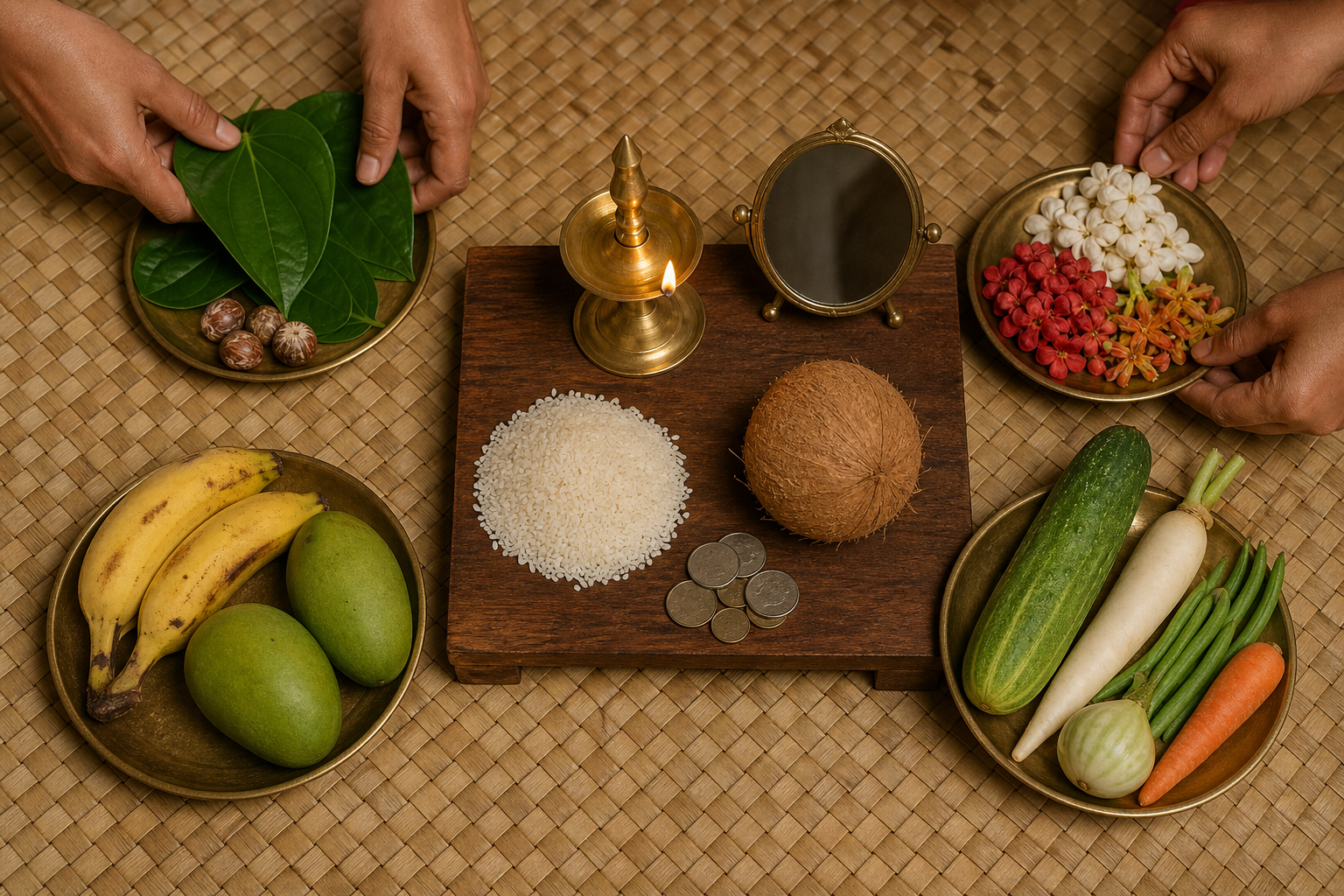
The Bisu Kani is an arrangement of auspicious objects intended to become the first meaningful sight at dawn. Its purpose is not to demonstrate how much the household can buy. It gathers ordinary forms of well-being into one deliberate field of vision so that the year begins with awareness rather than distraction.
A customary Bisu Kani can include seasonal fruits, grains, flowers, a mirror, and coins. Together, these objects evoke abundance, clarity, and prosperity. No particular quantity is needed to make that symbolism meaningful. A small, carefully prepared arrangement is preferable to a large one assembled without attention.
- Choose seasonal fruits that are fresh and available to your household. Their place in the arrangement does not depend on rarity or price.
- Set aside a clean portion of grain. It represents sustenance more clearly when it is treated respectfully rather than used as loose decoration.
- Add fresh flowers in a form that suits your family’s practice and circumstances.
- Clean the mirror before placing it. Because the Kani is meant to be contemplated, avoid letting dust, packaging, or clutter dominate the view.
- Include coins without turning the arrangement into a display of wealth. The relevant idea is sufficient material well-being, not comparison with another household.
If your family has inherited a particular arrangement, follow it. Living tradition is carried through household memory as well as public descriptions. If you are rebuilding the observance after a gap, begin with the established elements above and ask an elder whether your family formerly included a particular order or devotional focus. It is better to recover a custom patiently than to invent certainty.
Prepare the Kani and its surroundings before the household wakes. Since it is meant to shape the first sight of the morning, last-minute searching defeats part of the purpose. Put the phone aside, reduce visual clutter, and allow a quiet pause before anyone starts taking photographs or attending to messages. The first response should be gratitude and resolve, not documentation.
A workable order for Bisu morning

Household sequences can differ, so an inherited family practice should take precedence. If you do not have one, the following order keeps the first-sight symbolism intact while incorporating the observances commonly associated with Bisu.
- Complete the practical preparation before dawn. Purify the home, clear the entrance, and make the threshold rangoli so that morning is not consumed by hurried setup.
- View the Bisu Kani as the first deliberate sight of the new year. Pause long enough to notice the whole arrangement and form a clear intention for the year ahead.
- Take the customary early-morning oil bath and put on fresh attire. These actions give bodily expression to renewal and readiness.
- Offer respectful greetings to elders and receive their blessings. If you live far away, arrange a call instead of allowing distance to remove the intergenerational part of the day.
- Visit a temple where circumstances permit. Keep the visit devotional rather than treating the temple as a festival backdrop.
- Share a festive meal rooted in the Tulu food traditions your family actually knows. If that knowledge has weakened, ask relatives for the household menu instead of assembling an arbitrary collection of dishes labelled traditional.
- Carry the blessing outward through seva. Share food, assist an elder or neighbour, or support a community kitchen. Decide on the act beforehand so service does not become an intention repeatedly postponed.
The sequence has an ethical logic. The Kani places abundance before your eyes; greetings remind you that you did not arrive at the new year alone; worship places prosperity within dharma; the meal turns it into hospitality; and seva prevents good fortune from ending at the household boundary.
This is also why a resolution for Bisu should be concrete. Instead of resolving vaguely to become more spiritual, choose a practice you can recognise in daily life: speak to an elder regularly, set aside time for temple service, reduce waste in festival preparation, or make one continuing commitment to a neighbour or community effort. The day marks a beginning; repetition during the year gives that beginning substance.
Keep the celebration distinctly Tuluva and generously Dharmic

Bisu’s wider significance does not require us to dilute its local character. Its language, coastal geography, family memories, foodways, and domestic ritual belong to Tulunadu. Those features deserve preservation precisely because dharmic civilisation has never depended on making every region identical.
At the same time, the movement from gratitude to disciplined conduct and service resonates beyond one community. Compassion, self-restraint, reverence, and communal harmony are valued across Hindu, Buddhist, Jain, and Sikh traditions. Recognising that ethical kinship does not mean claiming that every Dharmic community celebrates Bisu. Shared values are strongest when they connect distinct traditions without absorbing one into another.
If you are raising children outside Tulunadu, give them more than a decorative Kani. Tell them why April 14 matters, show them where Tulunadu lies, name the Souramana calendar and Mesha Sankranti, and involve them in choosing the act of seva. A child who understands the structure of the observance can carry it forward; a child who sees only a photographable arrangement may remember the objects but lose their relationship to time, place, and duty.
If you are visiting Udupi, Mangaluru, or another part of Tulunadu during Bisu, participate as a guest rather than a collector of festival images. Observe local instructions, ask before entering a private household observance, avoid interrupting temple worship for photographs, support community kitchens where appropriate, and keep the celebration environmentally considerate. Respectful attention will teach you more than trying to reproduce every visible gesture without its context.
Key takeaways for April 14
- Bisu is the Tuluva Solar New Year, and in 2026 it falls on April 14.
- Its calendrical basis is the Souramana Panchanga, and it aligns with Mesha Sankranti.
- Its cultural home is Tulunadu, especially Udupi, Dakshina Kannada, and parts of Kasargod.
- The Bisu Kani commonly brings together seasonal fruits, grains, flowers, a mirror, and coins as auspicious signs of abundance, clarity, and prosperity.
- The day can include home purification, threshold rangoli, an early-morning oil bath, fresh clothing, blessings from elders, temple worship, a festive Tulu meal, and seva.
- Bisu shares a solar threshold with nearby observances such as Vishu, but its distinctly Tuluva identity should not be flattened into a generic festival.
Before April 14, choose the place for the Kani, gather its simple elements, ask an elder about your household custom, and commit to one act of service. Then let the first auspicious sight of the year lead to an equally auspicious first deed.
References
