
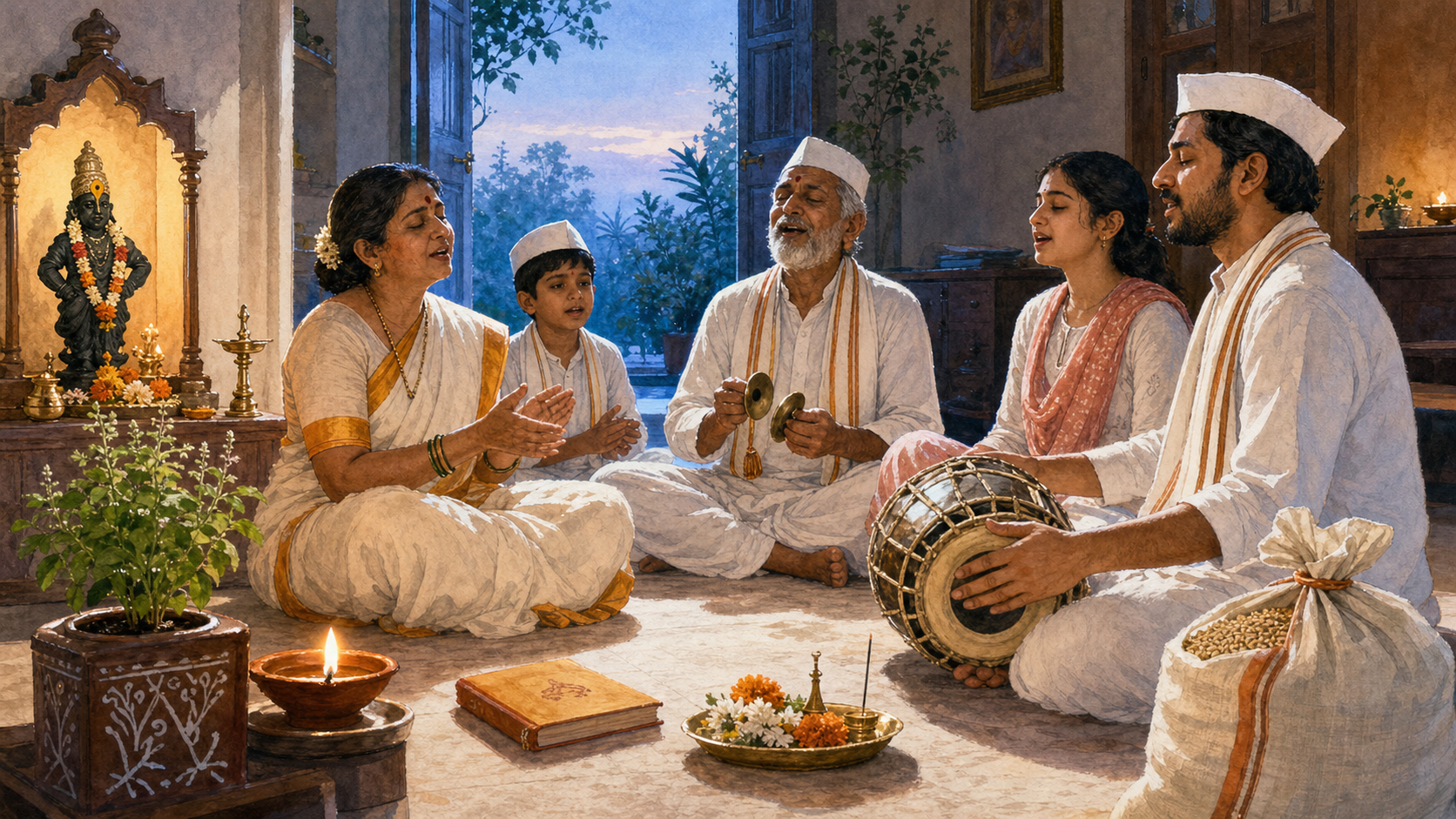
If Tukaram Beej is on your calendar but you are unsure what a faithful observance should look like, begin with a simple distinction: this is not merely a saint’s anniversary to acknowledge. It is an invitation to practise the kind of bhakti Sant Tukaram taught through the name of Vitthal, the singing of abhangas, ethical self-examination, and service.
You do not need an elaborate ceremony to enter that practice. You need enough quiet to listen, enough honesty to notice where pride or indifference has entered your conduct, and a concrete way to carry devotion into someone else’s life.
Begin with the meaning of Beej, not the event schedule
Tukaram Beej is Sant Tukaram’s Punyatithi. It generally falls on Phalguna Krishna Dwitiya, the waning-moon second lunar day known as Beej in Maharashtra. The 2026 observance fell on March 5.
The Varkari tradition remembers this as the day Sant Tukaram bodily ascended to Vaikunth, the abode of Lord Vishnu. That is a devotional claim belonging to the tradition and should be described as such. It should neither be stripped from the observance nor presented carelessly as though a sacred account and a modern historical assertion were the same kind of statement.
The remembered life behind the day is rooted in Dehu near Pune, where Tukaram was born in 1608. His departure is placed in 1650. His enduring gift is the abhanga: devotional poetry in which love of Vithoba is joined to moral clarity. Humility, equality, compassion, and remembrance of the divine name are not secondary themes in that inheritance. They are the tests by which devotion becomes credible.
This also explains why Tukaram Beej should not be treated as a smaller version of the Pandharpur Wari. The great Wari is especially associated with Ashadhi and Kartiki, whereas Tukaram Beej has its own contemplative character. If you attend a public program, ask whether it leaves room for remembrance, reflection, and recommitment rather than judging it by crowd size or spectacle.
Recognise the disciplines inside Varkari devotion
Varkari bhakti is musical, but it is not merely an emotional response to music. Its devotional forms train attention and then direct that attention toward conduct. Use the following elements as a practical filter for your observance:
- Nama-sankirtana: Repeat or sing the name of Vitthal with attention. The purpose is not vocal display. It is to interrupt distraction and return the mind to the divine.
- Abhanga: Read Tukaram’s words as instruction as well as poetry. Ask what a passage exposes in pride, social contempt, hollow piety, or indifference. If Marathi is not accessible to you, place a reliable translation beside the original rather than abandoning the text or pretending that every nuance survives translation.
- Humility: Let the reading question you before you use it to correct someone else. A devotional gathering loses Tukaram’s spirit when status, learning, caste, wealth, or performance becomes a reason to diminish another participant.
- Equality and compassion: Notice who is welcomed, who is heard, who is served, and who is expected to remain at the edge. Equality becomes a practice through hospitality and dignity, not a slogan added to a program.
- Seva: Connect remembrance to useful work. Annadan and neighbourhood cleanliness are especially fitting examples because they meet an actual need and can be performed collectively.
These elements support one another. Nama without ethical attention can become mechanical. Ethical language without remembrance can become self-congratulation. Seva keeps both grounded by asking whether another person or the shared community is tangibly better served.
Follow a simple Tukaram Beej observance at home
No single household plan should be passed off as a compulsory rite for every Varkari family. Local and family customs deserve respect. If you do not already follow an established form, the sequence below offers a restrained framework built from common Tukaram Beej practices rather than an invented ornate ritual.
- Prepare a clean, quiet place. Set out an image of Vithoba or Sant Tukaram if your household normally uses one. Light a lamp. If your family keeps padukas, paduka puja can express reverence for the saint’s spiritual footsteps; their absence does not prevent a meaningful observance.
- State your purpose plainly. Make a short sankalpa centred on remembrance, humility, and better conduct. Avoid asking only for personal gain. Tukaram Beej is particularly suited to gratitude and recommitment.
- Begin with the name of Vitthal. Sing if you can, or repeat the name in a steady voice if you cannot. Do not turn lack of musical training into a reason to remain silent. Nama-sankirtana depends on participation more than polish.
- Read from the Tukaram Gatha or a careful selection of abhangas. Read aloud and slowly. Pause over a short passage that consoles you and another that challenges you. Then ask what behaviour each passage calls for in your home, work, or community.
- Offer simple naivedya. Follow the food customs of your household. Simplicity is appropriate; the size of an offering is not a measure of devotion.
- Choose a specific act of seva. Support annadan, help with a local cleanliness effort, prepare food for someone who needs it, or offer quiet practical assistance within your capacity. Decide on the act before the prayer closes so that seva does not remain an intention indefinitely postponed.
- End with an ordinary-life commitment. Name a habit that must change when the lamp is no longer burning: speaking without contempt, listening before judging, sharing work fairly, apologising without self-defence, or serving without demanding recognition.
If your circumstances allow only a brief observance, retain the essential movement: lamp, Vitthal nama, abhanga, reflection, and a real act of service. Cutting ceremony is better than cutting the connection between worship and conduct.
Make the gathering communal without making it performative
Vithoba temples and Varkari mathas commonly mark the day through abhang recitation, bhajans, kirtan, satsang, and paduka puja. Dehu carries particular resonance and draws pilgrims for commemorations and readings from the Tukaram Gatha. If you cannot travel, attending an early puja or a local kirtan still places you within the shared rhythm of remembrance.
Participation matters more than passive attendance. Join the refrain when invited. Listen to the meaning of the abhanga, not only its melody. Volunteer for the practical work around the gathering. Welcome the person who does not know the expected sequence. A community honours Tukaram more fully when devotion lowers barriers instead of using familiarity with ritual to create new ones.
Help children and newcomers encounter a living tradition
Do not begin with a long lecture or test of prior knowledge. Give each person a way to participate: lighting the lamp under appropriate supervision, reading a translated passage, keeping the kirtan refrain, preparing naivedya, serving food, or helping with the cleanliness effort. Explain the essential words as they arise: Vitthal is the beloved form addressed in the devotion; abhanga is Tukaram’s devotional verse; nama is remembrance through the divine name; seva is service that gives devotion an ethical body.
After the singing, ask a concrete question: What did the abhanga ask us to stop doing, begin doing, or notice differently? That question moves the gathering from cultural exposure to moral participation without demanding that a newcomer master an entire tradition at once.
Notice when the observance has drifted from its centre
- If musical skill becomes more important than collective remembrance, return the gathering to a refrain everyone can join.
- If ritual scale becomes a measure of status, simplify the offering and redirect effort toward seva.
- If equality is praised from the stage while some participants are ignored or demeaned, correct the hospitality and distribution of responsibility.
- If Tukaram is remembered only as a historical personality, restore the relationship to Vitthal and the devotional purpose of his abhangas.
- If the Vaikunth ascent is discussed, identify it accurately as the Varkari tradition’s sacred understanding rather than using the occasion to provoke an unnecessary argument between faith and historiography.
See Dharmic kinship without erasing distinctions
Tukaram Beej can also open a careful conversation across Dharmic paths. The centrality of sung devotion has a recognisable kinship with Sikh kirtan. Its call to compassion, restraint, and inner transformation can be discussed alongside Buddhist and Jain ethical practice, including ahimsa. Kinship does not mean that these traditions have identical theology, texts, or disciplines. The useful question is narrower: how does each path turn spiritual insight into a way of treating living beings?
That approach protects both unity and difference. It gives families and community groups a basis for mutual respect without reducing every Dharmic tradition to interchangeable vocabulary.
Key takeaways
- Tukaram Beej is Sant Tukaram’s Punyatithi and is observed on Phalguna Krishna Dwitiya; in 2026, it fell on March 5.
- The Varkari tradition holds that Sant Tukaram bodily ascended to Vaikunth on this day.
- The observance is distinct from the Ashadhi and Kartiki Wari and is especially suited to remembrance, gratitude, and ethical reflection.
- A meaningful home practice can centre on a lamp, Vitthal nama, an abhanga reading, simple naivedya, and a definite act of seva.
- Humility, equality, compassion, and service are not decorations around Tukaram’s bhakti; they show whether that bhakti has entered daily conduct.
- A community gathering remains faithful to the tradition when participation and dignity matter more than performance or status.
When you next observe Tukaram Beej, put the act of service on your calendar before choosing the scale of the ceremony. Then carry one demand from the abhanga into your next ordinary encounter. That is where remembrance begins to become Varkari practice.
References
