
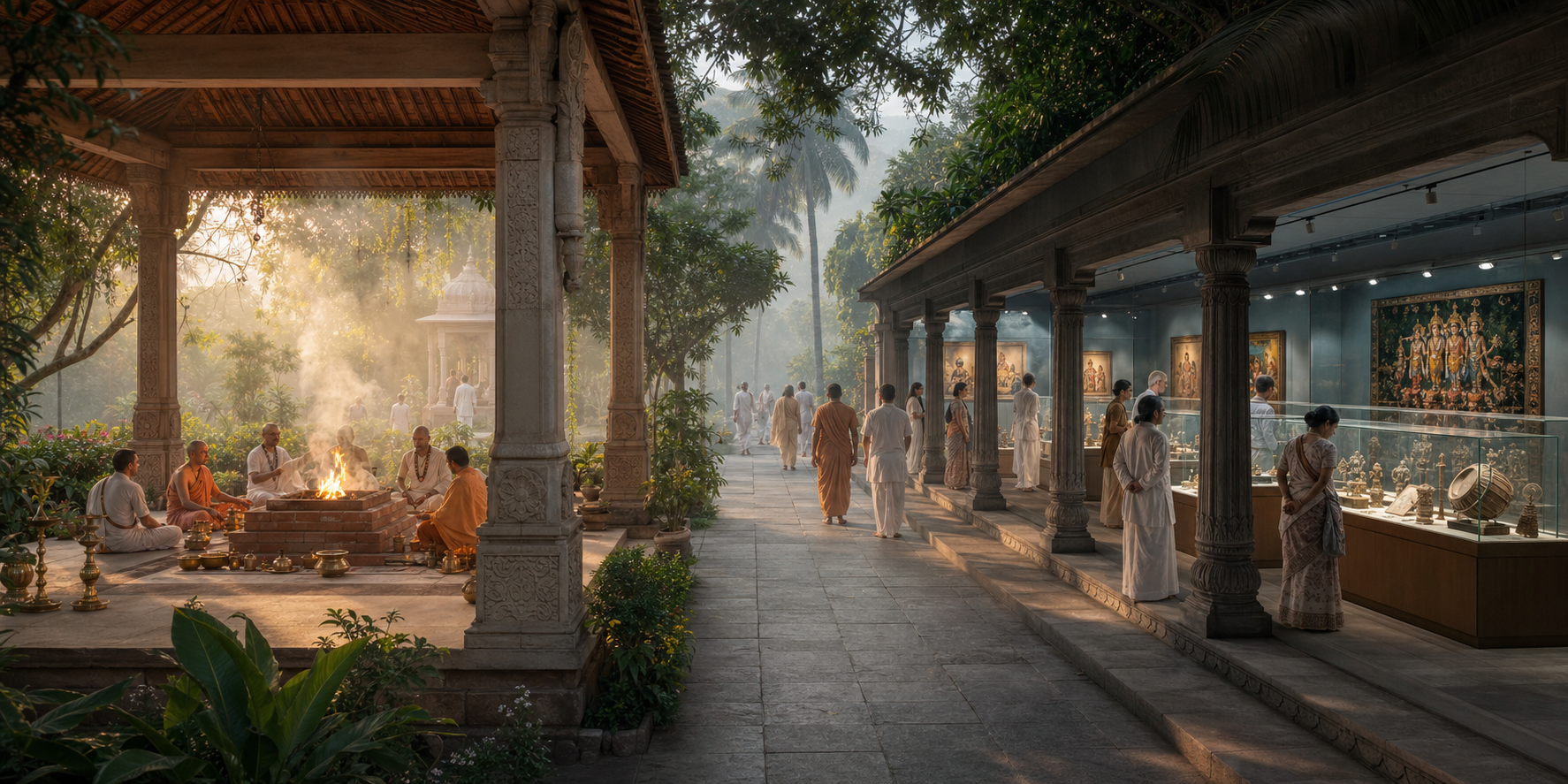
If you are planning a pilgrimage to Mayapur, it is easy to treat the TOVP Yajna Shala and the museum dedicated to Srila Prabhupada as two more places to add to your route. That would miss their deeper relationship. One is meant to preserve Vedic knowledge through disciplined practice; the other is meant to preserve a modern spiritual lineage through evidence, interpretation, and public memory.
You will understand both spaces better if you approach them with different kinds of attention. At the Yajna Shala, watch how a tradition is enacted. In the museum, ask how a tradition is documented. Before arranging your visit, however, verify the current operating status of each space rather than assuming that an announced inauguration date provides today’s visitor information.
First, separate the two experiences
The TOVP Yajna Shala is a consecrated setting for Vedic fire ceremonies. The Legacy Museum is being developed as a multidisciplinary account of the life, teachings, travels, and institutional work of A.C. Bhaktivedanta Swami Prabhupada, the Founder-Acharya of ISKCON. Their purposes are distinct, but their placement within the same larger sacred project creates an important dialogue between practice and memory.
| Space | Primary mode of learning | What to notice | Common mistake |
|---|---|---|---|
| TOVP Yajna Shala | Ritual performed in a living community | Order, restraint, mantra, offering, sacred boundaries, and the roles of participants | Treating the fire ceremony as a visual performance detached from its discipline |
| Srila Prabhupada Legacy Museum | History interpreted through objects, records, media, and narrative | Provenance, chronology, context, translation, travel, and institutional development | Treating devotional admiration as a substitute for examining the evidence |
February 11, 2026, was announced as the date for the Yajna Shala’s inauguration and the museum’s grand opening. That date does not, by itself, establish current opening hours, exhibit completion, admission arrangements, ritual schedules, or access rules. Confirm those details directly with the Mayapur or TOVP administration before committing travel time, especially if either space is the main reason for your journey.
At the Yajna Shala, learn by attending to discipline
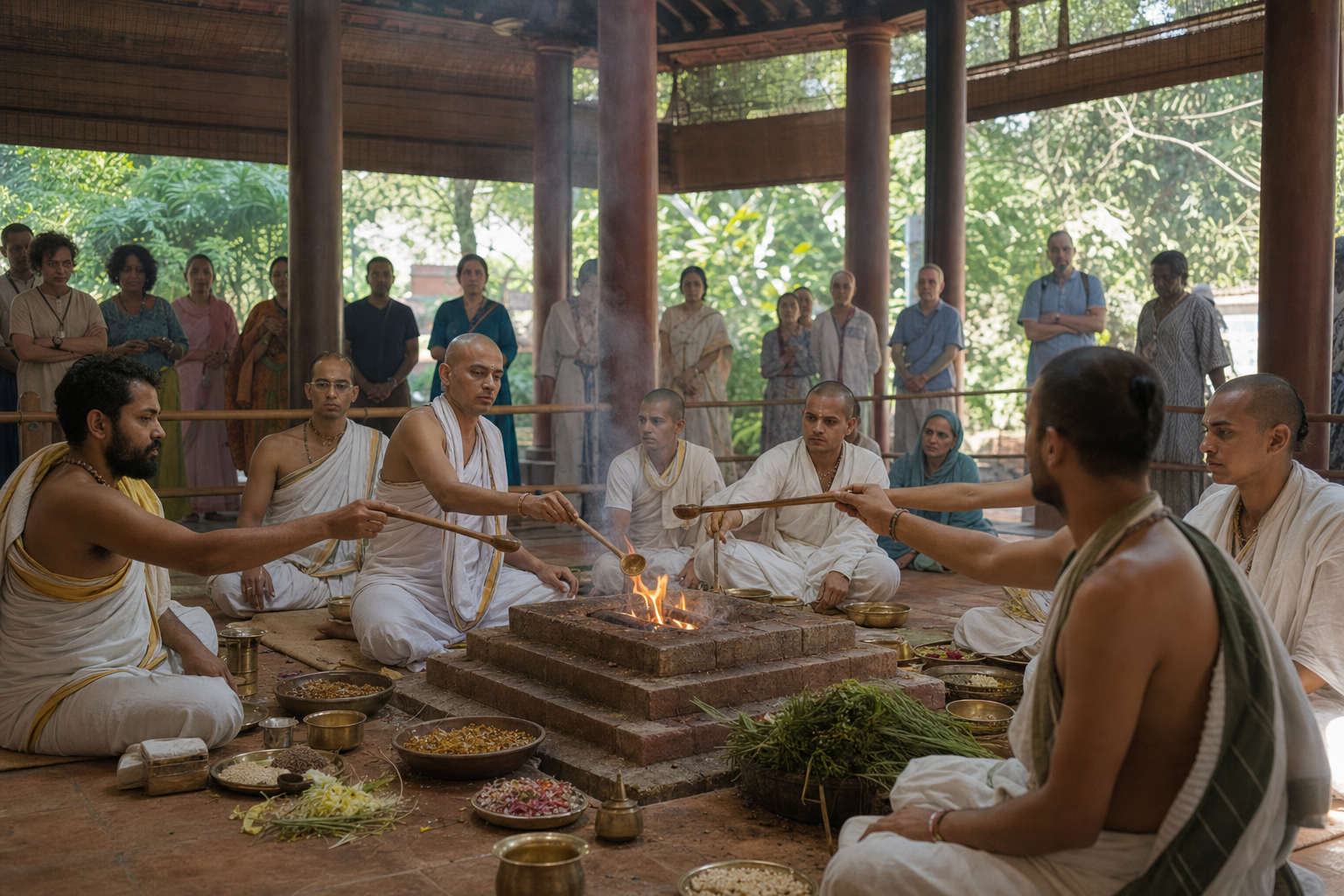
A yajna is not simply a fire surrounded by Sanskrit recitation. Offerings, mantra, intention, authorized roles, timing, and the sanctity of the ritual space belong together. The visible flame is therefore only one part of what is happening. If you concentrate exclusively on the spectacle, you may overlook the ordered conduct that gives the ceremony its religious meaning.
The Yajna Shala has been conceived around sacred architecture, ritual precision, and community participation. That combination matters. Architecture marks out a place for sacred action; precision carries inherited knowledge into the present; participation places that knowledge within a community rather than leaving it as an antiquarian subject.
- Establish what kind of access is available. An open hall, a ceremony that visitors may observe, and a yajna in which registered participants have defined roles are not the same situation. Ask before assuming that physical access means ritual participation.
- Follow the boundaries you are given. Stand or sit where the officiants and sevaks direct you. Do not cross into the ritual area, handle implements, approach the fire, or interrupt an officiant unless explicitly invited.
- Watch the sequence rather than chasing isolated symbols. Notice how preparation leads into invocation, offering, repetition, and conclusion. A ritual is intelligible as an ordered whole; a photograph of one dramatic instant rarely communicates that whole.
- Ask before photographing or recording. A space may welcome visitors while limiting photography during sacred actions. Keep your phone silent even when recording is permitted.
- Save explanatory questions for an appropriate moment. Ask a designated guide or knowledgeable sevak after the rite rather than seeking commentary from someone who is performing a ritual duty.
This approach lets you remain receptive without pretending to an authority or role you have not been given. Respectful observation is not lesser participation. It is often the correct form of participation for a visitor.
At the museum, ask how devotional memory becomes history
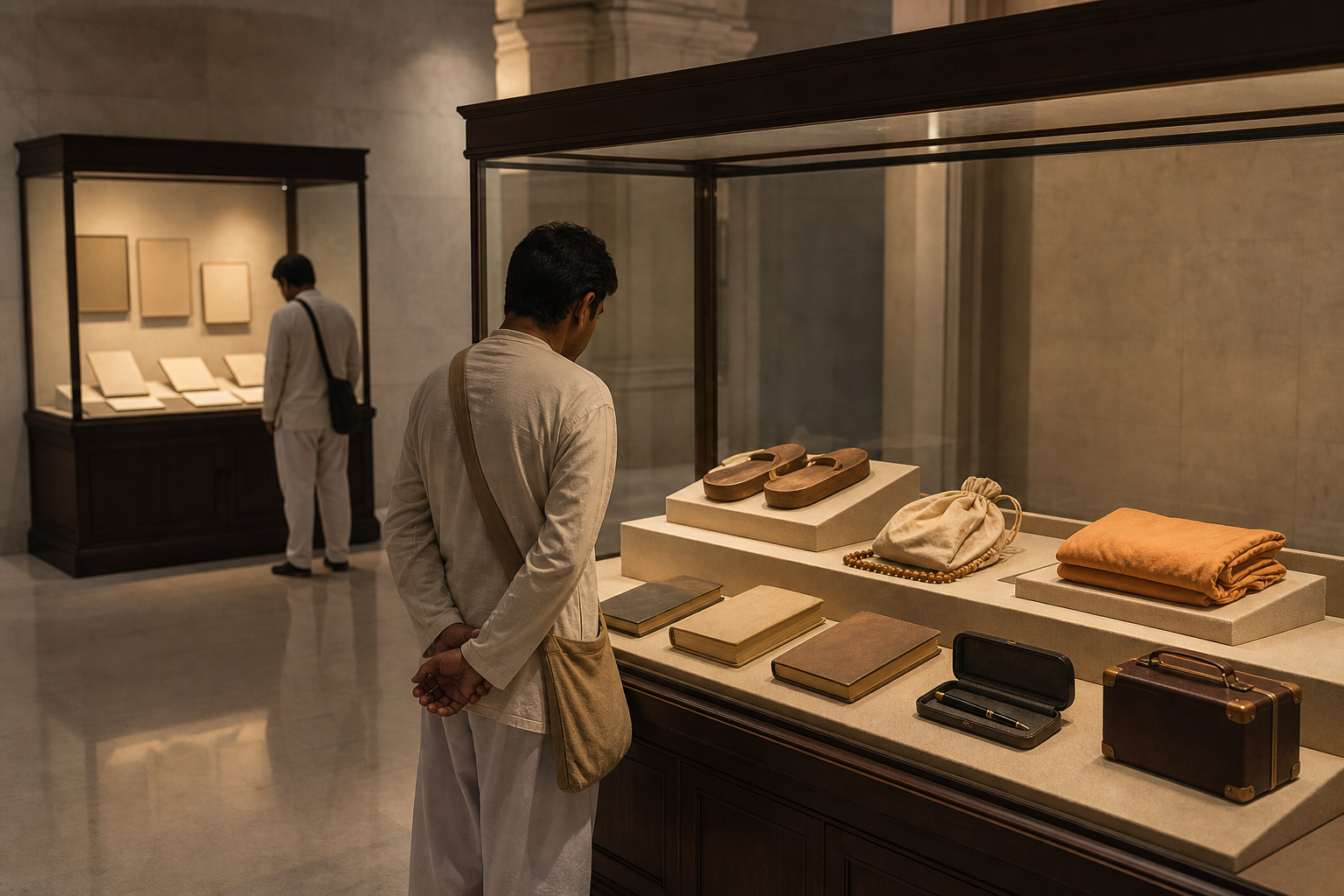
The Legacy Museum is intended to combine manuscripts, archival materials, multimedia displays, and the global histories of Gaudiya Vaishnavism and ISKCON. Its proposed scope includes Srila Prabhupada’s teachings, journeys, and the development of the institution he founded across continents. The stated ambition is eventually to become the world’s largest museum devoted to a single person. That is a plan and a measure of intended scale, not a reason to suspend critical attention.
A spiritually serious museum should welcome careful questions. Reverence and documentation are not rivals. Provenance protects sacred memory from careless repetition, while context helps a new generation understand why an object, letter, journey, translation, or institutional decision mattered.
- Is the object original, reproduced, or digitally represented? Each can be valuable, but the label should make the distinction clear.
- What date and place are attached to it? A manuscript or personal object becomes historically useful when you can locate it within a life and a sequence of events.
- How does it connect teaching with action? Look for the relationship between Prabhupada’s theological message, his travels, his translations, and the institutions built around them.
- Whose voice is interpreting the material? Distinguish Prabhupada’s own words from later narration, curatorial explanation, and recollection.
- Does the display explain the wider Gaudiya Vaishnava lineage? A founder’s legacy becomes clearer when visitors can see what he received, what he transmitted, and how transmission changed across languages and continents.
If you are visiting with children or students, give each person one object or display to study closely. Ask them to record its date, provenance, purpose, and connection to the larger history. That simple exercise turns a quick walk through display cases into a lesson in how civilizational memory is preserved.
Read the pair as a dharmic institution, not two attractions
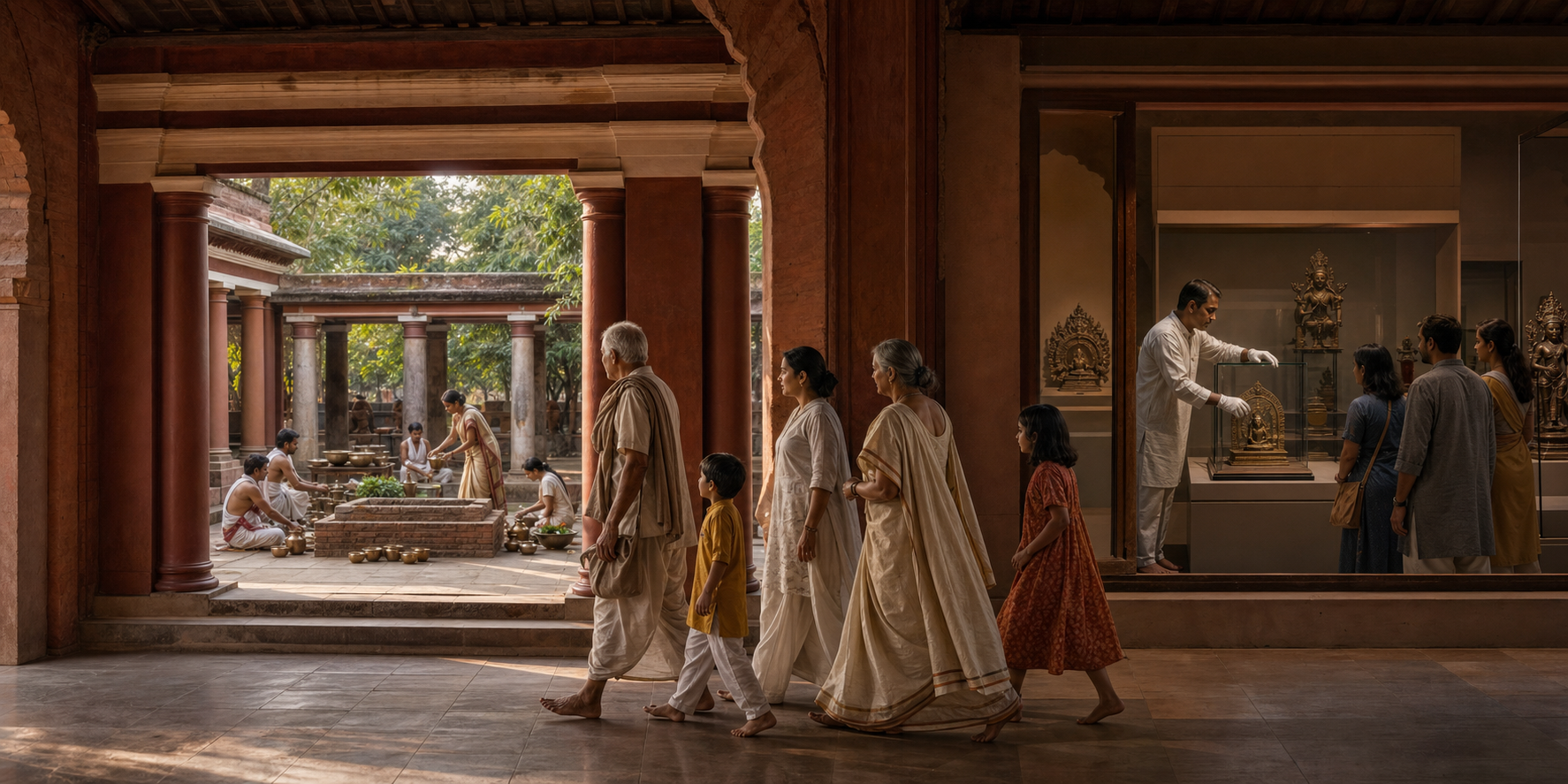
The most useful question is not which of the two spaces is more impressive. It is what each preserves that the other cannot. A museum can document a ritual tradition, but it cannot replace disciplined performance. A ritual hall can embody continuity, but it cannot by itself provide the archives, chronology, and explanatory context required by scholars, students, diaspora families, or visitors encountering Gaudiya Vaishnavism for the first time.
This distinction gives families and educational groups a practical way to read the site. After seeing both spaces, discuss two questions: What knowledge survives only when people continue to practise it? What knowledge needs objects, records, labels, and archives to remain publicly intelligible? The first question reveals the limits of a museum. The second reveals the limits of memory without documentation.
The museum’s global scope also places Mayapur within the story of Bharat’s modern spiritual influence. By tracing Prabhupada’s movement across continents and the development of ISKCON, it can show how a lineage rooted in Gaudiya Vaishnavism entered new languages, societies, and institutions. The valuable question is not merely how far the movement travelled, but how teachings were translated, communities were formed, and continuity was maintained while contexts changed.
The wider dharmic significance should also be handled with precision. Seva, compassion, wisdom, disciplined practice, and respect for plurality can support conversation among Hindus, Buddhists, Jains, and Sikhs. Shared ethical vocabulary, however, does not mean identical theology, ritual, or historical experience. If you are using the site for inter-dharmic education, begin with a clearly identified practice or value and let each tradition speak in its own terms. Unity becomes more credible when it does not erase difference.
Key takeaways for your Mayapur visit
- Confirm the current status, hours, entry arrangements, and ceremony schedule for the Yajna Shala and museum separately.
- Ask whether a yajna is open to observation, requires registration, or assigns particular roles to participants.
- Follow on-site instructions concerning sacred boundaries, seating, photography, and recording.
- At the Yajna Shala, pay attention to ritual order and responsibility rather than watching only the fire.
- At the museum, distinguish original artifacts, reproductions, direct words, later recollections, and curatorial interpretation.
- For a family or study group, compare what living practice preserves with what archives and exhibits preserve.
- Treat the proposed scale of the museum as an ambition; judge its educational value by provenance, context, clarity, and accessibility.
Plan enough time to encounter the two spaces without rushing from one photo opportunity to the next. If access is confirmed, go first as a student of practice and then as a reader of history. That sequence will help you see why Mayapur needs both a place where tradition is enacted and a place where its modern transmission can be examined.
References
