
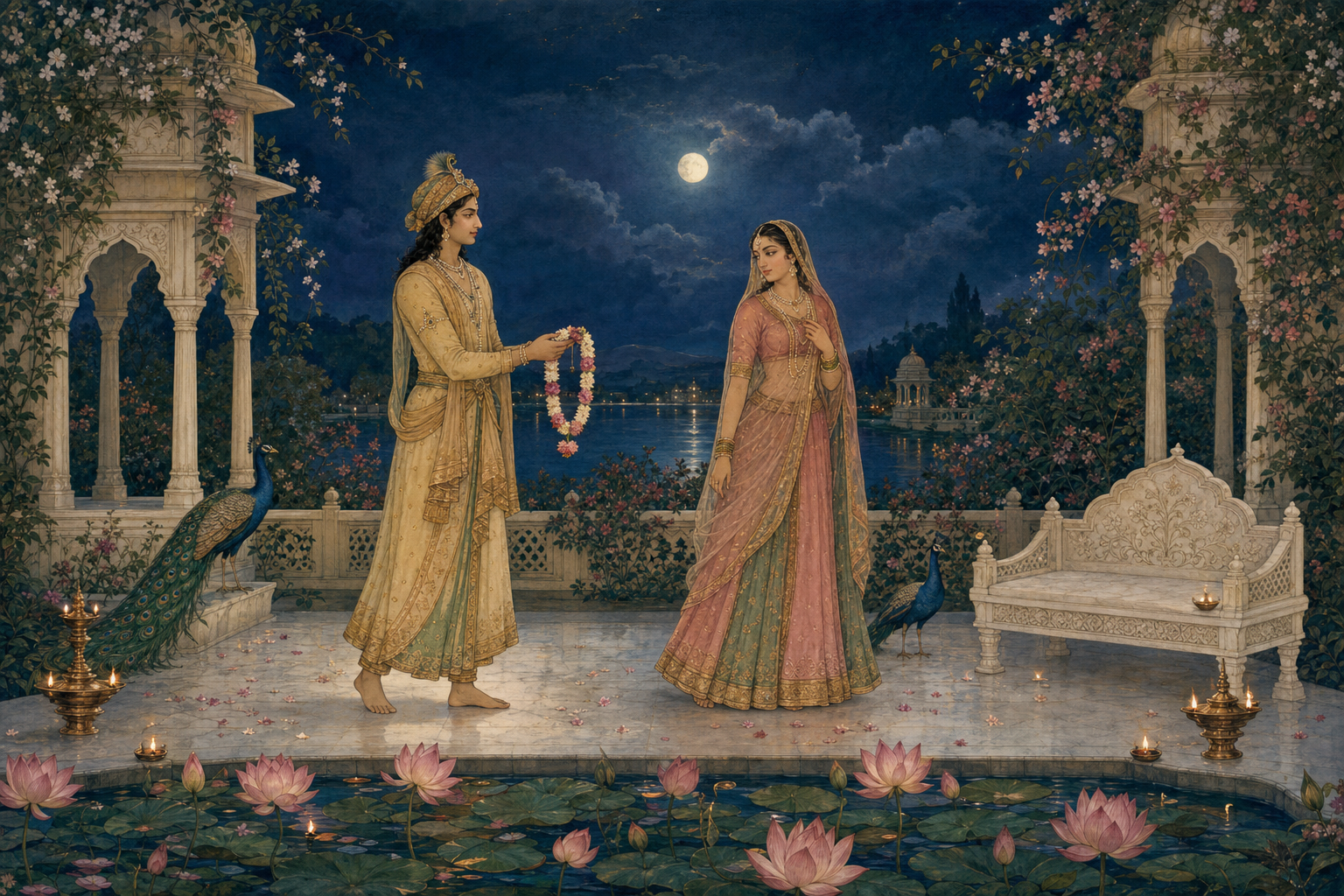
A garden, a garland, a turned glance, or an empty place beside a lover can look like romantic decoration. If you stop at the plot—two people meet, or two people part—you miss what classical Indian aesthetics asks you to notice.
The useful question is not merely, “What are these characters feeling?” It is, “How has affection been shaped so that I can experience its beauty?” Once you learn that distinction, Sringara becomes easier to recognize in poetry, classical dance, temple sculpture, music, and devotional expression without reducing every work to either sensuality or allegory.
Begin with rasa, not with romantic subject matter
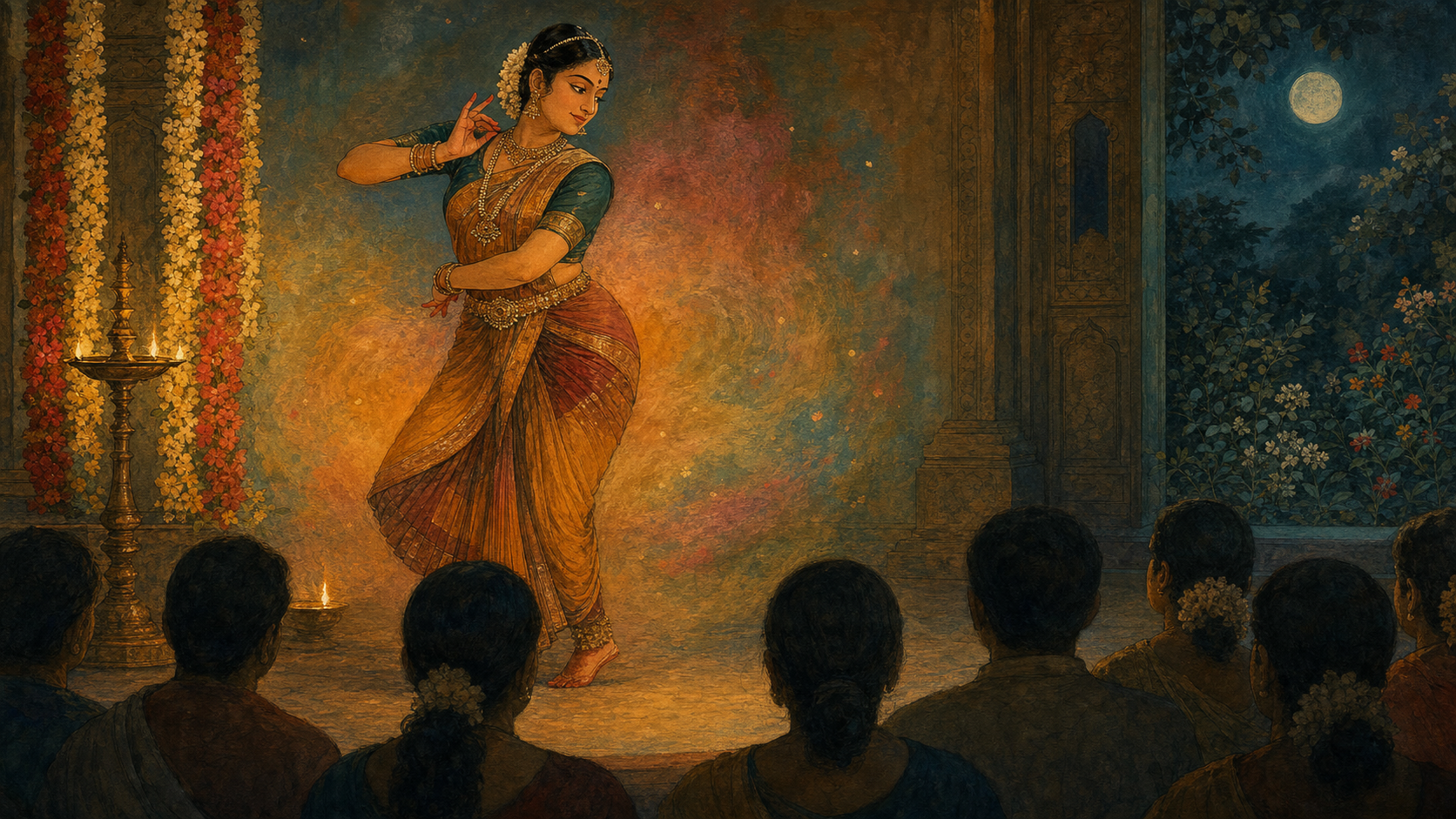
Classical Sanskrit aesthetics counts Sringara among the nine rasas and grounds it in rati, the enduring sentiment of affection. That distinction between sentiment and rasa is the key to reading the art accurately.
Rati is the stable affection operating within the represented emotional world. Sringara is that affection after artistic form has made it available for aesthetic contemplation. A character may love, desire, remember, wait, or rejoice. You, as the reader or spectator, are given a composed experience in which setting, expression, movement, and temporary states work together.
This is why “romance” is an incomplete translation. Sringara embraces love and beauty, including sensuous detail, but it is not produced merely by placing lovers in a scene. Nor does the presence of an ornament, an embrace, or an attractive body establish the rasa by itself. You have to examine the whole emotional arrangement.
- Sthayi bhava: the enduring emotional basis, which is rati in Sringara.
- Vibhavas: the persons, objects, circumstances, and settings that awaken or sustain the affection.
- Anubhavas: the perceivable expressions of that inner state, such as gestures, glances, and movement.
- Vyabhichari-bhavas: passing emotional states that color the moment without replacing its stable center.
- Rasa: the integrated aesthetic experience made possible by their interaction.
Use those terms as a sequence for attention, not as a mechanical equation. A work succeeds through the relation among its elements. Naming the elements simply helps you see what the work is doing.
Union and separation reveal two movements of one love

Sringara unfolds through two foundational modes: Sambhoga, love in union, and Vipralambha, love in separation. Do not reduce these to happy and sad scenes. The distinction identifies where affection becomes perceptible: through fulfilled presence or through an absence charged with memory and longing.
Sambhoga: In union, the beloved is present and love finds fulfillment in closeness. Seasons, garlands, ointments, ornaments, beautiful surroundings, gardens, sense objects, and the sight of the beloved can serve as stimuli that prepare the mind for intimacy and beauty. None of these is a self-sufficient symbol. Their force comes from their relation to rati and to the lovers’ expressive behavior.
When reading Sambhoga, look for convergence. Does the setting support the meeting? Do glances and movements acknowledge the beloved? Do several details direct attention toward shared presence? A garden may be merely a location in one work and a powerful vibhava in another. The difference lies in how the work organizes it.
Vipralambha: Separation is not an unsuccessful or incomplete version of Sringara. It gives love another means of disclosure. Memory preserves the beloved in absence; longing directs attention toward what cannot presently be reached; restraint can intensify tenderness instead of extinguishing it. The emotional weight falls not on emptiness alone but on an emptiness made meaningful by continuing affection.
This changes how you interpret an absent figure. If a poem, dance, or image repeatedly directs attention toward remembrance, distance, or the expected beloved, do not conclude that Sringara has disappeared because union is missing. Ask whether absence has become the very condition through which rati is revealed.
Use this five-step method on a poem, dance, or sculpture
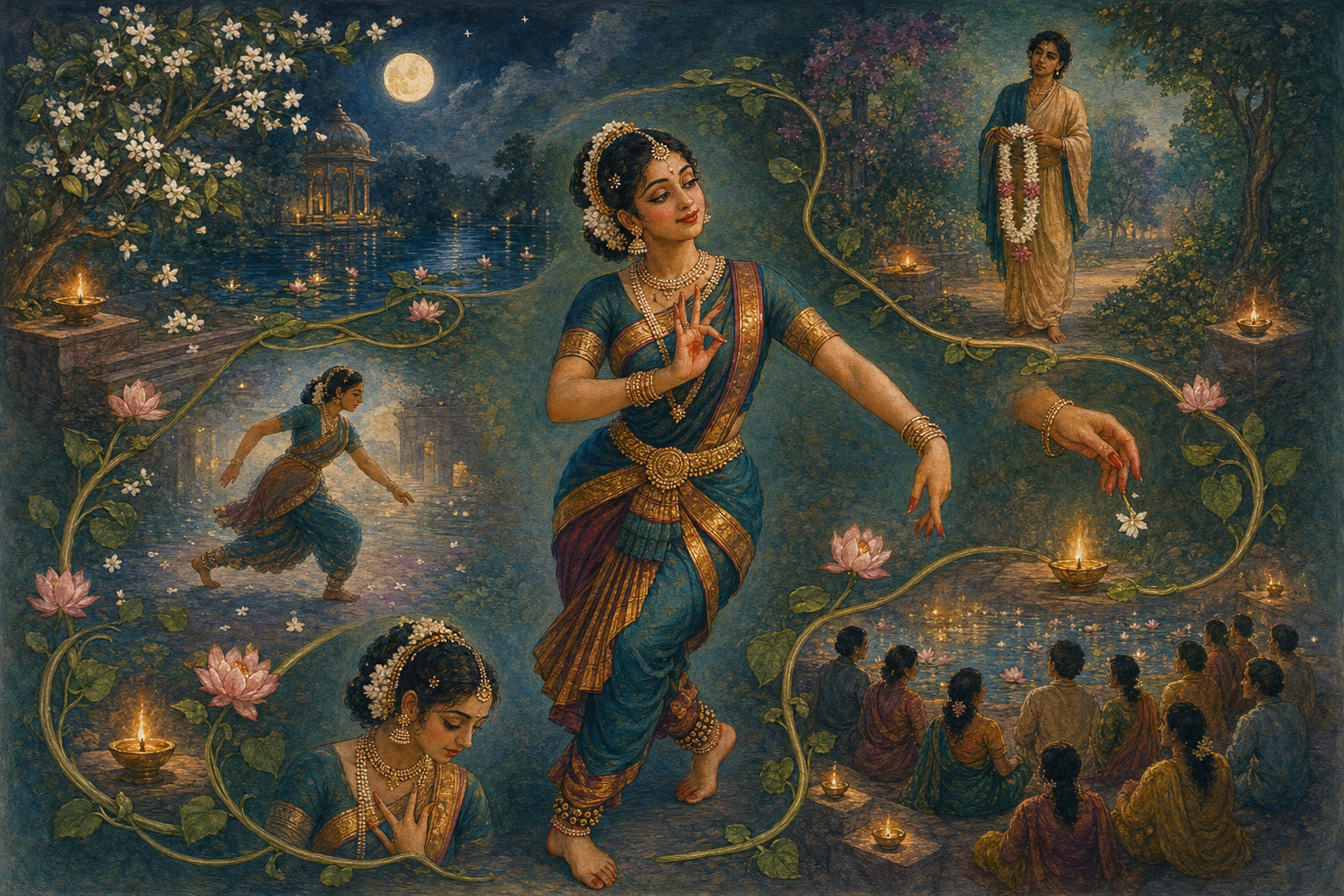
You do not need to identify every technical category before responding to a work. Start with five disciplined observations. They will prevent the two most common mistakes: treating Sringara as decorative romance and forcing a spiritual meaning before reading the artistic evidence.
- Name the stable emotional center. Ask what persists when the scene’s momentary reactions change. If enduring affection organizes the work, rati may be its basis.
- Inventory the vibhavas. Note the beloved, season, garden, ornament, dwelling, sensory object, remembered place, or other circumstance that awakens the emotional situation. Do not interpret each detail in isolation.
- Identify the anubhavas. Watch what makes the inner state perceptible: a glance, recurring gesture, change of bodily direction, or purposeful movement. Ask what the expression points toward.
- Separate passing states from the enduring one. A temporary emotional change can complicate affection without replacing it. Notice what passes and what continues to govern the scene.
- Decide whether love operates through union or separation. Presence, fulfillment, and mutual attention point toward Sambhoga. Longing and memory organized around an absent or distant beloved point toward Vipralambha.
Consider a hypothetical dance passage. A performer enters a garden, wears a garland, sees the beloved, and answers that presence with a deliberate glance and movement. The garden and garland function as vibhavas; the glance and movement function as anubhavas; continuing affection provides the stable center; and the beloved’s presence places the passage in Sambhoga.
Now change only the emotional arrangement. The performer enters the same garden, turns toward the place where the beloved once stood, and repeats a gesture shaped by memory. The physical setting remains, but its function changes. The garden now carries remembered presence, and the empty place acquires meaning through separation. That is a more precise reading than saying merely that one scene is joyful and the other sorrowful.
In Bharatanatyam, Kathak, and Odissi, abhinaya, gesture, glance, movement, and lasya can make this emotional grammar visible. Watch for clusters of signs rather than hunting for one decisive gesture. Costume and ornament may prepare the atmosphere, but expression shows how that atmosphere is connected to affection.
Use the same discipline when viewing temple sculpture. Begin with the relation among figures, their bodily orientation, the surrounding forms, and the details that direct attention. Sensuous form should not be dismissed as mere erotic display, but it should not automatically be declared mystical either. First establish how the composition makes love or beauty perceptible; then consider whether the work’s setting supports a devotional or philosophical interpretation.
A short FAQ for difficult cases
Is Sringara simply the aesthetic name for erotic content?
No. Sensuous detail can participate in Sringara, but a depiction of desire or an attractive body does not automatically produce the rasa. Sringara is the aesthetic realization of love and beauty grounded in rati. You still need the relevant circumstances, expressions, and emotional coherence.
Can a garland, garden, or glance prove that Sringara is present?
No single object or gesture proves it. A garland may be ceremonial, a garden may simply locate the action, and a glance may express something unrelated to affection. Treat each as possible evidence, then test whether the details work together around rati.
Does love in separation belong to a different rasa?
Not merely because the beloved is absent. Vipralambha is one of Sringara’s foundational modes. If longing and memory continue to organize the experience around enduring affection, separation is carrying the rasa rather than negating it.
Should every scene of human love be read as devotional allegory?
No. Love, compassion, and devotion have deep resonances across Hindu, Buddhist, Jain, and Sikh traditions, and Sringara can support spiritual reflection. But resonance is not automatic equivalence. Let the work’s language, setting, figures, and purpose establish a devotional reading. Otherwise, honor the aesthetic experience without forcing it to become a coded theological statement.
Take one verse, dance passage, or sculptural panel and annotate it in five lines: enduring affection, vibhavas, anubhavas, passing states, and union or separation. Only after that should you ask what ethical, philosophical, or spiritual meaning the work opens. That small change in reading order lets Sringara disclose its depth without losing its sensuous particularity.
References
