
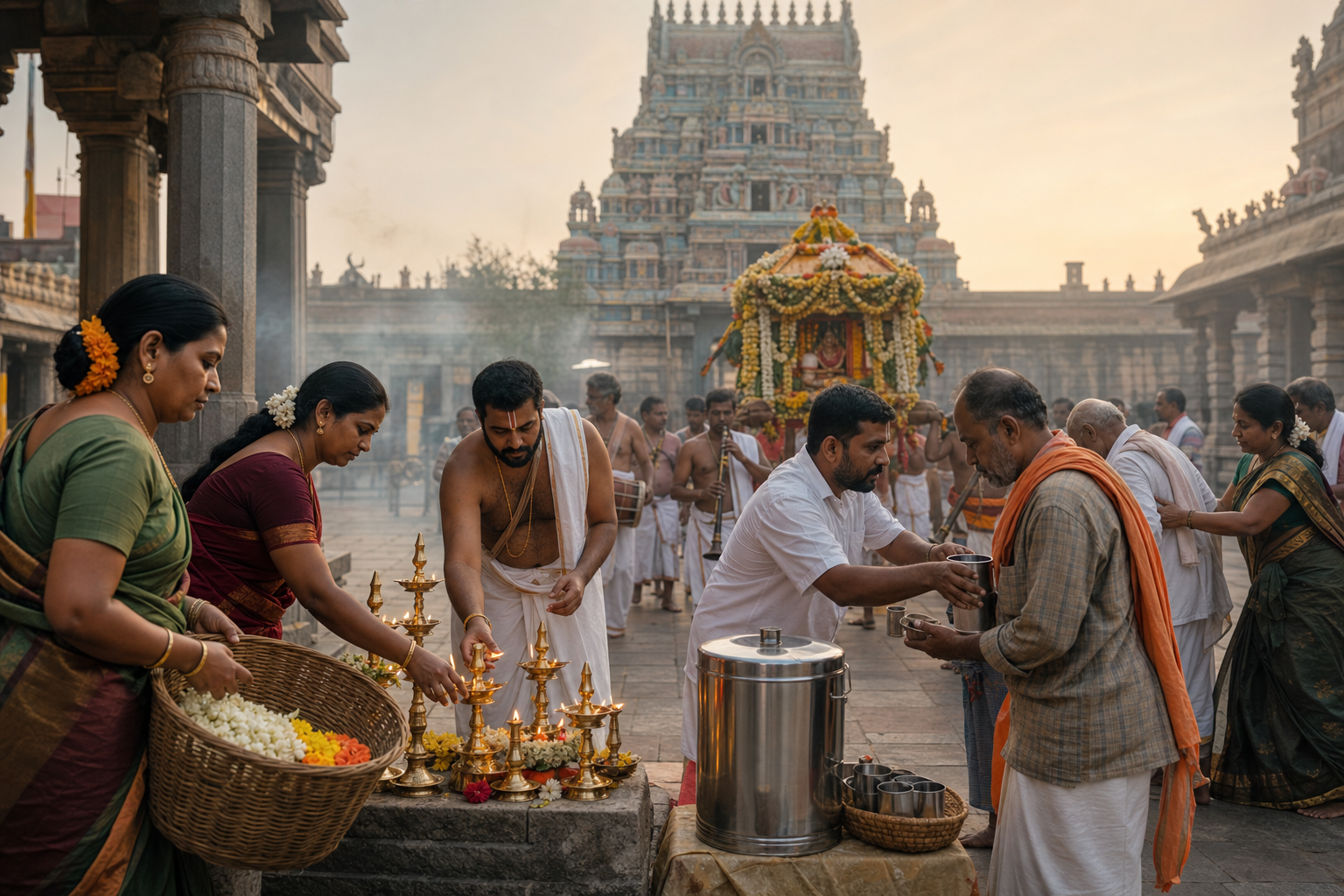
You have chosen the festival, arranged the journey, and made time for darshan. One question remains: when you enter the temple or join the procession, what should you actually do? Should you bring an offering, ask to volunteer, follow the crowd, or remain a quiet observer?
At a South Indian temple festival, meaningful participation is not measured by how close you get to the deity or how much activity you can fit into the day. It begins with understanding the sacred work being performed, placing yourself under the temple’s discipline, and offering only the service that the occasion can receive without disruption.
Begin with the festival’s sacred purpose
Before deciding how to serve, identify what the festival is doing. A consecration ceremony and a narrative festival may both include processions, music, offerings, and large gatherings, but those visible similarities do not make them ritually identical.
A Dhwajasthambha Samprokshana renews the temple’s flagstaff as part of the renewal of sacred space. The dhwaja is associated with the living presence of the deity and the public upholding of dharma. Purificatory procedures, Vedic recitation, and processional worship therefore belong to a carefully ordered act of consecration, not merely to the ceremonial opening of a public event. The observance associated with Sri Lakshmi Narasimha Swamy Temple at Tarigonda illustrates this relationship among the flagstaff, the presiding deity, ritual discipline, and communal devotion.
Avani Moolam at Madurai works through another ritual language. It reenacts a Thiruvilayadal in which Sundareswarar assumes the form of a laborer, carries sand for a devotee who sells puttu, and receives that simple food as his wage. The public procession, puranic narration, music, dramatic remembrance, and offering of puttu allow devotees to encounter a teaching about humility and labor as a lived event rather than an abstract proposition. The festival occurs on the Moolam nakshatra during the Tamil month of Avani, generally falling in August or September, and binds the sacred calendar to the civic life of Madurai.
Ask three questions before you leave home:
- What is being consecrated, remembered, offered, or enacted?
- Which parts invite public participation, and which belong to trained temple functionaries?
- What conduct will protect the central rite rather than compete with it?
Your answers determine the right form of service. During a consecration, respecting access boundaries and ritual timing may be more useful than seeking an active role. During a narrative festival, listening to the recitation and understanding the offering may matter more than obtaining the best view of the procession. If the answers remain unclear, wait for the temple’s instructions rather than filling the gap with your own assumptions.
Choose service the temple can actually use
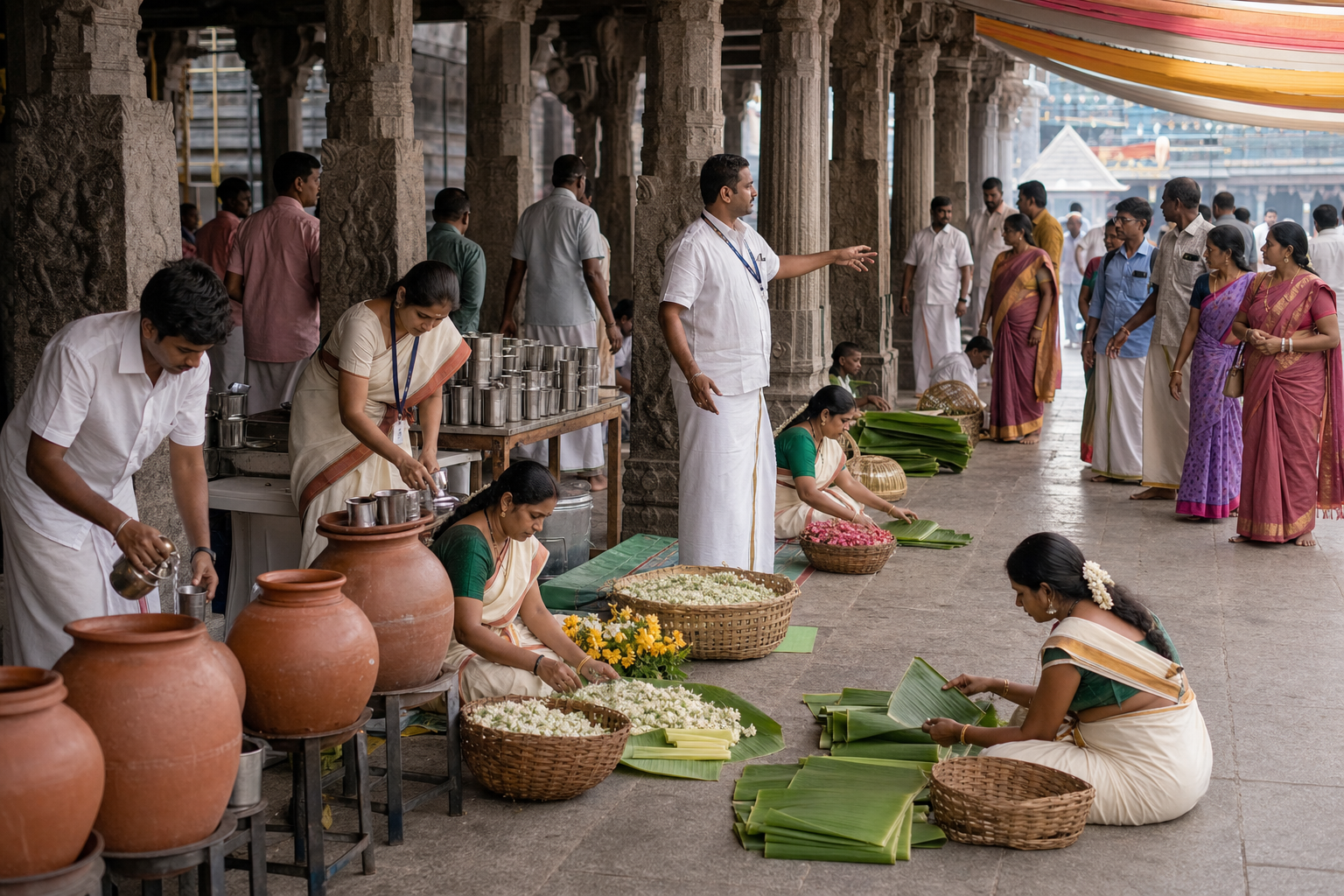
Seva is not simply volunteering in a sacred location. It is effort placed under the purpose of the deity, the ritual, and the community. Sincerity matters, but sincerity alone does not authorize you to handle ritual objects, enter a working area, organize an offering, or redirect other devotees.
Use this sequence when you want to help:
- Check official temple communications for the schedule, visitor guidance, entry arrangements, and any announced opportunities for service. A forwarded message can alert you to an event, but the temple’s own communication should govern your plan.
- State the festival’s central purpose in one sentence. If you cannot explain what the rite is doing, learn that before choosing a role.
- Ask one operational question: “Where may I help, and who is coordinating that work?” Address it to the designated organizer or temple representative if one is available.
- Accept a bounded task. If organizers request help with distribution, queue guidance, preparation, or cleaning, clarify the task, location, and responsible person before beginning.
- Bring only what has been requested. Unsolicited food, ritual materials, banners, equipment, or independent distribution can create another burden for the people already coordinating the festival.
- Expect correction without taking offence. A changed route, closed area, delayed entry, or reassigned task may reflect ritual requirements that are not visible to you.
The decisive distinction is not between active and passive participation. It is between authorized and self-appointed action. If no service role is available, attentive attendance remains a valid discipline: follow the announced order, keep movement paths clear, listen when recitation begins, and allow other devotees to receive darshan.
A donation can support a temple, but it does not confer ritual authority, privileged access, or ownership of the occasion. Likewise, recording a festival does not take priority over worship. Check the temple’s photography rules, keep your device out of another person’s line of sight, and never turn a consecrated focus or moving deity into a backdrop that must be approached at any cost.
Read consecration and divine play differently
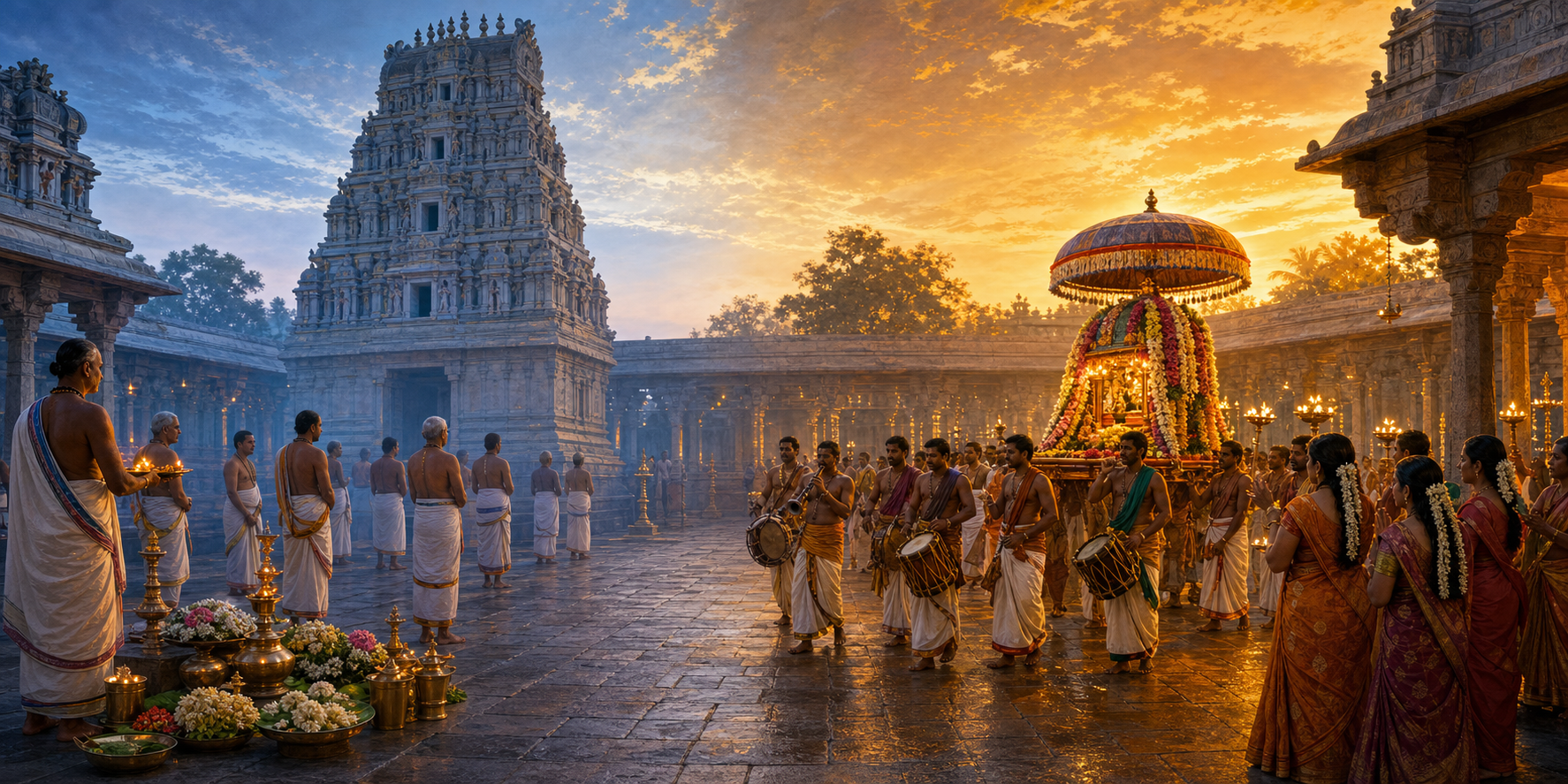
At a Dhwajasthambha Samprokshana, protect ritual order
Samprokshana is not ordinary maintenance followed by a decorative religious ceremony. The sanctification is itself the central work. In a Dhwajasthambha observance, the flagstaff becomes the visible focus of renewal within the temple’s sacred order. Agamic discipline, Vedic recitation, purification, and processional worship give that renewal its liturgical form.
This changes what you should notice. Purificatory actions prepare the sacred setting. Recitation gives the rite an audible order. Processional worship relates the renewed flagstaff to the deity and the gathered community. What may look like a pause or restriction to a visitor can be part of that ordered movement.
- Confirm the exact timing and public access arrangements from the temple, especially when a detailed program is released close to the observance.
- Follow the directions of priests, functionaries, and authorized volunteers without trying to anticipate or improve the ritual sequence.
- Keep processional and working routes open, even when another position appears to offer a better view.
- Do not touch the flagstaff, ritual materials, vessels, or prepared areas unless you have been explicitly assigned to do so.
- Observe the relationship among the flagstaff, the presiding deity, recitation, and congregation. That relationship carries more meaning than any isolated visual detail.
The renewed dhwaja makes continuity visible. Your service supports that continuity when it preserves discipline, enables worship, and leaves the sacred focus with the deity rather than the helper.
At Avani Moolam, let the story interpret the spectacle
At Madurai’s Avani Moolam celebration, the processions of Meenakshi and Sundareswarar, the sound of nadaswaram and tavil, the recitation and enactment of the Thiruvilayadal tradition, and the offering of puttu belong to one theological narrative. The Thiruvilayadal Puranam is attributed to Paranjothi Munivar, and its public retelling helps transmit the story across generations.
If you concentrate only on the crowd, music, or food, you will see the festival’s surface while missing its argument. Sundareswarar does not appear as a distant patron rewarding labor from above. He assumes the worker’s place, performs physical labor, and accepts a modest food as payment. The exchange sanctifies the devotee’s livelihood without pretending that work is beneath the divine.
- Learn the basic Thiruvilayadal episode before attending so that each public act has a narrative context.
- Make time for recitation or enactment instead of treating it as background before the procession.
- When puttu is offered, recognize its connection to livelihood, reciprocity, and the devotee’s simple means; do not reduce it to a festival novelty.
- Notice the people whose labor makes the celebration possible. The enacted teaching loses force if you honor divine humility while treating workers with impatience.
Here, the story is not an explanation added after the ritual. The festival performs the story in sound, movement, food, and public memory. Your task is to let that meaning govern how you watch and how you behave.
Let service change how you treat ordinary labor
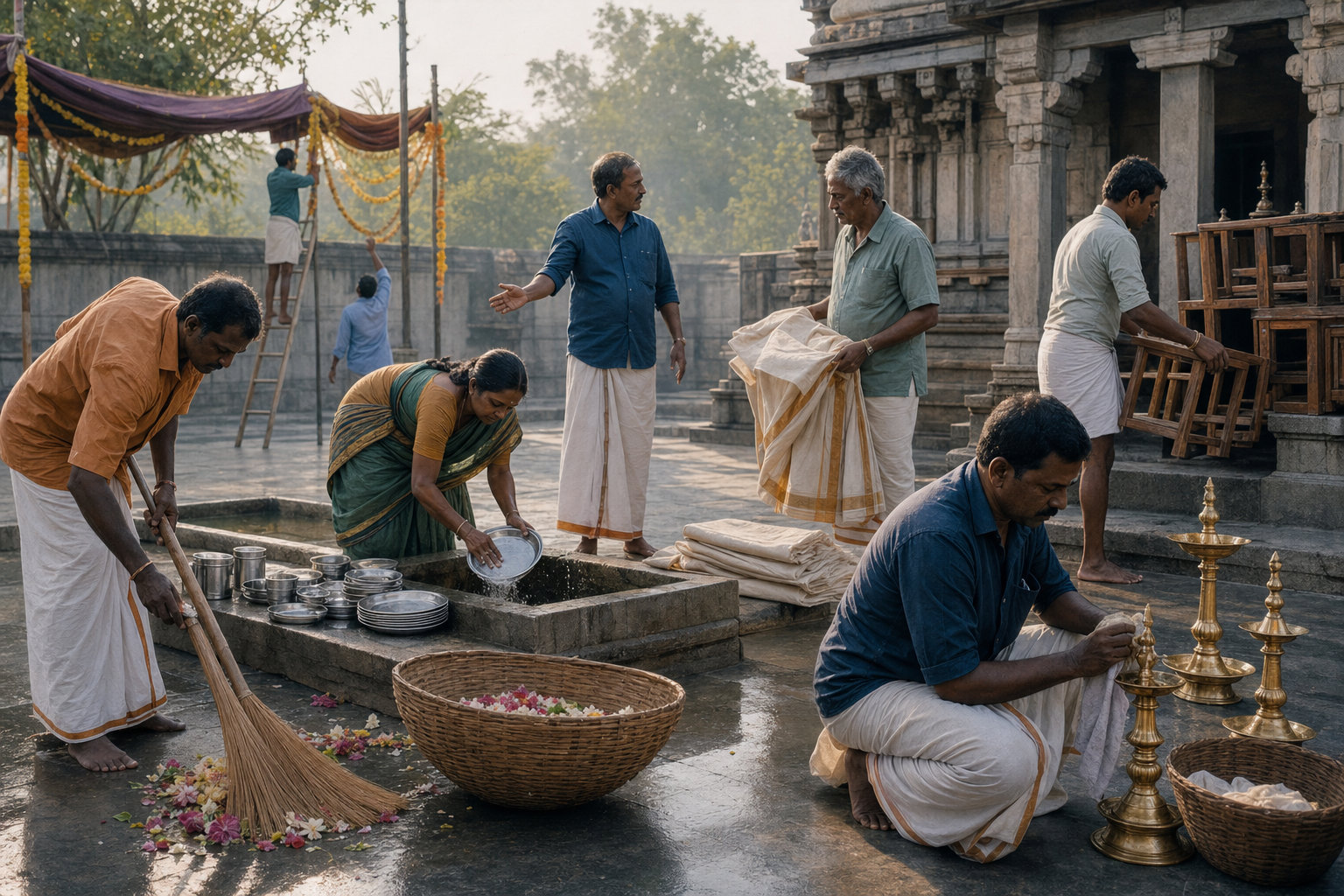
The easiest mistake is to admire seva as an ideal while overlooking the people already serving. A festival can inspire lofty language about devotion while cooks, musicians, attendants, cleaners, craftspeople, and temple functionaries carry its ordinary burdens. Sacred service becomes credible when your conduct lightens those burdens instead of adding to them.
Test your participation with four practical questions:
- Did my action complete an assigned need, or did someone have to stop and manage me?
- Did I preserve the congregation’s attention on the deity and rite?
- Did I extend the same patience to workers and other pilgrims that I associate with devotion?
- Can I do this without recognition, special access, or control over the result?
Avani Moolam gives these questions unusual sharpness. Shiva’s humility is not sentimental modesty. It is expressed by accepting the condition of a laborer and entering a devotee’s economy of work and food. If you respond by demanding precedence, bypassing a queue, speaking harshly to an attendant, or leaving disorder for someone else, your behavior contradicts the teaching you came to honor.
Dhwajasthambha renewal points to the communal dimension of the same discipline. A consecrated flagstaff stands before the temple as a public sign of sacred continuity and dharma. The rite depends on precise religious stewardship, but its meaning also calls the congregation to become worthy of what the symbol announces.
These festivals remain distinctly Hindu in deity, narrative, liturgy, and temple setting. Their wider dharmic resonances should be named without flattening those distinctions. Compassion in Buddhism, ahiṃsā and aparigraha in Jainism, and seva in Sikhism are not interchangeable doctrines. They nevertheless meet the Hindu emphasis here at an ethical point: spiritual seriousness becomes visible through restraint, care, humility, and service. First understand a festival in its own vocabulary; only then draw the wider civilizational connection.
Key takeaways for your next festival
- Name the central sacred act before deciding how you will participate.
- Use the temple’s official schedule and visitor instructions, especially when ritual details are released near the event.
- Ask for an authorized, bounded responsibility. If none is available, do not invent one.
- At a consecration, give priority to ritual boundaries, timing, and processional movement.
- At a narrative festival, learn the story and allow the narration, music, enactment, and offering to interpret one another.
- Measure seva by whether it reduces a real burden, protects worship, and requires no special recognition.
- Carry the teaching beyond the temple by changing how you treat ordinary work and the people who perform it.
Before your next festival, write a three-line plan: name what the rite is doing, name whose instructions you will follow, and name one form of service you can offer without becoming the centre. That small preparation can turn a day of religious sightseeing into disciplined participation in a living dharmic tradition.
References
- DharmaRenaissance Blog — Sacred Renewal: Dhwajasthambha Samprokshana 2026 at Tarigonda Lakshmi Narasimha Swamy Temple
- DharmaRenaissance Blog — Avani Moolam at Madurai Meenakshi Temple: Shiva’s Humility in the Puttu Festival
