
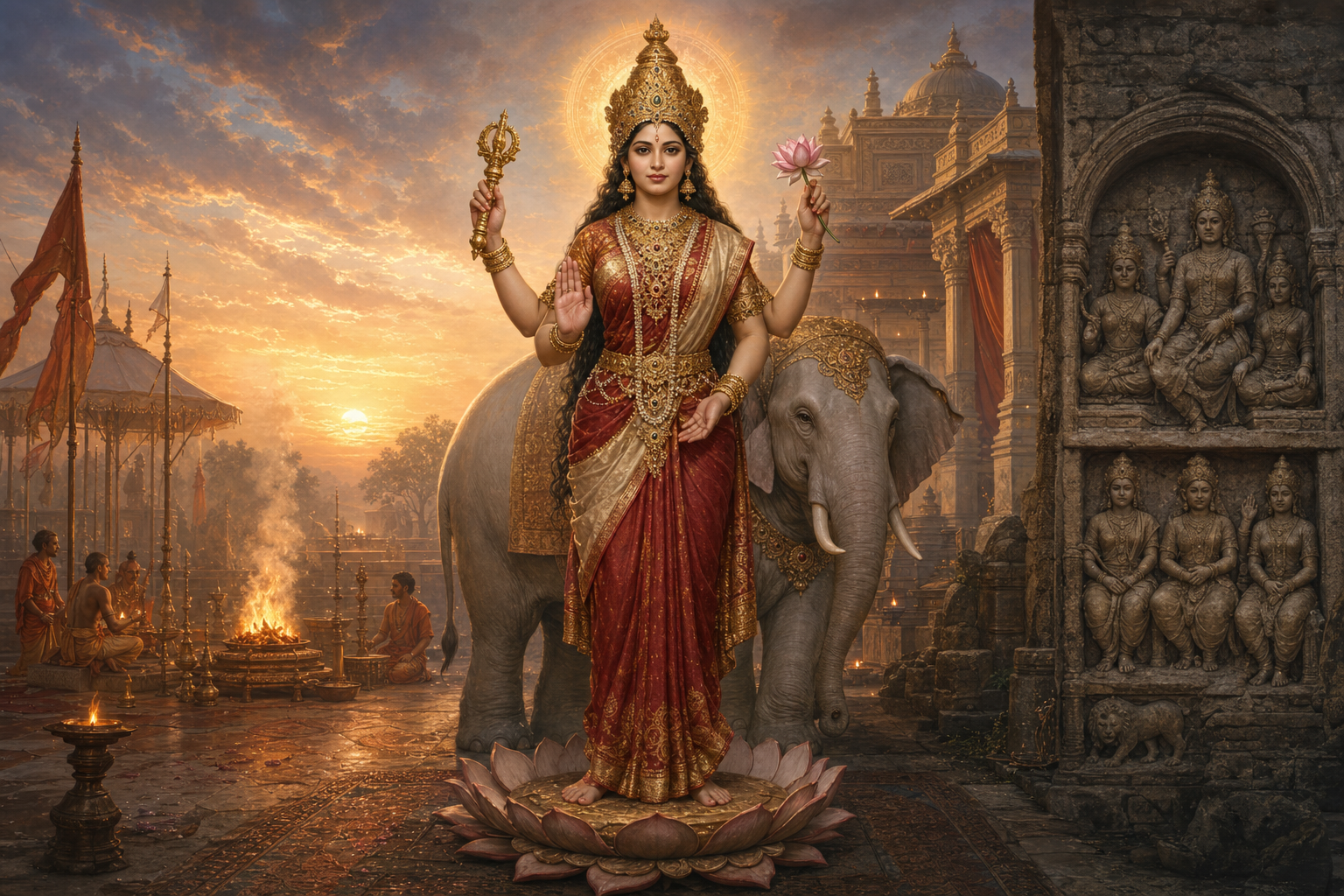
If you have encountered Shachi in a Vedic discussion, Indrani as the queen of the Devas, and Aindri in a Saptamatrika panel, you may wonder whether these are three goddesses or three names loosely joined by later tradition. The clearest answer is that they belong to one sacred identity, but each name places a different aspect of that identity in the foreground.
That distinction matters. It keeps you from reducing Indrani to a decorative consort, but it also keeps you from stripping away her relationship with Indra to make her seem independent in a modern sense. Her theology holds relationship, sovereignty, dignity, and protective power together.
Key takeaways: one goddess in three sacred frames
- Shachi and Indrani identify the same goddess. Shachi brings the divine personality into view, while Indrani emphasizes her royal relationship with Indra and her standing as queen of the Devas.
- The Vedic Indrani is not silent or incidental. Rig Veda 10.86 preserves her presence and voice in a setting concerned with status, rivalry, honor, and self-possession.
- Aindri is the Saptamatrika form of this power. In the company of the Seven Mothers, the emphasis moves from celestial queenship to collective protection and the restoration of order.
- The vajra and elephant are your strongest visual clues. They connect Aindri with Indra while expressing decisive force, majesty, and disciplined courage.
- Her practical lesson is not domination. Indrani helps you distinguish wounded pride from rightful dignity and impulsive aggression from action that actually protects dharma.
The Vedic starting point: a queen who speaks for herself
Indrani’s earliest textual footing appears in the Vedas, with Rig Veda 10.86 giving her a striking presence. This starting point is important because it prevents a common mistake: assuming that her significance began only when later iconography placed her among the Saptamatrikas.
Her Vedic identity is relational, but it is not passive. She is Indra’s consort and the queen of the Devas, yet she also possesses a voice, judgment, dignity, and a clear awareness of her rightful place. Consort here should not be read as an ornamental rank. It identifies a relationship within divine order while leaving her agency intact.
When you read Rig Veda 10.86, do not look only for a polished biography or the complete theology of the later Goddess traditions. A Vedic hymn need not function like a Purana or an iconographic manual. Watch instead for three things: when Indrani speaks, what threatens or tests her standing, and how she asserts that standing. Those questions reveal why honor, rivalry, jealousy, and self-possession became important lenses for contemplating her.
Jealousy is especially easy to mishandle. A shallow reading treats it as proof that divine figures merely reproduce human pettiness. An equally shallow devotional reading refuses to notice the uncomfortable emotion at all. A more useful approach asks what jealousy discloses. It may reveal insecurity, but it can also reveal a fear of displacement, an injured boundary, or a demand for proper recognition. Indrani’s presence invites you to examine the emotion without allowing it to rule your conduct.
Use a simple test when interpreting her Vedic identity. If removing Indra from your explanation makes Indrani disappear entirely, you have reduced her too far. If preserving her autonomy requires you to ignore her queenship and relationship with Indra, you have also lost part of the Vedic picture. Her distinctiveness lies in holding both truths at once.
How Indrani becomes Aindri among the Seven Mothers
Later Puranic and Shakta traditions do not simply discard the Vedic queen and invent a replacement. They place her power in a new field of action. As Aindri, she appears among the Saptamatrikas, the Seven Mothers whose coordinated energies protect cosmic and moral order.
The change is one of scale and emphasis. Indrani’s regal authority becomes a manifest protective force. Her connection with Indra is retained through the vajra and the elephant, but those signs now help identify a form of Devi Shakti acting alongside other maternal powers. The queen’s dignity has not vanished; it has become guardianship.
| Sacred setting | Name in focus | Primary emphasis | What you should notice |
|---|---|---|---|
| Vedic encounter | Shachi or Indrani | Voiced divine personality and queenly standing | Dignity, honor, discernment, and self-possession |
| Celestial and Puranic setting | Indrani | Consort of Indra, queen of the Devas, and defender of rightful order | Relationship joined to authority rather than dependence |
| Shakta and Saptamatrika setting | Aindri | Protective Shakti acting among the Seven Mothers | Vajra, elephant, collective defense, and decisive courage |
This table is a reading map, not a claim that one identity neatly ended before the next began. Hindu sacred traditions preserve several modes of a deity at once. The Vedic voice remains meaningful after the rise of temple iconography, just as Aindri’s protective character can illuminate the resolve already present in Indrani.
The collective setting also changes how you should understand the word mother. The Saptamatrikas are not confined to gentle or domestic imagery. Their maternal power includes the capacity to defend, confront disorder, and restore balance. Within the broader Shakta vision of the Devi Mahatmyam, Aindri belongs to the protective energies that arise when balance must be restored. Motherhood here includes guardianship.
This is the central continuity from Indrani to Aindri: rightful authority carries a duty to protect. Power is not vindicated merely because it can overpower an opponent. It becomes dharmic when it safeguards boundaries, dignity, and rta, the order within which life can flourish.
How to recognize Aindri in a Saptamatrika panel
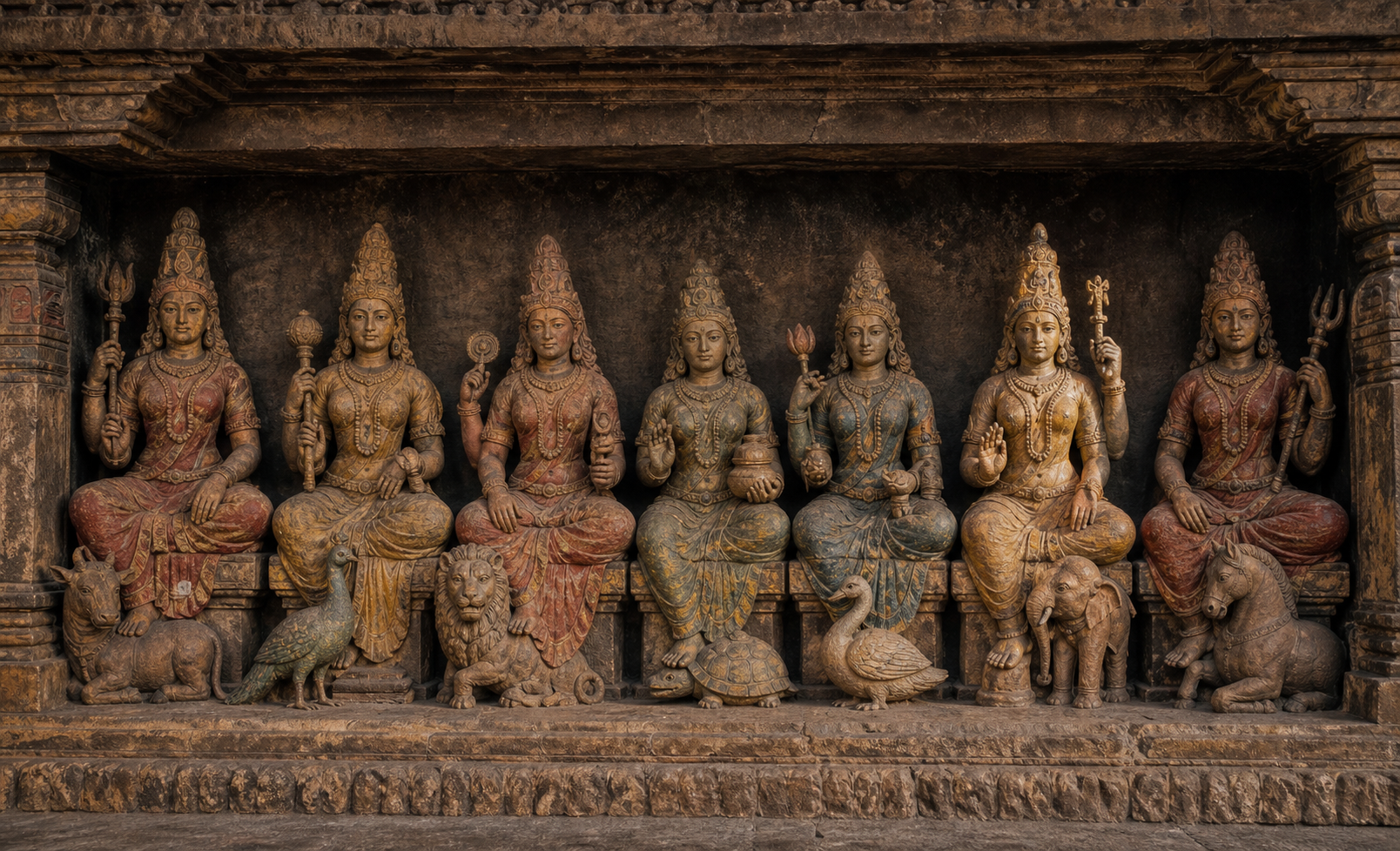
A crowned female figure is not automatically Aindri, and one familiar attribute should not be treated as an infallible label. Temple iconography is best read as a cluster of clues. Begin with the group before interpreting the individual figure.
- Establish that you are looking at a Matrika ensemble. Aindri’s position among other maternal forms is part of her identity. A solitary image needs more supporting evidence.
- Look for the elephant association. The elephant signals majesty and preserves Aindri’s connection with Indra. It may appear as her vehicle or as part of the surrounding visual vocabulary.
- Look for the vajra. The thunderbolt is the clearest emblem of concentrated, decisive force. In Aindri’s hand, it is not borrowed decoration; it identifies the particular divine power she embodies.
- Notice the regal bearing. A crown, commanding posture, or queenly presentation supports the identification, although regality alone is not enough.
- Confirm the clues against the whole panel. Where a temple inscription, local identification, or reliable panel guide is available, use it. The elephant, vajra, group context, and regal character should reinforce one another.
The vajra and elephant also tell you how to contemplate the image. The thunderbolt represents the ability to end hesitation when dharma requires a decision. The elephant gives that decision weight, stability, and majesty. Read together, they depict strength that is controlled rather than frantic.
One misreading deserves special care: Aindri’s Indra-like emblems do not turn her into a female copy with no identity of her own. The emblems establish the divine power with which she is associated; the Matrika setting tells you how that power is operating. In a panel of the Seven Mothers, the vajra has entered the field of Devi Shakti and collective guardianship.
When you next encounter one of the Saptamatrika panels found at ancient sacred sites in India, identify Aindri twice: first by her attributes, then by her function within the group. The first tells you who she is. The second tells you why she is there.
A simple Indrani practice for dignity without aggression
Indrani is especially relevant when your real difficulty concerns respect: a boundary repeatedly crossed, a place you fear losing, jealousy you do not want to obey, or anger that contains a legitimate grievance. Her worship should not become a religious justification for pride. Its purpose is to refine emotional force until you can see what deserves protection and what needs to be released.
The following is a simple reflective home practice, not a replacement for a family, temple, or lineage-based puja. If you already follow such a tradition, keep its procedures and guidance.
- Name the actual issue. Choose one situation involving dignity, recognition, or a boundary. Do not begin with the person you want to defeat; begin with the value you believe needs protection.
- Make a restrained offering. Light a lamp or offer red flowers before an image of Indrani, Aindri, or the Saptamatrikas. Simplicity keeps the attention on discernment rather than display.
- Contemplate the vajra. Visualize its brilliance as clear, concentrated resolve. Ask what a decisive but ethical response would look like.
- Tell the truth about the emotion. Is the disturbance jealousy, humiliation, fear of exclusion, wounded pride, or concern about a genuine wrong? Naming the emotion prevents it from disguising itself as righteousness.
- Choose one boundary-preserving action. It may be a clear request, a refusal, an apology, a correction of false information, or a decision to postpone a heated response until you can speak without contempt.
If you want words for the reflection, use a plain intention such as: May my strength protect what is right without humiliating another. Treat this as your own prayerful intention, not as a scriptural mantra or a promised formula.
Before acting, ask four questions. What exactly is threatened: dharma or my image of myself? What boundary is actually needed? What is the smallest decisive action that can protect it? Can I take that action without cruelty? These questions turn the thunderbolt from a symbol of raw force into a discipline of moral clarity.
This is where Indrani’s Vedic and Saptamatrika identities meet in lived devotion. The Vedic queen refuses erasure. Aindri converts that refusal into protective energy. The devotee’s task is to do the same without allowing insecurity to masquerade as dharma.
The next time you meet Shachi in a hymn, Indrani in a narrative, or Aindri in stone, pause before flattening the name into a label. Ask which dimension is active: voiced dignity, celestial sovereignty, or collective protection. Then carry one part of that insight into a real decision by setting a clear boundary that preserves both truth and self-command.



References
