
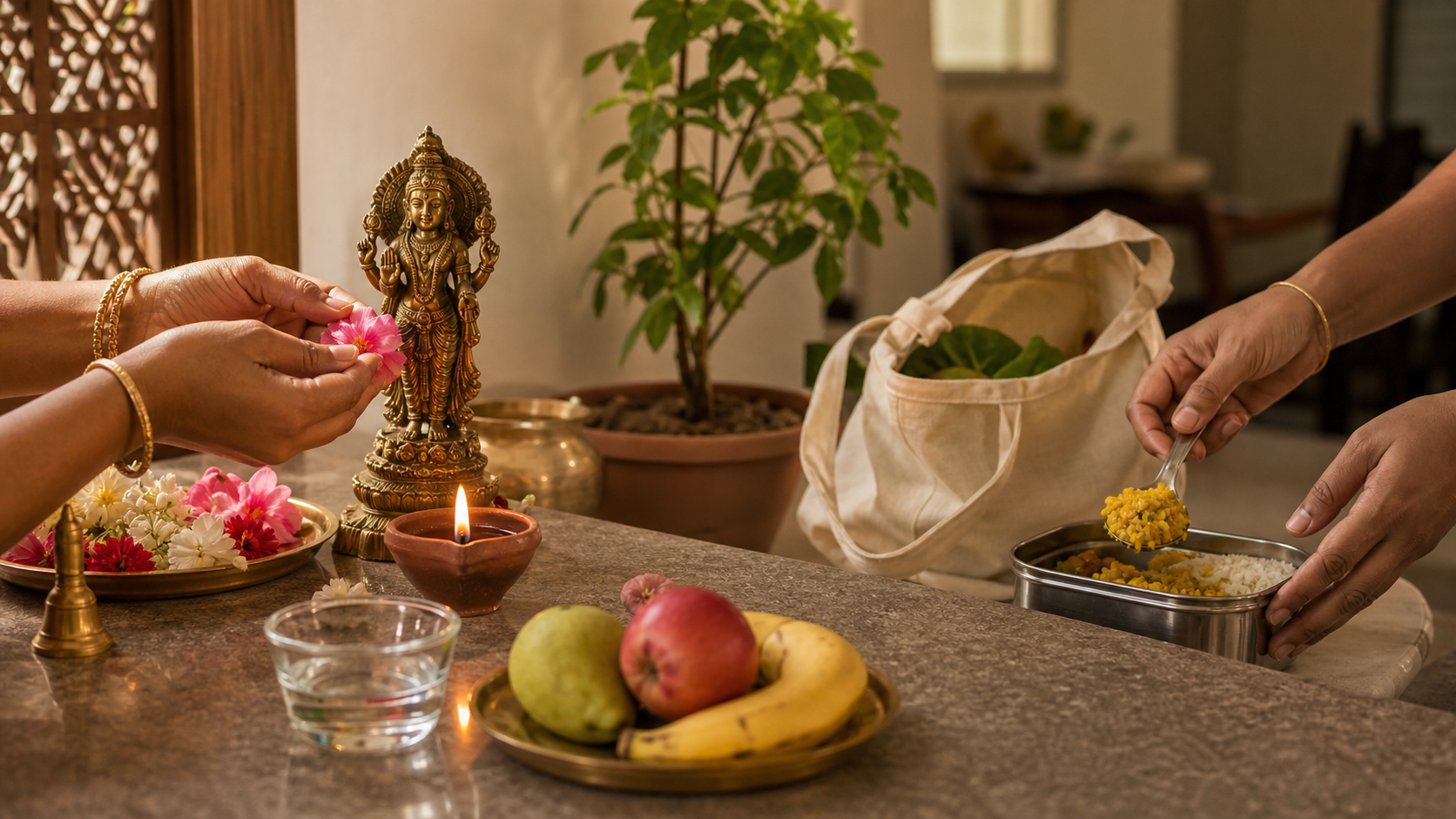
You may bow before a murti and still wonder what the gesture means beyond the visible object. Or your puja may be regular while anger, waste, indifference, or compulsive habits remain untouched. Both situations raise the same honest question: what is sacred form supposed to do in a human life?
Good worship gives attention a center and conduct a direction. It does not ask you to choose between sacred beauty and ethical seriousness. The form gathers the mind, the ritual rehearses a relationship, and your next decision reveals whether the worship has reached its purpose.
A sacred form gives attention somewhere to stand
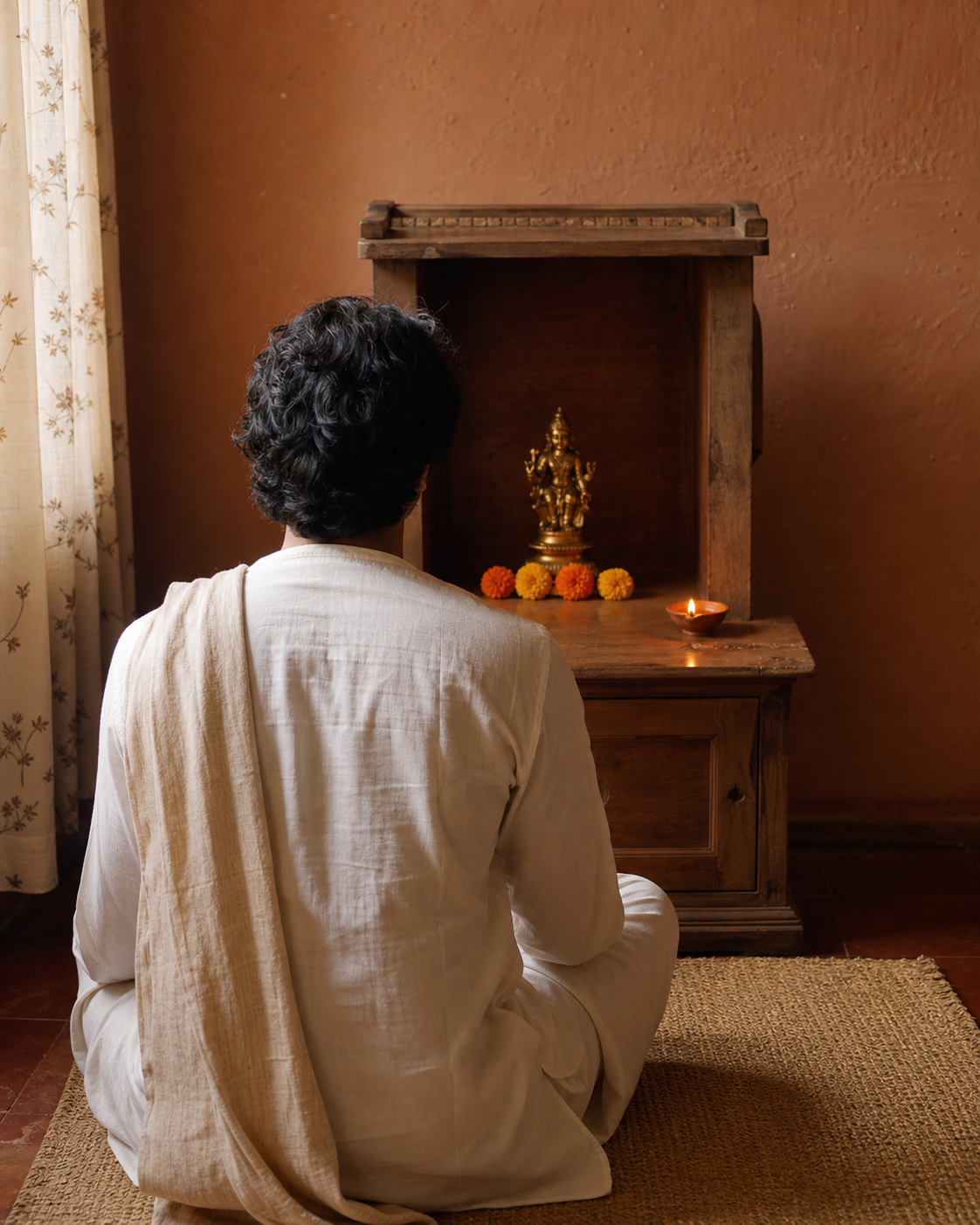
A murti is not treated in worship as an ordinary decoration, but neither must you imagine that the limitless Divine has been reduced to the dimensions of stone, metal, paint, or wood. The form makes relationship possible at the scale of human senses. Your eyes can rest, your hands can offer, your voice can chant, and your scattered attention can return.
That is why darshana, mantra, offerings, meditation, and seva need not compete. They engage different faculties. Darshana disciplines sight. Mantra gathers speech and hearing. An offering turns gratitude into a bodily act. Meditation steadies awareness. Seva carries devotion beyond the worship space.
The Vedic yuga-wise framework associates Satya-yuga especially with deep meditation, Treta-yuga with yajna, Dvapara-yuga with elaborate Deity worship, and Kali-yuga with particularly accessible mantra chanting. Yet these disciplines continue alongside one another rather than being erased whenever the emphasis changes. The practical lesson is not that one legitimate method must defeat the others. It is that a seeker should use the discipline capable of gathering attention and directing it toward dharma.
This also explains the importance of the Ishta, the chosen form through which a devotee most readily approaches the sacred. Temperaments differ. One person is moved by visual darshana, another by japa, another by kirtan, and another by quiet service. You do not need to imitate the most dramatic practice in the room. Choose a form and discipline you can approach sincerely, then judge them by what they cultivate.
If someone dismisses murti-puja as merely primitive or recent, do not answer by claiming that every Dharmic path uses images in the same way. The clearer answer is that Sanatana Dharma preserves multiple modes of spiritual formation. Form, sound, contemplation, ritual, and service can be distinct without being mutually exclusive.
Read a sacred symbol as a discipline, not a wish machine
A sacred form may be approached as divine presence, as a teaching image, or in both ways at once. Confusion begins when every symbol is treated as a mechanism for obtaining what the ego already wants.
Kamadhenu makes the problem especially clear. Calling her the wish-fulfilling cow can invite a shallow interpretation centered on acquisition. Yet her deeper meaning lies in nourishment, health, protection, reciprocity, and compassionate care. Although dedicated temples are uncommon and she is not usually the center of a separate cult, Gomata remains present in household shrines, prayers, gratitude, and go-seva.
To contemplate Kamadhenu seriously, ask three questions. What sustains my life? Whose labor or suffering is hidden behind what I receive? What obligation follows from being nourished? These questions change abundance from entitlement into responsibility.
- If an image of Gomata is in your shrine, connect the flower or prayer with an act of care rather than leaving it as decoration.
- If you support a cow shelter, look for sustained welfare and responsible care, not merely a ceremonial association with cows.
- Before a meal, let gratitude lead you to notice avoidable waste, excess, and indifference toward the beings and people involved in nourishment.
- Where direct go-seva is appropriate, follow the guidance of those responsible for the animals instead of turning service into a performance.
Sammohana Shasta teaches another kind of symbolic correction. Sammohana may be understood as the enchanter, but the sacred attraction here is not manipulation, glamour, or a promise of control over other people. It is the attraction of truth that draws attention away from compulsion and toward clarity. The symbol asks what has captured your mind and whether that attraction is making you freer, more truthful, and more compassionate.
During darshana of Sammohana Shasta, notice where attention repeatedly wanders. Do not manufacture a mystical feeling. Return to the form or mantra, identify the attachment or aversion behind the distraction, and carry one correction into your next decision. In this way, enchantment becomes concentration, concentration becomes discernment, and discernment becomes ethical action.
Four mistakes that separate ritual from dharma
Ritual becomes empty less often because it is simple than because the devotee stops allowing it to make a moral demand. Watch for four common mistakes.
- Transaction: You treat the offering as payment and expect the deity to deliver a preferred result. Correct this by offering gratitude before asking for anything. When you do make a request, include the clarity and strength needed to act dharmically.
- Literal confinement: You speak as though the Divine exists only inside one physical object. Correct this by honoring the murti precisely while remembering that sacred presence is not exhausted by its material support.
- Aesthetic escape: You enjoy lamps, flowers, music, and temple atmosphere but resist the discipline they signify. Correct this by choosing one quality represented in the worship and applying it where it is difficult, not only where it feels devotional.
- Symbolic reduction: You explain every deity as nothing more than a psychological metaphor. Correct this by allowing the tradition’s devotional claim to stand. A sacred form can teach the mind without being reduced to a private mental projection.
These errors can pull in opposite directions. Literal confinement makes the material form too small; symbolic reduction dissolves the deity into an idea. Transaction makes worship self-serving; aesthetic escape makes it inconsequential. A mature practice stays relational, reverent, and ethically demanding.
One question exposes all four mistakes: what would honoring this form require of me if no desired reward arrived? If the answer is still truthfulness, restraint, compassion, gratitude, or service, your worship has found firmer ground.
Build a worship cycle that reaches ordinary life
You do not need to make a home practice elaborate before making it meaningful. Build a repeatable bridge between attention at the shrine and conduct away from it.
- Name the quality before beginning. Decide what the form is asking you to cultivate: nourishment without excess, attraction to truth, courage, compassion, steadiness, or another virtue recognized in your own lineage.
- Give undivided attention through one primary act. Use darshana, a familiar mantra, a simple offering, or silent contemplation. Resist the urge to keep adding elements merely to make the practice look substantial.
- Notice the resistance. Observe the thought, attachment, aversion, or excuse that prevents the chosen quality from entering your life. This is often where the real work begins.
- Choose a companion action. Pair worship with something visible: an honest conversation, restraint from needless consumption, care for an animal, patient attention to a person, support for responsible welfare, or service without recognition.
- Review before the next worship. Ask whether the action happened and what obstructed it. Do not punish yourself or pretend success. Bring the obstruction back into prayer, japa, contemplation, and renewed effort.
This cycle prevents two distortions. It keeps ethics from becoming cold self-management, because conduct remains rooted in devotion. It keeps devotion from becoming private sentiment, because the ritual creates a duty you can recognize outside the shrine.
Mantra is especially portable when circumstances make elaborate worship difficult. The Kali-yuga emphasis on chanting, including japa and collective kirtan in Bhakti traditions, complements rather than abolishes temple worship, meditation, ritual, or service. If your schedule is unsettled, simplify the outer form while preserving attention and ethical follow-through. Simplicity is not carelessness when the practice remains sincere and disciplined.
In a temple, decide on the companion action before leaving. At home, keep the intention near the shrine so that you encounter it at the next worship. In a community observance, ask what continuing service will remain after the lamps, music, and decorations are put away. The point is to close the gap between sacred occasion and ordinary responsibility.
Test devotion by its fruit, not its emotional intensity
A powerful feeling during worship can be meaningful, but intensity is not a reliable ethical test by itself. The harder questions concern what happens when you are inconvenienced, contradicted, tempted, or asked to give without recognition.
Look for ordinary changes rather than demanding spectacle. Can you return attention without obeying every impulse? Does gratitude restrain excess? Does reverence for life affect how you treat animals and vulnerable people? Does devotion make honesty more important than saving face? Does receiving nourishment awaken a reciprocal duty to serve?
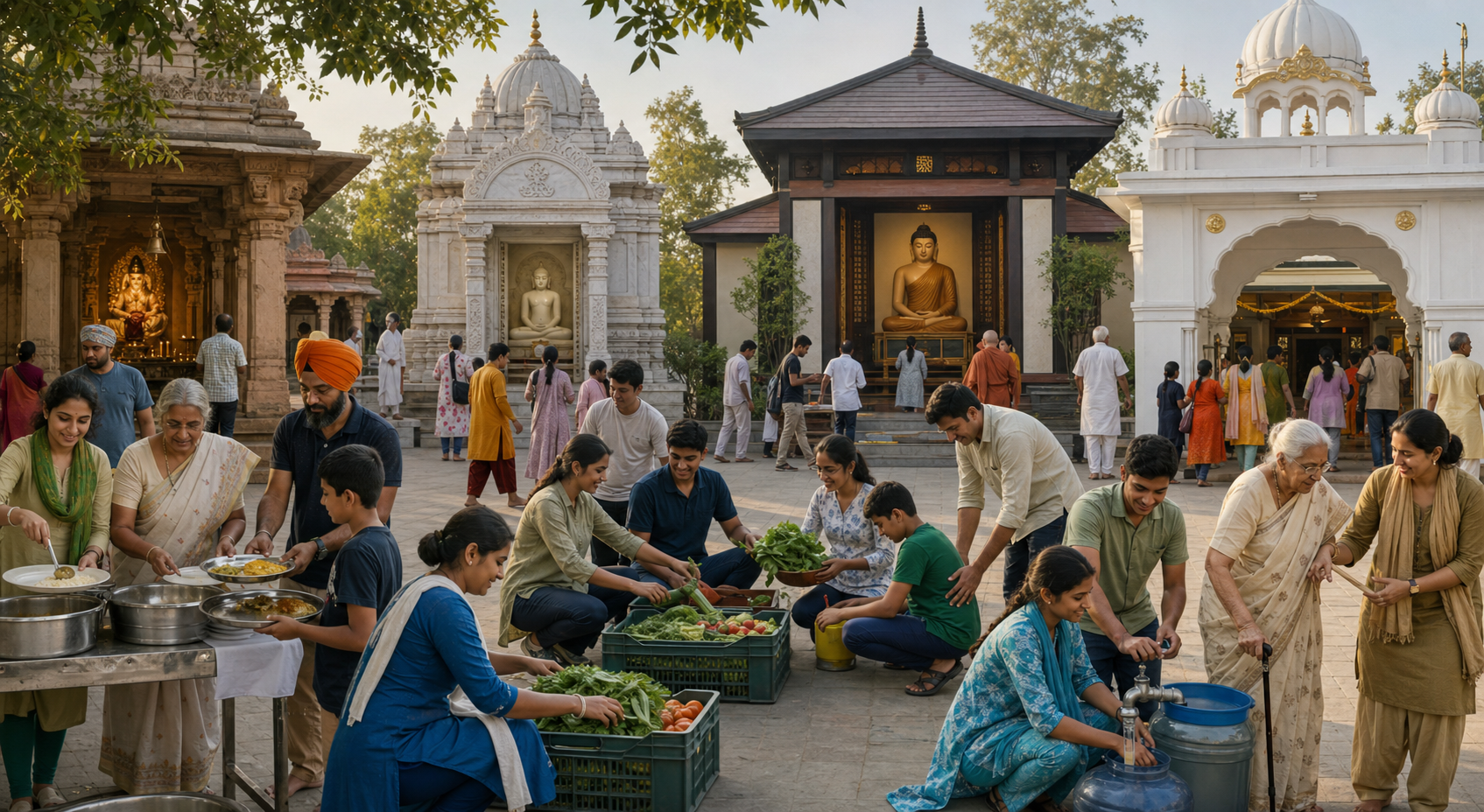
This is where Dharmic kinship becomes visible without requiring doctrinal sameness. Hindu darshana and murti-puja are not interchangeable with Buddhist, Jain, or Sikh practices. Yet bodhicitta in Mahayana, samyag-darshana in Jain thought, and Naam-simran in Sikhi can each orient attention toward truth, ethical refinement, compassion, or liberation within its own framework. The resemblance is a basis for respect, not a reason to erase differences.
When speaking across traditions, compare what practices train rather than declaring that every practice is secretly the same. Ask how attention is disciplined, how attachment is addressed, how compassion is expressed, and how service enters community life. Let each tradition answer in its own vocabulary.
Key takeaways
- A sacred form is doing ethical work when you can name the quality it asks you to embody.
- Darshana, mantra, offering, meditation, and seva can reinforce one another; you do not need to force them into competition.
- A symbol of abundance should deepen gratitude, restraint, reciprocity, and care rather than sanctify unlimited acquisition.
- A moving ritual still needs a companion action outside the worship space.
- Shared Dharmic values support solidarity, while respect requires preserving real differences among Hindu, Buddhist, Jain, and Sikh paths.
At your next worship, do not begin by adding another ceremony. Name one quality revealed by the sacred form, offer your full attention, and choose one act that will carry that quality into the rest of your life. The bridge between altar and action is where an admired symbol becomes lived dharma.

References
- Hindu Pad — Surabhi (Kamadhenu): Emblem of Abundance, Health, and Compassion Across Dharmic Traditions
- Hindu Blog — Sammohana Shasta Unveiled: Symbolism, Sacred Aesthetics, and the Pull of Divine Grace
- Dandavats — Timeless Deity Worship in the Vedic Tradition: Yuga-Wise Paths and Dharmic Unity
