

If fear has narrowed your choices, repeating that dharma will prevail may not tell you what to do next. A protective deity narrative becomes practically useful when it helps you identify the danger, the good that must be preserved, and the action your present agency allows.
Mahotkata Vinayaka, Devaki Mata, and Indrani Mata should not be collapsed into a single instruction to be strong. One interrupts the conditions sustaining disorder. One preserves life while living under a tyrant’s power. One shows how protective authority should be governed. Knowing which form of courage your situation requires can keep devotion from sliding into either passivity or recklessness.
Protection is not one kind of miracle
Sacred narratives can be encountered devotionally, theologically, and ethically at the same time. For a devotee, a deity is not merely a metaphor for a psychological quality. Yet divine action also educates human judgement. The practical task is to recognize the correspondence without pretending that everything performed by a divine manifestation is an instruction for literal imitation.
Read a protective narrative in two passes. First, ask what divine protection accomplishes: What is threatened? What feeds the threat? What is preserved? What kind of order follows? Then ask what human duty corresponds to that pattern: What can you remove, endure, move, restrain, organize, or safeguard without abandoning dharma?
Three different diagnoses emerge. When disorder is sustained by neglected conditions, Mahotkata Vinayaka directs attention to those conditions. When a cruel person controls the field and vulnerable life depends on patience, preparation, and a timely opening, Devaki’s ordeal becomes relevant. When you possess authority over another person, Indrani places your own use of power under examination.
Choosing the wrong mode carries consequences. Premature confrontation can expose the vulnerable person you meant to defend. Calling avoidable passivity patience can give adharma more room. Using force without accountability can make the supposed protector another source of fear. Courage therefore begins with discernment, not intensity.
These Hindu forms are theologically particular, but the ethical questions travel across the wider Dharmic family without erasing the distinctions among Hinduism, Buddhism, Jainism, and Sikhism. How do you resist wrongdoing without becoming cruel? How do you preserve life without worshipping fear? How do you exercise power without allowing ego to govern it? Compassion, restraint, truthfulness, and responsibility give those questions a shared moral ground.
Mahotkata Vinayaka: remove what keeps disorder alive
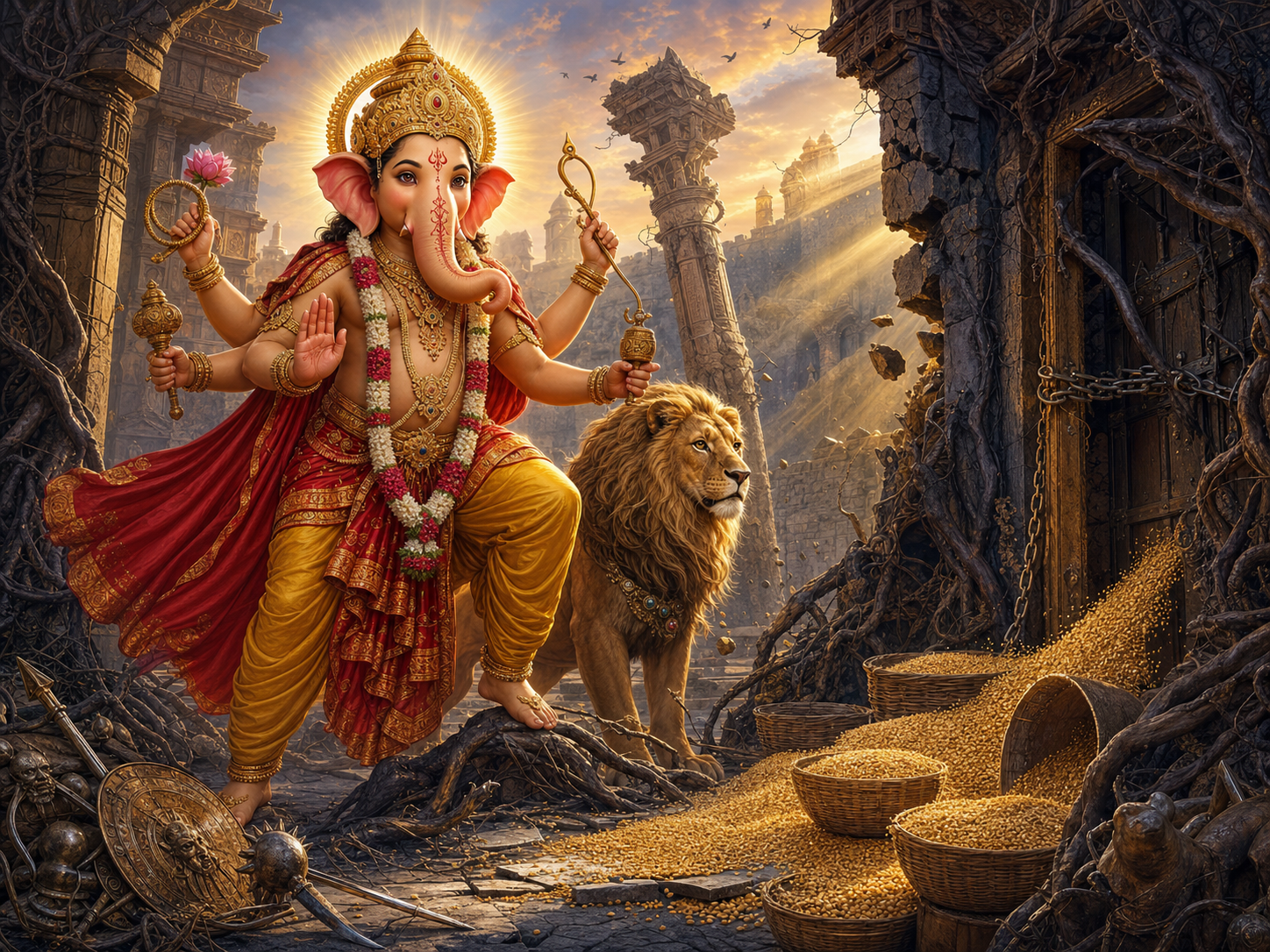
In the Satya Yuga episode, Mahotkata Vinayaka appears in a red, ten-armed form to confront Devantaka and Narantaka. The striking feature is not merely their defeat but its means: the scattering of grains of food instantly disperses the demons.
That detail should not be converted into a mechanical promise that scattered grain will solve an ordinary danger. Its practical force lies in the mismatch between the apparent scale of the threat and the simplicity of the response. Chaos meets nourishment, rightful provision, and order rather than a larger imitation of chaos. The episode invites you to inspect the supply line of an obstacle before escalating the conflict around it.
A recurring problem usually consumes something. It may consume attention, secrecy, confused responsibility, unrestricted access, neglected routine, or a continuing flow of resources. If you address only the visible eruption, the same conditions can produce it again. The Mahotkata question is direct: What are we repeatedly giving this disorder that allows it to return?
- Name the obstruction as a condition or behaviour. Do not begin by turning a whole person into a demon.
- Identify what feeds it. Look for the repeated input, permission, ambiguity, or omission without which the problem would weaken.
- Withdraw or reorganize that input through the smallest adequate dharmic intervention.
- Restore what the disorder displaced: nourishment, clarity, trust, responsibility, or a workable routine.
Suppose a family observance repeatedly collapses into argument. Labelling one relative the enemy may deepen the division. The sustaining conditions may instead be last-minute instructions, undefined roles, public correction, and exhaustion. Assigning responsibilities beforehand and moving necessary correction into a private conversation addresses what feeds the conflict. That is closer to the logic of the grains: change the conditions, then restore an order in which people can participate.
This is also why Ganesha’s protective character cannot be reduced to clearing a path for whatever you already want. As remover of obstacles and patron of auspicious beginnings, Ganapati asks whether the intended beginning is itself rightly ordered. Sometimes protection removes an external obstruction. Sometimes it exposes the confusion, appetite, or ahankara through which you have been sustaining one.
Devaki: preserve life without sanctifying helplessness
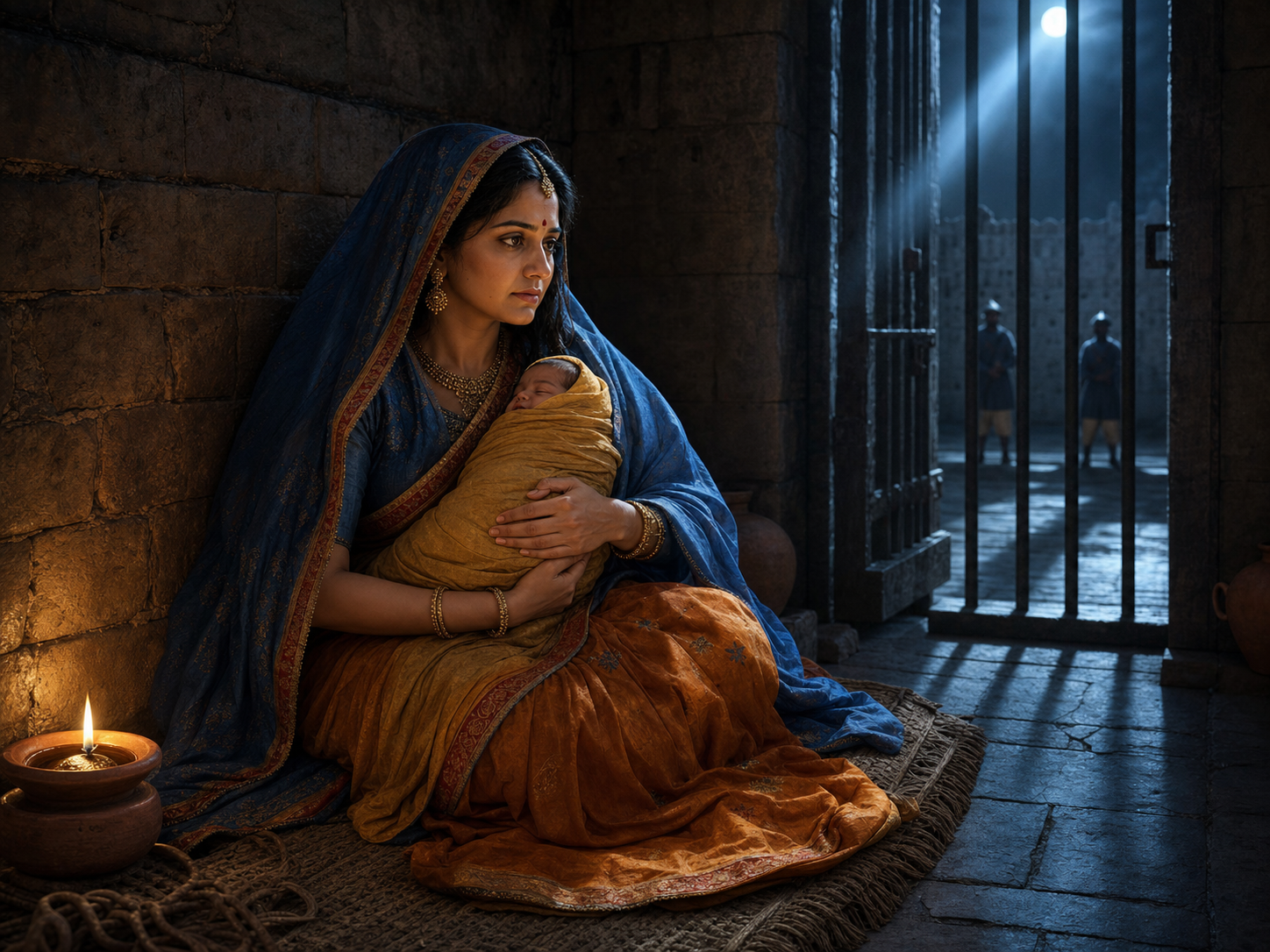
Devaki’s courage unfolds under conditions of extreme constraint. An akashvani declares that her eighth child will end Kamsa’s oppression. Kamsa imprisons Devaki and Vasudeva, then kills their first six infants. The seventh pregnancy is transferred to Rohini, from whom Balarama is born. When Krishna arrives as the eighth child, the chains fall, the doors open, and Vasudeva carries the infant across the Yamuna to Gokul. Krishna is exchanged with Yashoda’s newborn daughter, Yogamaya, who manifests as Durga when Kamsa tries to kill her.
Here courage is not control over the entire field. Devaki cannot command the prison, reform Kamsa, or set the hour of release. Her steadfastness preserves devotion and moral orientation while tyranny controls her surroundings. Yet the narrative does not sanctify immobility. When an opening appears, Vasudeva moves the vulnerable child. Protection includes transfer, relocation, help from others, and immediate action.
That distinction matters whenever endurance is praised. Patience is the disciplined preservation of what must survive until useful action becomes possible. Passivity is the refusal to take an available protective action because fear, confusion, or a mistaken idea of virtue has made inaction seem sacred. Devaki’s endurance belongs with Vasudeva’s movement; separating them distorts the lesson.
Before invoking patience in your own difficulty, write three lines. On the first, name what you cannot presently control. On the second, name what you can protect now. On the third, identify the opening that should trigger action. The protected good might be a child, an elder, your capacity to tell the truth, a community obligation, or the continuity of daily sadhana. The opening might be trustworthy help, safe movement, a private conversation, or access to someone with legitimate authority.
Do not use this sacred ordeal to tell someone facing real violence that faith requires continued exposure. The narrative itself moves the threatened infant away from the killer. Where immediate danger exists, devotion does not replace practical safety, trusted community assistance, or available emergency support. Preserving life is not a failure of spiritual endurance.
When you remember Devaki during Janmashtami, notice both halves of her courage: she does not surrender her inner allegiance to Kamsa, and the family acts when the way opens. A useful prayer arising from her life is therefore not only for strength to bear what cannot yet be changed. It is also for the clarity to recognize the moment when bearing must give way to movement.
Indrani: make protective power answer to dharma

Indrani, also known as Aindri, Shachi, and Paulomi, brings the question of courage to the person who already holds power. Her presence reaches into Rig Veda 10.86, where her voice is associated with dignity, sovereignty, and the guardianship of rta. As Aindri among the Saptamatrikas, she is the Shakti of Indra and is depicted with the vajra and with an elephant or lion as her vahana. These signs present protection not as anxious reaction but as ordered authority.
Her challenge is especially relevant when you are a parent, teacher, manager, elder, or community organizer. The central question is no longer whether you have the power to intervene. It is whether that power remains aligned with the duty that justifies it.
- Mandate: What responsibility gives you the right to act here?
- Aim: Which person, boundary, or shared good are you protecting?
- Proportion: Are you using the least coercive measure that can adequately protect it?
- Aftermath: Will your intervention restore capable participation, or merely produce dependence and fear?
A parent may need to establish a firm boundary. A manager may need to remove someone’s access to a vulnerable process. A community leader may need to enforce a transparent rule. In each case, volume and humiliation add no protective value. An intervention becomes easier to test when its purpose can be stated plainly, its scope is limited, and the person exercising authority remains accountable for what follows.
Traditional ways of honoring Indrani include contemplation of Rig Veda 10.86 where available, Shakti practice, Navaratri invocation of the Saptamatrikas, lamps, and red flowers. You can prevent ritual from becoming a request for domination by pairing the offering with one accountable act: explain a boundary you have set, correct an excess of your own authority, protect someone who cannot safely speak, or make a decision process more transparent.
Indrani thus supplies the discipline missing from many fantasies of protection. Righteous strength is not proved by how completely it can overpower opposition. It is proved by whether power remains the servant of dharma before, during, and after the intervention.
Key takeaways for your next difficult decision
- Begin with the good that needs protection, not the person you want to defeat. Naming the protected good keeps anger from quietly replacing duty.
- Diagnose the kind of courage required. An obstacle sustained by disordered conditions, a vulnerable life under constraint, and a responsibility backed by authority are different situations.
- Use the Mahotkata move when disorder has a supply line. Identify and withdraw the attention, access, ambiguity, habit, or resource that keeps feeding it.
- Use the Devaki move when your agency is constrained. Preserve what must survive, prepare for a real opening, accept trustworthy help, and do not mistake exposure to harm for spiritual patience.
- Use the Indrani move when you hold power. Establish your mandate and protective purpose, keep the intervention proportionate, and remain accountable for its effects.
- Judge the action by the order it restores. Dharmic protection should leave life, truth, responsibility, or community more capable of flourishing.
Before your next prayer for protection, complete one sentence: May I see whether this moment requires removal, endurance, movement, or disciplined authority. Then perform the smallest duty that answer makes clear. In these narratives, courage is neither panic nor inertia. It is power, patience, and action placed in the service of dharma.
References
- DharmaRenaissance Blog — 12 Incarnations of Ganesha: Sacred Avatars of Ganapati in the Mudgala and Ganesha Puranas
- DharmaRenaissance Blog — Devaki Mata: Krishna’s Brave Mother, Kamsa’s Terror, and the Enduring Power of Faith
- DharmaRenaissance Blog — Indrani Mata Mahatmyam: Vedic Origins, Saptamatrika Power, and Sacred Significance
