
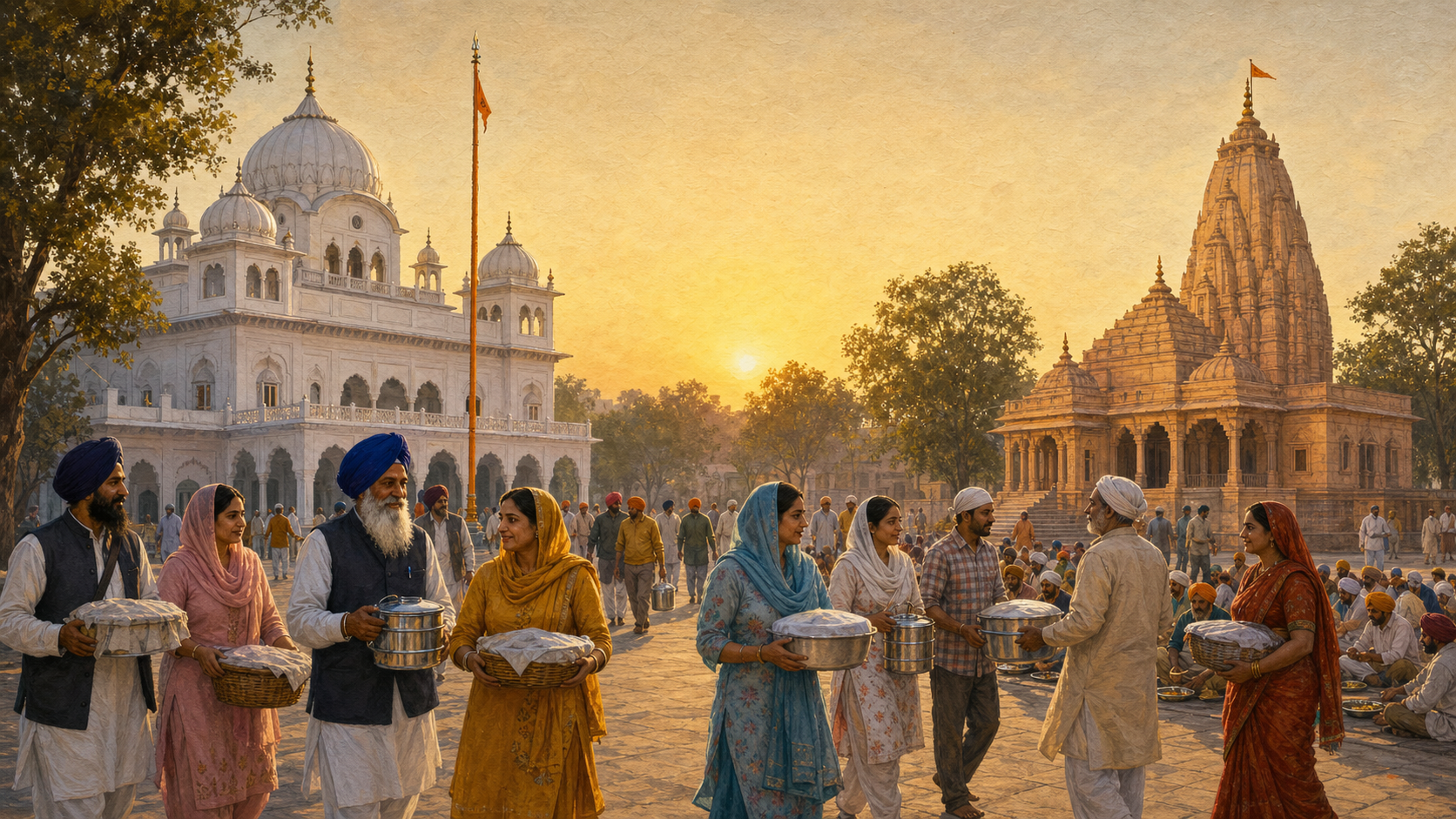
You may want to affirm that Sikhs and Hindus belong to a shared civilizational family, yet worry that doing so will sound like an attempt to absorb Sikh identity. You do not have to choose between separation and sameness. The more honest path is kinship without erasure.
That path begins by making the right kind of claim. Sikh tradition is a distinctive way of discipleship shaped by the Gurus, Gurbani, the Guru Khalsa Panth, Naam, Hukam, sangat, and seva. It also lives within Bharat’s interwoven sacred geography and civilizational memory. Dharmic unity becomes credible when it respects both truths at once.
Key takeaways
- Describe Sikh, Hindu, Buddhist, and Jain traditions as related before making any claim that they are alike. Historical and civilizational relationship does not require doctrinal identity.
- Let Sikh vocabulary lead. Shabad Guru, Naam, Hukam, Gur Prasad, haumai, sangat, and seva are not decorative synonyms for concepts borrowed from another path.
- Read the inclusion of Gurus and Bhagats in the Sri Guru Granth Sahib as disciplined openness to truth, not as an ownership certificate for any modern identity argument.
- Use comparisons to clarify a limited resonance, then return to the Sikh term and its place within Gurbani.
- Measure unity by conduct: accurate speech, attentive listening, service, defense of sacred institutions, and fairness in ordinary life.
Name the kind of unity you actually mean
Much confusion disappears when you separate four levels that are often compressed into the word unity. Bharat’s coherence has endured through changing political boundaries because people remained connected by pilgrimage, sacred places, stories, artistic conventions, scholarly exchange, ritual calendars, and everyday customs. Those connections form a civilizational field in which several traditions can remain distinct.
- Civilizational kinship: Sikh, Hindu, Buddhist, and Jain communities participate in the historical and cultural world of Bharat. This includes relationships to places, languages, institutions, collective memories, and inherited forms of learning.
- Ethical solidarity: Truthfulness, humility, compassion, courage, discipline, and service create substantial common ground. You can cooperate on these duties without settling every theological question.
- Spiritual resonance: Different traditions recognize guidance, grace, disciplined remembrance, the restraint of ego, moral transformation, and freedom from bondage. A resonance identifies a meaningful likeness; it does not prove that two teachings are interchangeable.
- Doctrinal identity: Each tradition gives its central terms authority and meaning within its own path. This is where a claim of total sameness becomes least reliable and most likely to cause unnecessary offense.
A careful formulation is therefore simple: Sikhism is a distinct tradition within an interconnected dharmic civilization, sharing historical relationships and ethical concerns with other traditions of Bharat while speaking in its own scriptural and communal grammar.
This formulation also gives you a practical boundary. If you are Hindu, do not make Sikh belonging in Bharat depend on accepting a Hindu theological description of Sikhism. If you are Sikh, acknowledging civilizational kinship need not mean surrendering the authority of the Gurus, Gurbani, or Panth. The word Dharmic is useful as an invitation to relationship and responsibility. It becomes counterproductive when it is used as a demand for self-reclassification.
Retire claims such as all paths are really the same. They sound generous but discard the commitments that make a path worth following. Say exactly what is shared instead: a history, an ethical duty, a practice of service, a sacred place, a vocabulary with related roots, or a commitment to protecting one another’s freedom and institutions.
Let the Sikh tradition speak in its own grammar
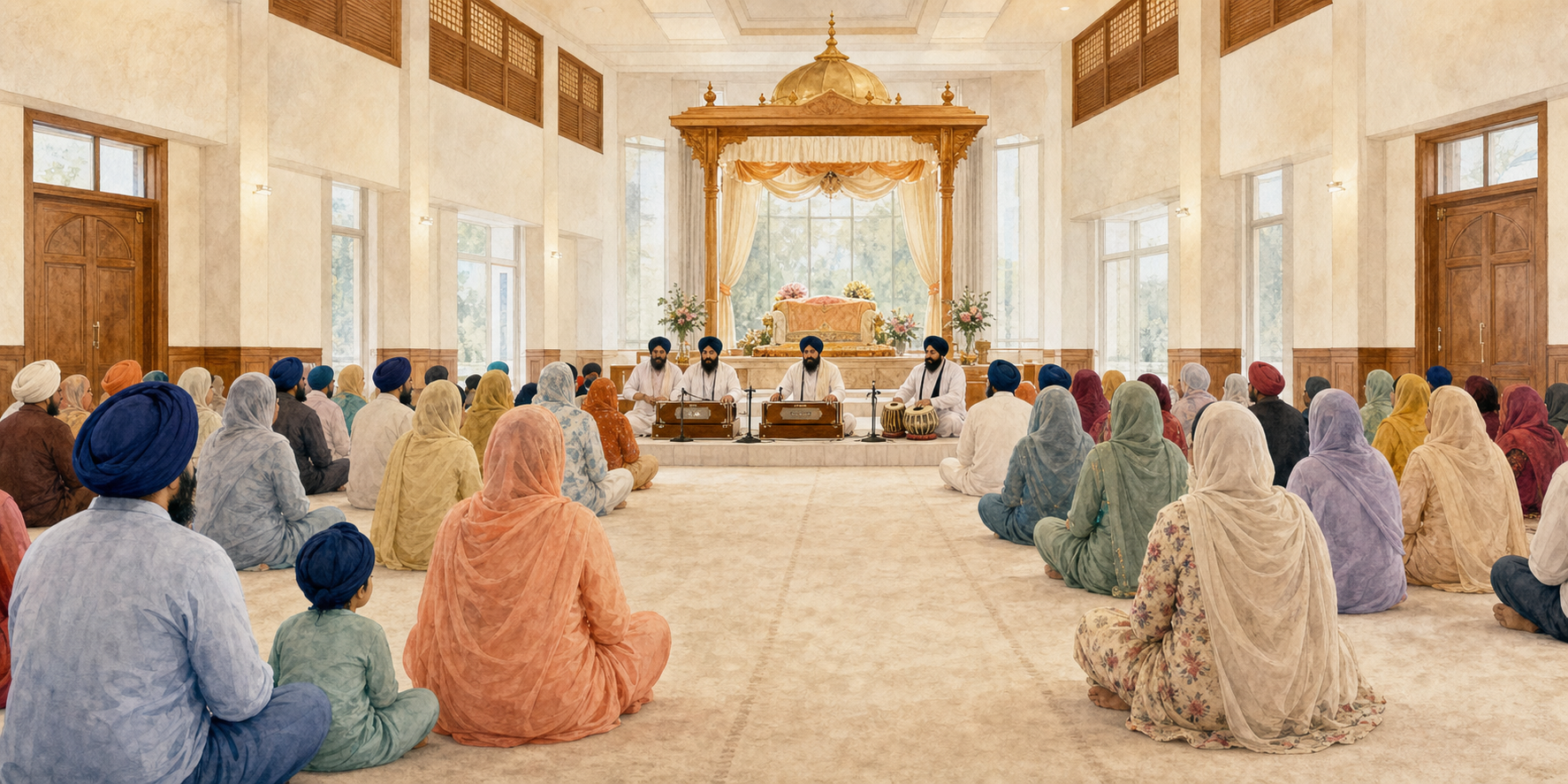
Begin with the Sikh understanding of the Guru. Satguru joins sat, truth, with guru, the one who dispels darkness. Within Sikh doctrine, the True Guru is not reduced to an inspiring mortal teacher. The Shabad Guru is the Divine Word enshrined in the Sri Guru Granth Sahib. Following the lineage of the Ten Gurus, Guruship was invested in the scripture and the Guru Khalsa Panth. That word-centered and community-anchored authority must remain visible whenever you discuss Sikh spirituality.
- Shabad Guru means that transforming guidance is encountered through the Divine Word. Treating Gurbani merely as inspirational literature misses its status within Sikh life.
- Naam is remembrance of the Divine Presence. It steadies attention, but it should not be flattened into a generic technique for relaxation.
- Hukam names the Divine Order to which the seeker learns to orient thought and conduct.
- Gur Prasad places transformation within grace. The loosening of haumai, or ego-centeredness, is not presented as a private achievement to display.
- Simran, kirtan, sangat, and seva join contemplation to community and action. Remembrance is expressed through listening, singing, fellowship, and selfless service.
Other dharmic traditions offer illuminating parallels. A Hindu may recognize the role of the sadguru, a Buddhist the guidance of a kalyana-mitra, and a Jain the ford-maker who shows a passage from bondage toward freedom. These ethical and spiritual resonances can help a learner find an initial point of orientation. They do not make the figures, doctrines, or paths identical.
Use a three-move method whenever you make such a comparison:
- Name the Sikh term first.
- Explain its function through Sikh teaching and practice.
- Introduce a parallel only to clarify one limited feature, and state where the comparison stops.
For example, explain that Naam is remembrance of the Divine Presence and belongs with the guidance of Gurbani, orientation to Hukam, and the grace that softens haumai. You may then note that other traditions also discipline attention through sacred remembrance. Do not replace Naam with the other tradition’s preferred term. A comparison has done its job when it opens a door; it has outlived its usefulness when it takes over the room.
Read the inclusive canon as relationship, not possession
The Sri Guru Granth Sahib preserves the voices of Sikh Gurus alongside Bhagats including Kabir, Namdev, Ravidas, and Sheikh Farid. Their presence reveals a spiritual world in which truth could be honored across inherited community boundaries. It also gives Dharmic unity a far deeper basis than a modern slogan: encounter and receptivity are built into the canon itself.
Yet the Sri Guru Granth Sahib is not a museum of detachable quotations. For Sikhs, it is the living Guru. The inclusion of a Bhagat’s bani therefore cannot be reduced to a claim that Sikhism belongs to whichever contemporary group also reveres that Bhagat. Inclusion demonstrates relationship, not possession. The canon honors multiple voices without surrendering its own authority or becoming an undifferentiated anthology.
When you read or share a shabad in a discussion about unity, use four checks:
- Keep the shabad in view. Do not build an identity claim around a clipped line while ignoring the larger movement of the hymn.
- Name the voice accurately. Preserve the distinction between a Sikh Guru and a Bhagat as the scripture presents it.
- Ask what the words demand of the reader. Look for the movement from ego toward remembrance, truth, humility, compassion, or service before turning the passage into an argument about labels.
- Seek guidance when context is uncertain. Study in or with sangat, consult a knowledgeable Sikh reader, and be ready to revise an analogy that does not fit Sikh usage.
This discipline blocks two equal and opposite mistakes. The presence of shared vocabulary or revered Bhagats does not make Sikhism a subsection of another tradition. Sikh distinctiveness does not make every dharmic relationship imaginary. The canon can witness to openness precisely because its own center remains intact.
Make unity visible in the next four weeks

Dharmic unity will remain fragile if it exists only in speeches, social-media arguments, or claims about ancestry. Across Bharat, sacred bonds have been sustained through lived worship, teaching, pilgrimage, artistic practice, and service. Temples, tirthas, monasteries, mathas, gurdwaras, and congregations should be approached as living institutions rather than scenery or religious tourism.
- Week one: audit your language. Write down three sentences you commonly use about Sikh-Hindu or wider Dharmic unity. Circle every use of same, essentially, really, or just. Replace each vague assertion with a precise relationship: shared geography, ethical convergence, canonical encounter, cultural memory, or present-day cooperation.
- Week two: put Gurbani before argument. Read or listen to one shabad each morning, using a translation if necessary. Keep a short note of the Sikh terms you encounter and resist translating each one immediately into the vocabulary you already know. If you share a line publicly, include enough context for another reader to locate its actual teaching.
- Week three: practice seva. Give time to a concrete service effort in a Sikh setting when you are welcomed, or to a local effort shaped by the same discipline of selfless care. Take the assigned task, work without turning service into an identity debate, and notice whether you are seeking recognition.
- Week four: have one boundary-respecting conversation. Ask a Sikh relative, friend, teacher, or community member which forms of civilizational kinship feel meaningful and which descriptions feel imposed. Listen for the distinction rather than trying to secure agreement. End by identifying one action you can take together, such as service, heritage care, language learning, or support for young people’s religious education.
Carry the same test into household and professional life. The Sikh householder’s path treats integrity in work, tenderness in family relationships, and fairness in society as arenas of spiritual responsibility. If a public claim of unity is accompanied by contempt, dishonesty, or indifference to another community’s sanctity, the conduct has disproved the slogan.
Before you make your next claim about Dharmic unity, ask three questions: Does it use Sikh terms accurately? Does it preserve Sikh distinctiveness? Does it lead to service, learning, or shared stewardship? If the answer to any one is no, refine the claim before repeating it. Begin this week with one shabad, one corrected sentence, and one act of seva. That is small enough to do and substantial enough to make unity real.
References
- The Dharma Dispatch – Unbroken Sacred Bonds of Bharatavarsha: Living Sanatana Dharma and India’s Cultural Unity
- SikhNet – Satguru in Sri Guru Granth Sahib: Timeless Wisdom for Inner Freedom and Dharmic Unity
