

Perhaps a friend has told you that only one revelation can be true. Or perhaps, in trying to keep peace, you have heard that all religions are basically the same. If neither answer feels intellectually honest, your discomfort is justified.
Dharmic pluralism offers a more demanding alternative. You can remain devoted to a particular deity, teaching, or discipline without pretending that your formulation contains the whole of infinite reality. You can also respect another path without erasing the differences that make it a path at all.
Begin by separating unity from sameness

The Sanskrit formulation Ekam Sat Vipra Bahudha Vadanti expresses a foundational insight: Truth is one, while the wise speak of it in different ways. The sentence supports humility about human descriptions of the Real. It does not require you to declare every religious proposition identical, equally complete, or equally persuasive.
This distinction matters because religious discussions often collapse three different things into one:
- Reality: what ultimately exists, whether described as the Divine, Brahman, awakening, or through another tradition’s own language.
- Description: the doctrines, metaphors, names, images, and arguments through which human beings try to understand reality.
- Discipline: the prayer, meditation, worship, inquiry, ethical restraint, or service by which a person is transformed.
Two traditions can agree that human language is limited while disagreeing about whether the Divine is personal, whether an enduring self exists, or what liberation means. Those disagreements should be named rather than dissolved into a vague claim that everyone means the same thing.
When you encounter a religious claim, therefore, ask three questions. What exactly is being asserted? At what level is it being asserted: ultimate reality, symbolic expression, spiritual method, or ethical rule? What would accepting it require you to believe or do? These questions let you distinguish a genuine contradiction from two teachings addressing different spiritual needs.
This is why pluralism is not relativism. Relativism avoids judgment by treating truth as little more than preference. Dharmic pluralism asks for more judgment, not less: careful attention to context, coherent reasoning, disciplined practice, and humility about the reach of one’s own concepts.
Let a chosen form deepen commitment without narrowing reality
For a Hindu practitioner, Ishta provides a practical way to unite devotion and openness. Your chosen orientation may be Krishna, Shiva, another sacred form, contemplation of formless Brahman, selfless action through Karma Yoga, or inquiry through Jnana. Choosing one center of practice does not require declaring that the Infinite is confined to it.
A sacred form need not be dismissed as a convenient fiction. A devotee can encounter Krishna or Shiva as a real and intimate presence while accepting that no mental image exhausts the Divine. Form gives love somewhere to stand. Formlessness prevents that standpoint from becoming a wall around reality.
This balance also answers a common practical worry: if many approaches are possible, why commit to any one of them? Because spiritual depth requires continuity. You cannot develop attention, devotion, self-restraint, or insight merely by collecting attractive teachings. Pluralism protects other paths from contempt; it does not protect you from the demands of your own discipline.
Use three tests when deciding whether a chosen path is becoming a genuine practice rather than a religious preference:
- Regularity: Does it give you something definite to practise when enthusiasm is absent?
- Integrity: Can you explain what you affirm without misrepresenting or belittling another tradition?
- Transformation: Does it train you toward truthfulness, compassion, responsible action, and service rather than merely strengthening a spiritual identity?
Variety by itself is not pluralism. Moving to a new teacher, ritual, or philosophy whenever discipline becomes uncomfortable may enlarge your vocabulary without deepening your life. A steadier approach is to establish a spiritual home while keeping its doors and windows open.
In Hindu philosophies that use Brahman, Atman, and Dharma as a connected framework, names and forms belong within a larger account of reality, inward awareness, and right action. Hindu schools do not interpret every one of these terms in precisely the same way. That internal diversity is itself a reason to study carefully before converting a living tradition into a slogan.
Keep Dharmic traditions distinct enough to respect them

Courtesy becomes misdescription when Hinduism, Buddhism, Jainism, and Sikhism are presented as interchangeable versions of one theology. Their pluralist resources have a family resemblance, but each operates within a distinct account of spiritual life.
| Tradition | Pluralist resource | What it permits you to recognize | What it does not require |
|---|---|---|---|
| Hindu traditions | Ishta and one Truth articulated in many ways | Focused devotion can coexist with openness to other forms and disciplines. | Every deity, doctrine, or school must be treated as interchangeable. |
| Jainism | Anekantavada, the many-sidedness of reality | A human standpoint may disclose a real aspect without exhausting the whole. | Every assertion is equally sound or beyond examination. |
| Buddhism | Upaya, or skillful means | Different teachings may guide different minds according to their needs. | Buddhism must be redescribed as another doctrine about the same creator God. |
| Sikhism | Ik Onkar, the oneness of the Divine | Divine unity can ground devotion, community, and ethical responsibility. | Distinctive Sikh teachings should be dissolved into generic monism. |
Anekantavada, upaya, and Ik Onkar therefore contribute to pluralism in different ways. Anekantavada disciplines certainty by reminding you that reality can exceed a single standpoint. Upaya directs attention to the fitness of a teaching for the person receiving it. Ik Onkar affirms divine oneness while joining spiritual life to a shared moral and communal order.
The respectful sentence is not necessarily, “All paths lead to the same destination.” Before saying that, ask whether each tradition defines the destination, the human problem, and the means of transformation in the same terms. Often it does not. A more accurate statement is: “Different Dharmic traditions offer disciplined responses to ultimate questions, and their differences deserve study rather than hostility.”
This precision protects everyone involved. Hindus need not reduce murti worship to symbolism to make it acceptable to an outsider. Buddhists and Jains need not be placed inside a theology they do not claim. Sikhs need not see Ik Onkar treated as a detachable synonym for every other metaphysical idea. Respect begins by allowing a tradition to speak in its own grammar.
Use pluralism when a religious conversation becomes difficult
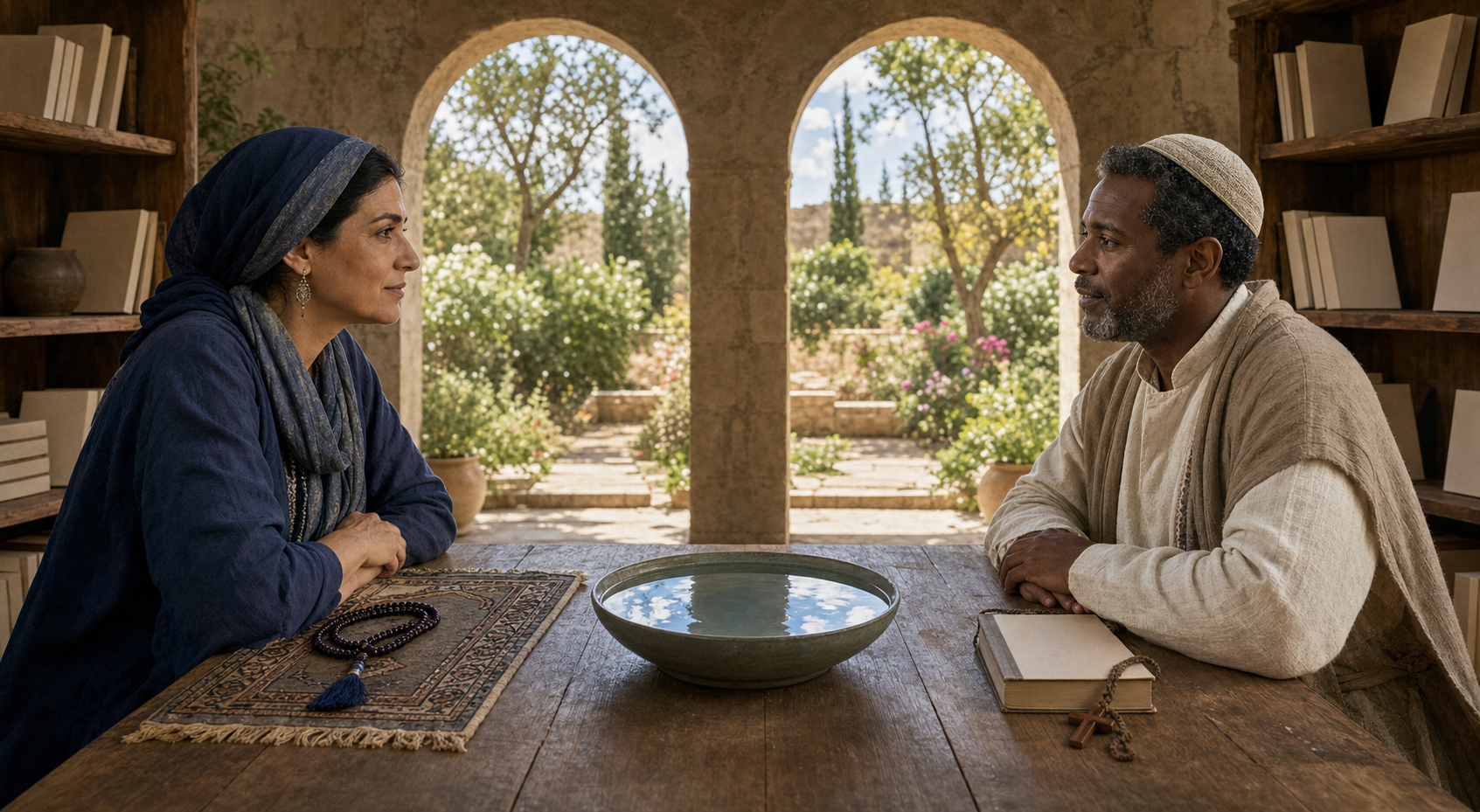
Religious conversations often go wrong during translation. Someone hears devotion to one form as denial of every other form. Someone else hears openness to many paths as a lack of conviction. You can prevent much of that confusion by answering in a deliberate order.
- State your conviction plainly. Say what you worship, practise, or believe without beginning with an attack on someone else’s position.
- State the boundary of your claim. Clarify what your commitment does not require you to deny. Devotion to an Ishta, for example, need not imply that infinite reality has no other name or form.
- Ask before translating. If another person uses words such as God, self, liberation, emptiness, or oneness, ask what the term means within that person’s tradition.
- Locate the real disagreement. Decide whether you differ about metaphysics, ritual, authority, ethical conduct, or simply vocabulary. Debate the actual difference rather than a larger conflict you have imagined.
- Choose an appropriate next step. Some differences deserve study or reasoned debate. Others can remain unresolved while you cooperate in service. Agreement is not the only peaceful outcome.
If you need language for the moment, these sentences are firm without being hostile:
- “I do not need to deny your path in order to remain committed to mine.”
- “We may be using similar words for different claims, so let us define them before deciding whether we agree.”
- “We have a real doctrinal disagreement, but it does not prevent us from treating each other truthfully and with dignity.”
- “Shared service does not settle our metaphysical differences, but it gives us a worthy place to work together.”
Pluralism does not demand that you approve every idea or practice carrying a religious label. You may reject an argument as incoherent, a historical claim as unsupported, or conduct as adharmic. The discipline is to criticize the specific claim or action without treating an entire community as spiritually worthless.
Nor should shared ethical work be made to prove more than it can. Seva, compassion, ecological responsibility, and truthful living can bring people together across doctrinal boundaries. Such cooperation demonstrates that difference need not produce enmity. It does not prove that every metaphysical claim is secretly the same.
Key takeaways
- One ultimate Truth does not make every human statement about it identical or equally adequate.
- An Ishta gives your practice a center; it need not place a boundary around the Divine.
- Religious pluralism requires enough commitment to practise deeply and enough humility to admit that your concepts are not infinite.
- Anekantavada, upaya, and Ik Onkar support openness in distinct ways. Treating them as synonyms erases the traditions you intend to honor.
- A real contradiction should be examined, not covered with the phrase “all religions are the same.”
- Shared ethical action can sustain trust even when doctrinal agreement remains impossible.
Before your next interfaith or inter-sectarian discussion, write two sentences: what you affirm, and what you do not need to deny in order to affirm it. Then ask the other person one sincere question about how their tradition understands its own terms. That small discipline turns pluralism from a pleasant idea into a way of seeking truth together.
Your path becomes generous not by becoming vague, but by becoming secure enough to see difference without fear. Practise what has been entrusted to you, study what you do not yet understand, and leave room for the Infinite to exceed every name you know.
References
