
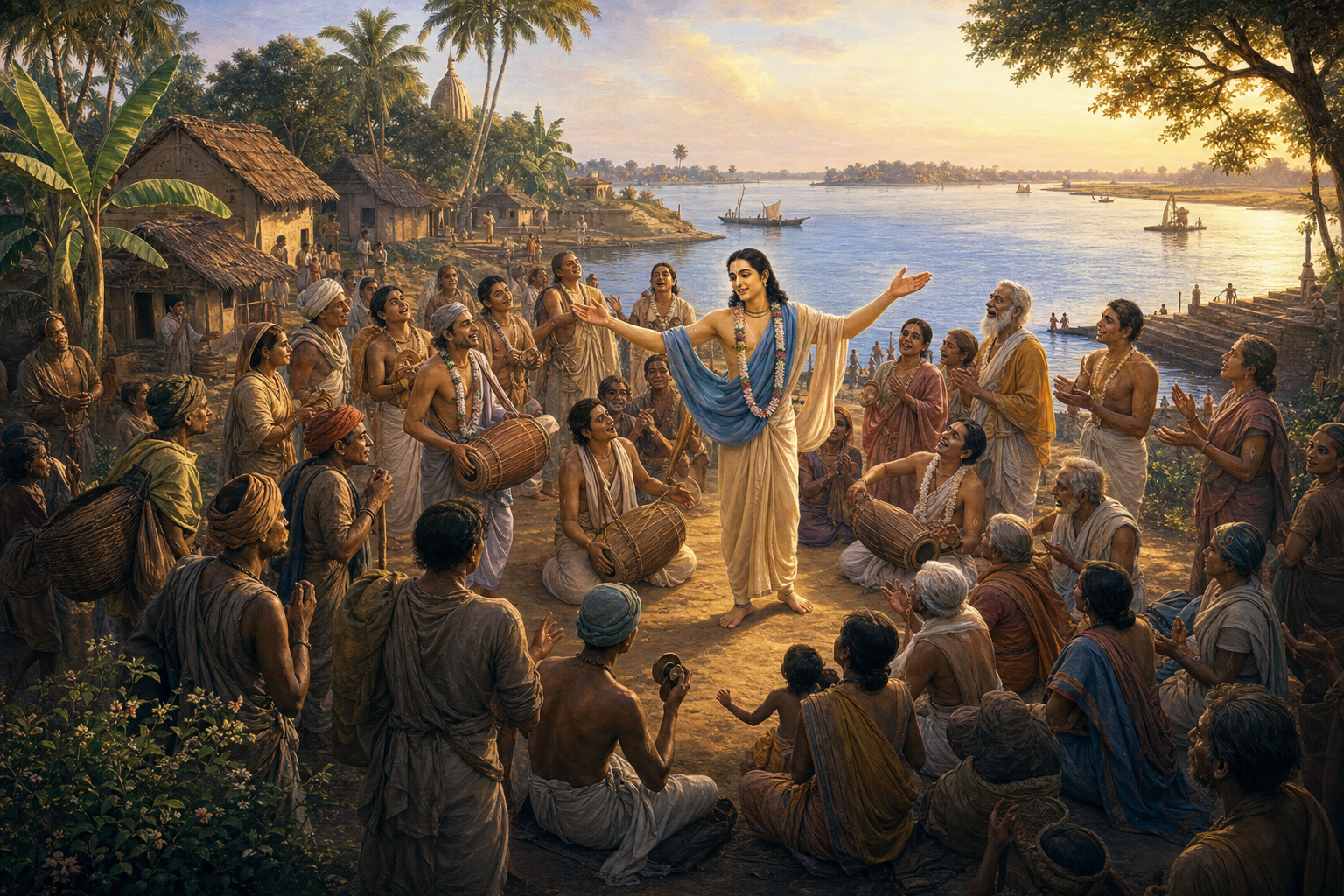
You may know Nityananda Prabhu as the merciful companion of Sri Chaitanya, yet still wonder what makes that mercy theological rather than merely temperamental. Why does Gaudiya Vaishnavism place compassion so close to the heart of divine reality?
The answer changes how you practise bhakti. Nityananda’s compassion is not indulgence, vague friendliness, or a refusal to distinguish dharma from adharma. It is the power to support a soul, make devotion accessible, and open a path from wrongdoing to transformed conduct. Once you see that structure, remembrance, sankirtana, forgiveness, hospitality, and seva cease to be separate virtues. They become parts of one devotional movement.
Compassion is not a soft addition to theology
Gaudiya theology begins with Nityananda’s identity. He is understood as non-different from Balarama and as the source of Sankarsana, Sesa Naga, and the Visnu manifestations associated with the Karana Ocean, the Garbha Ocean, and the ocean of milk. These are not decorative cosmological details. They establish a pattern: divine greatness expresses itself by sustaining, accommodating, accompanying, and serving.
The technical language of amsa and kala, often rendered as plenary portions and portions of plenary portions, describes manifestations that perform distinct functions without reducing divinity to a collection of disconnected parts. Sankarsana is associated with integration and support. Sesa supports the worlds and serves as the Lord’s couch and paraphernalia. The three Visnu forms situate divine presence across the cosmic order, within each universe, and as Paramatma in every heart.
This is the first key to Nityananda’s compassion: support is not beneath the Divine. It is one way divine fullness acts.
The same principle appears in the predominance of sandhini-shakti, the existential potency associated with Balarama and therefore with Nityananda. Sandhini manifests the sacred abodes, relationships, paraphernalia, and stable ground upon which divine lila unfolds. Navadvipa as dhama and a living sankirtana community can thus be contemplated as expressions of sustaining grace, not merely as locations or human organisations.
This gives you a demanding test for compassion. Ask whether your conduct creates ground on which another person can move toward Krishna. A cutting remark may be factually correct and still destroy that ground. A welcoming gesture may look small and yet make hearing, chanting, service, or repentance possible. Compassionate devotion does not abandon truth; it communicates and embodies truth in a way that supports spiritual movement.
The Adi-Guru brings devotion within reach

Nityananda is revered as the Adi-Guru, the original spiritual guide whose mercy grants access to Sri Chaitanya’s grace and Sri Krishna-bhakti. This reveals more than his rank within a theological hierarchy. It tells you what genuine guidance is meant to accomplish.
A guru does not merely transfer information. The guru makes a living relationship with bhakti possible by correcting, encouraging, exemplifying service, and directing the seeker toward the Divine. In Nityananda, this guiding function appears in its most generous form: his mission brought the Holy Name and Krishna-bhakti beyond entrenched social stratifications.
His avadhuta mood should therefore not be reduced to eccentricity or used as permission for arbitrary behaviour. It signifies transcendental freedom joined to unbounded compassion and unwavering commitment to awakening devotion. The freedom has a direction. It reaches those whom respectable society, religious pride, or their own past conduct may have placed at the edge.
If you teach, organise a temple programme, host kirtana, or simply speak about dharma with family members, use three questions to examine your own form of guidance:
- Is the obstacle before this person genuinely spiritual, or have we turned social familiarity, education, status, or devotional vocabulary into an unnecessary entrance test?
- After inviting someone in, are we giving them something they can actually do: hear the Holy Name, chant, read, serve, receive prasada, or ask a sincere question?
- Does our guidance direct attention toward Sri Chaitanya and Sri Krishna, or does it make belonging dependent on pleasing a personality or social circle?
Nityananda’s example does not make initiation, discipline, or discernment irrelevant. It puts them in their proper order. Mercy opens the way; guidance teaches the way; practice changes the person.
Jagai and Madhai show what mercy is trying to achieve
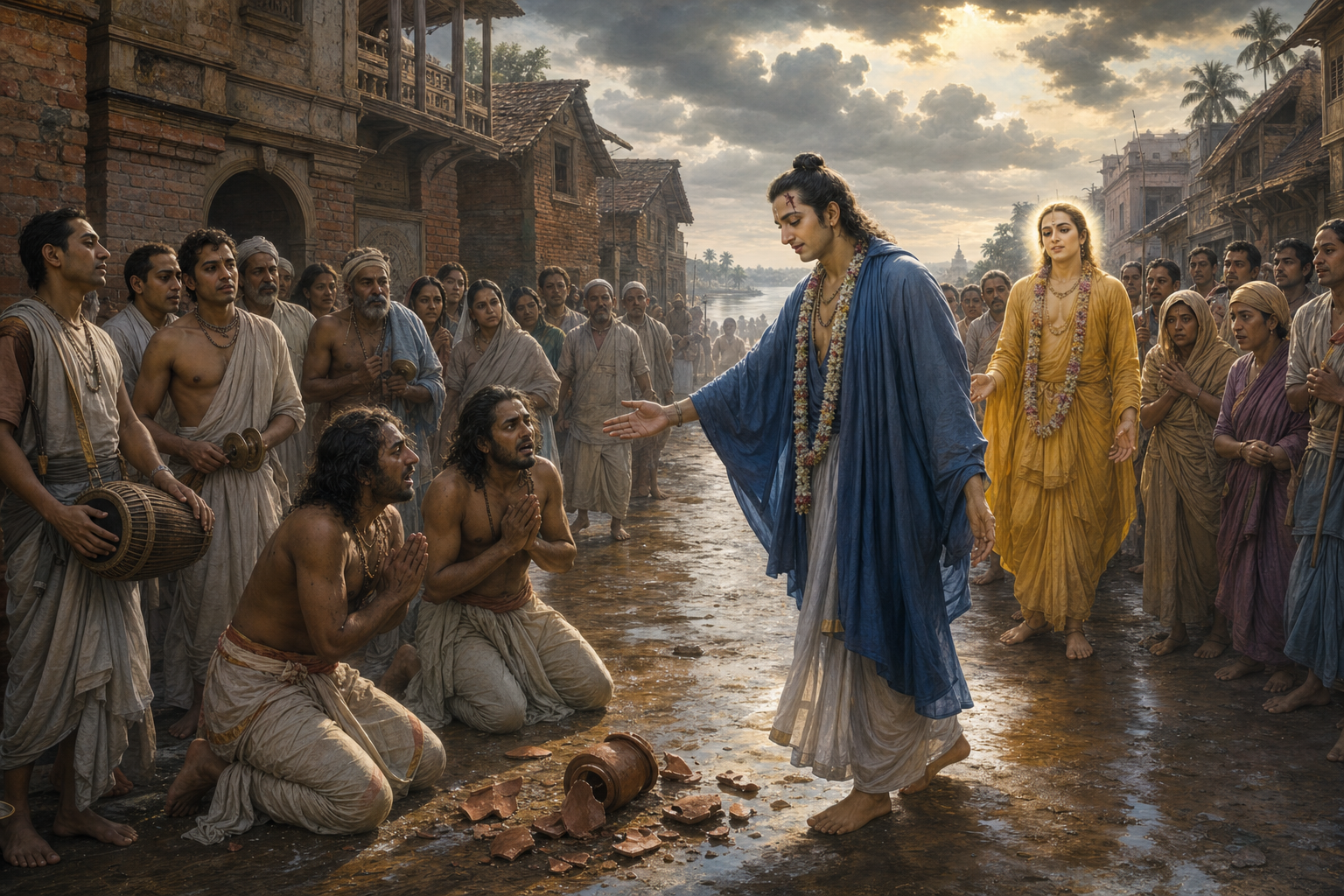
The deliverance of Jagai and Madhai has endured in Gaudiya memory because it confronts the difficult case, not the easy one. Compassion toward a polite and receptive person costs little. Nityananda’s mercy addresses people marked by serious wrongdoing and refuses to treat their present condition as their final identity.
Forgiveness supersedes retribution in this episode because mercy aims at transformation through contact with the Holy Name. That does not mean conduct is inconsequential. If wrongdoing did not matter, there would be nothing from which to be delivered. The theological claim is stronger: wrongdoing is real, yet Krishna’s Name and divine grace can produce a future that punishment alone cannot create.
This distinction protects you from two opposite errors. One is merciless correctness, which condemns the person while congratulating itself for defending standards. The other is sentimental permissiveness, which calls everything compassion and asks for no change. Nityananda’s model holds open a path of return while expecting a different direction of life.
When conflict reaches your family, sangha, or workplace, translate that model into concrete choices:
- Name the wrong action precisely instead of converting it into a permanent label for the person.
- Replace public humiliation with a clear path toward apology, repair, service, and changed conduct.
- Keep appropriate boundaries where harmful conduct continues. Forgiveness does not require pretending that trust has already been restored.
- Remember or chant the Divine Name before answering in anger, so that correction serves restoration rather than revenge.
- Measure reconciliation by conduct over time, not by how quickly everyone can be pressured into appearing harmonious.
This is compassion-in-action. It protects the moral seriousness of dharma while refusing to make another person’s fall the occasion for our own pride.
Turn the theology into a repeatable devotional practice

You do not need to wait for Nityananda Trayodashi to practise this theology. Build it into an ordinary day through five connected movements.
- Begin with remembrance. Contemplate Nityananda as Balarama, Adi-Guru, and the sustaining servant of divine lila. This keeps compassion rooted in who he is rather than in your passing mood.
- Study one defined teaching. Read a passage on Nityananda-tattva in the Adi-lila of the Chaitanya-caritamrita. Look specifically for the relationship among identity, service, support, and mercy.
- Give the Holy Name an audible place. Join sankirtana where possible, or chant with attention at home. In Nityananda’s mission, the Name is not background atmosphere; it is the means by which the heart is invited to change.
- Perform one act of sustaining seva. Feed someone, help prepare a gathering, welcome a newcomer, support a strained relationship, or do an unnoticed task that allows another person’s devotion to continue.
- Review the day honestly. Ask where you opened a path toward bhakti and where impatience, status-consciousness, or the desire to punish made that path narrower.
May Sri Nityananda Rama be the object of my constant remembrance.
Gaudiya invocation
On Nityananda Trayodashi, communities commonly deepen the same pattern through sankirtana, readings on Nityananda-tattva, remembrance, and generous prasada distribution. Fasting until midday is observed in some lineages and regions, so follow the practice of your sampradaya rather than turning one local custom into a test of everyone else’s devotion.
If you are helping to host the observance, notice the details that reveal whether hospitality is real. Can a newcomer tell where to sit? Is someone prepared to explain the kirtana or reading without condescension? Does everyone receive prasada? Are children, elders, visitors, and people outside the organising circle treated as participants rather than interruptions? These ordinary decisions are where a theology of sustaining grace becomes visible.
Shared dharmic values do not erase distinct teachings
Nityananda’s compassionate devotion can open a meaningful conversation across the dharmic family. Buddhist karuna honours compassion. Jain ahimsa and anukampa join non-violence with empathy and self-purification. Sikh seva and Naam-simran unite service, remembrance, and social uplift. The hospitality of prasada distribution can also resonate with the spirit of langar.
Resonance is not equivalence. The specifically Gaudiya claim is that Nityananda is Balarama within Sri Chaitanya’s lila, the Adi-Guru whose mercy leads the soul into Krishna-bhakti. You do not honour dharmic unity by dissolving that claim into a generic message about being nice. You honour it by recognising shared ethical and devotional movements while allowing each tradition to name its own metaphysics, practices, and goal accurately.
In an inter-dharmic gathering, a sound approach is simple: identify the shared act, state the doctrinal distinction, and then serve together without demanding artificial agreement. A conversation about compassion can lead to food distribution, care for a community, remembrance of the Divine, or reconciliation. Distinct teachings remain intact while shared dharmic responsibility becomes concrete.
Key questions, briefly answered
- Is Nityananda’s compassion simply kindness? No. Kindness is one expression of a deeper theology in which divine power sustains sacred existence, opens access to bhakti, and supports transformation.
- Does forgiveness mean removing every boundary? No. Mercy refuses revenge and permanent condemnation, but ongoing wrongdoing can still require correction, distance, repair, and the rebuilding of trust.
- Can a non-Gaudiya dharmic seeker learn from Nityananda? Yes. Compassion, remembrance, service, hospitality, and non-retributive transformation have broad dharmic resonance, even while Nityananda’s identity and goal remain distinctly Gaudiya.
- What is the simplest way to begin? Chant or remember Sri Nityananda, then perform one act that makes another person’s sincere spiritual practice easier.
Choose that act before the day ends. Welcome someone who remains at the edge, repair a relationship without hiding the wrong, distribute prasada, or quietly carry a task that supports your sangha. Then place the result before Sri Nityananda rather than using it to build your own image. That is how compassionate devotion moves from an admired quality to a lived theology.
References
