

You may know how to bow, where to sit, and how to address a senior, yet still leave a temple meeting wondering whether you spoke too sharply—or remained silent when something needed to be said. The difficult part of Vaiṣṇava etiquette begins when service is delayed, a message is misunderstood, correction touches your pride, or another devotee disappoints you.
The answer is not more ceremony. Humility keeps the ego from occupying the centre of every interaction; etiquette gives that humility a repeatable social form. Practised together, they let truth be spoken, correction be heard, and seva continue without making every disagreement a test of loyalty.
Humility should make you more available for service
External modesty does not necessarily reveal inner humility. You can lower your eyes, use deferential language, and think poorly of yourself while remaining intensely preoccupied with how humble you appear. The ego is capable of turning even self-abasement into a private performance.
The Bhagavad-gita places amanitvam, humility, beside adambhitvam, freedom from pretence. The pairing is diagnostic. Humility becomes distorted when it is used to advertise spirituality, win reassurance, avoid responsibility, or make another person feel guilty for correcting you.
Repeatedly telling yourself that you are useless may sound devotional, but it can keep your attention fixed on yourself. Healthy humility is more truthful. It recognises your dependence on grace, your capacity for error, the value of other people’s service, and the duties actually entrusted to you. It does not require you to deny your dignity, pretend you have no abilities, accept a false accusation, or treat mistreatment as a spiritual lesson you must silently endure.
The familiar Gauḍīya instruction trinad api sunicena taror iva sahisnuna, amanina manadena directs humility toward a practical result: greater tolerance, less demand for personal honour, more readiness to honour others, and steadiness in Hari-kirtana. The standard is not how small you can feel. It is whether your inner posture allows remembrance and service to continue.
- Humility is not self-contempt. Humility loosens your claim to superiority; self-contempt makes your supposed worthlessness the centre of attention.
- Respect is not compulsory agreement. You can honour a person while questioning a decision, interpretation, or method.
- Forbearance is not permission for harm. It gives you enough inner space to pursue truth without revenge or needless harshness.
- Patience is not indefinite postponement. It allows growth to take time while still establishing the next responsible action.
When a senior or service coordinator corrects you, do not rush either to defend yourself or to collapse into shame. First repeat the substance in your own words: Let me check that I understood what needs to change. Ask for a concrete example if the feedback is vague. Acknowledge what is accurate, clarify what is not, and agree on the next action. Your follow-through will reveal more humility than an emotional declaration of unworthiness.
Before darśana, an offering, or a difficult conversation, use a short inward reset. Take one steady breath. Recall a specific mercy or instruction you have received. Then identify the service required in the present moment. This moves attention away from evaluating yourself and toward gratitude, receptivity, and action.
Make respect, forbearance, and patience observable

Respect, forbearance, and patience work as interdependent disciplines in Vaiṣṇava community life. Respect without forbearance becomes fragile when others fail. Forbearance without patience becomes temporary suppression. Patience without respect can become cold detachment. You need all three, expressed in conduct that other people can recognise and rely upon.
| Virtue | Visible practice | Distortion to avoid |
|---|---|---|
| Respect | Listen attentively, acknowledge service, use appropriate forms of address, and make room for newcomers. | Ceremonial deference toward prominent people while ignoring peers, juniors, volunteers, or visitors. |
| Forbearance | Pause before reacting, clarify intention, regulate your tone, and address the real issue without attacking character. | Suppressing a concern until it becomes resentment, or calling harshness honesty. |
| Patience | Keep sādhana, satsanga, feedback, and follow-up steady while people and communities mature unevenly. | Demanding instant transformation, or leaving a necessary decision unresolved forever. |
Etiquette becomes credible in ordinary moments. Intentional greetings, timely replies, punctual service, measured speech, and unobtrusive assistance communicate whether people matter to you. None is dramatic. Their cumulative effect is a community in which members know what to expect from one another.
- When you arrive: greet the people already present, notice anyone standing alone, and introduce a newcomer to someone who can explain what is happening. Do not make a visitor decode the community through embarrassment.
- When you accept seva: confirm the task, the agreed time, the coordinator, and any decision you are authorised to make. If you cannot fulfil the commitment, inform the responsible person early enough for another arrangement.
- When you meet: listen to the complete point before preparing your reply. Ask a clarifying question before criticising a proposal. Distinguish disagreement about the work from judgement of the devotee.
- When service ends: acknowledge specific contributions, including cleaning, transport, cooking, administration, and other work that is easy to overlook. Close any promise you made rather than leaving the other person to chase you.
Forms of address differ across lineages and local communities. If you are unsure, ask quietly how someone prefers to be addressed. A title pronounced perfectly cannot compensate for interruption, neglect, or dismissive treatment. Conversely, a sincere question asked with warmth is usually more respectful than anxious formality.
Pay particular attention to people with little institutional status. It is easy to honour a guru, respected teacher, major donor, or visible leader. Your treatment of a new visitor, a child, an elderly member who can no longer perform much service, or a volunteer whose work is hidden is a more searching test of whether honour has become character.
Use disciplined speech and a clear conflict process
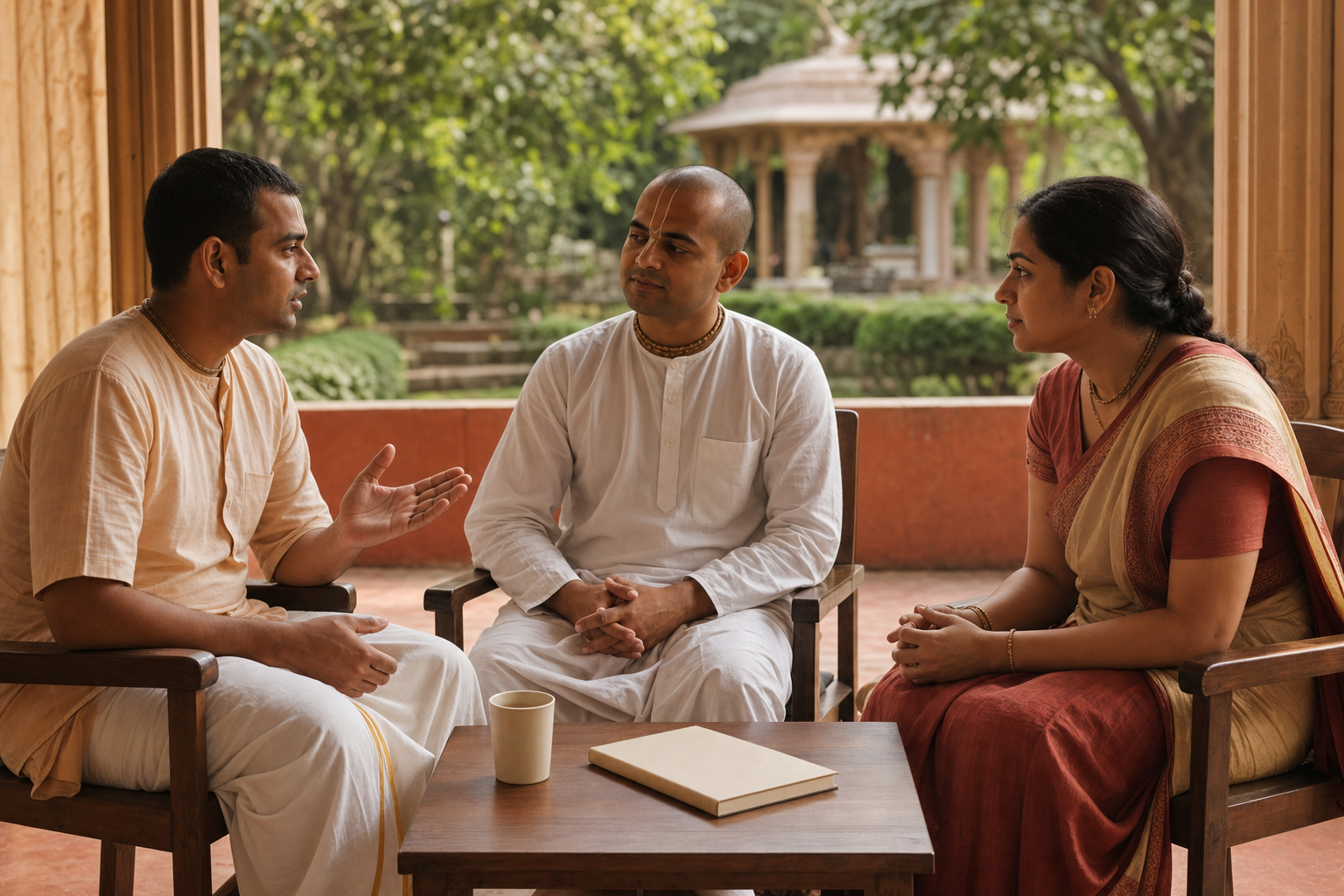
Speak for benefit, not merely for release
Vaiṣṇava speech should be truthful, beneficial, and offered at the right time. All three conditions matter. A fact delivered to humiliate is not sanctified because it is accurate. A pleasant falsehood is not kindness. A necessary correction delivered when neither person can listen may only deepen the problem.
Before repeating a criticism, sending a charged message, or speaking in a meeting, ask:
- What do I know directly, and what have I inferred about the person’s motives?
- Does the person receiving this information need it to perform a real responsibility?
- Am I seeking a remedy, or am I seeking an audience for my frustration?
- Would a private conversation protect both truth and dignity more effectively?
- Can I say the same thing without sarcasm, exaggeration, or a judgement about character?
When someone begins telling you about an absent third person, interrupt the pattern gently: Have you spoken with them directly? Do you want help arranging that conversation? This does not prevent legitimate reporting to a responsible leader. It prevents grievance from turning into social entertainment.
Digital communication requires extra restraint because tone is easy to misread and a private irritation can acquire an audience instantly. Slow down sensitive exchanges, avoid public disputes, and move them to a private voice conversation when possible. If you are agitated, draft the message but do not send it until you can remove accusations, imagined motives, sarcasm, and unnecessary recipients.
In a group chat, state the operational fact, the decision required, and who needs to respond. Do not litigate a devotee’s character before the group. If false information is already circulating publicly, correct the relevant fact without ridicule, then address personal conduct through the appropriate private process.
Resolve the issue without turning tolerance into silence
Forbearance does not bypass justice. It creates the composure needed to speak privately, understand one another, involve a trusted senior when needed, and repair an offence without multiplying it. Use the following sequence when ordinary friction becomes a real grievance.
- Define the issue as conduct, not identity. Replace you are disrespectful with a description of what was said, done, omitted, or agreed.
- Separate observation from inference. State what you know directly. If you are uncertain about intention, ask rather than declare.
- Check your purpose. Decide whether you need clarification, an apology, a changed procedure, restitution, or a boundary. A conversation without a desired remedy easily becomes accusation without an end.
- Invite a private conversation. Choose a setting in which both people can speak without an audience and without disrupting worship or service.
- Begin with shared purpose. Name the seva, relationship, or community responsibility you both want to protect. Then describe the concern plainly.
- Listen for the other person’s account. Repeat what you heard before answering it. Understanding an explanation does not require agreeing with it.
- Agree on the next observable step. Specify what will change, who will act, and when the matter will be revisited. Follow with a simple written confirmation if memory or role boundaries could create more confusion.
- Invite a trusted senior or facilitator if direct dialogue stalls. Ask that person to help clarify facts, responsibilities, and repair—not merely to validate one side.
A sound apology identifies the action, acknowledges its effect, accepts the responsible part without an if, and states how the damage will be repaired. Where a loss can be restored, restitution matters. Where trust has been weakened, do not demand immediate warmth as proof of forgiveness. Consistent changed conduct is part of the repair.
The private-first norm is not a command to face intimidation, coercion, or likely retaliation alone. If direct contact would be unsafe or a power imbalance prevents free speech, approach responsible leadership or a trusted senior first. Patience can govern the process without granting someone indefinite access to continue harmful conduct.
Build etiquette into the community’s service system

A community cannot depend on every member independently guessing the right conduct. Leaders and coordinators turn virtues into culture by making expectations visible, correcting consistently, and accepting the same disciplines themselves. A leader who asks members to avoid public criticism while publicly humiliating volunteers teaches the opposite of the stated rule.
Put the norms where people repeatedly encounter them
- Newcomer orientation: explain forms of address, the rhythm of worship, basic temple conduct, how seva is assigned, and whom to approach with a concern. Warm clarity is more welcoming than waiting for a mistake.
- Service descriptions: state the purpose, scope, coordinator, timing, communication channel, and decision path. Many apparent attitude problems begin as undefined responsibilities.
- Meeting practice: open with a brief reminder to clarify before criticising, keep one conversation active at a time, and end with named responsibilities and next actions.
- Feedback: offer correction privately and close to the event. Express gratitude specifically and promptly. Do not save either appreciation or resentment for a dramatic occasion.
- Leadership decisions: explain who made the decision, what principle governed it, and how a member can request reconsideration. Transparency does not require disclosing confidential personal information.
- Ongoing formation: return periodically to Bhagavad-gita 12.13–20, Upadeśāmṛta, Bhakti-rasāmṛta-sindhu, and Hari-bhakti-vilāsa, then connect the reading to a current service situation rather than leaving it as theory.
Srila Prabhupada’s cooperative vision becomes credible when people can offer seva without navigating avoidable ambiguity, personality contests, or fear of public embarrassment. Systems do not replace spiritual character. They give good character a stable channel and prevent chronic confusion from consuming the energy meant for devotion.
Notice whether the culture is actually becoming healthier
Do not reduce bhakti to a dashboard. Still, a community can watch for practical signs that etiquette is becoming habitual:
- disagreements are addressed before they become public campaigns;
- resolution becomes clearer and less prolonged;
- members collaborate across established social circles and service teams;
- people of different ages and levels of experience participate meaningfully;
- volunteers know their roles and receive acknowledgement for their work;
- members can say that they were heard and treated with dignity even when a decision did not favour them.
In a wider dharmic gathering, shared ethical language can also reduce sectarian hardness. Vaiṣṇava forbearance resonates with Buddhist kshanti, Jain kshama and ahiṃsā, and Sikh nimrata joined with seva and truth. These traditions should not be flattened into identical doctrines. Their shared insistence on restraint, compassion, reverence, and service can nevertheless provide a practical bridge when Hindus, Buddhists, Jains, and Sikhs work together.
Key takeaways
- Measure humility by receptivity, truthfulness, and readiness for seva—not by self-denigrating language.
- Make respect visible through listening, reliable commitments, appropriate address, and attention to people with little status.
- Use forbearance to create room for truth; do not use it to hide injustice, resentment, or recurring harm.
- Keep personal correction private whenever possible, describe conduct rather than motives, and agree on an observable next step.
- Move emotionally charged digital exchanges away from group chats and into private, voice-based conversation.
- Give leaders clear service roles, feedback practices, decision paths, and early mediation procedures so etiquette does not depend on personality.
At your next gathering, choose the interaction you usually rush: greeting a newcomer, answering a message, receiving correction, or raising a concern. Slow that moment down. Offer honour, ask a clarifying question, and leave with a defined next step. That is how sadācāra becomes community culture—through conduct other devotees can safely rely on.
References
- Dandavats — Transforming Community through Vaiṣṇava Etiquette: HG Urmila Mataji, Naperville 2026
- Dandavats — In Memoriam: Ekanatha Das’s Profound Humility and the Timeless Guru–Shishya Ethos
