
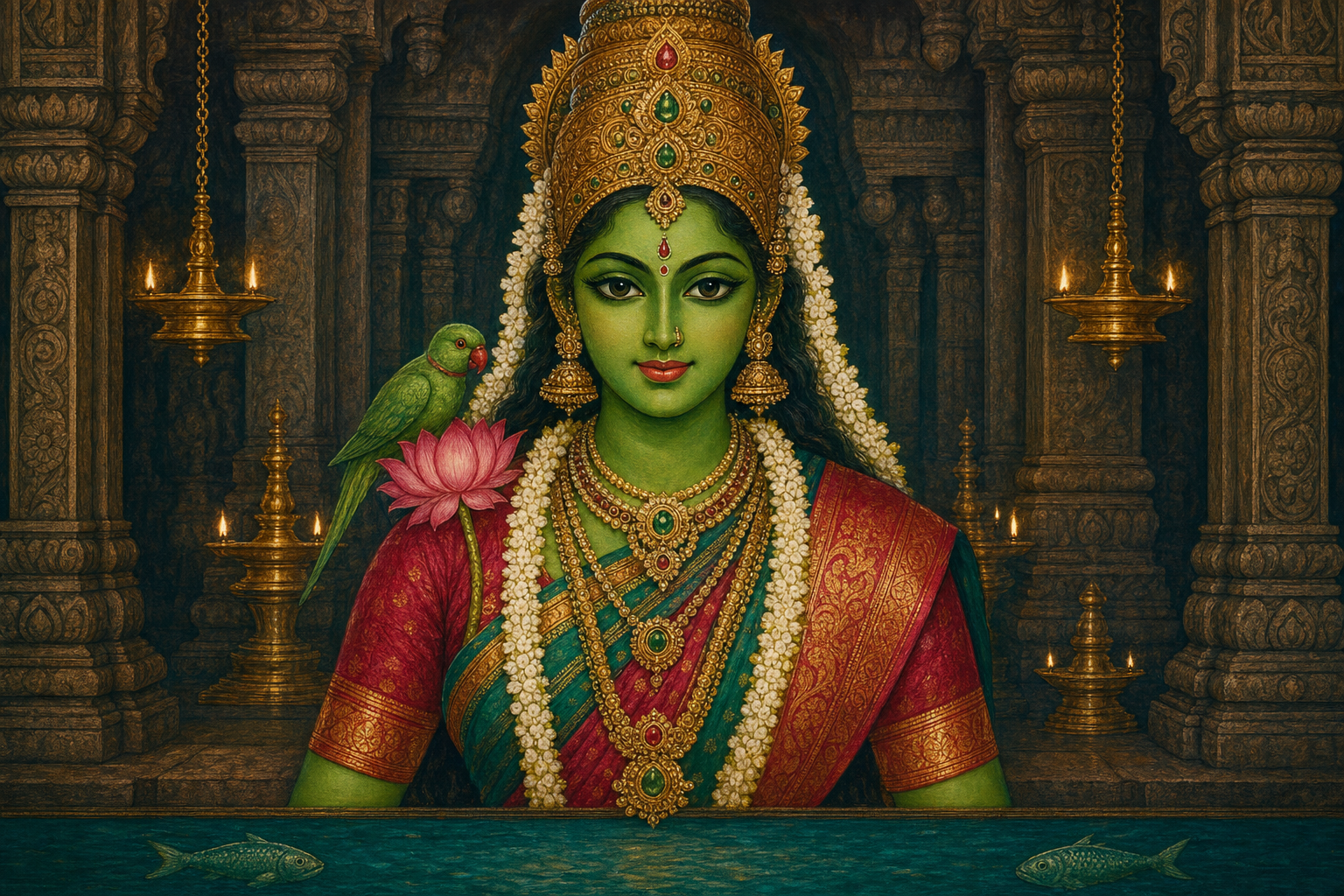
You may enter Meenakshi Amman Temple knowing that the goddess’s name means “fish-eyed,” yet still wonder what you are meant to see. Is it simply an old convention for describing beautiful eyes, or does the fish carry a deeper meaning?
The answer changes how you approach her sanctum. Meenakshi’s eyes unite beauty, vigilance, royal authority and grace in one image. Once you understand those layers, darśana becomes more than looking at a celebrated icon: it becomes the experience of placing your life within a gaze that neither neglects suffering nor releases you from dharma.
The name is a map, not an anatomical description
Mīnākṣī joins mīna, “fish,” with akṣi, “eye”. The familiar Tamil word meen gives the name an especially natural home in Madurai. It works across Sanskrit and Tamil rather than belonging neatly to only one linguistic world.
Begin with the visible form. Classical Indian poetry and performance aesthetics praise long, radiant and gently tapering eyes by comparing them with fish, lotus petals or the eyes of an antelope. Matsyākṣī, the fish-eyed woman, is therefore an image of auspicious beauty. The comparison concerns shape, luminosity and alert softness; it is not asking you to imagine a human face with the literal organs of a fish.
That aesthetic language is not superficial decoration. In a sacred image, beauty directs attention. The attractive form gathers a restless mind and leads it toward the presence represented by the form. Meenakshi’s eyes are beautiful because her gaze is gracious, and the beauty gives that grace a form you can meet.
When you look at an image of Meenakshi, first notice the elongated outline of the eyes. Then shift from form to function: ask what kind of seeing those eyes represent. That second movement—from admiring the image to understanding the gaze—is the doorway into its theology.
The gaze gathers beauty, protection, polity and water
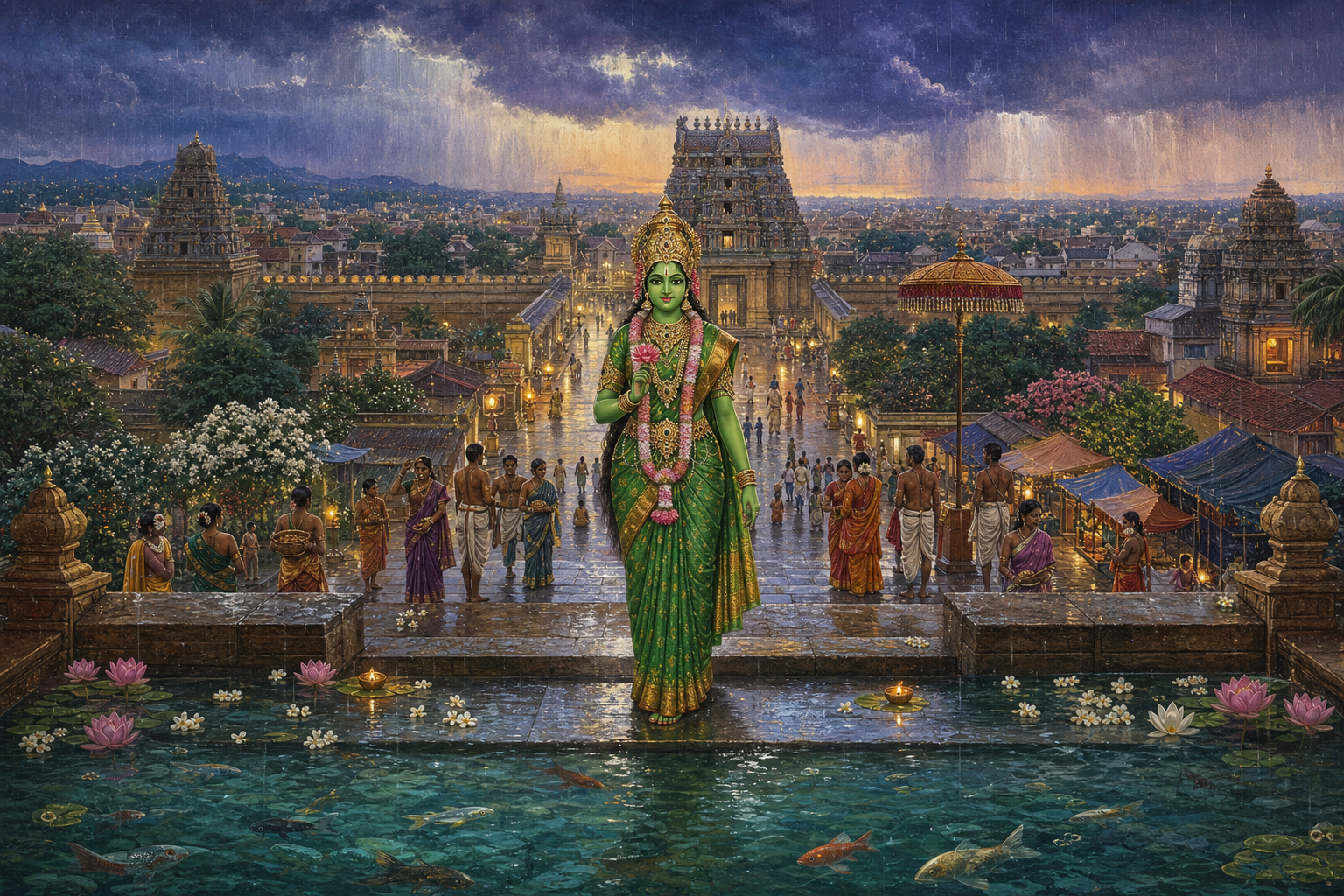
No single explanation exhausts the fish symbol. Four meanings operate together, and each corrects a different misreading.
- Auspicious beauty: The fish-like shape belongs to an established Indic language of graceful eyes. It tells you that divine beauty is not opposed to spiritual seriousness; beauty can steady attention and make grace perceptible.
- Uninterrupted care: Fish do not close their eyes as human beings do. Within the symbol’s logic, Meenakshi therefore remains watchful when everyone else sleeps. Her protection is imagined as maternal attention without an interval of abandonment.
- Pandya sovereignty: The paired fish served as the Pandya dynastic emblem on royal signs such as coins, seals and flags. The goddess’s name consequently belongs to Madurai’s civic memory as well as to devotional poetry. Her eyes mark her as the divine queen who watches over the city.
- Life sustained by water: Fish belong to the rivers, rains and productive waters on which communities depend. Around Madurai and the Vaigai, the image can carry associations of fertility, food, seasonal abundance and the maritime world of the Pandya realm.
These meanings should not be forced into competition. The aesthetic reading explains why the eyes look as they do. The devotional reading explains what the gaze does. The Pandya reading locates the goddess in Madurai’s history. The ecological reading places her within a landscape sustained by water. Together they show why Meenakshi is at once Devi, mother, queen and guardian of a particular place.
Madurai’s sacred narrative identifies her as the daughter of Malayadhwaja Pandya and Kanchanamalai. She is born with a third breast and a prophecy that it will disappear when she meets her destined consort. It vanishes when she beholds Shiva as Sundareśvara, and their marriage is ritually remembered in the Chithirai festival.
Do not let the miraculous bodily sign obscure the narrative’s larger structure. Meenakshi enters the story through the Pandya royal house, meets Shiva through sight, and remains the presiding identity of Madurai. Even her marriage is narrated through a transformative exchange of gazes. Seeing is not incidental to her story; recognition reveals relationship and destiny.
The fish also participates in a wider Dharmic vocabulary, but the traditions should not be collapsed into one another. The pair of golden fish in the Buddhist Aṣṭamaṅgala signifies fearlessness and unimpeded freedom in the ocean of saṃsāra. Aquatic forms can appear in Jain visual ornament as signs of auspicious abundance, although the fish is not a central Jain doctrinal emblem. Sikh thought speaks of nadar, divine favor or gracious regard, without making the fish a focus of worship. The useful comparison is not “all traditions teach the same symbol.” It is that Dharmic cultures repeatedly use vision, grace, nature and fearlessness to make compassionate awareness intelligible.
Darśana means you are not the only one looking
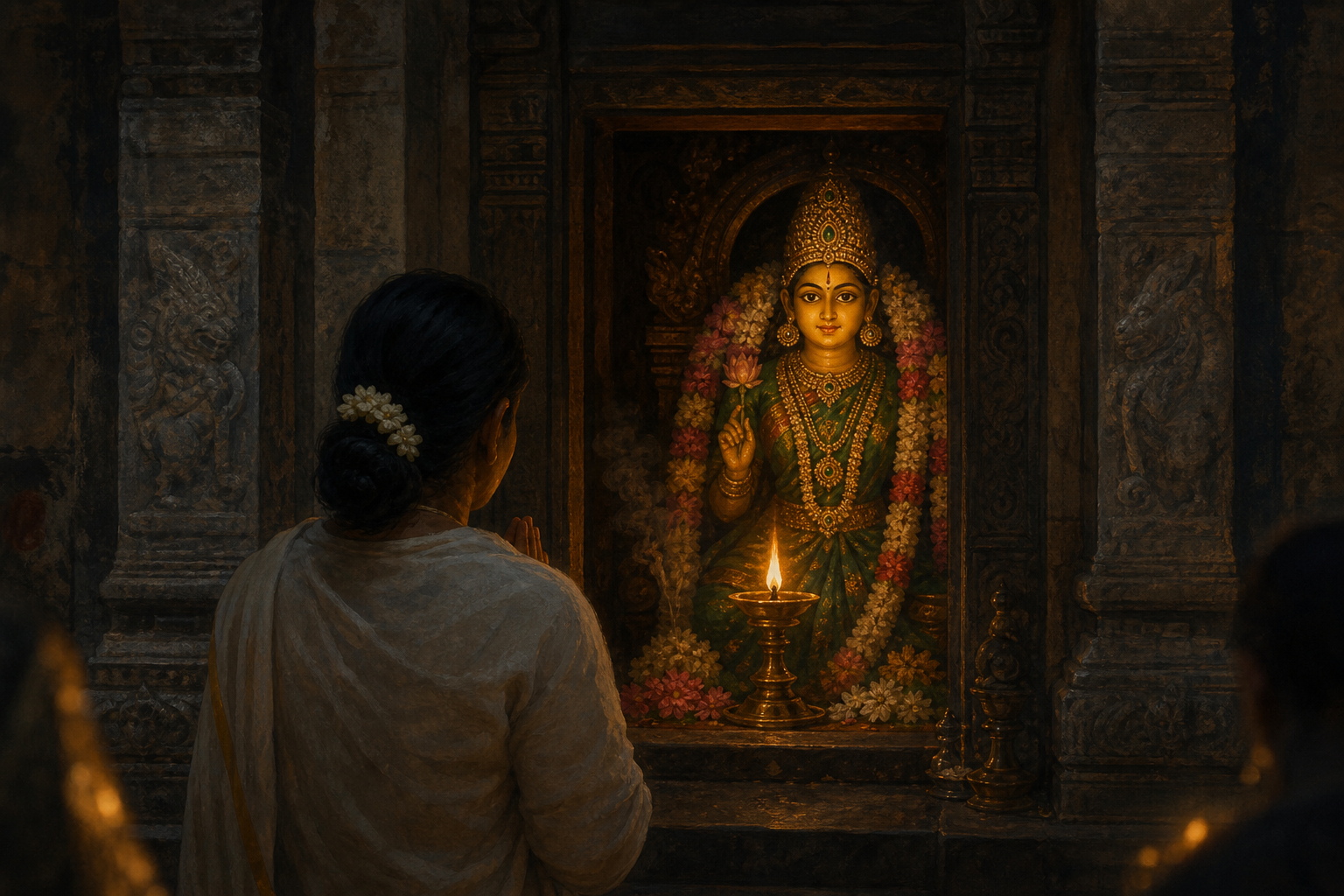
A museum visitor usually controls the act of looking: the object is inspected, interpreted and left behind. Darśana unsettles that arrangement. You approach the deity to see, but also to be seen. The sacred image is not treated as an inert specimen whose meaning ends at its surface.
This is why Meenakshi’s eyes matter more than a clever explanation of their shape. In devotional language, her kaṭākṣa—her gracious glance—can communicate anugraha, divine favor. Her netra are not merely features on an icon; they express knowledge, recognition and benevolent power. The devotee brings confusion, grief, gratitude or responsibility into that field of awareness.
Deepārādhana makes this reciprocity especially vivid. As the ritual lamp illuminates the face and eyes of the deity, the brief passage of light gathers attention. You may have only a moment before the crowd moves, but duration is not the measure of darśana. The question is whether you are present for the moment you receive.
- Before the sanctum, decide what you are bringing. Put it into one plain sentence: a gratitude, a fear, a duty you have avoided or a decision that needs moral clarity. This prevents the mind from scattering across every visible detail.
- When the image becomes visible, receive the whole form first. Do not strain immediately for one feature. Let the posture, color, ornaments and surrounding sanctum establish the presence of the deity.
- When the lamp rises, attend to the face and eyes. Remember the governing meaning: this is a gaze of awareness without neglect. You do not need to manufacture an unusual emotion or visual experience.
- After moving aside, translate recognition into conduct. Ask what must change if your concern has truly been seen. The answer may be an apology, a disciplined refusal, a promise kept, a neglected act of care or a duty completed without resentment.
The movement from seeing to conduct is essential. Grace is not permission to remain passive. To stand under an ever-watchful compassionate gaze is also to have your own selective vision exposed: whom have you stopped noticing, what responsibility have you tried not to see, and where have you confused indifference with detachment?
The encounter may carry śānta rasa, a quieting of agitation, or vātsalya, the tenderness associated with parental care. It may also be shaped by service, friendship or reverent love. There is no need to demand one approved feeling. Let the image meet the bhāva with which you have honestly arrived.
Approach the eyes without reducing the rest of the image
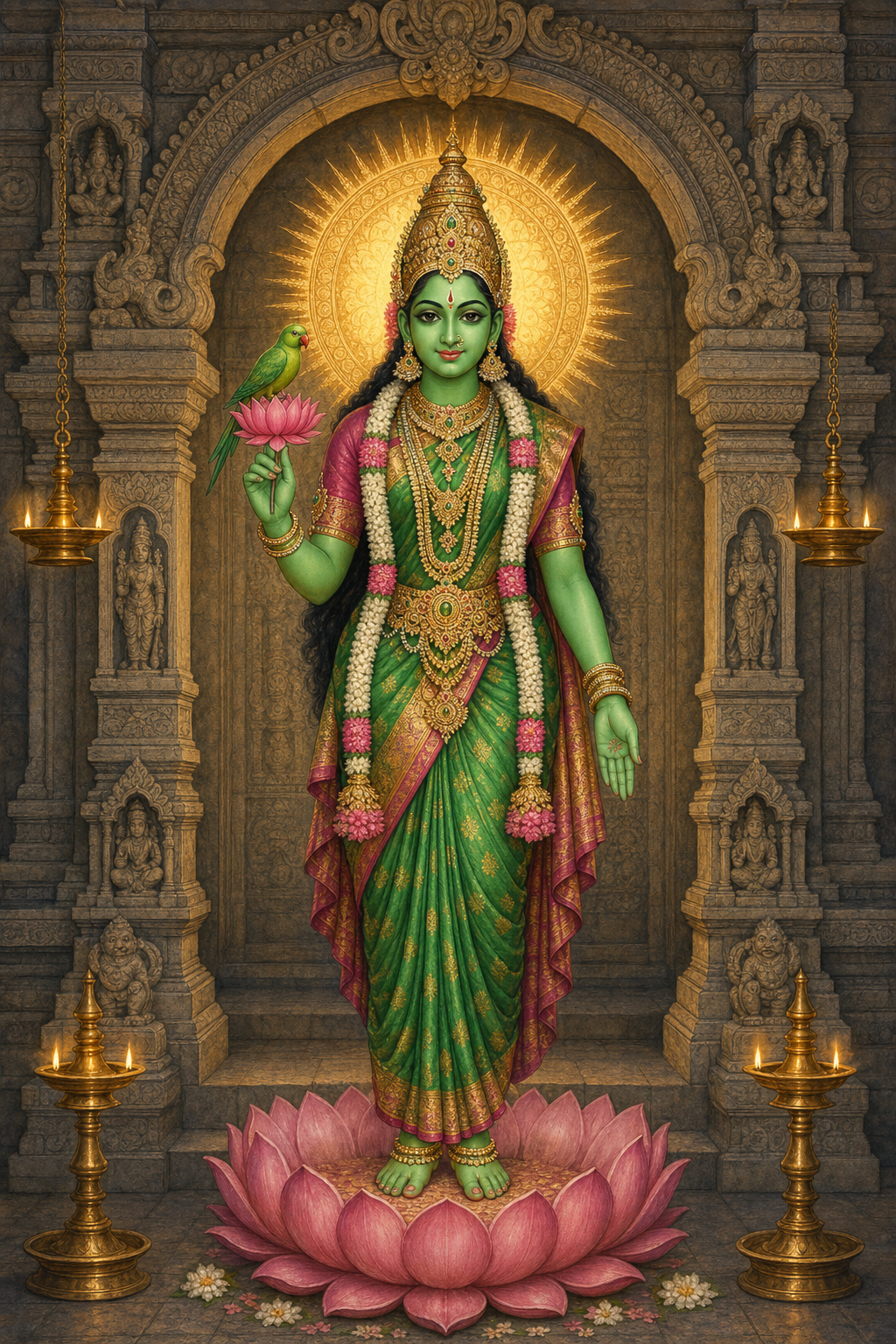
Meenakshi’s eyes are her identifying signature, but they belong to a complete iconographic and architectural world. The temple’s carved gopurams, guardians, processional spaces and Golden Lotus Tank gradually move your attention from the many forms of the sacred toward the concentrated presence of the sanctum. You do not have to decode every figure. Notice the change in scale and attention as you move inward.
At the sanctum, allow the day’s alankāram to speak without assuming that every representation will look identical. Meenakshi is frequently shown with a greenish complexion associated with fertility and healing. A lotus or parrot may accompany her, while gestures such as abhaya and varada communicate protection and giving. Ornaments, flowers and visible gestures can vary; the radiant, lengthened eyes remain the central cue.
A sound reading moves from detail to relationship. Green, lotus, parrot, gesture and gaze are not separate trivia to collect. They present a sovereign Śakti whose life-giving abundance is joined to the power to protect. Look for that unity rather than treating the icon as a checklist.
If you are contemplating an image at home, you can use the same principle without pretending to reproduce temple ritual. The following is a simple personal discipline of attention, not a prescribed āgamic rite:
- Place the image where you can see it comfortably and sit without needing to hold your body rigidly.
- Begin with the entire form. Let your breathing settle before directing special attention to the eyes.
- Rest your gaze gently rather than staring or trying to force a vision. Trāṭaka offers a useful parallel of steady attention, but devotional darśana is not a test of endurance.
- Name what you want Meenakshi’s gaze to hold: sorrow, gratitude, uncertainty, anger, obligation or concern for someone else.
- Ask, “What does dharma require me to see clearly here?” Wait without bargaining for a preferred answer.
- End by choosing one proportionate action. Let contemplation issue in speech, restraint, service, repair or disciplined work.
This practice protects you from two opposite errors. One is reducing the goddess to an aesthetic object. The other is treating her gaze as a magical transaction in which attention to an image guarantees the outcome you want. Darśana is relational: you bring yourself before grace, and grace reorders how you see your life.
Key takeaways
- “Fish-eyed” first describes long, luminous and tapering eyes within classical Indian aesthetics; it is not a literal anatomical claim.
- The fish’s unclosed eye becomes a theological image of compassion and protection without interruption.
- The Pandya twin-fish emblem connects Meenakshi’s gaze to Madurai’s royal history, civic identity and waterside culture.
- Darśana is reciprocal sacred seeing: you behold Meenakshi while placing yourself under her knowing and gracious regard.
- The most useful response to the gaze is a dharmic action—seeing a neglected person, obligation or truth and responding to it.
The next time you stand before Meenakshi, do not spend the brief moment asking whether her eyes resemble a fish realistically enough. Let the symbol do its proper work. Receive the beauty, remember the unbroken care, recognize the queen of Madurai and allow her gaze to expose what your own eyes have avoided.
Then leave with one duty made clearer. The most faithful way to carry Meenakshi’s fish-eyed gaze beyond the sanctum is to become less willing to let another being’s need remain unseen.
References
