
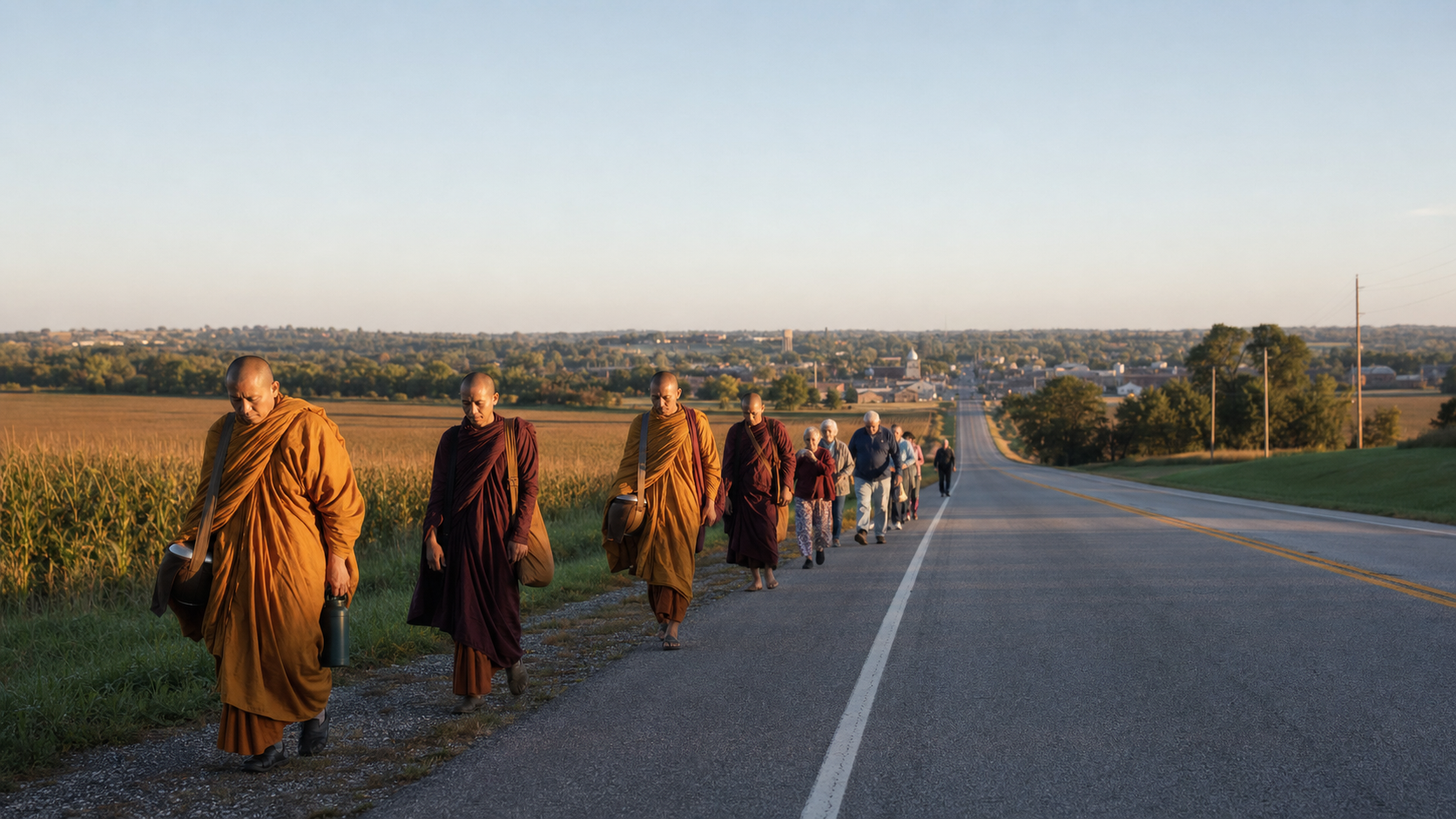
If you saw the monks crossing American towns in silence, you may have wondered what such a procession could actually change. A walk cannot settle every dispute or repair a divided society by itself. Yet it can show whether peace is merely an opinion we hold or a discipline we are willing to embody.
The Walk for Peace offers you two practical lessons. First, nonviolence becomes credible when it costs time, effort, and restraint. Second, you do not need to cross a continent to begin. You can bring the same structure into a difficult conversation, a community gathering, or one ordinary walk through your neighborhood.
The scale made the message credible

Nineteen Vietnamese Buddhist monks from the Huong Dao Vipassana Bhavana Center in Fort Worth walked approximately 2,300 miles over 108 days. Their route passed through nine states on the way to Washington, D.C. That scale matters because it turns an agreeable word such as peace into a demanding physical commitment.
The distance works out to about 21 miles per day. Maintaining that pace required route planning, bodily recovery, coordination, hospitality, basic supplies, and repeated attention to safety. This was not passive withdrawal from public life. It was disciplined exertion carried out without aggression.
The monks also avoided slogans, campaign messages, proselytizing, and argumentative speeches. Their method was their message: measured steps, attentive breathing, restraint, and consistent conduct. People did not have to accept a manifesto before they could understand what was being demonstrated.
The choice of 108 days gave the journey a clear spiritual form. A Buddhist mala commonly contains 108 beads, allowing recollection to be sustained through repetition rather than left to mood. The number also carries sacred significance across Hindu, Buddhist, Jain, and Sikh settings, though each tradition interprets and uses it in its own way.
The useful point is not that arithmetic made the walk holy. A defined cycle made the intention accountable. There was a beginning, a rule of practice, a demanding period of continuation, an arrival, and a return. The procession reached the Lincoln Memorial and then returned to Fort Worth for its closing ceremony. Completion included reintegration, not merely a dramatic finish.
If you are taking up a personal vow or organizing a community observance, copy that structure. State when it begins, what conduct it requires, how long it lasts, and how you will carry its discipline into ordinary life afterward. An aspiration without a form is easily postponed. A form turns it into practice.
Why quiet presence reached people who might reject a slogan
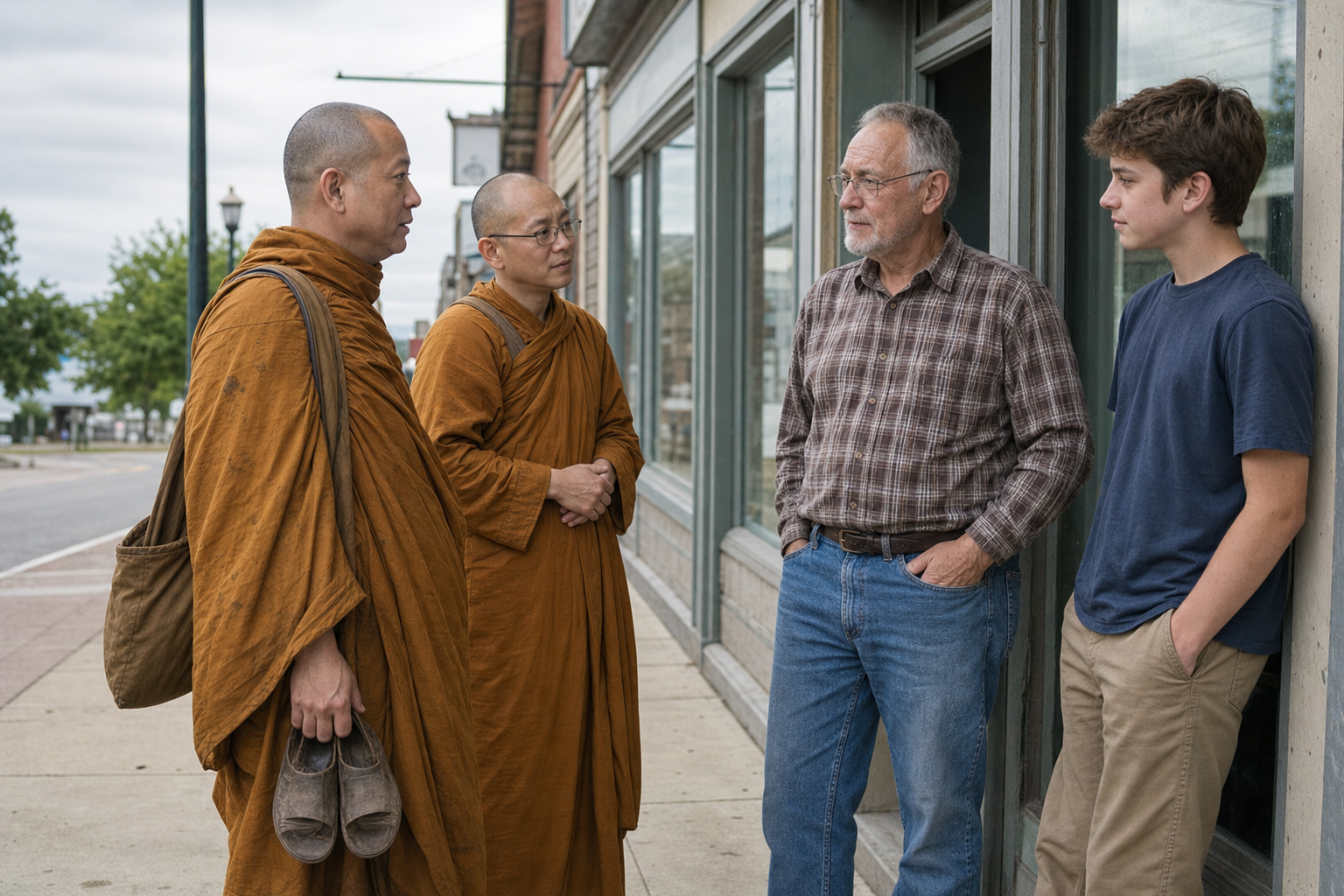
The procession asked very little of a bystander. You could watch without being recruited, bow without changing religions, walk beside the monks for a few minutes, or simply return to your day. That low threshold made participation possible across political, religious, and cultural boundaries.
Along the route, people commonly answered with the words “Thanks” and “Compassion”. Some stood silently on sidewalks and porches. Others folded their hands, bowed, placed a hand over the heart, or joined the walk briefly. Live tracking and social media allowed people farther away to follow the journey without turning the procession itself into a rally.
Observers also noticed small changes in the immediate surroundings: voices softened, traffic became quieter, and strangers acknowledged one another. These local reactions should not be inflated into proof that the walk permanently changed the national mood. They do show something more modest and usable: composed behavior can change the tone of an encounter before anyone wins an argument.
A reasonable explanation is that deliberate, non-threatening movement gives other people fewer reasons to become defensive. There is no slogan to rebut and no demand to refuse. The body sees a slow pace, relaxed attention, and coordinated restraint. That does not guarantee agreement, but it creates room for curiosity where confrontation might otherwise begin.
Visible emotion, including tears among some onlookers, does not need to be treated as mystical proof. A person may be responding to relief, grief, admiration, spiritual memory, or the unusual experience of receiving attention without a demand attached. The honest response is to respect the emotion without inventing a single explanation for it.
The walk also encountered the two sides of American religious pluralism. A small number of people expressed hostility, while Christian elders, lay believers, local residents, volunteers, and a police officer met the monks with hospitality or mutual respect. Pluralism did not require everyone to erase theological differences. It required people to maintain dignity in the presence of those differences.
Even Aloka, the stray dog who attached himself to the procession, clarified the walk’s moral imagery. He followed the group through routine, relationship, and consistent care, eventually becoming one of its most recognizable companions. There is no need to turn the animal’s behavior into a supernatural claim. Its simpler meaning is strong enough: trust often begins when another being becomes predictable, gentle, and safe.
A shared Dharmic grammar without erasing differences
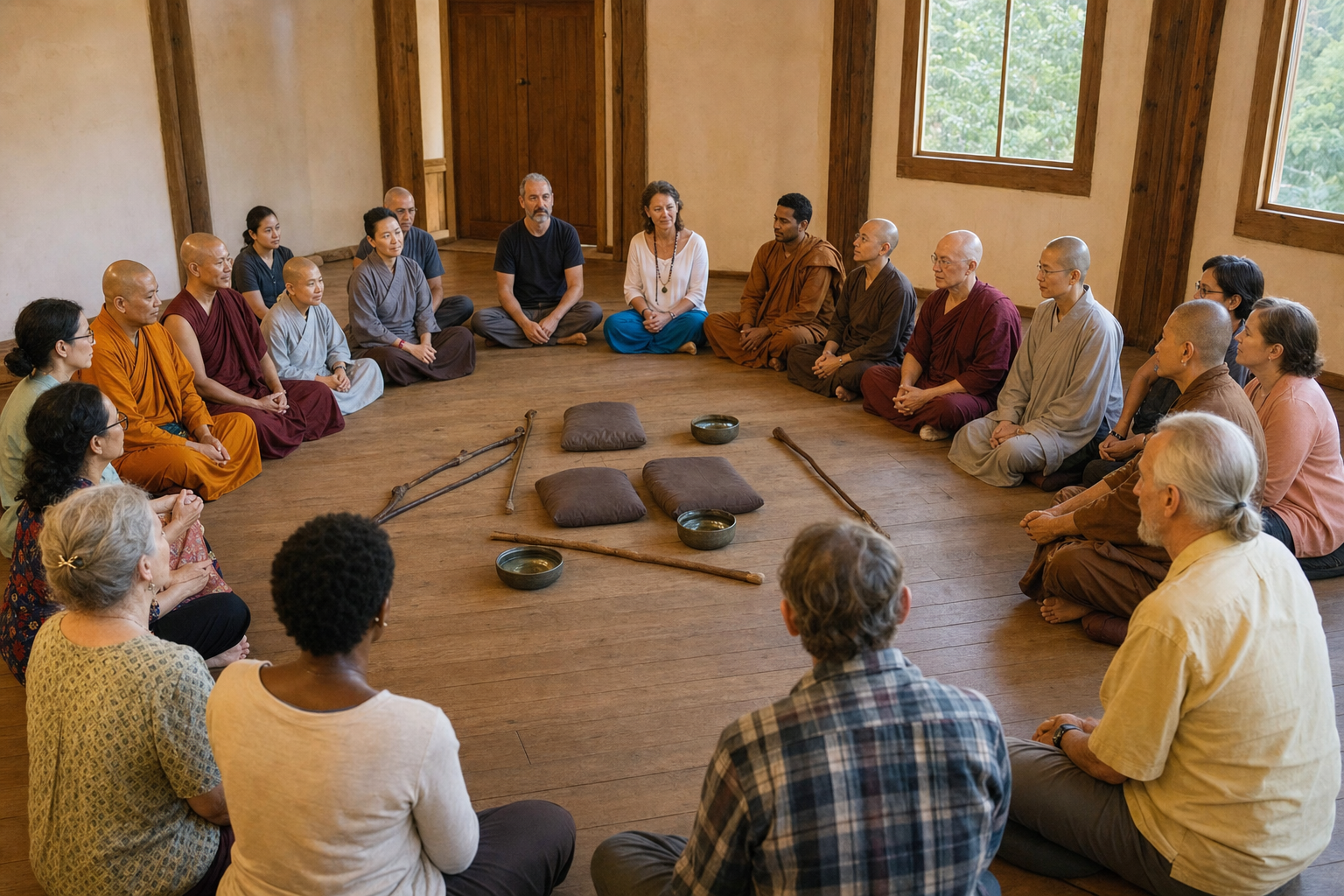
The walk is best understood neither as an isolated Buddhist curiosity nor as evidence that all religions are secretly identical. It expressed a shared Dharmic ethical grammar while remaining distinctly Buddhist in method.
The organizing center follows a Vipassana orientation. Vipassana concerns insight into experience as it is occurring. Sati is mindful awareness and recollection. Upekkha is equanimity, the capacity to remain balanced without becoming indifferent. Metta and karuna cultivate loving-kindness and compassion. During the walk, these were not merely concepts to be explained; they shaped pace, attention, response, and conduct.
- Buddhist metta and karuna direct the mind toward goodwill and compassionate response.
- Hindu ahimsa and tapas join non-harm to disciplined effort rather than treating peace as mere softness.
- Jain reverence for life presses nonviolence into thought, speech, and action with exceptional rigor.
- Sikh seva expresses humility through practical, selfless service.
These concepts are related, but they are not interchangeable. Jain ahimsa, Buddhist compassion, Hindu tapas, and Sikh seva arise within different teachings, communities, and disciplines. The convergence is ethical rather than doctrinal: refuse needless harm, govern your own reactions, and become useful to others.
That distinction gives you a better way to speak about Dharmic unity. Avoid saying that every path teaches exactly the same thing. Say instead that several paths cultivate recognizable forms of non-harm, self-restraint, compassion, and service while preserving their own theology and practice. Unity built on honest distinction is more durable than unity built on flattening.
A Vietnamese Buddhist community based in Texas carried this Dharmic discipline through the American civic landscape. That is an important form of Bharat’s civilizational influence. It does not depend on political branding or ethnic ownership. A practice born within the Dharmic world traveled across cultures, took root in another community, and entered public life through conduct.
The warm response from many Christian hosts adds another layer. Common ethical ground did not require theological merger. People could recognize humility, love, sacrifice, and neighborliness in one another while remaining committed to different faiths. If you are building interfaith relationships, begin with a shared act of service or disciplined presence. Doctrinal conversation can follow after trust exists.
What you can copy without walking 2,300 miles
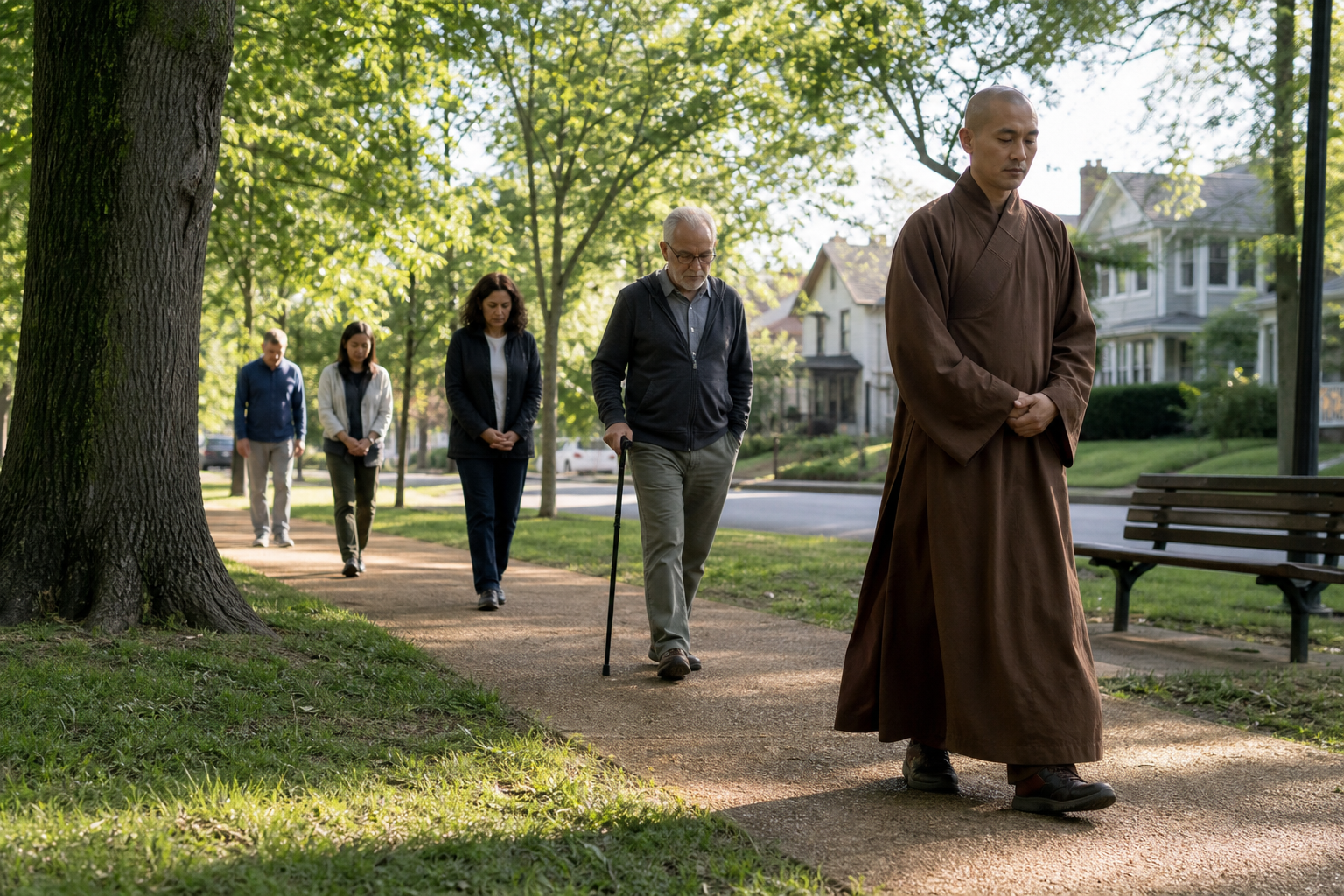
You do not need to imitate the monks’ mileage. Unless you have appropriate preparation and support, trying to reproduce that physical demand would miss the point. Copy the relationship between intention and conduct: slow down, notice your own state, refrain from immediate retaliation, and choose the next non-harming action deliberately.
Use a three-breath reset before a difficult response
The most portable practice demonstrated along the route is a brief combination of grounding, paced breathing, and softened attention. Use it before answering an inflammatory message, entering a tense meeting, or continuing a family disagreement.
- Pause in a physically safe place and feel the contact between your feet and the ground.
- Take three unforced, slow breaths. Let each exhalation last a little longer than the inhalation without straining.
- Soften your gaze or lower your eyes briefly. Notice the jaw, shoulders, hands, and abdomen without trying to manufacture a special state.
- Ask one practical question: What is the least harmful truthful thing I can do next?
The purpose is not to suppress anger or pretend that injustice is harmless. The pause separates the first surge of reaction from the action you choose. You may still need to say no, correct a falsehood, leave an unsafe situation, or defend someone. Ahimsa is not helplessness; it is disciplined power that refuses unnecessary harm.
If slow breathing makes you uncomfortable or light-headed, stop forcing the rhythm and breathe normally. This reset is a momentary contemplative aid, not treatment for trauma, anxiety, or persistent psychological distress. When distress is severe, recurring, or disruptive to daily life, seek appropriate professional care rather than expecting a brief practice to carry a clinical burden.
Turn an ordinary walk into moving practice
Choose a safe, familiar path away from traffic hazards. Walk at an unhurried but natural pace. Feel each foot make contact, follow the breath without manipulating it, and notice when the mind begins rehearsing an argument. When it does, return attention to the next step. Keep enough visual awareness to move safely; contemplative walking does not require staring at the ground.
End by carrying one quality from the walk into an action. You might listen without interrupting, complete an unglamorous act of seva, refrain from forwarding an inflammatory claim, or address a disagreement without humiliating the other person. The walk becomes Dharmic practice when its steadiness survives contact with another human being.
If you organize a community peace walk, design the conduct first
A public procession can easily become a photo opportunity with no discipline behind it. Prevent that by deciding how participants will behave before promoting the event.
- Write a one-sentence purpose. State clearly whether the event is non-political, non-proselytizing, interfaith, or rooted in a particular tradition.
- Choose a practice rule that expresses the purpose, such as silent walking, attentive breathing, courteous speech, or a commitment not to answer provocation with provocation.
- Plan the route, rest, basic needs, accessibility, and safety briefing with the same seriousness as the spiritual intention. Use volunteers with clearly assigned coordination and safety responsibilities.
- Make participation low-pressure. Allow residents to watch, greet, join briefly, or decline without being judged.
- Contact potential hosts in advance. Hospitality from temples, churches, homes, and community groups can turn a procession into a network of relationships.
- Decide how the group will respond to hostility. A calm designated spokesperson and a clear non-escalation rule are more useful than improvisation in a tense moment.
- Use live updates or social media to help distant supporters follow the route, but do not let documentation dictate the pace or turn vulnerable encounters into content.
- Plan the ending. A closing observance should identify what participants will continue after the walk rather than treating arrival as the end of the responsibility.
The American walk succeeded as a public teaching because its logistics supported its ethic. The same principle applies at a much smaller scale. If people are confused, unsafe, pressured, or treated as scenery, a peace event contradicts itself regardless of the words on its banner.
Key takeaways for judging a peace action
Before you join, organize, promote, or donate to a public peace initiative, test it with five questions:
- Does the method embody the message, or does the event use aggression to advertise nonviolence?
- Can a stranger participate without surrendering religious or political independence?
- Are safety, hospitality, accessibility, and volunteer responsibilities treated as ethical duties rather than afterthoughts?
- Is there a disciplined plan for meeting criticism without humiliation or escalation?
- Will participants leave with a repeatable practice, act of service, or continuing responsibility?
The Walk for Peace did not demonstrate that silence solves every conflict. It demonstrated that disciplined presence can create a different kind of public encounter: one in which people meet a practice before they are asked to accept an argument.
Your next step can be small. Before the next difficult reply, feel your feet, take three unforced breaths, and choose the least harmful truthful response available. If you are gathering a community, write the conduct rule before you announce the event. Peace becomes publicly credible when private restraint can be repeated under pressure.
References
