
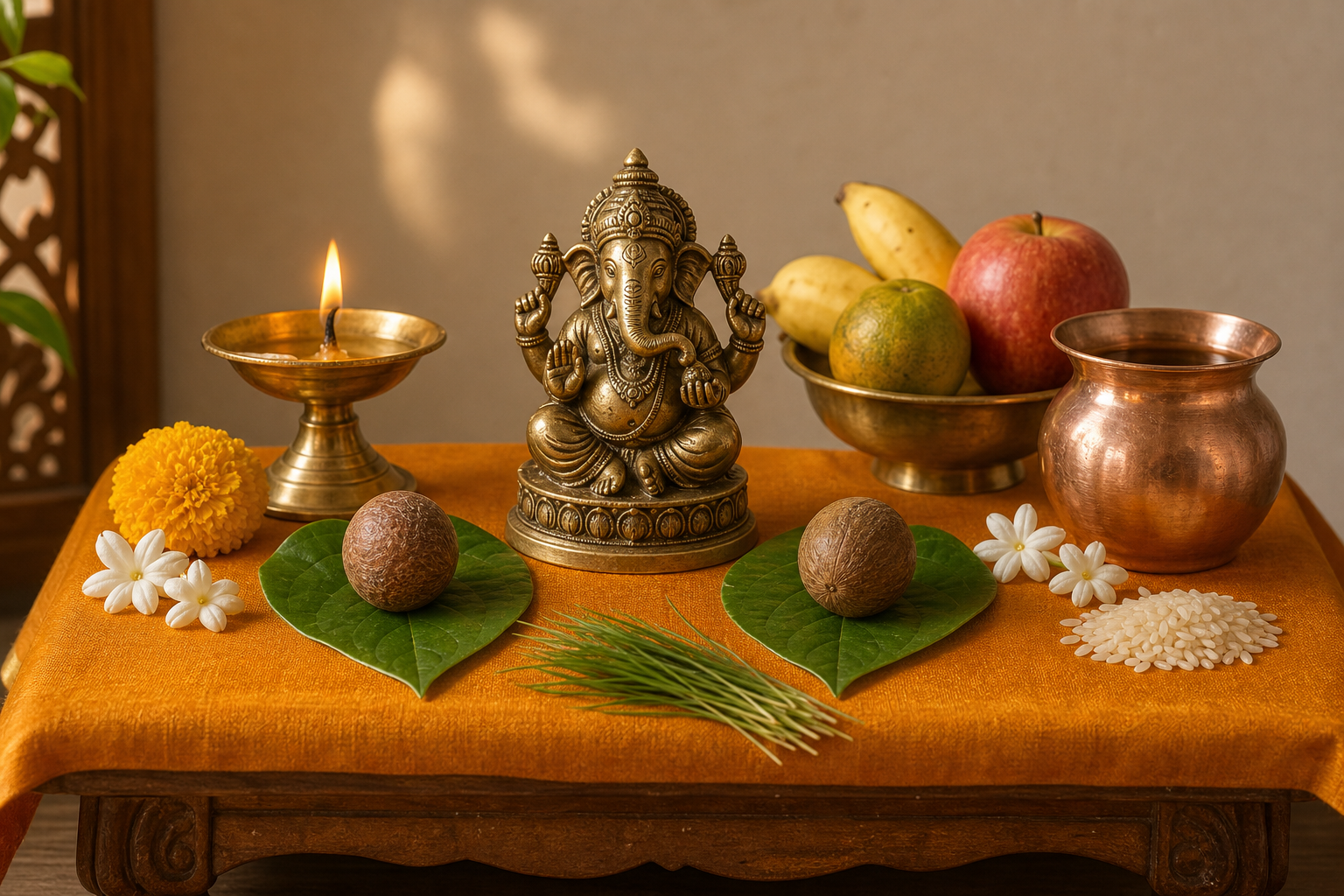
You have arranged Ganesha, the lamp, flowers, durva, and naivedya. Then you notice two betel nuts in the puja tray and wonder whether they are offerings, symbols, or simply customary decoration. In many households, they are doing more than one job.
The pair commonly represents Riddhi and Siddhi: flourishing guided by dharma and capability refined through discipline. Once you understand that pairing, placing the suparis becomes a practical way to connect your sankalpa with the life you intend to build after the puja.
What the paired suparis mean beside Ganesha
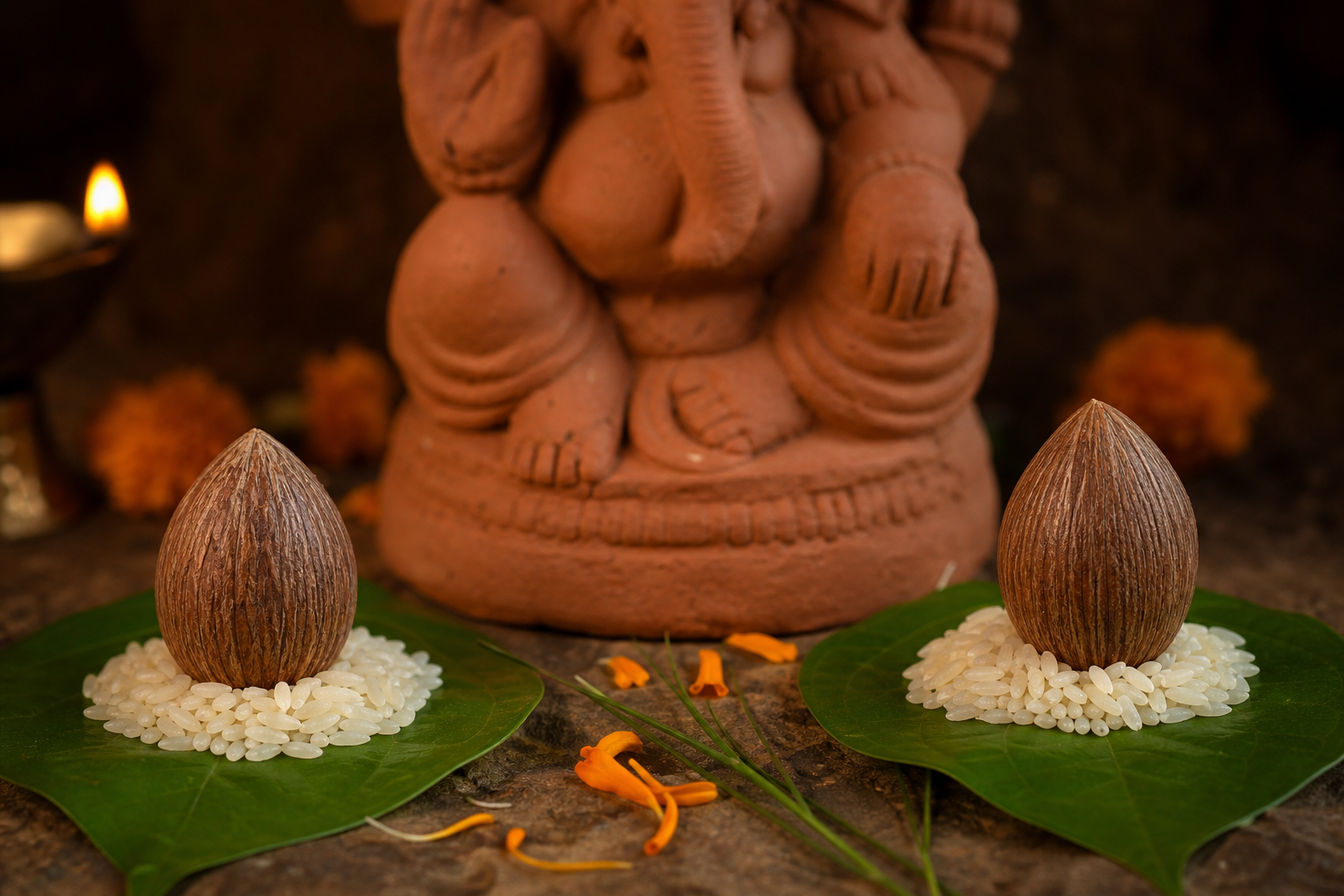
Two suparis placed on opposite sides of Ganesha are widely understood as symbols of Riddhi and Siddhi. Local narratives may personify them in different ways, but their ritual meaning is more useful than a debate over a single family relationship.
Riddhi is auspicious flourishing: material stability, growth, and well-being obtained through rightful effort. It is not wealth detached from conduct. Siddhi is accomplishment, perfected capacity, or spiritual attainment developed through practice. It is not success detached from humility. Together, they express a balanced aspiration: may you have enough to sustain what is good, and may you develop the ability to use it wisely.
This balance matters in a Ganesha Puja because Ganapati presides over beginnings and thresholds. You do not invoke him merely to make every difficulty disappear. You seek the steadiness to recognise obstacles, correct your course, and carry a worthy undertaking through. The paired nuts make that prayer concrete.
If you are beginning a course of study, for example, Riddhi can mean the time, health, books, and household support that make learning possible. Siddhi can mean disciplined study and genuine command of the subject. If you are starting a business, Riddhi can mean honest prosperity, while Siddhi means the competence to serve people well. Neither is complete without the other.
Before placing the pair, give each side of your sankalpa a sentence. Ask, “What kind of well-being should this undertaking support?” Then ask, “What discipline or ability must I develop to deserve its result?” This turns Riddhi and Siddhi from distant auspicious names into two standards for your next action.
Why a hard seed carries the vow
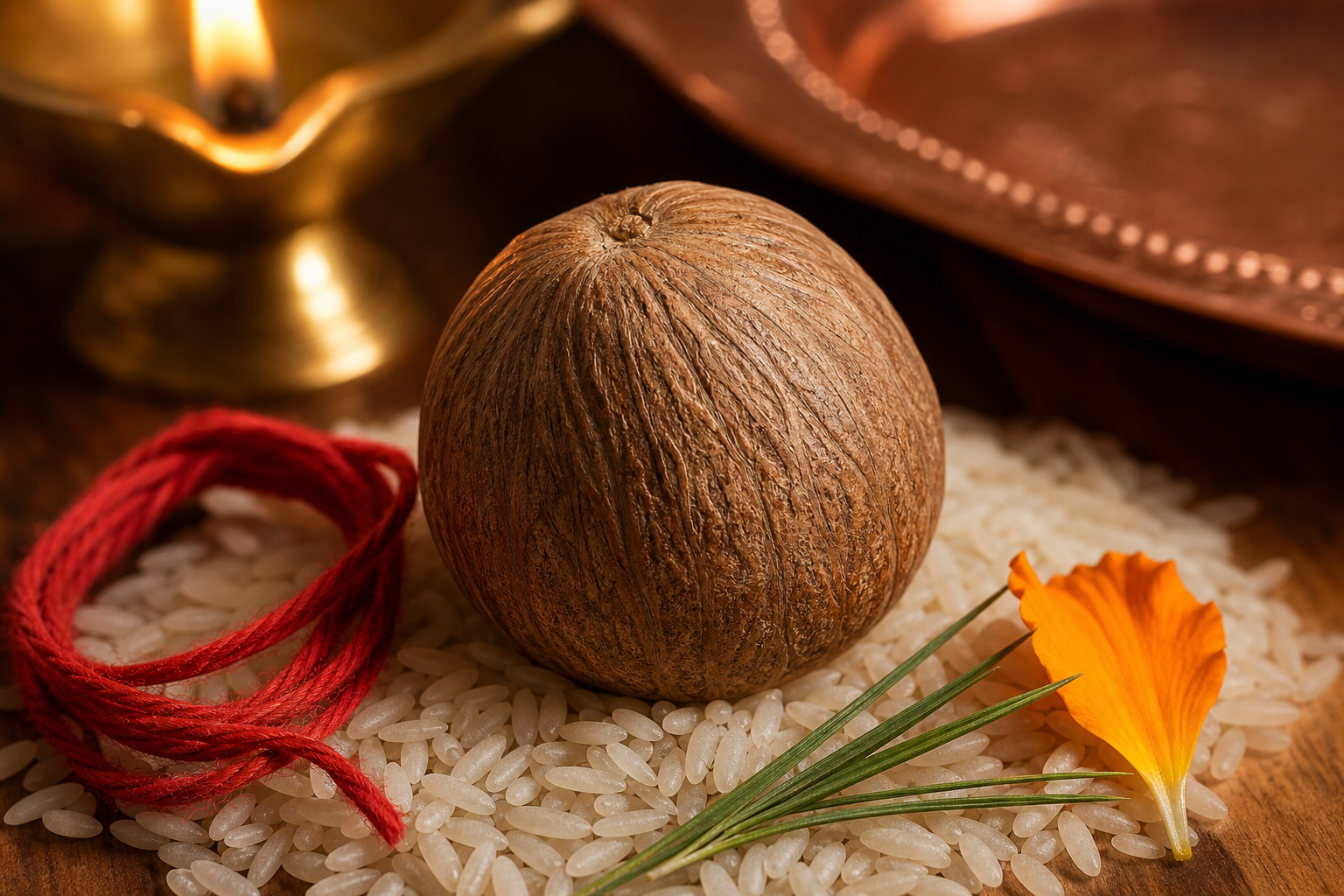
Supari, also called poogiphala in Sanskrit usage, is the seed of the areca palm, Areca catechu. Although “betel nut” is its familiar English name, it is not the same object as the betel leaf. The distinction explains why the two have related but different ritual functions.
- The whole nut suggests integrity. Its compact form represents a resolve that has not been divided by conflicting intentions. When you make a sankalpa, choose one commitment you can actually keep rather than a cluster of vague wishes.
- Its hardness suggests firmness. A vow must survive the change of mood that follows a festival or an emotionally powerful puja. Let the nut remind you that constancy matters more than intensity.
- Its durability suggests continuity. A properly kept supari can remain in a household shrine or dedicated container, linking later work to the intention with which it began.
- Its character as a seed suggests potential. Ganesha governs beginnings, while a seed holds growth in a concentrated form. Your undertaking may be small at the moment of worship, but it already requires the right conditions and discipline.
The betel leaf has a different emphasis. Fresh tāmbūla belongs to hospitality, gratitude, and respectful completion. At the close of worship, a leaf may be offered with a small piece or whole supari and, depending on custom, a coin or fragrant condiments. The standing Riddhi–Siddhi pair remains a durable symbol throughout the puja; the concluding tāmbūla marks courteous completion. Do not collapse these two roles merely because both use related materials.
There is also a contemplative layer. Ganesha is devotionally associated with mūlādhāra, the foundational centre in yogic anatomy. The stable, seed-like supari suits that image of a sound base. Riddhi supplies grounded well-being; Siddhi refines capacity. The spiritual lesson is not to reject material support, but to place it beneath insight and ethical purpose.
How to place supari in a simple home Ganesha Puja
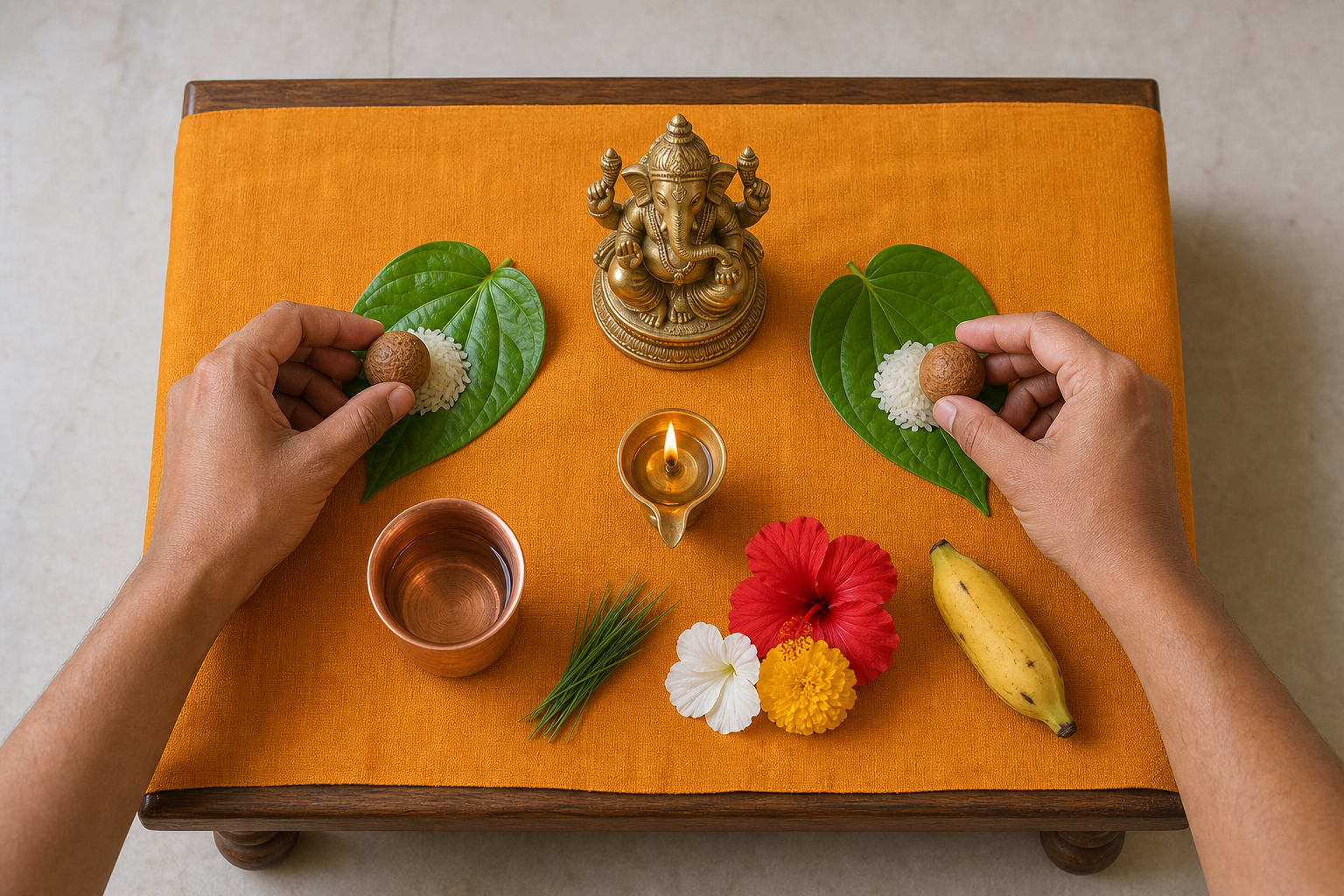
Your family paddhati takes priority over a generic sequence. If you have received instructions from an elder, guru, or temple priest, retain them. If you have no inherited procedure, the following restrained arrangement keeps the symbolism clear without pretending that optional details are universal rules.
- Prepare two clean, whole suparis. Keep them separate from any additional nut intended for the concluding tāmbūla offering. You may also prepare two small mounds of unbroken rice, fresh betel leaves, turmeric, and kumkuma if these belong to your household practice.
- State your sankalpa before decorating the pair. Name the undertaking, the dharmic good it should support, and the discipline you will contribute. Avoid treating the nuts as objects that mechanically guarantee an outcome.
- Anoint them lightly if that is customary. A touch of turmeric and kumkuma marks the pair as ritually honoured. Some households wrap each nut in a betel leaf; others leave the nuts visible. Neither embellishment is necessary when it is foreign to your practice.
- Give the pair stable seats. Small mounds of akshata, or unbroken rice, can keep the nuts upright and signify abundance and steadiness. Use a clean plate or shrine surface so the arrangement remains orderly through the worship.
- Place one supari on each side of Ganesha. Aim for deliberate symmetry. Exact assignments of Riddhi or Siddhi to Ganesha’s left or right differ, so do not invent a rigid rule when your family has none. You may touch each nut to the heart and brow before placement as a way of aligning intention and understanding.
- Leave the pair in place through the puja. During prayer, remember the two responsibilities represented there: obtain or protect the conditions for wholesome flourishing, and practise the skill required for right accomplishment.
- Offer tāmbūla at the close. Present a fresh betel leaf and a small supari with gratitude. This is the concluding offering, distinct from the two standing symbols. Other additions should follow local custom rather than an improvised checklist.
- Decide how the pair will continue. Some families retain the Riddhi–Siddhi suparis in a dedicated container. They may bring them out when beginning study, work, or community service and acknowledge the original vow again. If your tradition replaces or retires them, follow that practice instead.
The crucial action occurs after the shrine is cleared. Translate your sankalpa into one visible commitment. Put the first study session on the calendar, write the ethical condition for the business decision, or assign the first task in the seva project. The nut symbolises firmness; your scheduled action supplies it.
Which details vary, and where you should not improvise
Dharmic ritual has a shared grammar without requiring identical regional accents. Paired suparis for Riddhi and Siddhi are familiar in many Maharashtrian and Gujarati observances. Areca nut naturally has a strong ritual presence in Karnataka and other coastal areas where the palm is part of local material life. Bengali households may give greater visual emphasis to the kalasha and conch while still including supari in tāmbūla. Variation does not make one arrangement authentic and another deficient.
That principle becomes especially important when supari represents something beyond Riddhi and Siddhi. Some traditions permit a clean supari to serve as an auspicious proxy when a coconut cannot be placed over a kalasha. Simple household rites may also arrange nine decorated suparis for the Navagrahas when separate images are unavailable. These are tradition-dependent substitutions, not automatic permissions. Ask someone who knows the paddhati before assigning a nut to a deity or ritual role you have not received.
Keep the material handling as thoughtful as the symbolism. Natural turmeric, kumkuma, cotton thread, rice, and biodegradable leaves suit the offering better than plastic ornaments that immediately become waste. Store retained nuts in a clean, dry, dedicated place. When an old pair must be retired, use your household or temple’s established method rather than placing a consecrated object casually in the rubbish.
Ritual supari is a symbol, not an instruction to consume areca nut. It has a stimulant profile, and habitual chewing is outside the purpose of this worship. Do not assume that consecration turns the standing pair into ordinary edible prasad. If your family distributes tāmbūla, follow its customary handling while keeping the ritual role distinct from casual chewing.
You also do not need to enlarge a simple puja merely to reproduce every possible use of supari. Two clearly understood nuts beside Ganesha are more meaningful than a crowded arrangement of proxies whose identities no one present can explain. Let inherited practice, clarity of intention, and reverence set the boundary.
Key takeaways for your next puja
- Use two whole suparis when your tradition represents Riddhi and Siddhi beside Ganesha.
- Read Riddhi as dharmic flourishing and Siddhi as disciplined accomplishment; do not reduce them to wealth and effortless success.
- Keep the standing pair conceptually distinct from the fresh betel leaf and supari offered during concluding tāmbūlārpaṇa.
- Place the pair symmetrically, but follow your family paddhati for left-right assignments, anointing, wrapping, and later handling.
- Treat coconut or Navagraha substitutions as tradition-specific practices that require guidance.
- Complete the symbolism with one scheduled action that advances the sankalpa after worship.
At your next Ganesha Puja, pause before placing the two nuts. Give Riddhi a worthy purpose and Siddhi a real discipline. Then carry both into the first decision you make after the lamp is extinguished. That is where a durable ritual symbol becomes a durable way of living.
References
