

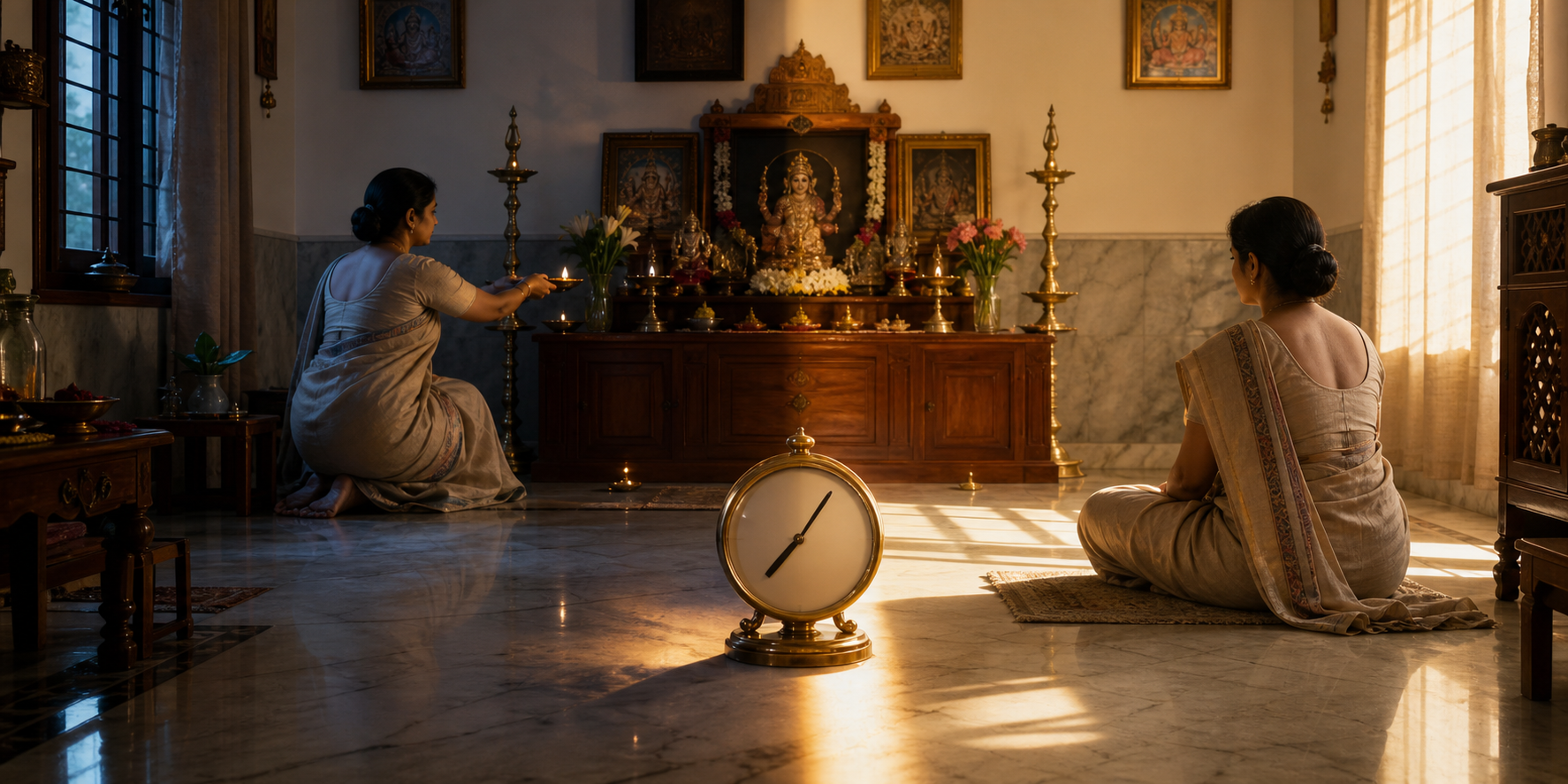
If you are arranging puja, vrata, study, travel, or another sankalpa for Tuesday, February 24, the date cannot be treated as though it belongs to one tithi from midnight to midnight. In the standard Indian almanac frame, Shukla Saptami is present at sunrise and ends at 7:09 AM IST; Shukla Ashtami governs the rest of the day.
The practical rule is simple: use the sunrise tithi for the day’s general devotional identity, use the 7:09 AM boundary when a rite must begin or finish within a particular tithi, and use a reliable local Panchang for every location-dependent time. That distinction prevents most calendar confusion.
The timing that determines your observance
| Calendar question | Answer for February 24 | What you should do |
|---|---|---|
| Which tithi prevails at sunrise? | Shukla Saptami | Use Saptami for a sunrise sankalpa and Saptami-centred morning worship. |
| When does the tithi change? | 7:09 AM IST | Complete any practice that must remain within Saptami before this boundary. |
| Which tithi prevails afterward? | Shukla Ashtami | After the transition, give precedence to Ashtami observances and intentions. |
| Which weekday is it? | Tuesday, or Mangalavara | Check the Tuesday-specific Rahu Kalam in your local Panchang before scheduling an inauguration or major commitment. |
A tithi changes when the angular separation of the Moon and Sun crosses the next twelve-degree interval. Saptami corresponds approximately to 72–84 degrees of separation, while Ashtami corresponds to 84–96 degrees. This astronomical threshold can occur at any clock time, which is why the tithi changes shortly after sunrise rather than at midnight.
Many traditions resolve this mismatch through udaya tithi: the tithi present at sunrise supplies the calendar identity used for daily worship, sankalpa, and many vratas. That makes February 24 a Saptami sunrise even though most of its clock hours fall under Ashtami.
Udaya tithi does not erase the exact transition. If your vrata requires the relevant tithi at the start of puja, at its completion, or at parana, that specific rule takes priority. Do not assume that a rite begun before 7:09 AM automatically qualifies if your lineage requires it to be completed during Saptami.
Use the Saptami morning for light, clarity, and disciplined effort
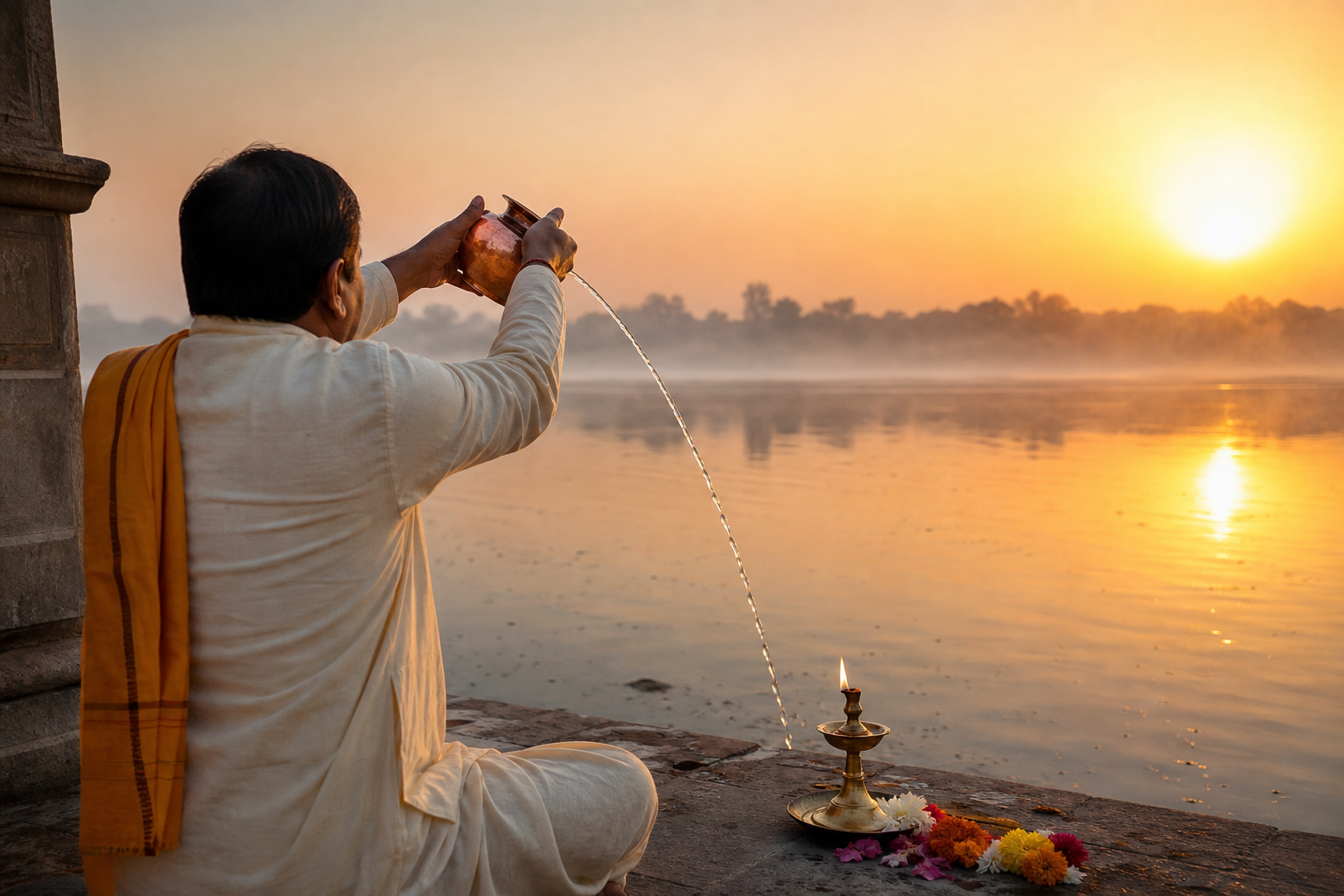
The period from sunrise until 7:09 AM IST is the clearest window for a Saptami-oriented observance in India. Shukla Saptami carries a natural emphasis on vitality, clarity, purposeful effort, and reverence for Surya. You do not need an elaborate ceremony to honour that character.
- Confirm your local sunrise and prepare before it. A generic national time cannot tell you when sunrise occurs in your city.
- At sunrise, make your customary sankalpa while recognising Shukla Saptami as the prevailing tithi.
- Offer arghya to the rising Sun according to your household practice.
- Recite Aditya Hridayam, use your lineage’s Surya prayer, or offer silent salutations if that is your established discipline.
- Turn the symbolism of light into one concrete commitment: careful work, service for collective well-being, or the correction of a neglected duty.
- If the practice must be completed during Saptami, finish before 7:09 AM IST rather than merely starting before it.
Do not automatically label the day Ratha Saptami simply because Saptami is present at sunrise. A festival designation depends on its full calendar rule, including the applicable lunar month and tradition; the name of the tithi by itself is not enough.
Nor should an ordinary daily puja become a source of anxiety if it crosses the boundary by a few moments. The exact end time matters when a prescribed vrata or ritual explicitly makes it a condition. For regular worship, the sunrise sankalpa and devotional intention provide continuity as Saptami gives way to Ashtami.
After 7:09 AM, let Ashtami change the emphasis
Once Ashtami begins, the day’s centre of gravity moves from outward vitality toward restraint, protection, ethical scrutiny, and inner steadiness. You do not necessarily need to change your altar or abandon the morning intention. Change what you are cultivating.
For a Hindu household
Ashtami often carries an association with the protective dimension of the Divine Mother. Follow the Devi prayer, japa, stotra, or quiet worship already authorised by your family or sampradaya. The useful discipline is not merely asking for protection; it is noticing where fear, anger, careless speech, or avoidance is weakening your own conduct.
Choose one restraint for the remainder of the day and make it observable. You might guard your speech, refrain from an avoidable quarrel, correct a harmful habit, or complete an act of service without seeking recognition. This gives Ashtami’s protective symbolism an ethical expression.
Across the wider Dharmic family
Some Buddhist communities observe the eighth lunar day as a quarter-phase Uposatha, with attention to mindfulness, ethical discipline, and self-examination. Some Jain communities undertake Ashtami vratas or austerities that emphasise ahimsa and self-restraint. Sikh readers may use the day as a prompt for seva, truthful living, disciplined remembrance, and attention to the Divine without turning a Hindu tithi into a Sikh ritual requirement.
These practices should not be blended into a newly invented ceremony. Their kinship lies in an ethical direction—less harm, greater awareness, disciplined conduct, and compassionate service—not in interchangeable rites. Stay within your own tradition while recognising the values that neighbouring Dharmic paths cultivate.
A simple evening examination can complete the Ashtami observance: identify where you acted with steadiness, where you caused avoidable harm, and what you will repair. That turns contemplation into a decision for the next day rather than a passing devotional mood.
Use a local Panchang before fixing a muhurta or vrata

The 7:09 AM IST transition answers the central tithi question for the standard Indian frame, but tithi alone does not establish a complete muhurta. A traditional assessment layers five Panchanga limbs: Tithi, Vara, Nakshatra, Yoga, and Karana. It may then apply practical exclusions or preferences relevant to the intended activity.
Do not copy location-dependent times from another city
Nakshatra tracks the Moon through 27 divisions of the ecliptic and can affect the traditional suitability of activities such as learning, travel, healing, or consecration. Rashi describes the Moon’s sign-based setting. Both depend on place and exact time, so neither should be guessed from the tithi alone.
Abhijit Muhurta, centred on local solar noon, can provide a balanced default for some initiatives when a fully customised muhurta is unavailable. It is not a universal fixed clock slot. Rahu Kalam and Yamaganda likewise depend on the local span from sunrise to sunset. On Tuesday, Rahu Kalam generally falls in a mid-afternoon portion of that span, but its clock time must be calculated for your location.
- For ordinary prayer or study, use your local sunrise and the tithi transition as the main practical anchors.
- For travel, a purchase, an inauguration, or another chosen undertaking, check local Nakshatra, Yoga, Karana, Rahu Kalam, and Yamaganda as relevant to your custom.
- For a consecration, marriage-related rite, major samskara, or lineage-specific observance, use the authority your family or sampradaya ordinarily follows rather than assembling a muhurta from isolated internet timings.
- If you are outside India, consult a Panchang calculated for your location; an IST boundary is not a substitute for the lunar-day calculation used by your local community.
Resolve month-name differences before assuming an error
You may see the lunar month described as late Magha in one calendar and early Phalguna in another. This can result from the difference between Purnimanta reckoning, in which the lunar month is indexed around the full moon, and Amanta reckoning, in which it is indexed around the new moon. The month label can therefore differ while both almanacs identify the same Saptami-to-Ashtami sequence.
Before rejecting either calendar, compare its location, time zone, and month system. For the observance on February 24, the actionable point remains that Saptami prevails at sunrise and Ashtami follows the morning transition.
Ask which moment your vrata rule actually tests
Smarta, Vaishnava, Shaiva, and Shakta calendars may apply different requirements. Some observances privilege the tithi at sunrise; others require it during the principal worship or at the time of completion. Parana can have its own rule. Before fasting, answer these questions from your community calendar or teacher:
- Must the tithi be present at sunrise?
- Must it be present when the main worship begins?
- Must it continue until the worship is completed?
- Does parana depend on a later tithi or prescribed window?
- Does your regional calendar assign the observance to February 24 at all?
Do not calculate an entire fast or its parana from the 7:09 AM transition alone. If a food or water fast is unsuitable for your health, use the permitted alternative given by your tradition and seek appropriate medical guidance where needed; religious austerity is not a substitute for medical care.
Key takeaways for February 24
- Tuesday, February 24, 2026 begins under Shukla Saptami and changes to Shukla Ashtami at 7:09 AM IST in the standard Indian almanac frame.
- Use the sunrise period for Surya arghya, Aditya Hridayam or your customary Surya prayer, and a sankalpa centred on clarity, vitality, disciplined effort, or service.
- After 7:09 AM, favour Ashtami themes such as restraint, protection, ethical self-examination, ahimsa, mindfulness, and compassionate action.
- Use udaya tithi for the day’s general devotional identity, but respect the exact boundary whenever a vrata rule requires the tithi at commencement, completion, or parana.
- Check a location-specific Panchang before relying on Nakshatra, Rashi, Abhijit Muhurta, Rahu Kalam, Yamaganda, Yoga, or Karana.
- Do not treat Magha and Phalguna labels as an automatic contradiction; Purnimanta and Amanta systems can name the lunar month differently.
The evening before, make four decisions: which local Panchang you will follow, what you will do at sunrise, whether any part of the rite must finish before 7:09 AM IST, and which restraint or act of service will carry Ashtami through the rest of the day. Once those choices are clear, the changing tithi becomes a coherent spiritual rhythm rather than a calendar complication.
References
