
You can meditate every day, become calmer, and still wonder whether you are moving toward moksha or merely managing stress. That uncertainty usually begins when meditation, self-knowledge, and liberation are treated as three names for the same achievement.
They do different work. Meditation steadies the inner instrument. Self-inquiry corrects mistaken identification. Dharma tests whether the resulting clarity survives contact with desire, conflict, duty, and other people. If you want your practice to serve liberation, all three have to remain connected.
Calm prepares the mind; it does not answer who you are
A peaceful sit is valuable, but it is still an experience. It begins, changes, and ends. Bliss, silence, spaciousness, bodily lightness, and freedom from thought can all become objects of attachment when you take them as proof of realization.
In a Vedantic inquiry, the decisive question is not whether an experience was extraordinary. It is whether you recognized the difference between what changes and that by which change is known. Body sensations change. The breath changes. Thoughts, emotions, memories, and the sense of being a particular personality also move. The contemplative use of waking, dreaming, and deep sleep makes the same distinction: the states vary, while awareness is approached as their unchanging witness.
Do not rush from that distinction to the verbal conclusion, ‘I am awareness.’ That sentence is another thought appearing in awareness. Atma-vichara is not the repetition of a correct philosophy. It is the sustained investigation of the assumed identity behind every claim beginning with ‘I.’
This is why sakshi-bhava, the attitude of witnessing, matters. A thought such as ‘I have failed at meditation’ can be noticed as thought. Anxiety can be known as changing sensations, images, and predictions. Even the observer you imagine yourself to be can be examined. Neti-neti, ‘not this, not this,’ removes premature identifications; it does not ask you to become indifferent to the body, relationships, or duty.
Conduct supplies an essential test. If your calm disappears whenever you are contradicted, the mind has gained a pleasant state but not freedom from ahankara. If witnessing makes you cold, avoidant, or spiritually superior, detachment has been confused with dissociation or indifference. Genuine insight is expected to appear as truthfulness, non-injury, restraint, compassion, and responsible action. Equanimity means that you can respond without being owned by the reaction; it does not mean that nothing matters.
Build a meditation that moves from attention to inquiry
A liberation-oriented sit should be simple enough to repeat when the day is inconvenient. Two daily periods of 12 to 20 minutes, joined with abhyasa and vairagya, provide a workable structure. If two periods are not sustainable yet, protect one. Consistency trains the mind more reliably than an ambitious schedule that soon collapses.
- Reduce preventable disturbance. Silence notifications, lower unnecessary noise, and use the same place when practical. Your seat should be steady and easeful: spine upright without stiffness, pelvis neutral, jaw released, and hands at rest.
- Stabilize the body before asking the mind to be still. Scan the body for 60 to 90 seconds. Release obvious tension, then practise simple bodily stillness. Constant adjustment keeps attention tied to each new sensation.
- Let the breath become even. Do not force it. If you use nadi shodhana, begin gently with an equal rhythm and no strain. Aggressive breath control is a poor choice when you are anxious, ill, or sleep-deprived. Stop if dizziness or discomfort appears.
- Choose one anchor. Use the breath at the nostrils, the movement of the abdomen, or a mantra appropriate to your path. So’ham can join breath and remembrance in a Vedantic practice; Om, Rama, or Om Namah Shivaya can support japa. Keep the same anchor long enough to learn how your mind actually behaves.
- Handle thoughts without negotiation. When attention wanders, name the activity briefly: planning, remembering, worrying, judging, or imagining. Notice its bodily expression, then return once to the anchor. Suppression adds conflict; following the story adds momentum. Recognition followed by return trains freedom from capture.
- Turn from the object to the knower. Once attention is reasonably collected, ask: ‘This breath is known; what knows it?’ Apply the same inquiry to a thought, emotion, memory, and the felt sense of ‘me.’ Do not search for a visual object called the Self. Anything that appears as an object of experience is already being known.
- Close in dharma. End with gratitude and identify one place where the clarity must become conduct: a truthful reply, restraint of anger, non-harm in speech, freedom from grasping, or service without demand for recognition.
The transition from the fifth step to the sixth is crucial. Concentration collects the mind; inquiry examines misidentification. If inquiry immediately becomes conceptual debate, return to the anchor. A steadier mind can investigate more honestly than an agitated mind trying to think its way into realization.
Keep a short record rather than writing an autobiography about every sit. Before practice, use two lines to note the condition of the body and breath, the dominant emotion, and the active mental loop. After practice, use two lines to record what repeatedly captured attention and what restored steadiness. When the same practical concern keeps returning, write it down for later action. This separates a task that needs handling from a narrative that only wants repetition.
Treat restlessness, dullness, and doubt as different problems
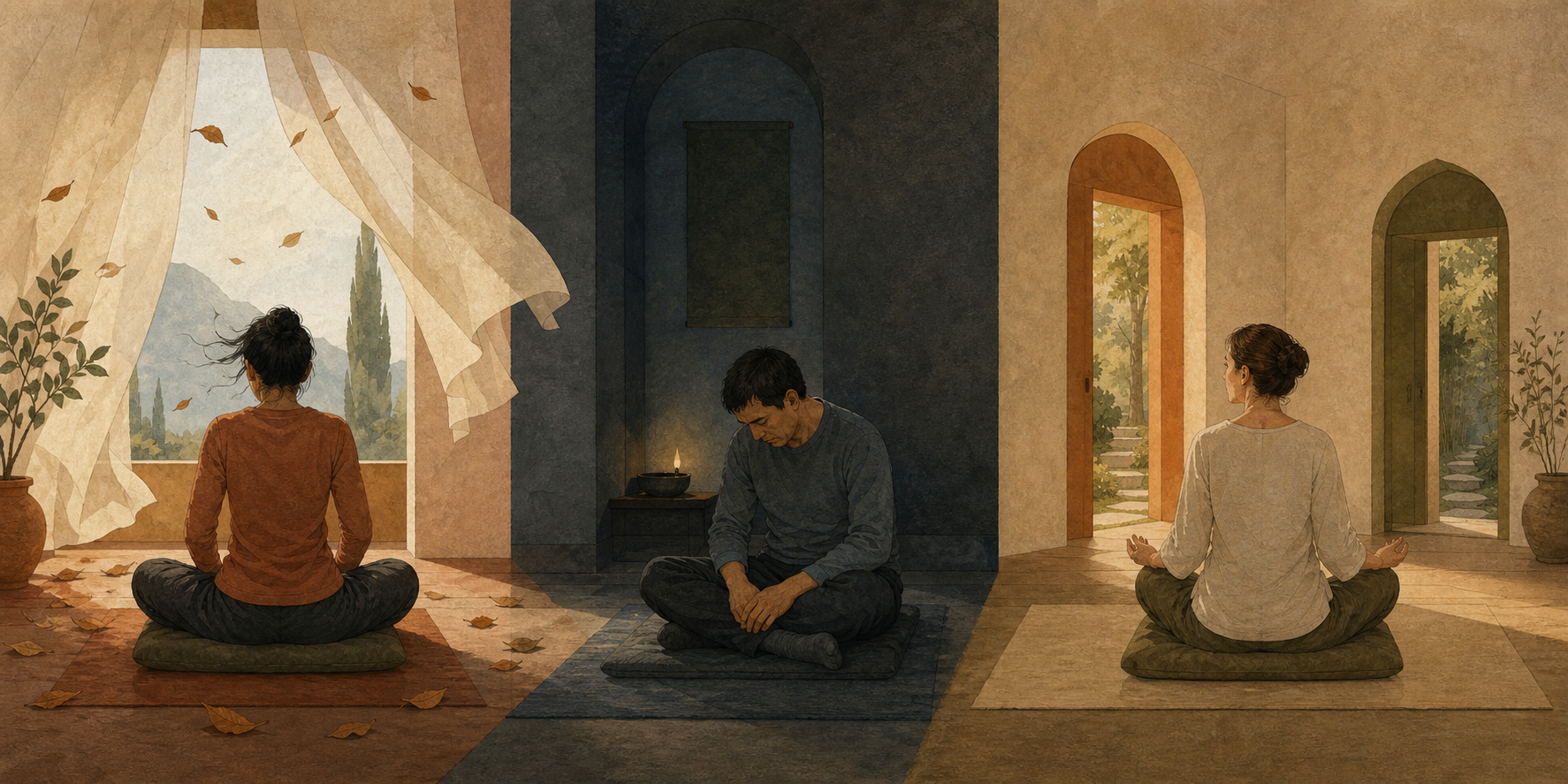
Trying harder is not a universal remedy. Rajas, tamas, emotional pain, doubt, sensory excess, and physical illness disturb practice through different mechanisms. Before you sit, ask four questions: Is the body restless or heavy? Is the breath smooth or jerky? Which emotion is strongest? Which story keeps restarting? Then match the intervention to what is present.
| What you notice | Working diagnosis | What to do now |
|---|---|---|
| Fidgeting, rapid planning, shallow breath, and attention jumping to every sound | Rajasic agitation or restlessness-worry | Reduce stimulation, settle the body, use gentle even breathing, and narrow attention to one clear anchor. |
| Heaviness, sleepiness, slumped posture, and resistance before beginning | Tamasic dullness or sloth-torpor | Sit upright, practise at a more alert time, shorten an unproductive sit when necessary, and use only gentle energizing breath work. |
| Anger, resentment, or an argument being replayed | Dvesha, ill will, or emotional activation | Locate the feeling in the body, stop feeding the internal prosecution, and introduce maitri or karuna before returning to the anchor. |
| The same obligation or fear returns throughout the sit | An unresolved concern mixed with attachment or aversion | Label the process, promise to record it after practice, return to the anchor, and deal with the actionable part outside meditation. |
| Repeatedly changing teachers, mantras, or methods | Samsaya, doubt, or impatience with gradual training | Keep one coherent method, study its framework, test it through regular practice, and seek qualified guidance for a precise question. |
| Longing to recreate bliss, silence, visions, or a previous breakthrough | Raga joined to subtle asmita | Apply vairagya. Recognize the remembered state as another object, release the demand for repetition, and resume the present practice. |
The classical obstacle maps of Yoga, Buddhism, Jainism, and Sikhism are useful because they prevent a moral judgment from replacing diagnosis. Restlessness is not proof that you are unfit for meditation. Dullness is not a permanent character flaw. Doubt is not resolved by collecting endless techniques. Each pattern calls for a fitting response and then a return to practice.
Physical conditions come first. Sleep debt, illness, stimulant use, pain, irregular breathing, and digital overstimulation can make a spiritual problem appear where there is a practical one. Rest and appropriate medical care take priority when you are ill. Meditation is not a contest of will against the body, and it is not a substitute for medical or psychological treatment.
Choose a Dharmic path without flattening its differences

Hinduism, Buddhism, Jainism, and Sikhism share disciplined attention, ethical restraint, non-attachment, compassion, and the transformation of craving and anger. They do not therefore make identical claims about the self or liberation. You can learn from their practical convergence without pretending that their philosophical conclusions are interchangeable.
- Hindu Yoga and Vedanta: Meditation refines the antahkarana so that viveka and atma-vichara can distinguish the witness from body, senses, prana, and mind. Jnana is supported by karma, bhakti, ethical discipline, and vairagya. So’ham remembrance can return attention to the awareness in which changing experience appears.
- Buddhism: Calm and insight address sensual desire, ill will, sloth-torpor, restlessness-worry, and doubt. Anatta should not be quietly replaced with a Vedantic eternal witness. The disciplined observation of experience may look similar at one stage, but the interpretation belongs within the Buddhist path being practised.
- Jainism: Samayik cultivates equanimity, while the 12 bhavana support reflection, humility, and release from karmic disturbance. Ahimsa and anekantavada make self-mastery inseparable from non-harm and freedom from one-sided certainty.
- Sikhism: Naam Simran, including remembrance of Waheguru, works with devotion rather than detached introspection alone. Kaam, krodh, lobh, moh, and ahankar are confronted through remembrance, life in hukam, and seva. A practice that never reaches service remains incomplete in this grammar.
The practical decision is straightforward. If your aim is Vedantic atma-jnana, let Yoga steady the mind and Vedanta govern the inquiry. If you are rooted in a Buddhist, Jain, or Sikh discipline, allow that tradition’s account of bondage and freedom to direct the same seriousness of practice. Shared methods and real doctrinal differences can both be respected.
Cross-traditional learning is safest at the level of ethical discipline, attentional skill, compassion, and recognition of recurring obstacles. It becomes confused when metaphysical conclusions are mixed because one phrase feels inspiring. Choose a home discipline, learn its terms accurately, and take unresolved questions to a competent teacher or sangha. Do not change paths merely because repetition has exposed boredom; boredom is often where abhyasa begins doing its deeper work.
Questions that keep a serious practice on course
Is a blank mind the goal?
No. Yoga’s stilling of mental fluctuations is not violent suppression, and the appearance of thought does not make a sit unsuccessful. Your immediate task is to stop granting every thought the authority to command attention. Recognize it, release identification, and return. Silence may arise, but chasing silence creates another fluctuation.
How can you tell whether self-inquiry has become imagination?
Imagination gives you a new object, image, story, identity, or philosophical answer to possess. Inquiry notices that the new answer is also known. When you find yourself accumulating claims about being advanced, chosen, pure, or beyond ordinary duties, examine the claimant. The inquiry is doing useful work when identification loosens and ethical clarity strengthens, not when the spiritual biography becomes more impressive.
Can a householder orient meditation toward liberation?
Yes. Vairagya is freedom from compulsive possession, not automatic withdrawal from family, work, or society. The integration of insight, responsibility, and compassionate action makes ordinary duties a testing ground. Notice whether praise and blame dictate your conduct, whether desire overrides discernment, and whether service requires an emotional reward. Those moments reveal bondage more clearly than an unusually peaceful sit.
Should you meditate through panic or destabilization?
Do not force the practice. Stop aggressive breath techniques, open your eyes, orient to the room, and return to ordinary bodily grounding. Persistent panic, severe distress, dissociation, loss of sleep, or impaired daily functioning calls for qualified mental-health support; an experienced meditation teacher can separately help you adjust the contemplative method. Spiritual determination should not be used to ignore a condition that needs appropriate care.
For your next sit, choose a sustainable period within 12 to 20 minutes and keep one anchor. When attention becomes steady enough, ask: ‘This thought is known; what is the knower?’ Refuse to replace the question with a slogan. Then end by naming one act of ahimsa, truthfulness, restraint, or service that you will carry into the day. Repeat the experiment without demanding a special state. That is how meditation becomes preparation for knowledge rather than another experience to collect.
References
- DharmaRenaissance Blog — Overcoming Inner Battles in Meditation: Hindu-Yogic, Buddhist, Jain, Sikh Tools for Calm
- DharmaRenaissance Blog — Hamsa Gita in the Mahabharata: A Timeless Swan-Song of Self-Knowledge and Liberation
