
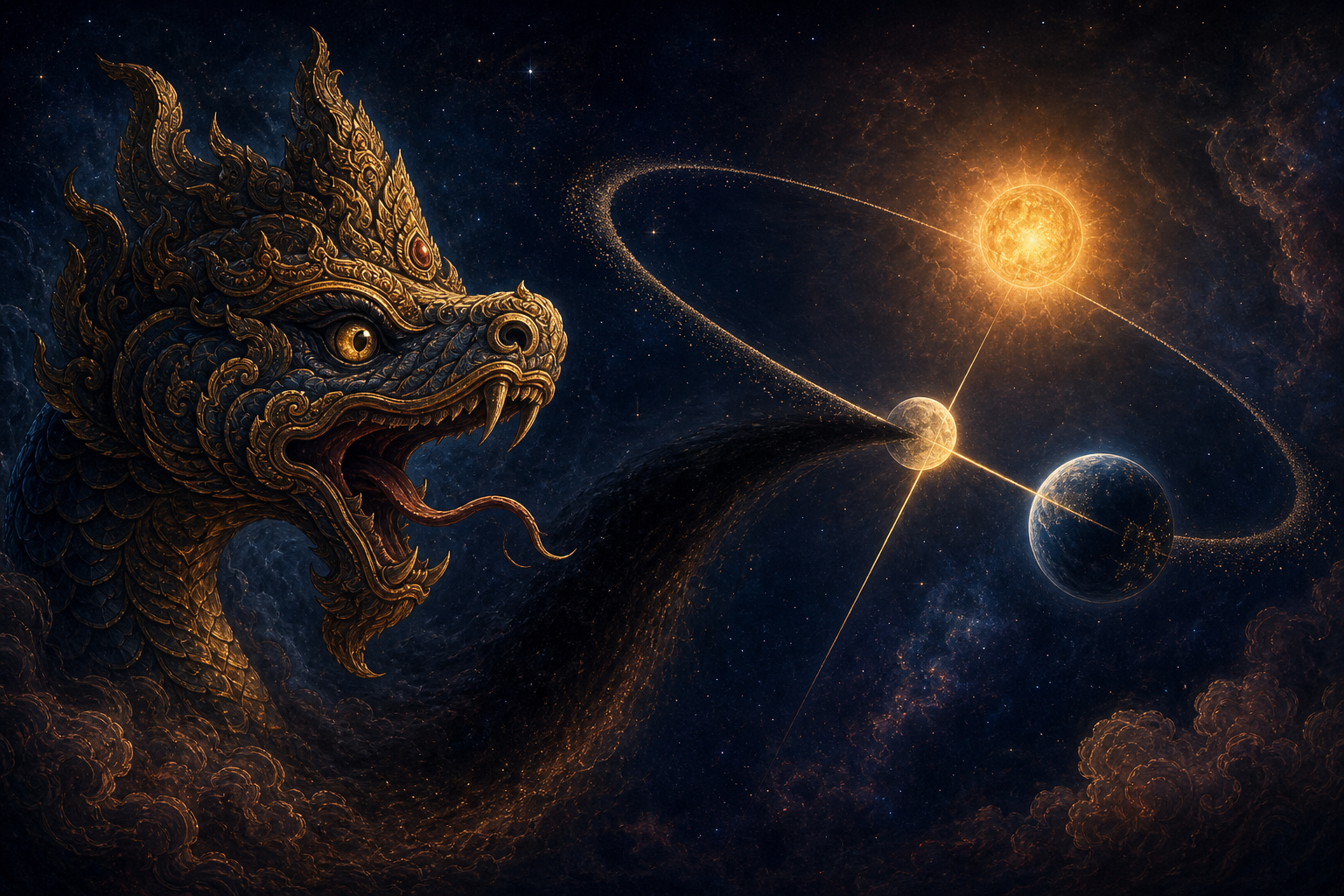
You may meet Rahu in two settings that seem impossible to reconcile: as a bodiless serpent at a Navagraha shrine and as a mathematical point in an explanation of eclipses. Is Rahu a mythic being, an astronomical object, or an astrological influence?
The useful answer is that Rahu belongs to three distinct but connected languages. Astronomy uses Rahu to identify a lunar node. Myth gives that invisible point a memorable form. Spiritual interpretation turns the form into a test of desire, discernment, and conduct. Once you keep those levels distinct, you can understand an eclipse without dismissing the myth, and engage the symbol without surrendering your judgment.
Key takeaways
- Astronomically, Rahu corresponds to the ascending lunar node, where the Moon crosses the ecliptic from south to north. Ketu is the opposite, descending node.
- Rahu is not a material planet or a physical object that casts a shadow. It marks one of the two places where eclipse-producing alignments can occur.
- The Moon’s orbit is inclined about 5.1 degrees to the ecliptic, so most new and full Moons pass above or below the required alignment. An eclipse becomes possible only near a node.
- The severed head represents appetite without digestion: the capacity to seek, consume, and magnify without reaching a natural state of enough.
- Jyotiṣa treats Rahu and Ketu as an axis of interpretation. It can prompt useful questions, but it should not be converted into a fatalistic verdict or used by itself to make a major life decision.
The astronomical Rahu is a crossing point, not a planet
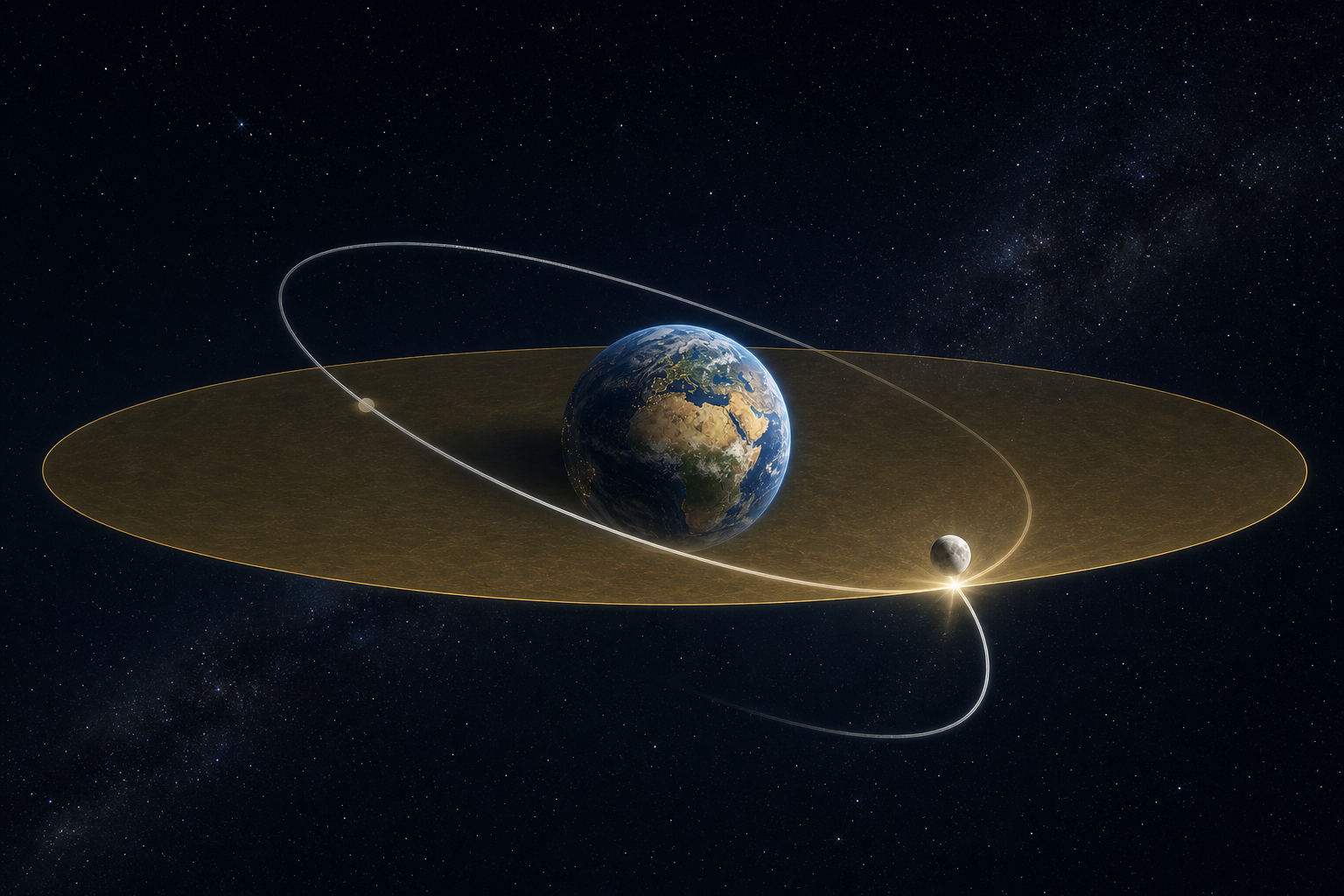
Picture two hoops that are slightly tilted relative to one another. One represents the ecliptic, the plane defined by Earth’s orbit and seen from Earth as the Sun’s apparent annual path through the sky. The other represents the Moon’s orbital plane. The two hoops intersect at two points. Those intersections are the lunar nodes.
At the ascending node, the Moon crosses from the southern side of the ecliptic to the northern side. This point is identified with Rahu. At the descending node, the Moon crosses in the other direction. That point is Ketu. Because these are geometric locations rather than bodies, Rahu and Ketu have no physical surface, mass, or reflected light of their own.
The Moon’s orbital plane is tilted by about 5.1 degrees relative to the ecliptic. That tilt answers a common question: why is there no eclipse at every new Moon and full Moon? Usually, the Moon passes a little above or below the exact Sun-Earth-Moon alignment. It must also be near Rahu or Ketu for the geometry to line up closely enough.
A solar eclipse requires a new Moon near a node, when the Moon comes between Earth and the Sun. A lunar eclipse requires a full Moon near a node, when Earth lies between the Sun and Moon and Earth’s shadow falls on the Moon. Rahu does not physically block the Sun or cast Earth’s shadow. It identifies the nodal location at which the required alignment becomes possible.
This also clarifies the term chāyā graha, often rendered as shadow graha. It should not make you imagine an undiscovered dark planet or a cloud moving across the Sun. In the Navagraha and jyotiṣa framework, Rahu has significance without being a luminous physical globe like the visible grahas.
The nodes are not fixed against the zodiac. They regress, moving in the direction opposite the ordinary zodiacal sequence, and complete a cycle in approximately 18.6 years. This works out to roughly 18 months in each sign. Jyotiṣa assigns Rahu an 18-year mahādaśā. The astronomical cycle and the astrological period are closely associated within the traditional framework, but they are not the same kind of claim: one measures orbital geometry, while the other organizes astrological interpretation.
Why the eclipse myth gives Rahu a mouth but no stomach
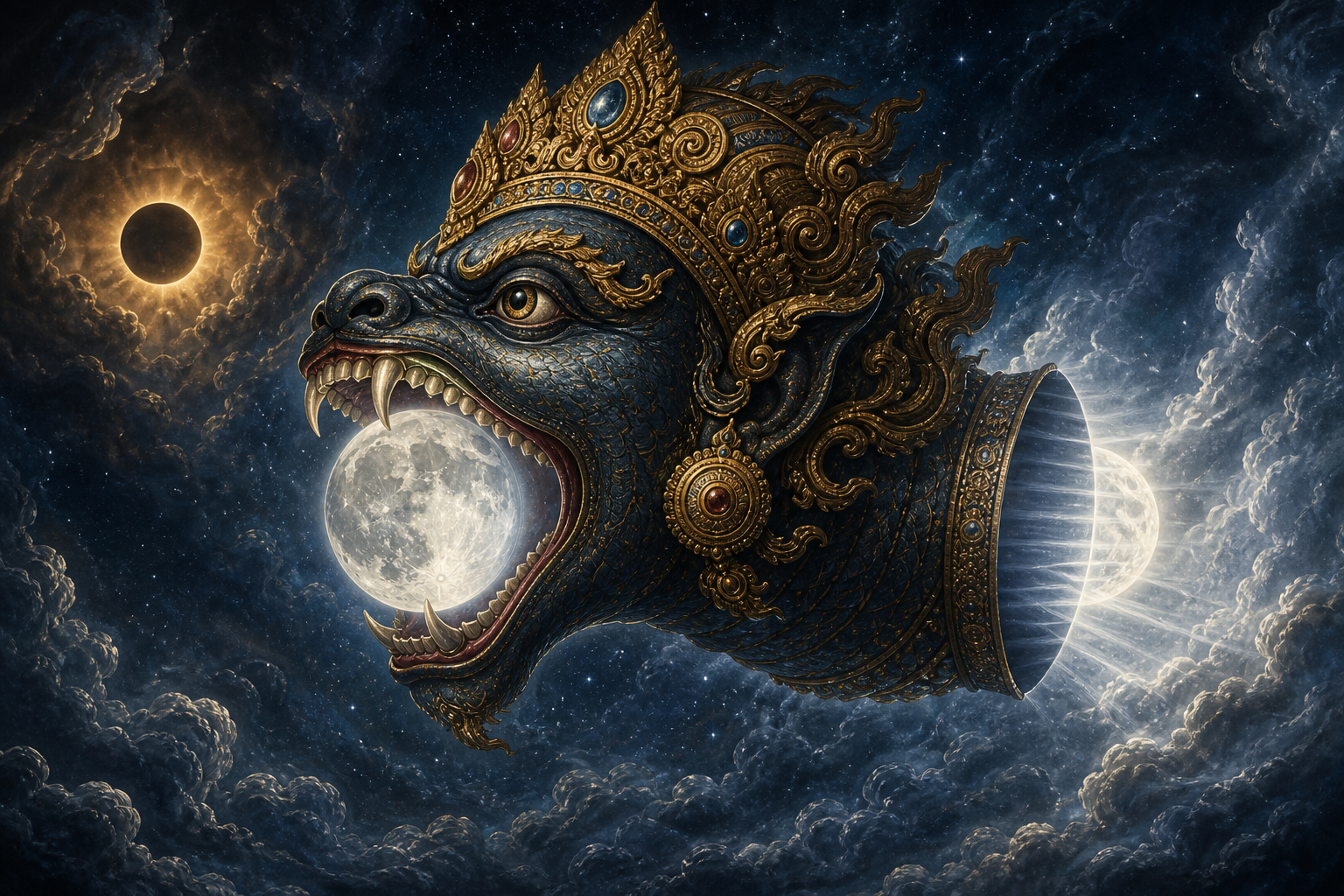
The severing of Rahu and Ketu
During Samudra Manthan, the churning of the ocean, Rahu – often identified with Svarbhānu – enters the assembly of the devas and tastes the amṛta being served by Mohini. Sūrya and Chandra recognize the intruder. Viṣṇu’s Sudarśana severs him, but the nectar has already made the divided being immortal. The head becomes Rahu; the headless trunk becomes Ketu.
Rahu thereafter pursues the Sun and Moon who exposed him. When he catches one, he swallows its light, producing an eclipse in the mythic register. Yet a head without a body cannot retain what it consumes, so the luminary emerges again. The disappearance is real to the observer, but temporary and ordered rather than final.
The astronomical diagram and the sacred narrative answer different questions. Geometry tells you where and under what conditions an eclipse can occur. Myth gives the recurring darkening a character, a motive, and a place in moral memory. Treating the myth as defective physics misses its purpose. Treating it as a substitute for celestial mechanics asks it to do work it was not designed to do.
The hunger test hidden in Rahu’s form
A head can see, imagine, calculate, speak, and consume. Without a body, however, it cannot digest a meal or feel the settled satisfaction that follows nourishment. Rahu therefore presents a precise image of desire detached from completion. The next object, achievement, identity, experience, or piece of information always appears capable of supplying what the last one did not.
This does not make every ambition Rahu-like or every boundary crossing wrong. Traditional interpretations associate Rahu with novelty, foreign settings, unfamiliar knowledge, technology, research, risk, and the taboo. The same exploratory force can support discovery or become compulsion. The decisive question is whether desire remains answerable to dharma.
When you suspect that Rahu’s pattern is active in your own attention, apply these checks before you intensify the pursuit:
<!– wp:list {