

When someone tells you that Hindu families should have three children, you are being asked to answer several questions at once. Is India running out of people? Is Hindu continuity at risk? Does a community appeal create a personal duty? And would a three-child norm actually make children, mothers, and society stronger?
You do not have to choose between demographic complacency and unquestioning acceptance of a slogan. You can take civilizational continuity seriously while insisting on accurate diagnosis, reproductive freedom, family-level realism, and measurable support for every child. That is the standard by which the three-child call should be judged.
Key takeaways: how to judge the three-child call
- India’s national Total Fertility Rate was 2.0 in NFHS-5 (2019-21), slightly below the replacement level of about 2.1, but state-level fertility ranged from approximately 1.4 to 3.0 among the cited examples.
- Replacement fertility is a long-run population threshold, not an instruction that every couple must have two children or that every Hindu couple must have three.
- A social or religious appeal may persuade, but it should not become coercion, a penalty, a loyalty test, or a burden imposed mainly on women.
- A couple considering a third child should test mutual consent, maternal health, caregiving time, household finances, support networks, and the quality of upbringing they can sustain.
- A credible pro-family programme must reduce the cost and risk of parenthood through childcare, health care, housing, transport, parental leave, flexible work, nutrition, and recognition of unpaid care.
- Dharmic demographic strength includes well-formed children, capable adults, care for elders, social service, and intergenerational continuity. Birth totals alone cannot measure it.
Before agreeing or disagreeing with any three-child appeal, ask four questions: What precise demographic problem is being diagnosed? At what geographic level does it exist? What practical support accompanies the appeal? Which outcomes, beyond a higher birth count, will be measured? If those questions have no clear answers, the proposal is not yet a population policy. It is only a preference.
India’s fertility map makes one national slogan inadequate

India is already well into a demographic transition. NFHS-5, conducted in 2019-21, placed the national Total Fertility Rate at 2.0. That is below the replacement benchmark of approximately 2.1, but the national average hides substantial regional differences. Most states and Union Territories were at or below replacement, while a smaller group remained above it.
The following figures are approximate NFHS-5 examples, not a complete state ranking:
| Position relative to replacement | State or Union Territory examples | Approximate TFR |
|---|---|---|
| Well below replacement | Jammu and Kashmir | 1.4 |
| Well below replacement | West Bengal, Punjab, Delhi, Telangana | 1.6 |
| Below replacement | Karnataka, Maharashtra | 1.7 |
| Below replacement | Tamil Nadu, Kerala | 1.8 |
| Above replacement | Jharkhand | 2.3 |
| Above replacement | Uttar Pradesh | 2.4 |
| Well above replacement | Meghalaya | 2.9 |
| Well above replacement | Bihar | 3.0 |
This variation changes the policy question. A low-fertility state anticipating an older population does not face the same immediate conditions as a state where rapid population growth still puts pressure on schools, maternal services, housing, and employment. Even within a state, urban housing costs and rural access to health care can produce very different family decisions. A national exhortation cannot substitute for diagnosis at the level where families actually live.
Total Fertility Rate is also easy to misread. It is a period measure based on age-specific fertility rates. It is not the number of children every woman currently has, a forecast that population decline begins immediately, or an ideal family size ordained for each household. Replacement fertility describes the approximate level at which one generation replaces itself over the long run after mortality is considered. Population momentum means that a country can continue growing for some time even after fertility falls below replacement.
Sustained low fertility still deserves attention. It can gradually age the population and increase the number of older people relative to working-age adults. Sustained high fertility creates a different challenge by stretching public goods and household resources. The responsible position is therefore neither that numbers never matter nor that three is universally ideal. The responsible position is to match the remedy to the actual demographic condition.
Religious demography requires the same discipline. Fertility has declined sharply across India’s religious communities over roughly three decades, and the inter-community differential has narrowed by half or more. Education, urbanisation, later marriage, better child survival, and rising aspirations have been stronger long-term forces than identity-based appeals. This does not make cultural continuity unimportant. It means that a static picture of permanently diverging communities does not fit the trajectory.
If your concern is Hindu continuity, look beyond a national headcount. Ask whether children receive dharmic education, whether families can transmit language and tradition, whether young adults can afford stable homes, whether temples and community institutions include the next generation, and whether capable people remain connected to seva. A larger cohort without formation is not automatically stronger. A smaller but healthy, educated, rooted, and socially responsible cohort can carry enormous civilizational capacity.
Persuasion is legitimate only while refusal remains legitimate
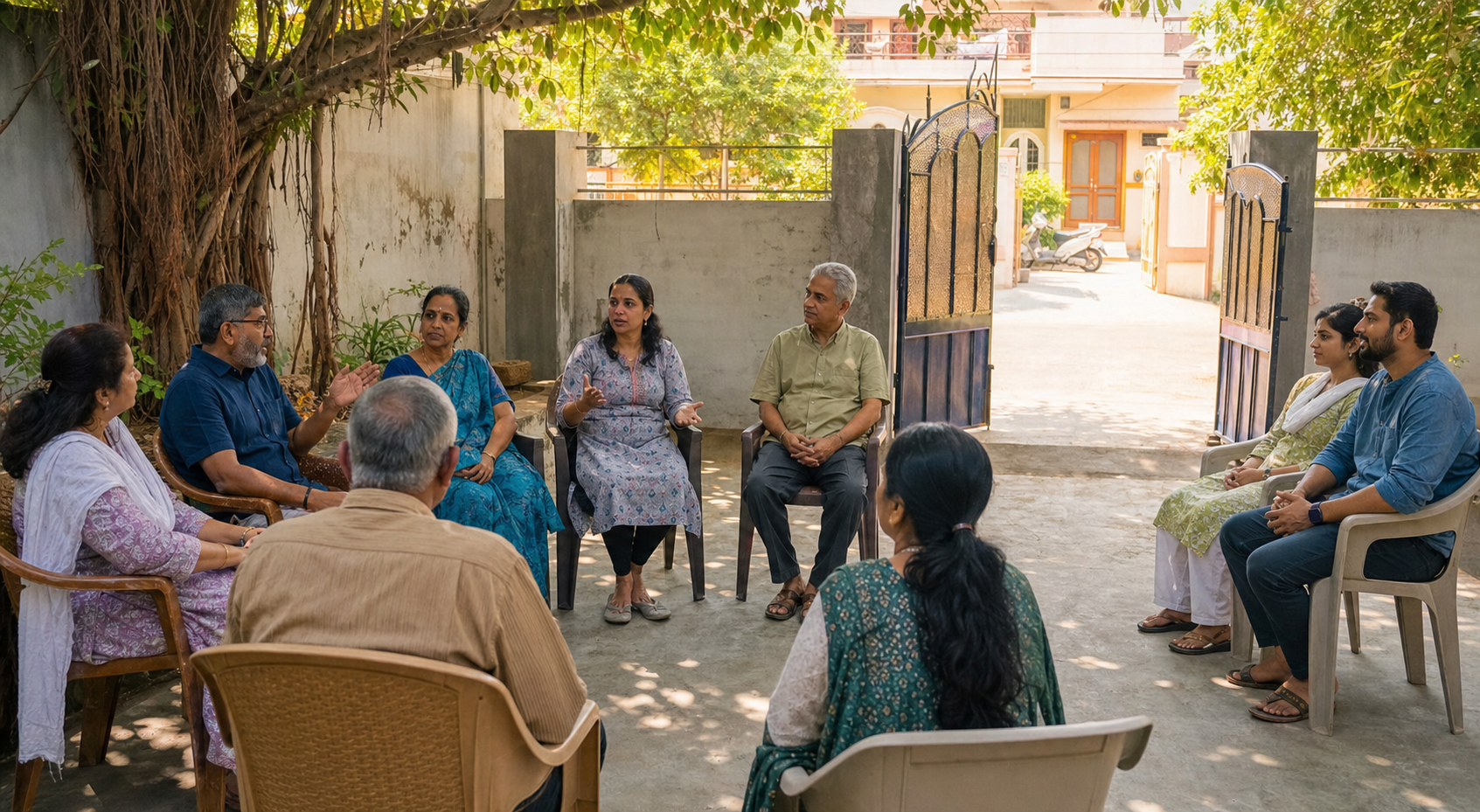
A three-child call is not the same thing as a three-child law. A cultural organisation may argue that larger families serve continuity, just as parents and couples may answer that their health, finances, or calling lead them elsewhere. Persuasion remains compatible with freedom only when the person being persuaded can decline without losing dignity, benefits, civic standing, employment prospects, or acceptance within the community.
India’s National Population Policy of 2000 adopted a voluntary, target-free approach. In Suchita Srivastava v. Chandigarh Administration (2009), the Supreme Court affirmed reproductive autonomy under Article 21. These are not technical obstacles to dharmic social thought. They establish a boundary within which moral argument must operate: neither the state nor a social movement should treat another person’s reproductive capacity as an instrument it controls.
This boundary matters most for women. Pregnancy, childbirth, recovery, breastfeeding, interrupted employment, and a large share of routine care often fall disproportionately on them. A campaign that praises larger families while leaving those costs private is not neutral. It asks one group to carry a public ambition without giving that group equivalent authority, protection, time, or resources.
A dharmic appeal should therefore be women-centric without becoming women-burdening. It should treat consent, health, safety, education, and opportunity as foundations of grihastha dharma, not concessions made after a numerical target has been set. Men who advocate larger families should be equally explicit about paternal leave, night care, school work, medical appointments, elder care, lost earnings, and the daily discipline of raising children.
The circulating claim that many RSS karyakartas have fewer than two children cannot establish an organisation-wide double standard without reliable internal data. A valid assessment would need to distinguish age, marital status, geography, length of service, and completed family size. It would also need a clear sampling method, response rate, anonymised results, and uncertainty estimates. Mixing young unmarried volunteers with older householders, for example, would make a simple average difficult to interpret.
That does not make consistency irrelevant. An organisation asking other families to bear substantial costs should disclose how its own members encounter those costs and what support it is prepared to provide. A smaller personal family can coexist honestly with a large social family built through mentorship, scholarships, service, and institution-building. But leaders should explain that relationship openly instead of presenting one number as a universal measure of commitment.
When you assess an organisational family-size appeal, look for five signs of seriousness:
- A precise statement of whether the appeal is personal advice, a community aspiration, or a proposed government policy.
- A demographic diagnosis that identifies the relevant region, time horizon, and population structure rather than relying on national anxiety.
- Explicit protection for reproductive choice and an equally explicit rejection of stigma, penalties, and coercion.
- A funded support plan covering health, childcare, housing, education, caregiving time, and women’s employment.
- Transparent measurement of both the organisation’s internal experience and the public outcomes it hopes to improve.
Before a third child, run a grihastha capacity test

A demographic argument cannot decide whether your household should have another child. That decision reaches into health, marriage, money, time, and the life of the child who would be born. Treat it as a serious grihastha decision rather than a vote for or against a community slogan.
- Establish mutual desire without pressure. Each partner should be able to say yes, no, or not yet without being accused of selfishness or disloyalty. Agreement extracted through family, religious, or political pressure is not genuine agreement.
- Put maternal health before the numerical target. Previous pregnancies, complications, recovery, age, and current health can change the risk of another pregnancy. Those questions belong with the woman and an appropriately qualified clinician, not with a public campaign. A general appeal must never override individual medical judgment.
- Map a normal week of care. Write down who handles mornings, meals, school travel, homework, illness, medical visits, night waking, household work, and existing elder care. Add a third child’s needs to named people and actual time periods. If every new task silently lands on one person, you have identified a care problem, not a commitment problem.
- Stress-test the household budget. Include housing space, food, childcare, schooling, coaching if your family regards it as necessary, health care, transport, and the possible reduction of one caregiver’s earnings. Then test what happens if a grandparent becomes unavailable, a parent changes work, or a significant health expense arises.
- Check whether support has redundancy. A single willing grandparent or one informal childcare arrangement is not a durable system. Identify who can help when the usual caregiver is ill, travelling, ageing, or caring for someone else. Support that disappears during a crisis should not be counted as guaranteed capacity.
- Define what a good upbringing requires. Nutrition, safety, attention, education, emotional presence, dharmic formation, and an equal welcome for a girl or a boy all matter. The relevant question is not merely whether you can produce another birth, but whether you can sustain another human being’s development.
- Decide what would have to change before yes becomes responsible. The answer may be better housing, shared care, stable employment, completed medical recovery, affordable childcare, or a firmer commitment from the father. Naming the condition converts vague disagreement into a practical family plan.
If a third child is mutually desired and the household can provide the necessary care, a cultural appeal may reinforce a choice the family already considers meaningful. If those conditions are absent, the appeal does not transform preventable strain into dharma. Raising one or two children with integrity, presence, and strong values is not demographic failure.
Do not compare your family’s visible child count with another household’s invisible support system. One family may have shared housing, grandparents nearby, flexible work, and inherited financial security. Another may be carrying debt, disability, elder care, costly rent, or unstable employment. Equal numbers can represent radically unequal burdens.
Judge pro-family policy by what it makes possible

If public leaders sincerely want more families to realise a desired second or third birth, they must reduce the cost, risk, and career penalty of care. Education, formal employment, urban housing constraints, and the rising cost of intensive investment in each child already shape family size. Repeating the desired number without changing those conditions leaves the mechanism untouched.
- Affordable childcare and early-childhood centres: reliable local care gives parents usable time and prevents the entire employment cost from falling on one caregiver.
- Maternal and child health: antenatal care, postnatal care, nutrition, and programmes such as POSHAN Abhiyaan make family policy answerable for survival and well-being, not just births.
- Equitable parental leave and flexible work: leave available in practice to both parents spreads care more fairly and reduces the assumption that motherhood must end or stall a career.
- Safe transport: dependable travel affects access to work, schools, childcare, and medical services. It is part of family infrastructure, particularly where women shoulder multiple daily journeys.
- Family-suitable housing: affordable homes and rental policies designed for families address a concrete barrier in expensive urban areas. An extra bedroom cannot be created by moral encouragement.
- Recognition of unpaid care: pensions, portable health protection, or carefully designed tax relief can acknowledge that caregiving produces social value while carrying real household costs.
- Education, sanitation, nutrition, and safety: families make reproductive decisions partly on whether children can grow up healthy, learn well, and move through public space safely. These are population-policy inputs, not separate charitable concerns.
International experience sets realistic expectations. Coercive or highly directive birth policies can leave long-term damage, including distorted sex ratios, rapid ageing, and intergenerational imbalance. Generous family systems in parts of Europe – including child allowances, subsidised childcare, parental leave, and flexible work – have generally produced only modest fertility increases and have rarely lifted fertility above 2.1. Governments can remove barriers to wanted children, but they cannot reliably command a preferred fertility rate without unacceptable costs.
This distinction should shape the objective. A responsible government does not promise to manufacture a particular family size. It makes it more feasible for people to have the children they already desire while protecting those who choose differently.
Total Fertility Rate alone cannot tell you whether that policy is succeeding. Any serious campaign should publish a baseline and track a wider dashboard:
- Total Fertility Rate: the overall period measure, useful for the broad direction of fertility.
- Net Reproduction Rate: whether a generation of women is being replaced by daughters after mortality is considered.
- Age-specific fertility rates: whether births are shifting by age rather than simply rising or falling uniformly.
- Couples’ reported ideal number of children: whether people are having fewer or more children than they actually want.
- Maternal mortality and anaemia: whether a higher number of births is being pursued at the expense of women’s health.
- Sex ratio at birth: whether pressure for family size or sons is distorting equal welcome for girls.
- Learning outcomes: whether children are gaining capability rather than being treated as demographic units.
A programme that raises births while worsening maternal health, sex equality, nutrition, or learning has not strengthened society. It has transferred costs into the future. The policy target should be wanted, safe, well-supported parenthood and capable children.
A dharmic answer enlarges the circle of care
Hindu unity cannot rest on reproductive arithmetic alone. In a dharmic understanding, grihastha life joins continuity to duty: care for children, elders, guests, community, and the vulnerable. Dayā and sevā widen the family beyond biology. That wider obligation is particularly important when many people cannot, should not, or do not wish to have three biological children.
This is also where Hindus, Buddhists, Jains, and Sikhs can find common ground. Each community has its own theology and institutions, but none needs a zero-sum demographic contest to defend care, discipline, learning, compassion, and responsibility. A campaign that creates suspicion among neighbours weakens the social cohesion it claims to protect.
You can turn concern about demographic continuity into concrete work regardless of your family size:
- If you are raising children, give them language, history, ethical formation, practical competence, and a living relationship with community institutions. Identity transmitted only as fear will not remain strong.
- If you do not choose another biological child, support a first-generation learner, mentor a young person, contribute to nutrition or community kitchens, or explore adoption and foster care only through lawful, qualified channels suited to such serious commitments.
- If you lead a temple or association, build childcare cooperatives, tutoring, maternal support, transport assistance, and respite for families caring for elders. Measure participation and outcomes so that seva becomes dependable infrastructure.
- If you advocate a family-size norm, publish the demographic basis, internal survey method, expected household costs, safeguards for autonomy, and the support your organisation will fund.
- If population ageing concerns you, support productivity growth, lifelong learning, preventive health, and longer healthy participation by older adults. New births affect the workforce only after a long interval; healthier and more capable people strengthen society across that interval.
The most useful response to the three-child call is therefore a better question: what would allow families who genuinely want another child to raise that child safely, freely, and well? Put that question to political leaders, social organisations, temples, employers, and your own household. It converts demographic anxiety into accountable duty.
Support a three-child appeal where it is voluntary, geographically grounded, honest about costs, protective of women, and backed by practical care. Reject pressure that treats birth count as proof of loyalty. Then invest your time in the outcome that demographic rhetoric often overlooks: every child already among us becoming healthy, capable, rooted, and ready to serve.
References
