
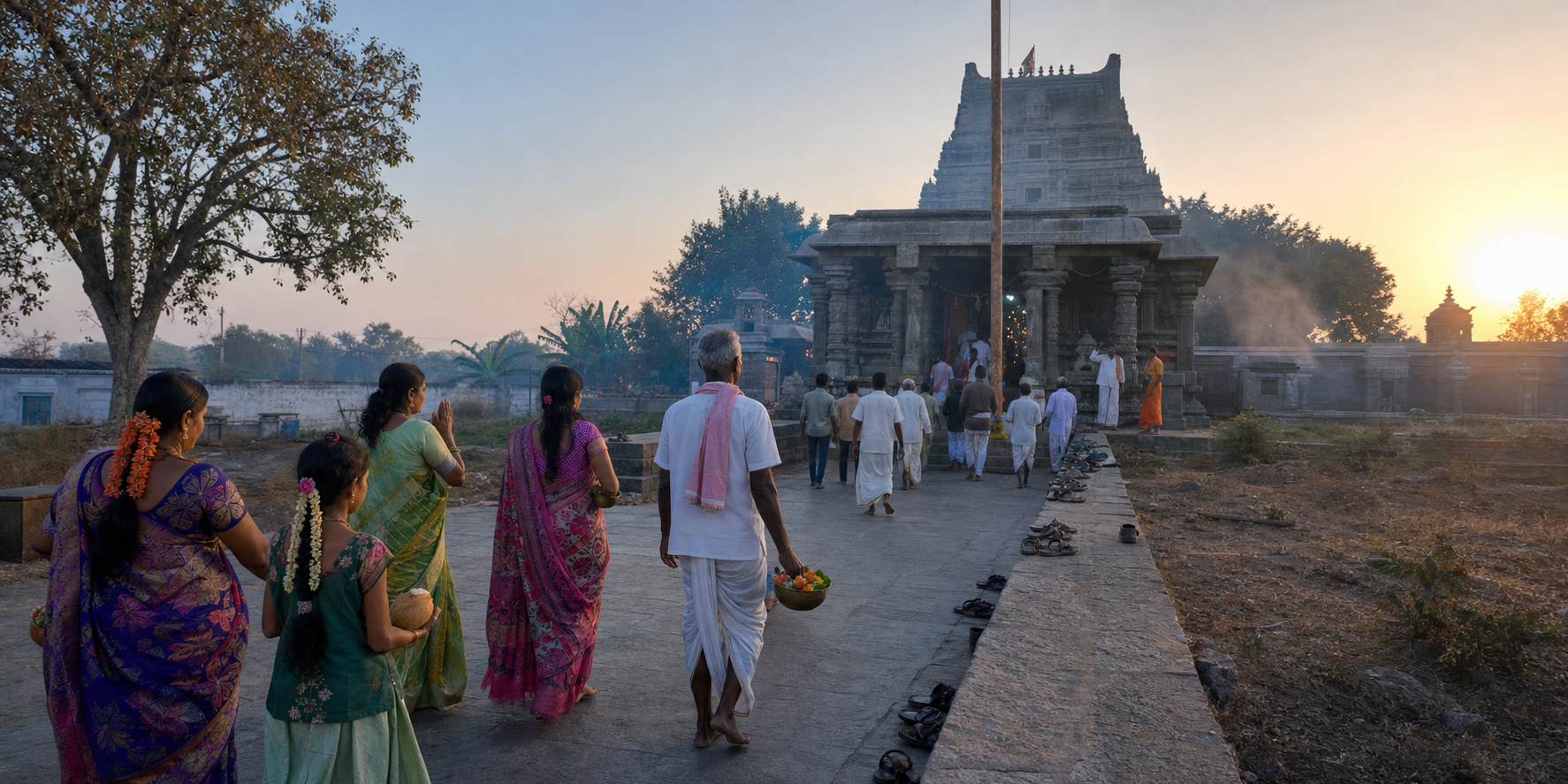
If you are planning your first darshan at Kuravi, the useful question is not simply what you will see. It is how to approach a fierce form of Shiva without reducing the visit to fear, hurried petition, or heritage sightseeing.
Kuravi is an active Shaivite sanctuary in Mahabubabad district, Telangana. When you understand Veerabhadra’s fierce grace, follow the ritual rhythm of the temple, and choose your visiting day deliberately, even a short pilgrimage can become coherent rather than rushed.
Approach Veerabhadra as Shiva’s disciplined force
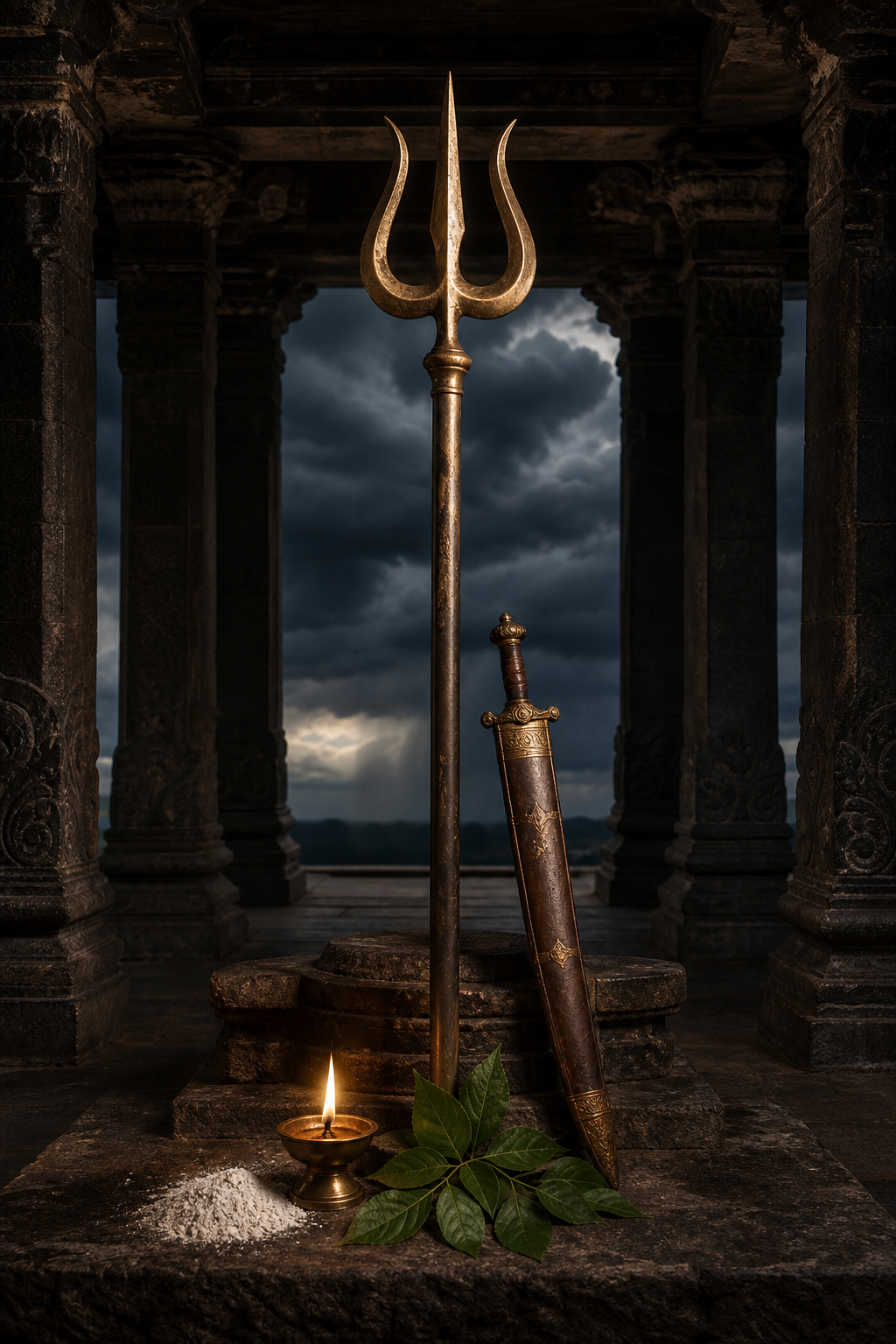
Veerabhadra is a formidable manifestation of Shiva, not a deity standing outside the Shaiva tradition. His theological setting is the Daksha Yajna episode: after sacred order is violated, Veerabhadra emerges from Shiva’s matted locks to confront the disorder. At Kuravi, the enduring lesson is not that anger becomes holy whenever we feel offended. It is that force becomes righteous only when it is governed by dharma, proportion, and responsibility.
This distinction should shape your prayer. You need not approach the deity with a demand that an adversary be punished. A more faithful sankalpa is to ask for the courage to face what you have avoided, the clarity to name a violated boundary, and the discipline to respond without becoming unjust yourself. Veerabhadra’s fierceness is not permission for uncontrolled rage. It is a demand that strength remain answerable to wisdom.
The traditional iconographic vocabulary makes the same point. Veerabhadra is described with three eyes and ten arms. The three eyes signify comprehensive vision, while the many arms express multiple capacities to defend and restore order. The trident, sword, bow and arrow, drum, and noose belong to this protective visual language. Do not turn a brief darshan into an inventory exercise, trying to identify every attribute before the queue moves. Receive the form as a whole: alertness, capability, restraint, and protection held together.
The temple therefore holds raudra and karuna together: righteous intensity and compassion. That balance is especially useful when you are carrying conflict into the sanctum. Name the truth of the conflict, but do not feed it with fantasies of revenge. This is where a fierce deity can teach non-harm more seriously than a merely comforting image: peace without the courage to protect dharma is fragile, while force without compassion becomes another form of disorder.
Follow a simple Shaivite worship sequence
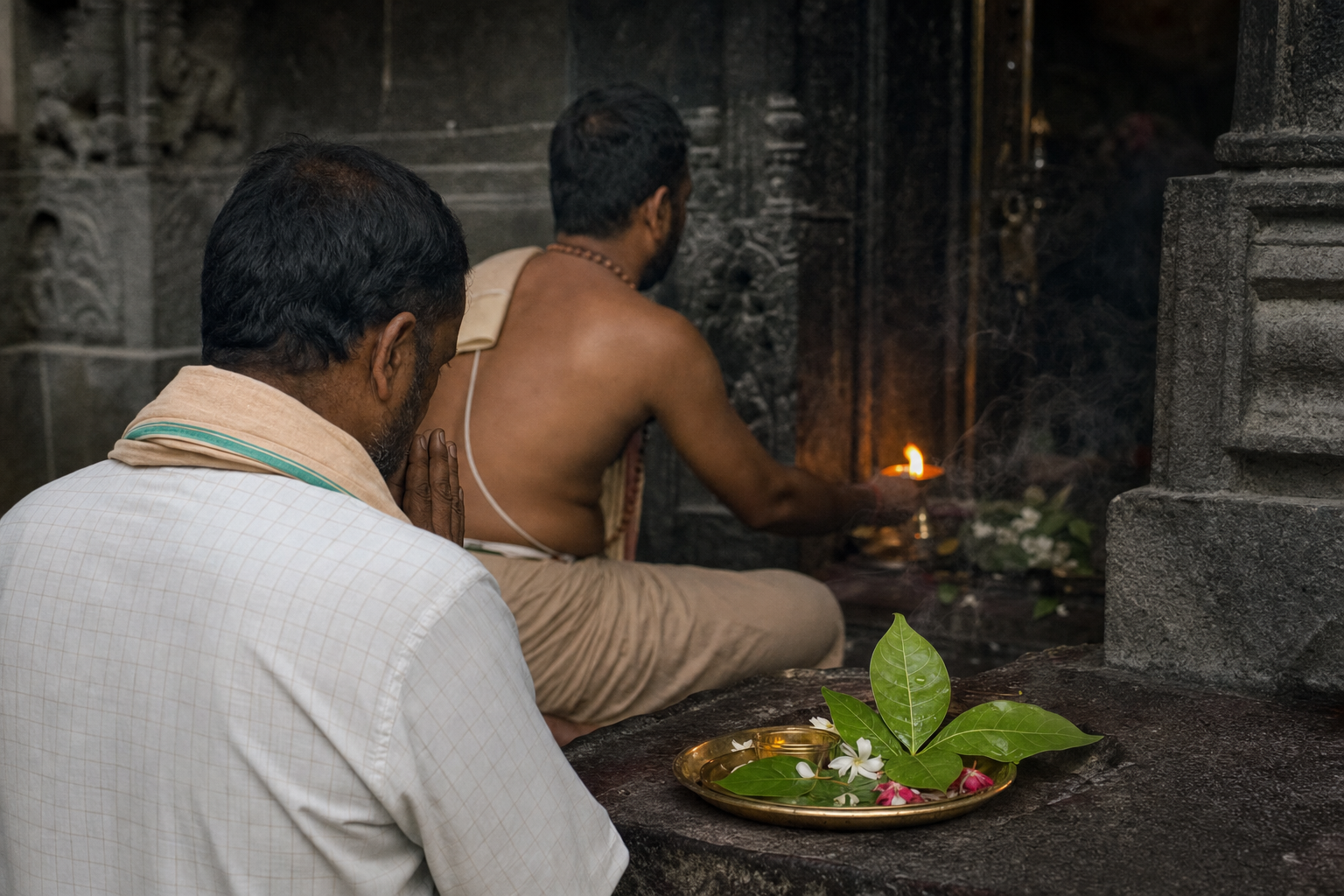
You do not need an elaborate personal ritual to worship meaningfully at Kuravi. You do need attention. The following sequence keeps the temple’s own rhythm at the center of your visit.
- Confirm the day’s opening periods and special rites before setting out. Kuravi’s schedule can change on festival days, major tithis, or seasonally, and an occasional midday closure is possible. A fixed time copied from an old listing should not overrule a current local announcement.
- Arrive in modest clothing and leave footwear at the designated place. Wear supportive footwear for the outer approach because the stone can be uneven, but remember that you will remove it before entering the sacred area. In warm weather, plan for hot stone underfoot and carry drinking water for use outside the ritual spaces.
- Let the main axis orient you. Nandi faces the sanctum, forming a direct visual relationship between steadfast devotion and Shiva’s grace. Pause without blocking movement, bring your attention to that line, and allow the agitation of the road to settle before seeking darshan.
- State one clear intention inwardly. It may concern courage, health, clarity, protection, accountability, or the strength to uphold a necessary boundary. One honest sentence is more useful than a hurried list of unrelated wishes.
- Offer only what the temple presently accepts. Bilva leaves, simple flower garlands, vibhuti, and rudraksha are associated with worship here, but local instructions determine how an offering is received. Ask before carrying materials toward the sanctum, and do not pour anything on the murti unless temple personnel explicitly direct you to do so.
- Distinguish personal offering from priest-led abhishekam. The temple’s Shaivite liturgy includes abhishekam with water, panchamrita, vibhuti, and fragrant substances, accompanied by Sri Rudram and related hymns. Participation means entering an established ritual order; it does not mean independently reproducing every action you have seen elsewhere.
- Make pradakshina only through areas that are open and intended for it. Move at the pace of the precinct, follow signs and staff directions, and give elders, families with children, and worshippers carrying offerings room to pass.
- Receive prasadam without rushing away. If seva opportunities or an orderly prasadam line are available, participate with the same restraint you brought to the sanctum. The movement from private prayer to shared food and service is part of the pilgrimage, not an administrative detail after it.
Key takeaways
- Approach Veerabhadra for disciplined courage and protection, not as a religious justification for personal anger.
- Choose one clear sankalpa before joining the darshan line.
- Confirm the current schedule locally instead of relying on an unverified permanent timetable.
- Bring only accepted offerings and leave abhishekam procedures to the temple’s ritual order.
- Use the Nandi-to-sanctum axis as a moment of inward alignment rather than treating it only as an architectural feature.
Choose between a quieter darshan and festival intensity
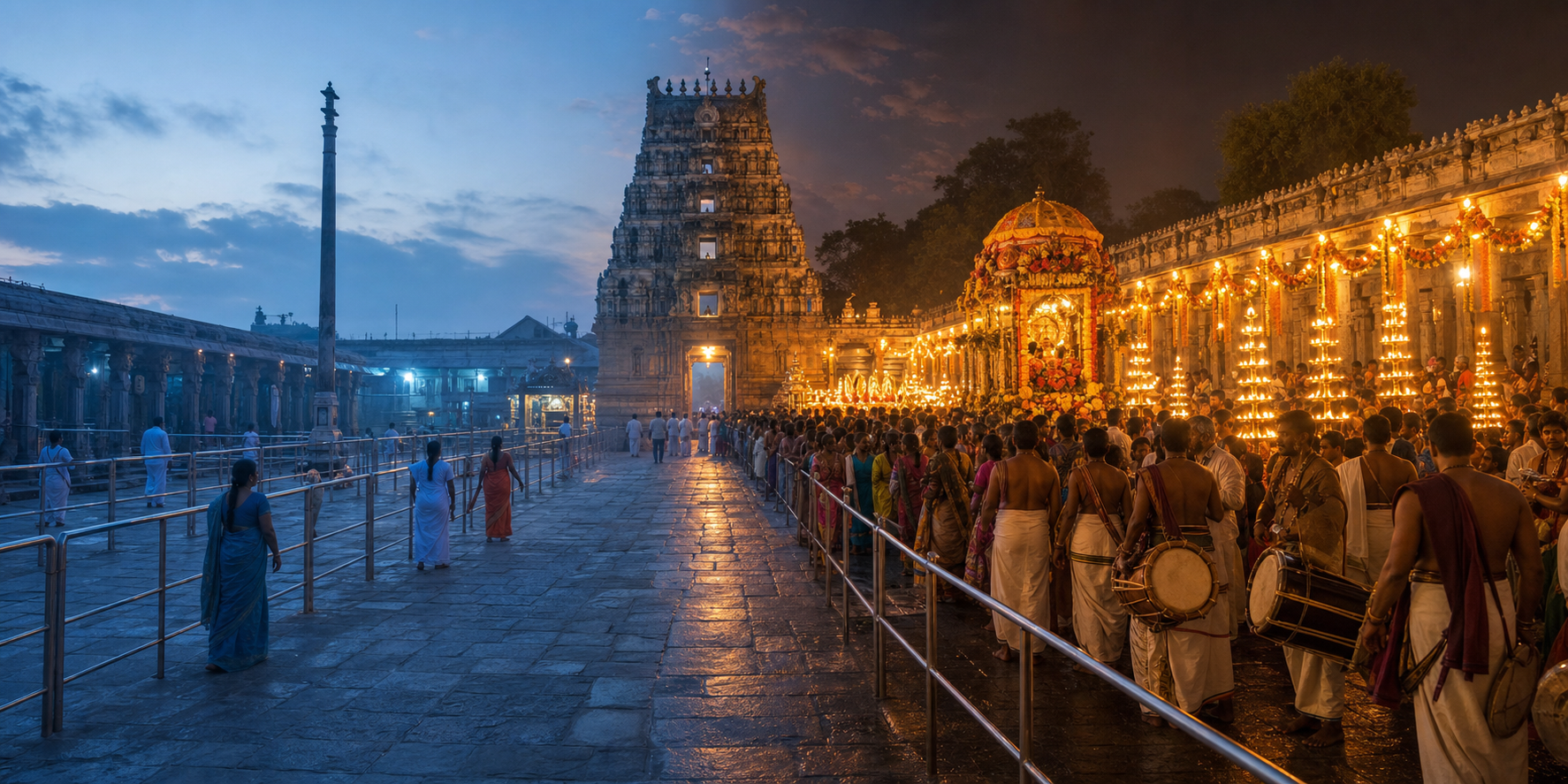
The best day depends on what you want from the pilgrimage. An ordinary morning gives you a different encounter from Maha Shivaratri, and neither is automatically superior. Decide whether you need contemplative space, a vrata-centered observance, or the collective energy of a major festival before choosing the date.
| Visiting period | What shapes the experience | Choose it when | Planning adjustment |
|---|---|---|---|
| Ordinary morning or early evening | Daily puja and darshan within the temple’s regular rhythm | You want time to observe the Nandi axis, make a focused prayer, and avoid festival-scale movement | Still confirm the day’s opening periods and any midday closure |
| Monday | A day widely favored for Shiva worship, with potentially heavier footfall | Monday observance matters to your vrata or family practice | Arrive earlier and allow more time than on an ordinary weekday |
| Pradosham, especially on Monday | Vrata, archana, darshan, and prasadam draw a steady devotional gathering | You want your visit tied to a recurring Shaivite observance | Check the relevant tithi and the temple’s announced ritual sequence |
| Karthika masam | Deepotsavam, extended pradakshina, and enhanced evening lamps | Lamp worship and the atmosphere of an illuminated precinct are central to your pilgrimage | Expect more evening activity and plan transport after darshan |
| Maha Shivaratri | The largest congregation, special abhishekam, night vigil, and collective Shaiva singing | You actively want an intense communal observance rather than an unhurried visit | Prepare for long queues, extended standing, and changed access arrangements |
For elders or young children, festival scale is not a minor inconvenience. Longer queues, uneven stone, and extended standing can determine whether the family can remain through the intended rite. If a major observance is spiritually important, divide responsibilities in advance: one person can manage water and necessary belongings outside the sacred zone while another stays attentive to the queue and local instructions.
If your priority is quiet prayer, do not choose Maha Shivaratri merely because it is the most important date in the annual cycle. Visit on a less crowded morning, then observe Shivaratri in your home or local temple. If collective vigil and hymn singing are themselves your purpose, accept the queue as part of that choice and do not expect the pace of an ordinary darshan.
Read the temple without inventing its history
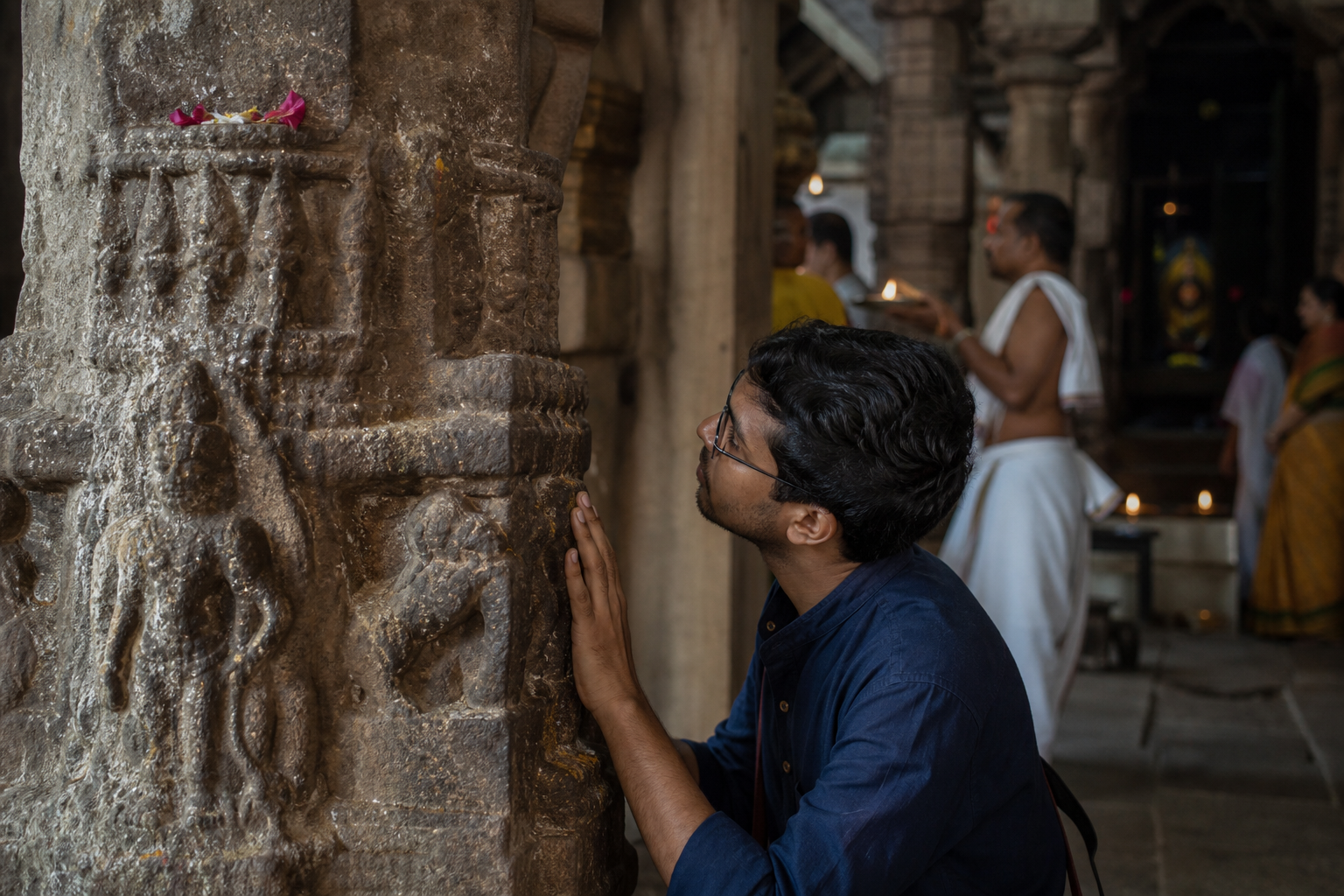
Kuravi belongs to a landscape in which Shaiva worship flourished under successive regional polities. Local memory places the shrine’s beginnings somewhere within the broad early-to-late medieval period. The precise foundation date, however, is not established as a secure epigraphic fact. That uncertainty matters.
Resist attaching a precise dynasty, ruler, or year to Kuravi simply because its stonework resembles another Telangana temple. Architectural resemblance can help frame a question, but it cannot substitute for a dated inscription or another firm historical record. The responsible claim is both more modest and more meaningful: Shaivite worship at Kuravi has persisted through rituals, festivals, oral memory, and community participation.
You can read the sacred plan without making an unsupported dating claim. The garbhagriha holds the concentrated presence of the deity; the antarala mediates between sanctum and hall; and the pillared mandapa receives worshippers. Nandi’s axial position directs attention toward the sanctum. Where the dhwaja-stambha, bali-peetham, and enclosing prakaras organize the forecourt, they also regulate movement from public approach to increasingly focused sacred space.
Notice how the building changes your conduct. The approach permits conversation and practical coordination. The mandapa lowers the voice and slows the feet. The sanctum gathers attention into a narrow visual field. Local granite and sandstone give the structure durability, but the temple’s meaning does not rest on ornament alone. Light, shadow, the sound of recitation, and the direct line through Nandi can carry more ritual force than a crowded sculptural surface.
This is also why Kuravi should not be approached only as an archaeological stop. Its strongest historical evidence is living continuity. A worn path of pradakshina, a recurring festival, or a family vrata does not answer every question about chronology, but each shows how a community has kept a Shaivite place intelligible across generations.
Plan the journey so logistics do not consume the pilgrimage
Kuravi lies in Kuravi mandal of Mahabubabad district. For rail travel, Dornakal Junction and Mahabubabad are the principal nearby nodes, with connections along the Kazipet-Vijayawada corridor. Regional buses serve the mandal, while a taxi or auto may be needed for the final approach. If you are arriving by air, Hyderabad’s Rajiv Gandhi International Airport is the main gateway, followed by a substantial onward rail or road journey.
Do not plan the last mile as an afterthought. Confirm your return arrangement before entering the temple, particularly if you choose an evening observance or a festival date. That small step protects the final part of darshan from becoming a calculation about finding transport after dark.
Mahabubabad and Warangal offer more accommodation choices than the immediate temple setting. Staying in one of these centers also helps if you want to extend the journey through Telangana’s sacred and historical landscape. Warangal Fort, the Thousand Pillar Temple at Hanamkonda, and Ramappa Temple at Palampet can form a wider heritage circuit, but they should not be squeezed into the same narrow window as Kuravi darshan. Give the living temple its own time rather than treating it as one hurried stop between monuments.
October through February is generally the more comfortable period for outdoor movement in the Deccan. Monsoon travel brings greener surroundings but intermittent rain. In summer, choose an early or late visit instead of building the day around a hot afternoon. Vegetarian food is widely available in nearby towns, and temple prasadam may complement rather than replace your meal plan.
Inside the precinct, modest clothing, quiet speech, and compliance with footwear rules are the baseline. Treat photography as permission-dependent. Policies can vary, and a camera should remain put away whenever signs or temple personnel indicate restraint. The fact that a sacred object is visible does not make it available for documentation.
Before you leave home, make three decisions: choose a quieter day or a festival deliberately, verify the current temple schedule locally, and write your sankalpa in one sentence. At Kuravi, move slowly enough for that intention to survive the queue. The encounter with Veerabhadra becomes useful when the courage requested in the sanctum is carried into your next difficult but dharmic action.
References
