
If you are trying to decide whether to keep Amalaki Ekadashi on February 27 or wait another day, the decisive detail is not the date printed at the top of a calendar. It is the tithi present at your local sunrise.
For most of India, the answer is straightforward: observe the vrata on Friday, February 27, 2026. If you live outside India, use the same sunrise rule with a Panchang calculated for your city, and obtain the local Dwadashi Parana window before you begin.
Key takeaways for February 27, 2026
- In Indian Standard Time, Dashami ends and Shukla Paksha Ekadashi begins at 12:06 AM on February 27, six minutes after midnight.
- Ekadashi is therefore present at sunrise in most Indian locations, making Friday, February 27 the vrata day there.
- Smarta and Vaishnava devotees generally observe on the same date in this instance because Ekadashi already prevails at sunrise.
- Parana should normally be planned for the following civil day, on Dwadashi, after local sunrise and after Hari Vasara has ended.
- Outside India, do not convert 12:06 AM IST and treat the converted time as a complete observance ruling. Confirm the tithi at your own sunrise and use a city-specific Parana window.
| Question | Practical answer |
|---|---|
| When does Ekadashi tithi begin? | 12:06 AM IST on Friday, February 27, 2026. |
| When is the vrata observed in most of India? | Friday, February 27, because Ekadashi is present at sunrise. |
| When is Parana? | Normally on the following civil day during the city-specific Dwadashi Parana window, after Hari Vasara. |
| What should diaspora devotees do? | Use a reliable Panchang or temple calendar configured for the city where the vrata is being kept. |
Why 12:06 AM is not the only timing that matters
A tithi is an astronomical interval rather than a fixed weekday or midnight-to-midnight date. Each tithi corresponds to 12 degrees of angular separation between the Moon and the Sun. Thirty such intervals form the lunar month. Because the apparent motion of the Moon is not uniform, a tithi can begin or end at almost any civil-clock time.
That explains why Ekadashi begins at 12:06 AM IST instead of neatly beginning at sunrise or midnight. The clock time tells you when the astronomical interval changes. The sunrise rule tells you which civil day receives the religious observance.
For February 27 in most of India, the two facts fit together cleanly. Ekadashi begins shortly after midnight and remains the operative tithi when the Sun rises. You do not need to treat 12:06 AM as a universal moment for beginning every part of the vrata. The precise dietary cutoff, sankalpa procedure, and preliminary observances can follow your family or sampradaya tradition. What 12:06 AM establishes is that Ekadashi is already underway well before sunrise.
The distinction also resolves apparent disagreements between calendars. One calendar may use the Amanta month system and another the Purnimanta system, producing different-looking month labels. That difference does not necessarily produce a different vrata day. Tithi at sunrise remains the central test.
How to verify the date for your own city

The astronomical boundary occurs at one instant, but its local clock label changes with the time zone, and the relevant sunrise occurs at a different time in every place. A converted IST time can therefore help you understand when the tithi begins, but it cannot by itself tell you which local sunrise governs your observance.
Use a drik, or astronomy-based, Panchang calculated for the place where you will physically keep the vrata. A trusted local temple almanac is also suitable when it clearly identifies the city and observance tradition. Before relying on an entry, check these four fields:
- Confirm that the location is your city, not Delhi, Mumbai, London, New York, or another default location.
- Find the tithi operating at local sunrise on the proposed vrata date.
- Check whether the calendar gives separate Smarta and Vaishnava dates. If it does, follow the convention of your lineage or temple.
- Record the next day’s Parana opening and closing times, including any warning that Hari Vasara must end before the fast is broken.
The Smarta-Vaishnava distinction matters most when Ekadashi begins after one sunrise but continues through the next. Vaishnava observance may then fall on the second civil day. That complication generally does not change the February 27 date in most of India because Ekadashi is already present at sunrise.
Do not use Nakshatra, Moon Rashi, Yoga, Karana, Choghadiya, or an auspicious muhurta to overrule the Ekadashi sunrise test. Those Panchang elements can refine the devotional character or timing of a particular act, but they do not replace the tithi rule that identifies the vrata day. Nakshatra and Rashi can also change during the day, so consult the city-specific listing if you want to incorporate them into worship.
A practical Amalaki Ekadashi observance at home
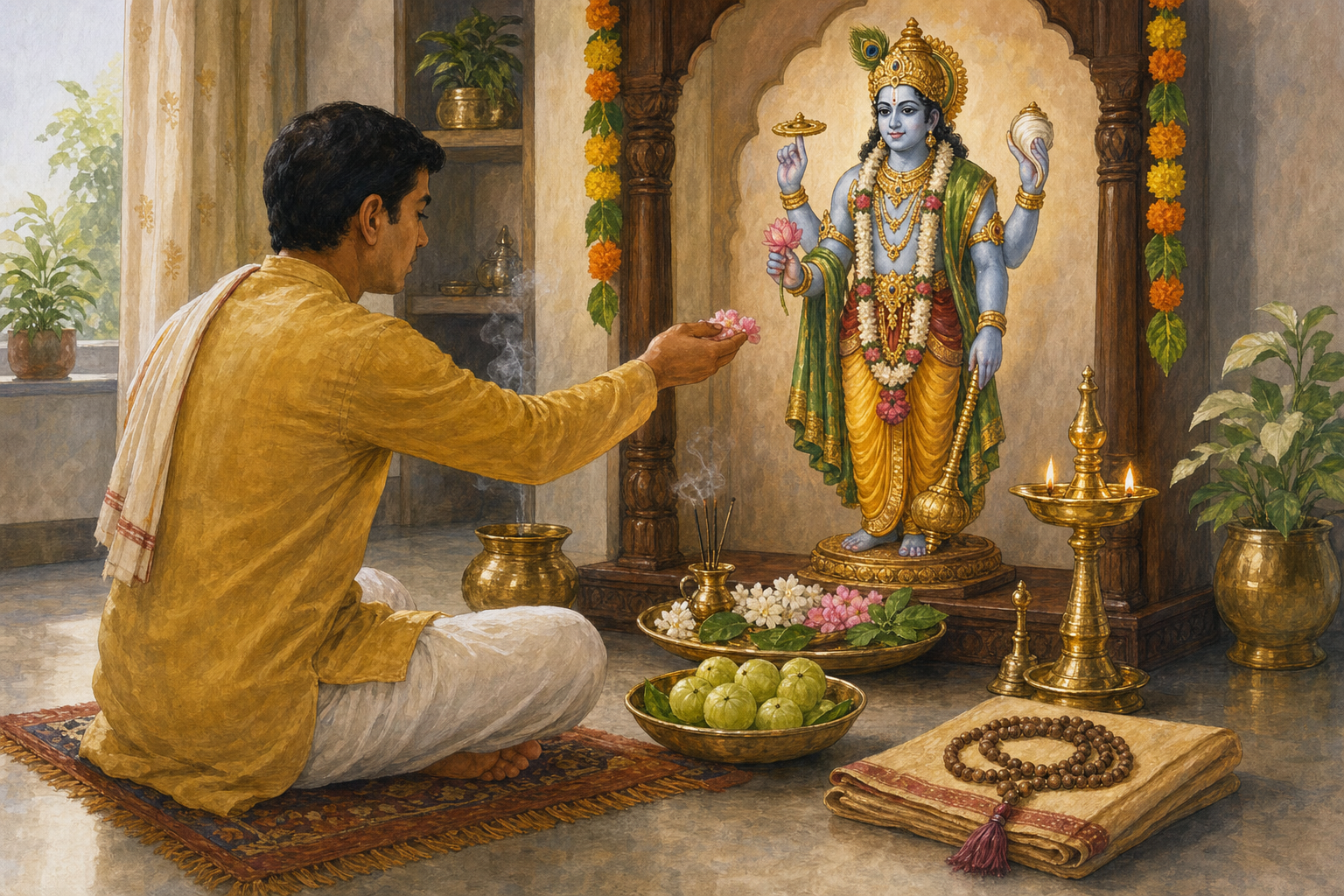
Amalaki Ekadashi is dedicated to Sri Vishnu and gives the amalaki, or Indian gooseberry, a visible place in the observance. The fruit represents purity, vitality, renewal, and resilience. The point is not to assemble the most elaborate ritual possible. Build a day in which food restraint, remembrance, study, and service support the same intention.
Prepare before the vrata begins
- Choose your level of fasting in advance rather than making the decision when hunger arrives.
- Check which ingredients your household or lineage permits. Ekadashi food customs are not identical across all communities.
- Set aside amalaki or another seasonal fruit, Tulasi, a lamp, and the text you intend to read.
- Save the local Parana window for the following day. This prevents an otherwise careful vrata from ending at an arbitrary breakfast time.
- Decide on one realistic act of dana or seva so that charity is part of the vow rather than an afterthought.
Begin the morning with a clear sankalpa
After snana, light a lamp and make a simple sankalpa for the vrata. Offer Tulasi and fruit to Sri Vishnu, including amalaki when it is available and consistent with your practice. Recite the divine names without rushing. Vishnu Sahasranama, selected passages from the Bhagavad-Gita, or an Amalaki Ekadashi vrata-katha are suitable anchors for the day.
If you use Brahma Muhurta, calculate it from local sunrise; it is approximately one hour and thirty-six minutes before sunrise. This period can be used for japa, meditation, or sankalpa, but waking at that time is not a substitute for observing the correct tithi.
Carry the vrata through the whole day
Upavasa is more coherent when restraint extends beyond the plate. Reduce avoidable distraction, speak with care, and give the time saved from cooking or entertainment to recitation, quiet study, seva, or dana. If you take permitted food, eat it mindfully rather than reproducing an ordinary feast with substitute ingredients.
Abhijit Muhurta, a roughly 48-minute period centered on local solar noon, can be used for a sattvic undertaking. Shubh, Labh, or Amrit Choghadiya may also help households that customarily use Choghadiya. These periods must be calculated for the city and should be treated as optional refinements. You do not need to postpone sincere Vishnu worship merely because a preferred secondary muhurta is unavailable.
At twilight, the early Pradosh period offers another natural pause for a lamp, japa, or quiet contemplation. Keep the evening simple enough that you can remain attentive to the vow rather than turning ritual preparation into agitation.
Choose a fast that preserves ahimsa
Ekadashi practice ranges from a strict fast to phalahara based on fruit, milk, nuts, and sattvic preparations made without grains and certain legumes. Follow the ingredient rules of your household or sampradaya; a generic food list cannot settle every regional and sectarian difference.
A harsher fast is not automatically a more faithful one. If you have a medical condition, are pregnant, or are elderly, adapt the fast with guidance from an appropriate healthcare professional and trusted spiritual counsel. Choosing permitted nourishment can preserve the vrata’s discipline without turning it into avoidable harm. Ahimsa and personal well-being remain part of the dharmic decision.
If full food abstinence is unsuitable, make the restraint concrete in another way: take simple permitted meals, avoid indulgence, maintain japa, read a chosen passage, and complete the dana or seva you included in your sankalpa. The purpose is steady remembrance and sattvic discipline, not a contest over deprivation.
Plan Parana before starting the fast
Parana is the ritual completion of the vrata, not merely the first convenient meal. It belongs on Dwadashi after sunrise and after Hari Vasara has passed. For an Ekadashi kept on Friday, February 27 in most of India, Parana will normally be planned for the following civil day. The exact opening and closing times must come from your local Panchang.
This is the part most likely to be mishandled when a devotee copies a schedule from another city. Sunrise changes by location, and the safe Parana interval can therefore carry different clock times. A universal Parana time without a named location is not precise enough for practice.
Before February 27, set your Panchang to the city where you will be, record the Dwadashi Parana window, and choose a sustainable form of fasting. Once those decisions are made, the observance can stay where it belongs: on Sri Vishnu, disciplined remembrance, and compassionate action.
References
