
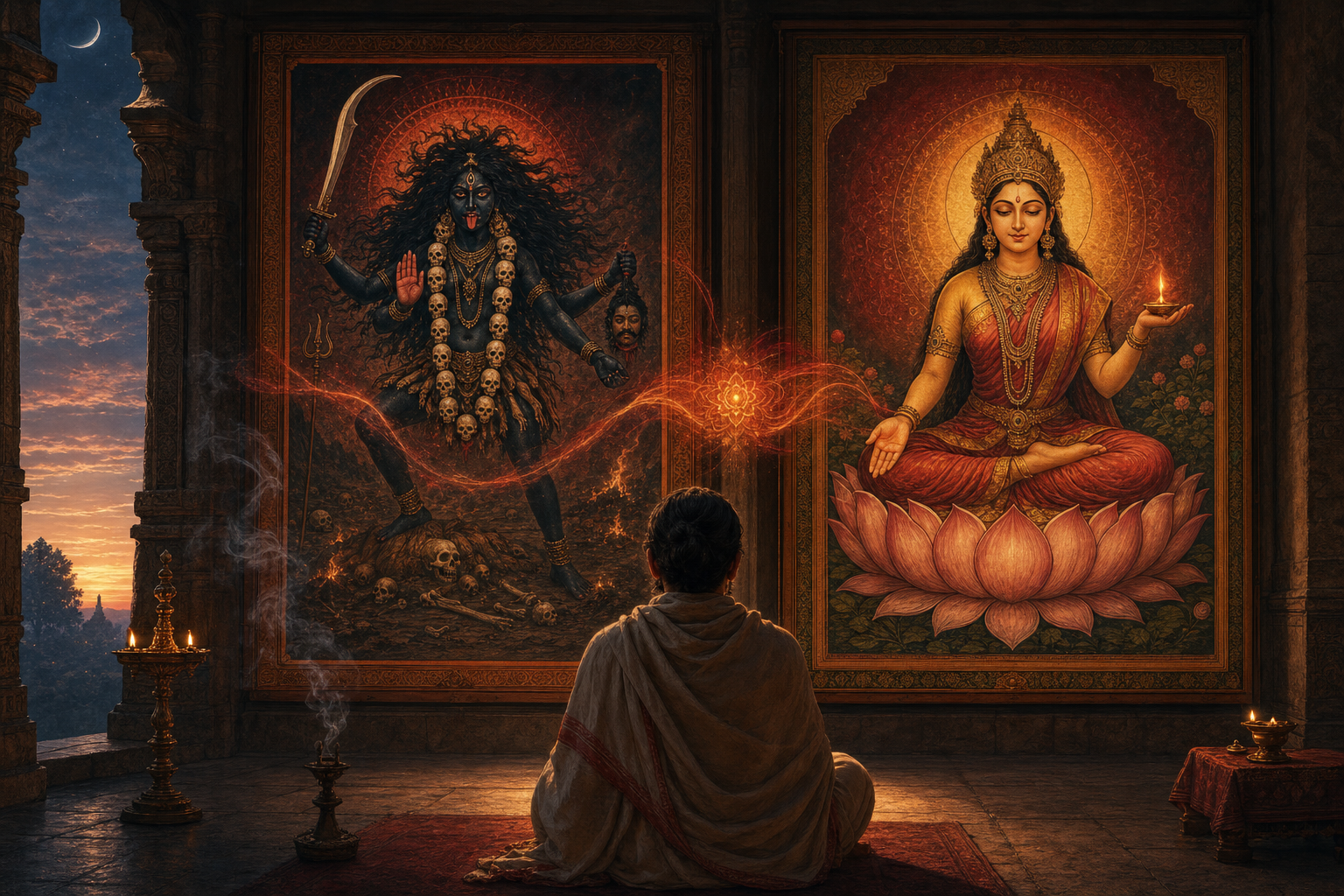
You are looking at a Shakta image and the symbols seem to pull in opposite directions. A skull garland, weapon, emaciated body, or cremation ground can look terrifying. Half-closed eyes, a lotus, a maternal lap, or an offering of food can look merely gentle. If you stop at the mood of the image, however, you miss its instruction.
Shakta iconography asks a more useful question: what is Shakti doing for beings? Divine grace may cut through danger, cleanse the residue of conflict, concentrate attention, hold vulnerable power, or turn devotion into service. Once you read purpose before appearance, fierce and meditative forms stop looking like theological contradictions.
Key takeaways
- Raudra, the fierce mode, and shanta or saumya, the tranquil and gentle modes, are not moral opposites. They answer different spiritual conditions.
- A fierce image should be read by its boundaries: what harm is confronted, whom the action protects, when the action stops, and what condition it restores.
- Meditative Parvati embodies concentrated Shakti, not passive withdrawal. Her stillness joins devotion, disciplined effort, and insight.
- Child Kali resting in maternal care does not become less powerful. Vatsalya, or parental tenderness, changes how the devotee approaches that power.
- The image has done its work when you can translate it into one ethical action: establish a boundary, release resentment, protect attention, nourish someone, or resume service without pride.
Grace changes form because the need changes
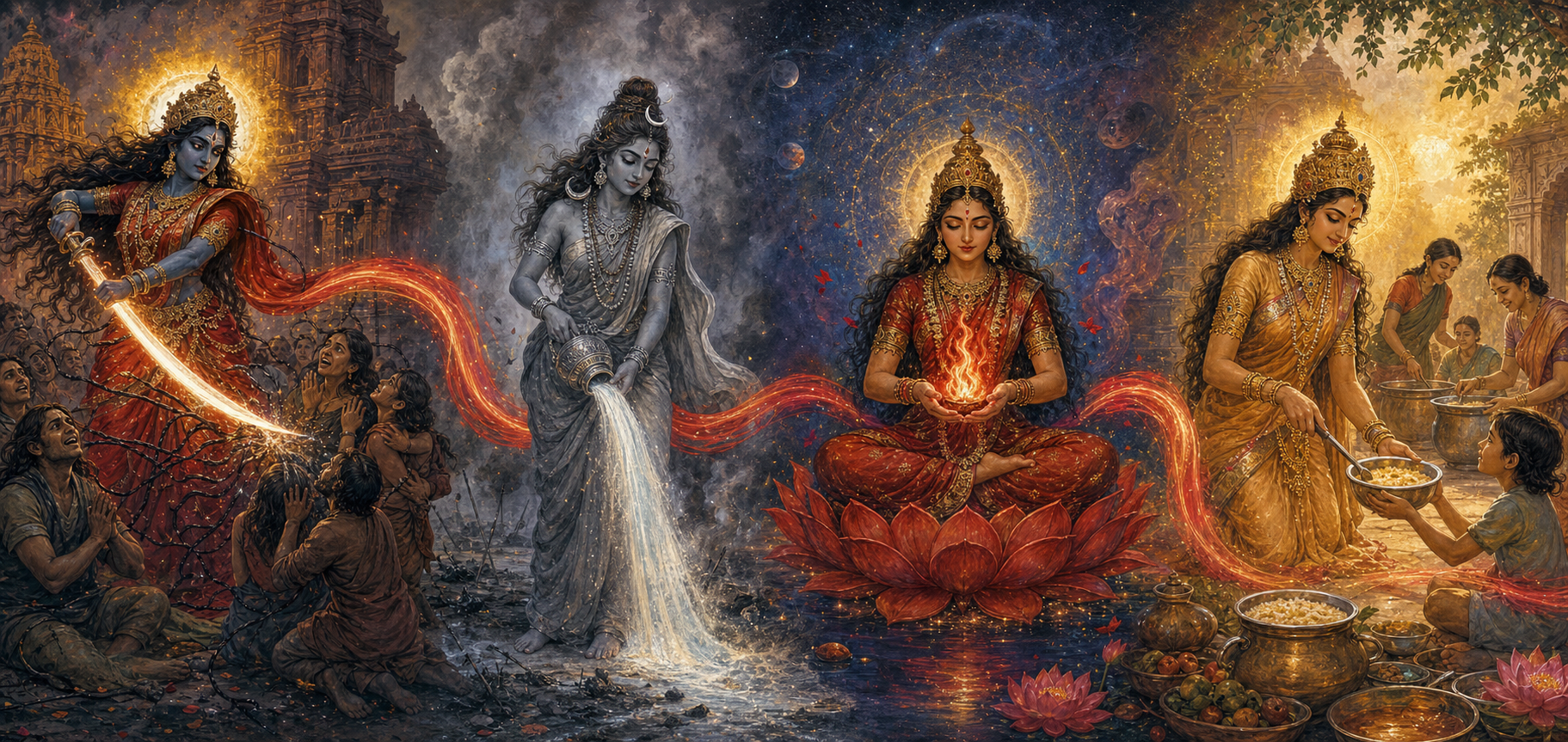
Grace in Shakta imagery is not a fixed facial expression. It is the right movement of divine power in response to a particular obstruction. Three visual verbs help you recognize that movement.
- Sever. Chamunda’s weapons, skulls, jackals, and cremation-ground setting place her where fear, corruption, and mortality are most difficult to evade. Her force is directed toward the removal of adharma and ignorance. The image does not ask you to admire destruction for its own sake.
- Steady. Parvati in meditation gathers energy rather than dispersing it. Half-closed eyes, a rosary, a lotus, and an absorbed posture can indicate japa, purity, tapas, and sustained attention. Stillness is what power looks like when it is fully governed.
- Nourish. Child Kali on Maa Sarada’s lap, with Sri Ramakrishna bringing food, shifts the relationship from dread to intimate care. The lap holds power without suppressing it, while the offering turns devotion into seva. The Divine is approached not only through awe but through feeding, tending, and service.
One image may contain more than one mode. Chamunda can be outwardly terrible and inwardly unattached. Child Kali remains Kali even when the dominant bhava is tenderness. Meditative Parvati remains Shakti, the dynamic power of reality, while appearing perfectly still. The apparent tension is the point: power becomes sacred when it is proportionate, disciplined, and ordered toward restoration.
This ethical structure also helps you notice family resemblances across Dharmic traditions without erasing their differences. Vajrayana wrathful deities express fierce compassion against the kleshas. Jain disciplines direct conquest toward the passions rather than other beings. The Sikh Sant-Sipahi ideal joins courage to restraint. In each setting, ferocity fails when it becomes appetite, ego, or indiscriminate hostility.
Read a Shakta image in five passes
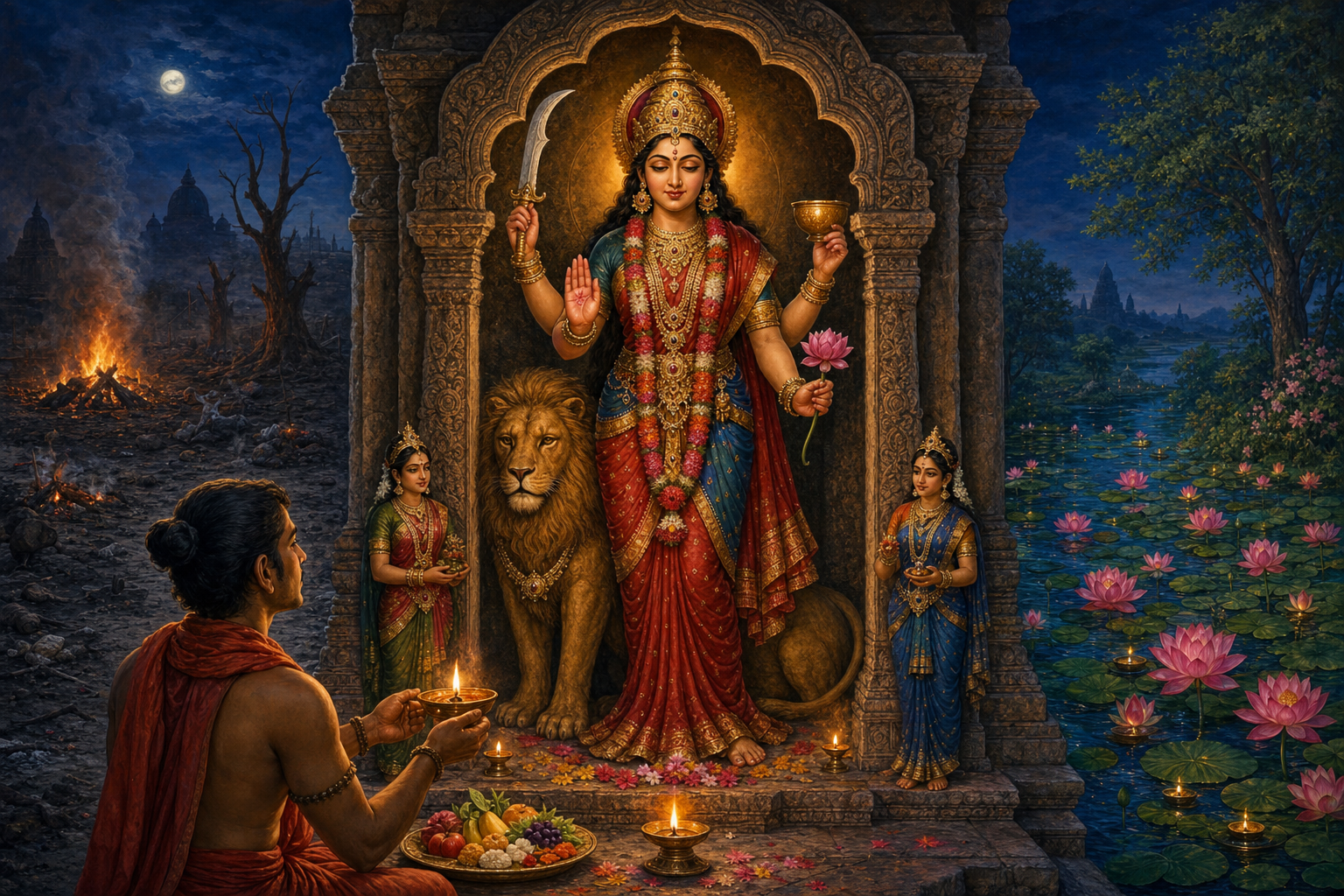
Do not begin by asking whether the image is beautiful or frightening. Begin with visual grammar. Move through these five passes before deciding what any isolated symbol means.
- Read the posture and gaze. Is the Goddess advancing, standing over a subdued force, seated in equilibrium, absorbed in meditation, or resting as a child? An active posture sends energy outward. A meditative posture gathers it. A child resting on a lap places power inside a relationship of trust.
- Read the hands before the weapons. A sword or trident identifies a capacity to cut, pierce, or protect, but a gesture may reveal how that capacity is governed. A hand giving fearlessness, holding a rosary, receiving food, or performing a post-conflict act can change the meaning of the entire composition.
- Read the mouth as a site of speech and appetite. Kali’s tongue, Chamunda’s teeth, or the calm mouth of a meditating Goddess should not be detached from the surrounding scene. In one layered interpretation of the Charchika gesture, cleaning the teeth signifies refusing to retain the taste of conflict. The mouth then becomes a lesson about truthful speech, restrained appetite, and the rejection of triumphalism.
- Read the setting and companions. A cremation ground places the Goddess within impermanence and decay. Jackals and skulls intensify that confrontation. A maternal lap creates a field of refuge. Food introduces nourishment and reciprocal offering. Kashi’s Manikarnika landscape brings meditation into the immediate presence of mortality and liberation.
- Read the sequence. Ask what happened before the depicted moment, who is being protected, and what comes next. A battle image that ends in purification teaches something different from an image that glorifies perpetual aggression. A meditation image that leads to compassionate action teaches something different from withdrawal disguised as spirituality.
After the fifth pass, write one provisional sentence using this form: This manifestation of Shakti does this, so that this can return. For example: Chamunda removes a threat and clears its residue so equilibrium can return. Parvati concentrates devotion so lucid awareness can emerge. Child Kali is held and nourished so power can be encountered through trust and service. If your sentence cannot name the restorative end, look at the image again.
Three images that correct three common errors
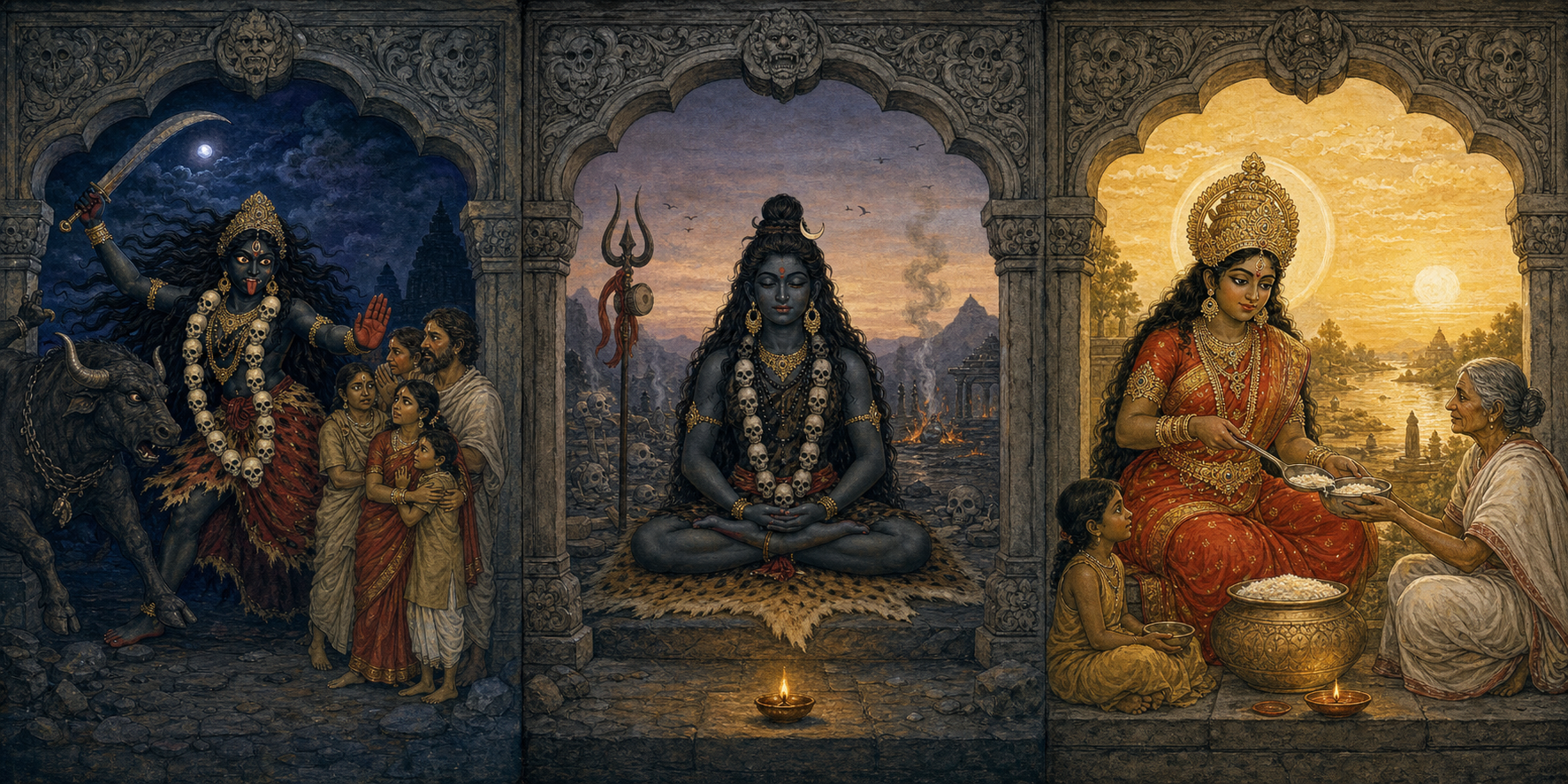
Chamunda corrects the confusion of courage with cruelty
Chamunda’s name recalls the defeat of Chanda and Munda in the Devi Mahatmyam. Her broader iconography may include an emaciated body, disheveled hair, a garland of skulls or heads, a trident, sword, skull-cup, damaru, jackals, and the cremation ground. These are not interchangeable decorations. Together they show a power that cannot be intimidated or contaminated by death, decay, or the forces it must confront.
The unusual Charchika gesture sharpens the lesson. In this regional form associated especially with Odisha, the little finger of the left hand appears to clean battle residue from the teeth. Not every Chamunda image contains this detail; periods, regions, and lineages vary. Where it appears, however, the gesture places purification immediately after force.
- As a sign of non-attachment, it says that victory must not become an object of enjoyment.
- As a sign concerning the mouth, it disciplines speech and appetite after conflict.
- In a yogic reading that connects the little finger with water and the left side with cooling, inward energy, it marks the return from agitation toward integration.
This gives you a practical test for any appeal to righteous fierceness. Is the response directed at a real harm rather than a hated category of people? Does it stop when protection has been achieved? Is there an intentional return to truthfulness, restraint, and social repair? If anger keeps searching for new targets, the Chamunda principle has been abandoned even if her image is being invoked.
Child Kali corrects the confusion of tenderness with weakness
Child Kali on Maa Sarada’s lap works through relationship rather than combat. Kali’s association with time, dissolution, and the severing of ignorance is not erased. The dominant bhava changes to vatsalya: the devotee meets the Infinite through the impulse to protect and nourish a child.
Maa Sarada’s lap functions as a living support where tremendous energy can rest without fear. Sri Ramakrishna’s offering of food supplies the next movement: power held in compassion is answered by seva. His Shodashi Puja, in which he worshipped Sarada Devi as the living Goddess, gives this relational theology a historical anchor. The lap, the child, and the food together join power, care, and offering.
The common error here is sentimentality. Tenderness is not an escape from Kali’s demand for discernment. It governs how strength is used. When you contemplate this scene, ask a concrete question: who becomes safer, steadier, or better nourished because of the power available to you? If the answer is no one, devotion has not yet become service.
Meditative Parvati corrects the confusion of stillness with passivity
Where Parvati is presented as Manikarnika in meditation, her stillness gathers bhakti, dhyana, and tapas into one form. A rosary can direct attention toward japa. A lotus can indicate purity. Half-closed eyes show awareness no longer being dragged outward by every stimulus. This is not a weak Shakti waiting for power to arrive from elsewhere.
Parvati’s tapas, also prominent in Kumarasambhava, makes her devotion active and one-pointed. Within Shaiva-Shakta thought, the union of Shiva and Shakti expresses the inseparability of consciousness and power. Shiva is not meaningful consciousness with Shakti removed, nor is Shakti blind activity detached from awareness. Meditative Parvati makes their mutual presence visible.
The Manikarnika association adds a demanding setting. Kashi’s ghat, kund, temples, and cremation ground collapse the comfortable distance between spiritual practice and mortality. Against that background, composure is not decorative serenity. It is the steadiness required to face impermanence without losing devotion or ethical clarity. When you look at this form, ask what your devotion is training you to sustain. A feeling that disappears at the first distraction is not yet tapas.
Make the image answer the problem in front of you
You do not need to combine these images into an improvised ritual. Choose the form whose spiritual task matches your present difficulty. Turn to Chamunda when you are avoiding a necessary boundary or carrying the residue of conflict. Turn to meditative Parvati when attention is scattered and devotion lacks continuity. Turn to Child Kali with Maa Sarada and Ramakrishna when strength has become harsh, frightening, or disconnected from care.
- State a narrow sankalpa. Use one sentence, such as: May I act firmly without hatred, may I remain steady without withdrawing, or may my strength become service.
- Settle the body and take three unforced exhalations. Let the breath return to its natural rhythm rather than manipulating it aggressively.
- Observe the image through the five passes: posture, hands, mouth, setting, and sequence. Delay interpretation until you have noticed at least one detail in each pass.
- Name one outer action and one inner discipline. For Chamunda, the pair might be setting a clear boundary and refusing to replay the victory. For Parvati, it might be protecting a regular period of attention and returning patiently when the mind wanders. For Child Kali, it might be offering food, help, or attentive care without making yourself the center of the act.
- Close by doing the smallest available part of that action. Contemplation should cross into conduct while its instruction is still clear.
If Shiva or Parvati japa already belongs to your practice, a gentle mental repetition of Om Namah Shivaya or Om Parvatyai Namah fits the meditative frame. Silence is sufficient when no mantra has been received or chosen. Deeper vows, initiated mantras, and advanced Tantric procedures require lineage guidance; visual interpretation is not a substitute for initiation.
The next time a Shakta image unsettles or attracts you, do not settle for frightening, peaceful, or beautiful. Ask what affliction the Goddess confronts, what order she restores, and what she requires you to do next. Then set the boundary, release the residue, protect the silence, or make the offering. Grace has become legible when it changes your conduct.
References
- DharmaRenaissance Blog – Decoding the Charchika Mudra: Chamunda’s Fearless Iconography and the Science of Inner Purification
- DharmaRenaissance Blog – Child Kali on Maa Sarada’s Lap: Decoding Ramakrishna’s Vision of Fierce Grace and Love
- DharmaRenaissance Blog – Manikarnika: Sacred Symbolism of Parvati’s Meditative Devotion and the Shiva-Shakti Union
