If you have heard that Ravana abducted only a shadow of Sita, then opened the Valmiki Ramayana and could not find that exchange, you have not missed a hidden verse. You have encountered two different layers of the Ramayana tradition.
The practical answer is straightforward: Maya Sita is absent from the critically reconstructed Valmiki Ramayana, but she appears explicitly in later theological tellings such as the Adhyatma Ramayana. The apparent contradiction clears up once you ask a more precise question: which Ramayana, and what is that telling trying to teach?
The direct answer depends on which Ramayana you mean
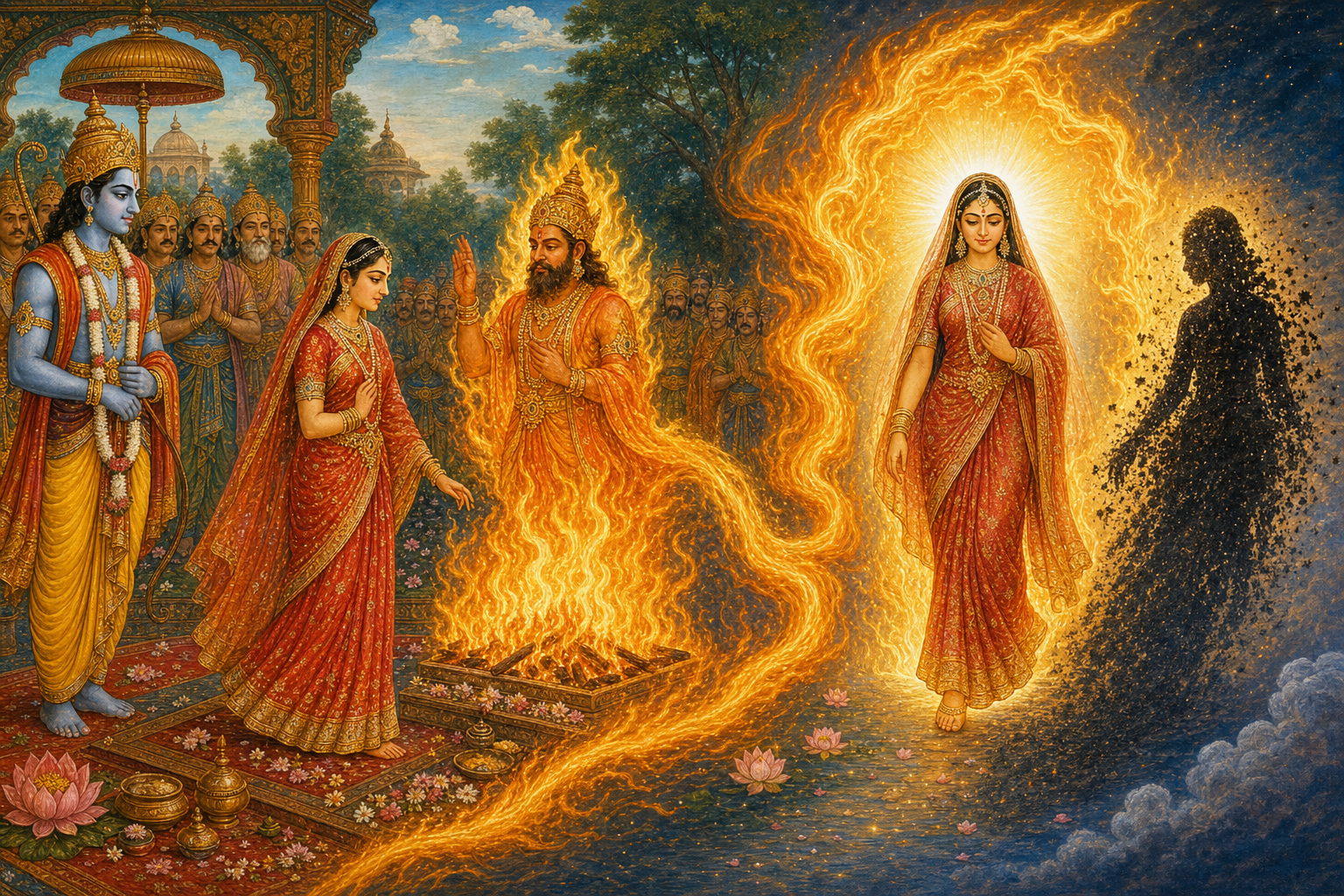
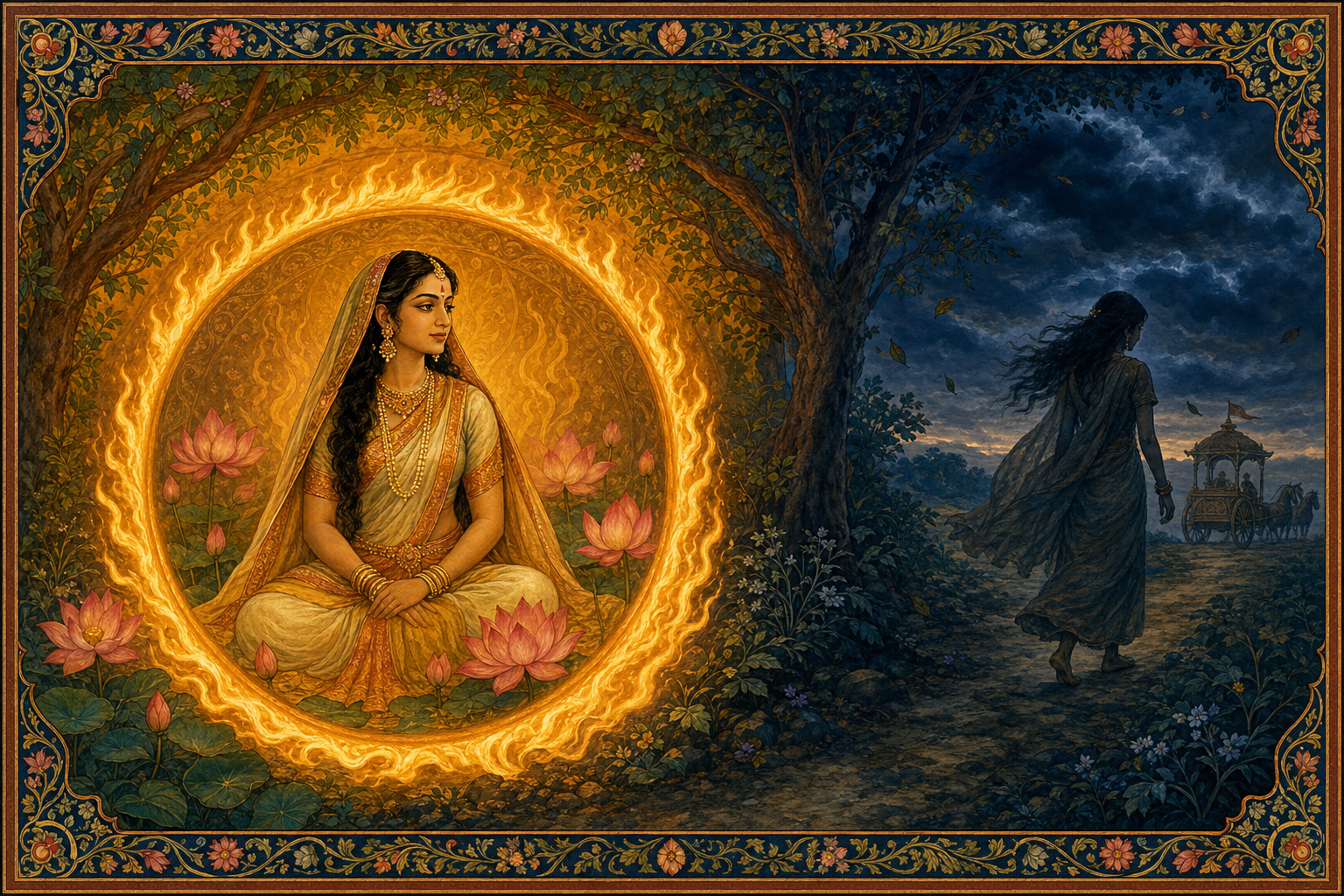
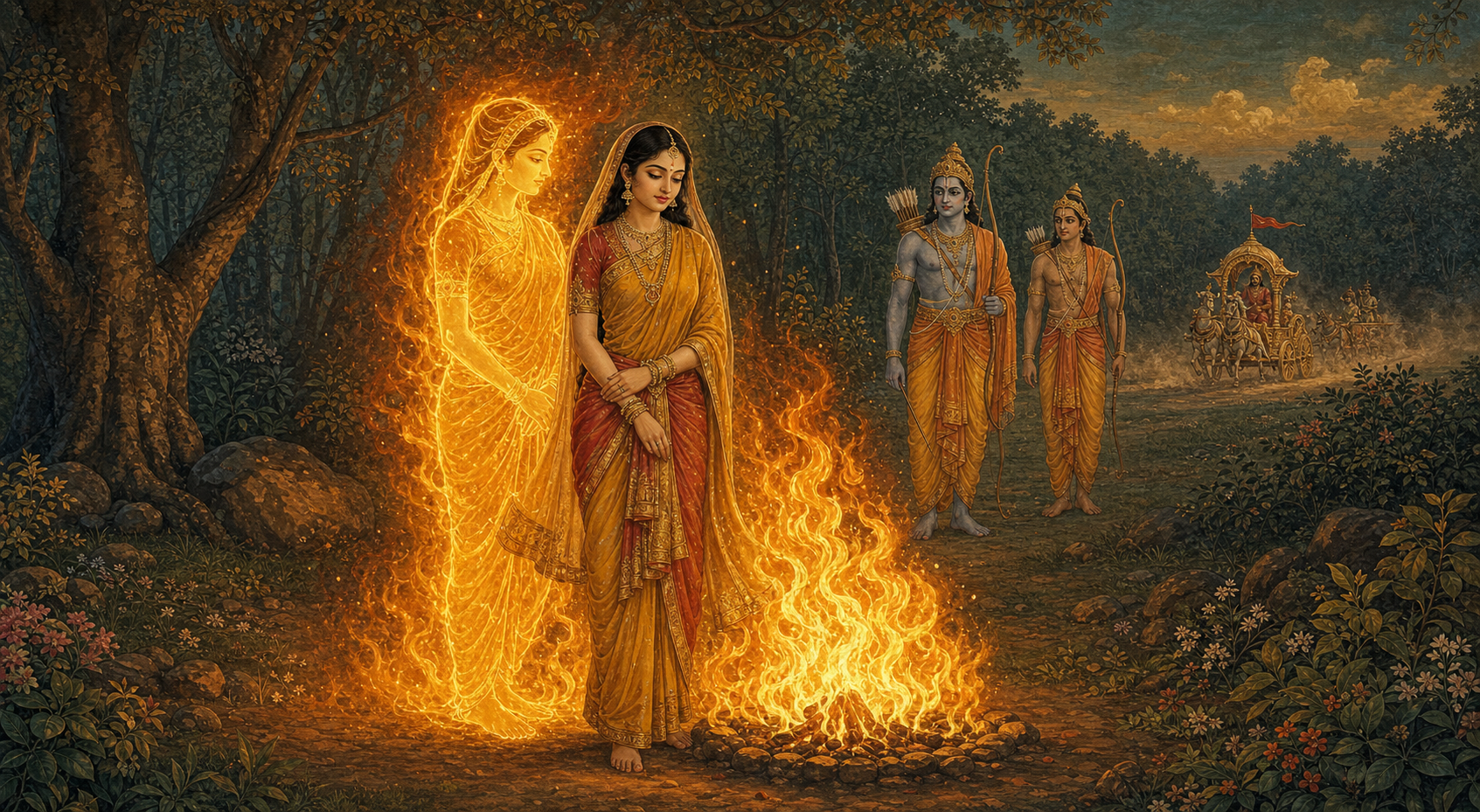
Maya Sita, also described in some traditions as Chhaya Sita or the shadow Sita, is a protective duplicate placed in Sita’s position before Ravana arrives. Ravana therefore carries away the duplicate, while the true Sita remains under divine protection. At the fire scene, the hidden Sita returns and the substitute withdraws into Agni.
That episode is not part of the Valmiki narrative preserved by the critical scholarly tradition. The critical edition was formed by comparing Northern and Southern manuscript families, and it does not attest a pre-abduction substitution. The motif is also absent from the Uttara Kanda, despite the separate debate over that book’s relative lateness.
This distinction does not require you to dismiss later Ramayanas. It requires you to stop using the Ramayana as though the phrase always named one uniform text. Valmiki’s composition is a particular textual work. The Ramayana tradition is a much wider civilizational conversation containing Puranic expansions, devotional retellings, regional literature, commentaries, temple narration, and performance.
Key takeaways
- The critically reconstructed Valmiki Ramayana does not narrate a Maya Sita substitution before Ravana’s abduction.
- The Adhyatma Ramayana explicitly uses the motif within a strongly theological presentation of Rama and Sita.
- Valmiki’s fire scene publicly vindicates Sita through Agni as witness; it does not reveal that another Sita had been in Lanka.
- Later tellings turn the fire scene into an exchange or restoration, protecting Sita’s divine inviolability through a hidden act of grace.
- You can honour a later devotional teaching without attributing it to an earlier text.
The most accurate short formulation is therefore: Maya Sita belongs to the later Ramayana tradition, not to the critically reconstructed Valmiki Ramayana. That sentence answers the textual question without making a judgement about the spiritual worth of the later tradition.
The fire scene does different work in the two narratives
The difference is not a minor variation in scenery. It changes the causal structure of the story and the meaning of Agni-pravesha.
| Question | Valmiki narrative | Maya Sita narrative |
|---|---|---|
| What happens before the abduction? | No exchange of Sitas is narrated. | Divine agency places a protective duplicate in Sita’s position. |
| Whom does Ravana carry to Lanka? | Sita within the direct action of the poem. | The protective or shadow Sita. |
| What does the fire scene accomplish? | Agni publicly confirms Sita’s spotless integrity. | The true Sita is restored or revealed as the duplicate returns to Agni. |
| Where does the main tension fall? | On Sita’s truth, public suspicion, royal duty, and cosmic testimony. | On divine foreknowledge, hidden protection, lila, and Sita’s inviolability. |
In Valmiki’s plot, Rama’s grief, the search through the forest, Hanuman’s mission, the war in Lanka, Sita’s speech before the assembly, and Agni’s testimony form one continuous dramatic arc. The story makes the danger and suffering real within the world of the poem. Sita’s inner integrity is not in doubt, but society’s perception of her becomes a public problem that the royal order cannot ignore.
This is why calling the episode merely an Agni Pariksha can be too blunt. In the Valmiki frame, Sita enters the fire after forcefully responding to Rama’s public stance. Agni then appears as sakshi, the cosmic witness, and confirms her blameless character before the assembled world. The scene is a public vindication, not the disclosure of a secret replacement.
The sequence is ethically difficult by design. Rama acts under the demands associated with raja-dharma and maryada: the ruler is accountable not only for private knowledge but also for public trust and appearances. Sita answers from the ground of personal truth and moral authority. Agni resolves the collision by making her private truth publicly undeniable.
Understanding that structure does not require you to suppress discomfort about what Sita endures. It tells you where to direct the question. Valmiki places duty, reputation, power, suffering, and a woman’s truthful speech in the same public space. If a protected substitute is inserted into that version, the hardest part of its moral architecture is quietly bypassed.
The Maya Sita frame solves a different problem. Because the true Sita was never in Ravana’s possession, the fire does not test or establish her purity. It closes a divine exchange already arranged before the abduction. What looks to human observers like an ordeal is disclosed as part of a hidden lila.
Why later bhakti traditions embraced a protected Sita
As Rama and Sita came to be presented in increasingly explicit theological terms, the abduction raised a devotional question: how could Sita as Sri, the divine feminine, ever fall under Ravana’s power? Maya Sita answers by separating visible events from divine reality. The world sees Ravana abduct Sita, but the Goddess herself remains untouched and protected.
The Adhyatma Ramayana, traditionally associated with the Brahmanda Purana, makes this solution explicit. Rama is identified fully with Brahman, Sita with Prakriti or Sri, and the course of events becomes a pedagogical divine drama. The substitution is therefore not an incidental embellishment. It follows from the work’s theological centre.
The device accomplishes three things at once. First, it protects Sita’s transcendent inviolability. Second, it presents Rama as acting with divine foreknowledge rather than responding only within human uncertainty. Third, it changes Agni-pravesha from a public verification into the visible completion of a hidden arrangement.
This explains why the motif became useful in medieval and early modern devotional settings. A community approaching Rama and Sita primarily as the Supreme Lord and Sri could receive the story without wondering whether Ravana had compromised the Goddess or whether Rama had failed to protect her. The duplicate functions as compassionate theological reassurance.
Katha, kirtana, Yakshagana, temple narration, and regional retellings could carry that reassurance to audiences who encountered the epic through hearing and performance rather than manuscript comparison. A vivid exchange at the fire also gives performers a clear dramatic resolution: hidden divine protection is finally revealed before everyone.
Calling these tellings corruptions misses what devotional literature often does. A retelling may preserve the moral horizon of an inherited story while changing its narrative machinery to emphasize bhakti, metaphysics, renunciation, nonviolence, or another community’s central concern. That is interpretation through storytelling.
Calling the Maya Sita episode original to Valmiki creates the opposite problem. It moves a later theological solution backward into a narrative that derives much of its force from not using that solution. Respect for tradition is strongest when it does not require false claims about textual history.
The word maya is not proof of a Maya Sita episode
A common shortcut is to find the word maya in an early narrative and assume the later metaphysical doctrine is already present in full. That method does not work. A word can remain in use while its conceptual range changes across genres and periods.
Within the Valmiki Ramayana, maya commonly operates as deception, magical strategy, or rakshasa sorcery. The deceptive golden deer, often called the maya-mriga, belongs to this narrative world. Such usage does not by itself establish a metaphysical substitute for Sita.
Later Vedantic and bhakti interpretation can place greater weight on maya as the power through which visible reality conceals a deeper divine truth. In that framework, Maya Sita becomes more than a magical double. She marks the difference between what ordinary participants think is happening and what the divine pair have already ordained.
When you encounter a claim about Maya Sita, look for an actual plot sequence rather than a familiar word. The complete motif normally requires three linked moves:
<!– wp:list {