
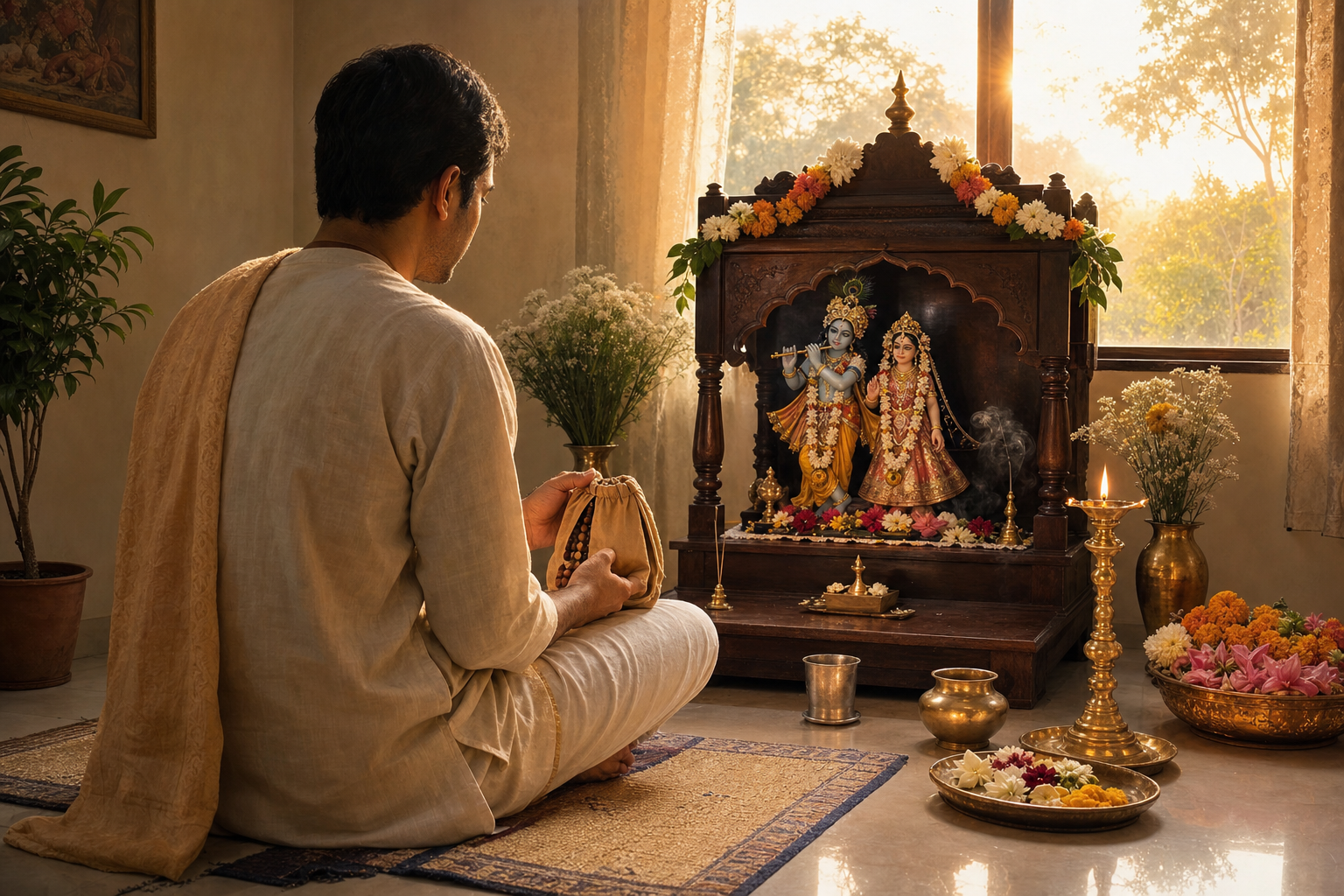
If you chant every day but remain unsure how much altar procedure matters in Kali-yuga, you do not have to choose between the holy name and regulated worship. In Gaudiya Vaishnava practice, nama-sankirtana is the center. Pancharatra gives your service a clean, reverent, and dependable form.
The practical question is not, “Which path can we discard?” It is, “What work does each path do?” Hearing, chanting, and remembering turn your attention toward Bhagavan. Cleanliness, mantra discipline, timely offerings, and sacred decorum train you to approach Him as a servant rather than as a consumer of religious experience.
Chanting and regulated worship do different work
The terms can be confusing because they describe overlapping forms of bhakti. Pancaratrika-vidhi is the codified Vaishnava Agamic discipline of mantra, diksha, samskara, and arcana. It governs such matters as consecration, daily puja, offerings, worshiper purity, festival observance, and the ordered life of a temple or home altar.
Bhagavad-vidhi, also called bhagavata-marga in this context, puts direct devotional absorption in the foreground. Its field includes the nine practices named in the Srimad-Bhagavatam: hearing, chanting, remembering, serving the Lord’s feet, arcana, prayer, servitude, friendship, and complete self-offering. Arcana is therefore not foreign to the Bhagavata path. It is one of its limbs.
This distinction prevents two common errors. The first is to treat procedure as obsolete because the holy name is the primary practice for Kali-yuga. The second is to make correct procedure the whole measure of devotion. Chanting without disciplined service can leave your habits untouched. Procedure without hearing and chanting can become an accurately completed task in which the heart is scarcely present.
“Without the help of such codes [of the pancaratra], one cannot approach the Lord…”
Srila Prabhupada
Read that instruction as guidance about the worshiper’s qualification and conduct, not as a claim that the holy name depends upon elaborate ritual for its power. The discipline is for us. It cleans up the way we approach, serve, and understand the Lord. It also protects arcana from becoming a display of personal taste.
If you are beginning bhakti, do not postpone chanting until you have mastered a ritual system. Begin hearing and chanting now. Add altar service at a level you can sustain honestly, and receive proper instruction before adopting initiated mantras, formal purification procedures, or responsibilities toward installed Deities.
Pancharatra turns reverence into repeatable conduct
It is easy to say that you revere Bhagavan. A rule becomes useful when it shows what reverence requires at a particular moment. Is your body and the worship area clean? Is the offering suitable? Are you using the mantra entrusted to you, in the manner you were taught? Are you on time? Are you acting for the pleasure of the Deity, or mainly for your own excitement?
Achamana, bhuta-suddhi, mantra-suddhi, and the ordered offering of upacaras address different parts of this preparation. Achamana marks ritual purification. Bhuta-suddhi directs attention toward inner sanctification. Mantra-suddhi requires care in recitation. Panchopachara and Shodashopachara arrange offerings into an intelligible sequence rather than leaving worship to impulse.
These names are not a do-it-yourself liturgy. Their precise performance depends on sampradaya, initiation, the form of worship, and the standard established for a particular altar. A compressed online list cannot tell you which mantras you are authorized to use or which procedure your temple follows. Learn the sequence from the authority responsible for that worship, then keep a written version for reference.
The same principle governs aesthetics. Deity dressing is not religious fashion. Before adopting a new ornament, color scheme, pose, or presentation, ask three questions: Does it agree with the tattva of the Deity? Does it suit the season or festival? Does it express the devotional ethos of the sampradaya? Artistic skill belongs in seva, but skill does not replace siddhanta or maryada.
You can also notice what disciplined worship is doing to you. Punctual offerings expose procrastination. Clean vessels expose carelessness. accurate mantra recitation exposes distracted speech. Shared procedures expose whether you can serve under a standard that you did not invent. The altar becomes a place of formation because apparently small actions repeatedly train attention, humility, and responsibility.
This relationship between sacred sound, disciplined conduct, purity, and service has a wider Dharmic resonance. Shaiva and Shakta Agamas, Jain puja and Pratikraman, Buddhist liturgy and Vinaya, and Sikh maryada organize communal and personal practice in different theological worlds. We should recognize the shared civilizational respect for disciplined sacred life without pretending that the traditions teach identical doctrines.
Temple standards should be teachable, not merely assumed
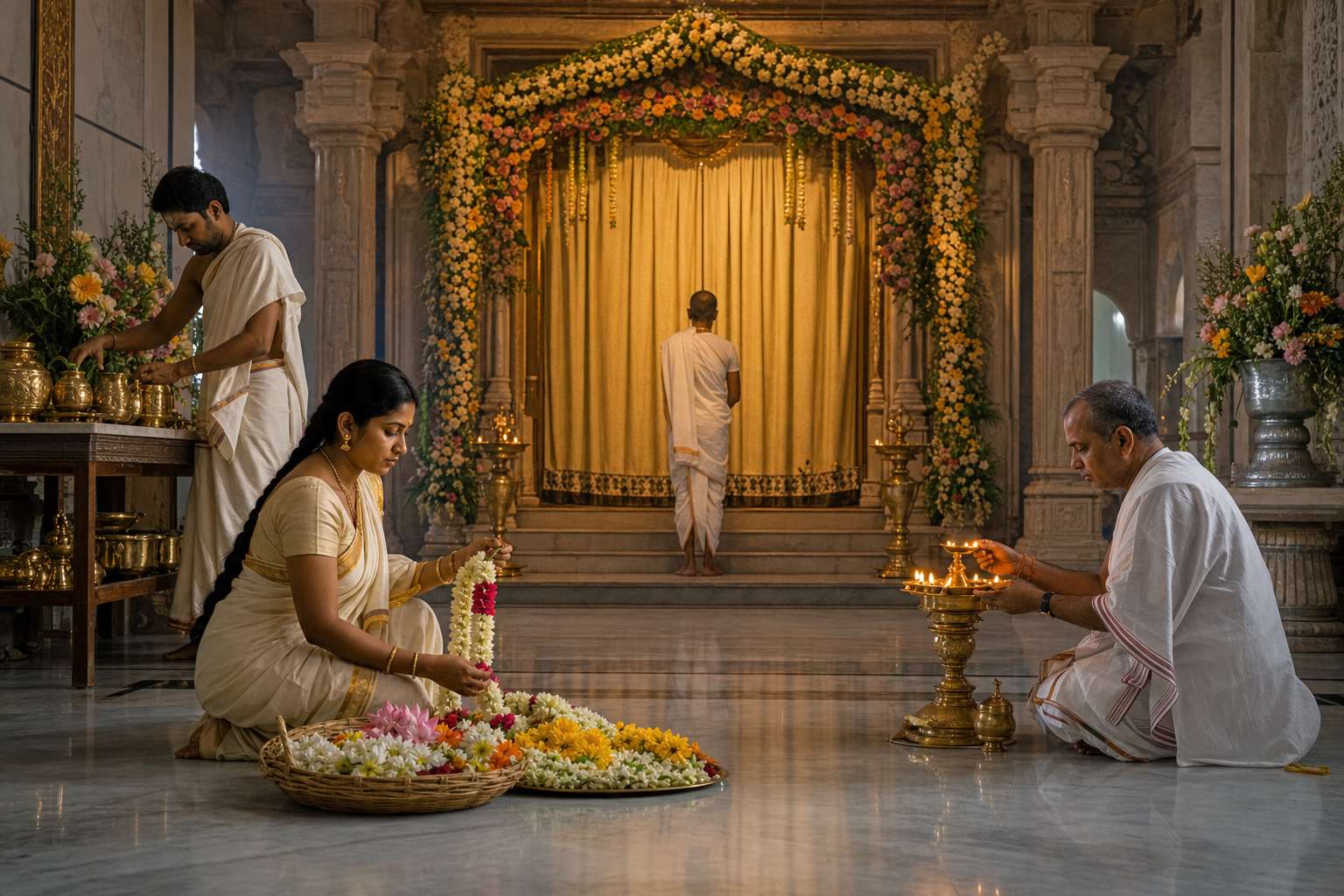
A temple cannot depend on each pujari’s memory, temperament, or preferred aesthetic. If a standard matters, it must be stated, taught, and reviewed. Otherwise, a community may speak strongly about tradition while leaving new sevakas to reconstruct that tradition from observation and correction.
Use one complete seva cycle as an audit. Follow the service from preparation through closing, and record the following:
- Responsibility: Name the person accountable for each service and the person who covers an absence.
- Timing: Write down when preparation must begin, not only when the curtain is meant to open or the offering is due.
- Cleanliness: Specify the standard for the worshiper, clothing, hands, vessels, ingredients, altar area, and post-service cleanup.
- Mantras and sequence: Keep an approved procedure available to qualified sevakas. Mark what is mandatory, what varies by occasion, and what must not be improvised.
- Offerings and dress: Connect choices to the Deity, season, festival calendar, and sampradaya rather than to individual novelty.
- Handoffs: State how one sevaka communicates an unfinished preparation, missing item, or timing problem to the next.
- Review: Decide who can clarify a rule and how a correction becomes part of training instead of remaining private knowledge.
This audit will usually reveal that failures occur at the handoff between devotion and operations. Everyone may value punctual worship, yet nobody owns the ingredient check. Everyone may value cleanliness, yet the cleanup boundary between two teams is unclear. Fix the ownership and the start time before blaming a sevaka’s attitude.
Training should include the reason for a rule as well as its outward form. A sevaka who understands why an item is handled in a particular way can preserve the principle when circumstances change. A sevaka taught only by imitation may reproduce a movement without recognizing which part is essential.
Corrections also need maryada. Correct an individual without humiliation, but make the clarified standard available to the whole qualified team. This keeps knowledge from turning into status and prevents five people from receiving five versions of the same instruction.
Finally, protect time for kirtan and scriptural hearing. Consistent schedules, pronunciation training, cleanliness reviews, kirtan, and scriptural classes belong in one devotional system. If the procedure team and the hearing-and-chanting life of the community operate as rival cultures, the temple has misunderstood the synthesis it is trying to preserve.
Build a home practice you can maintain with integrity
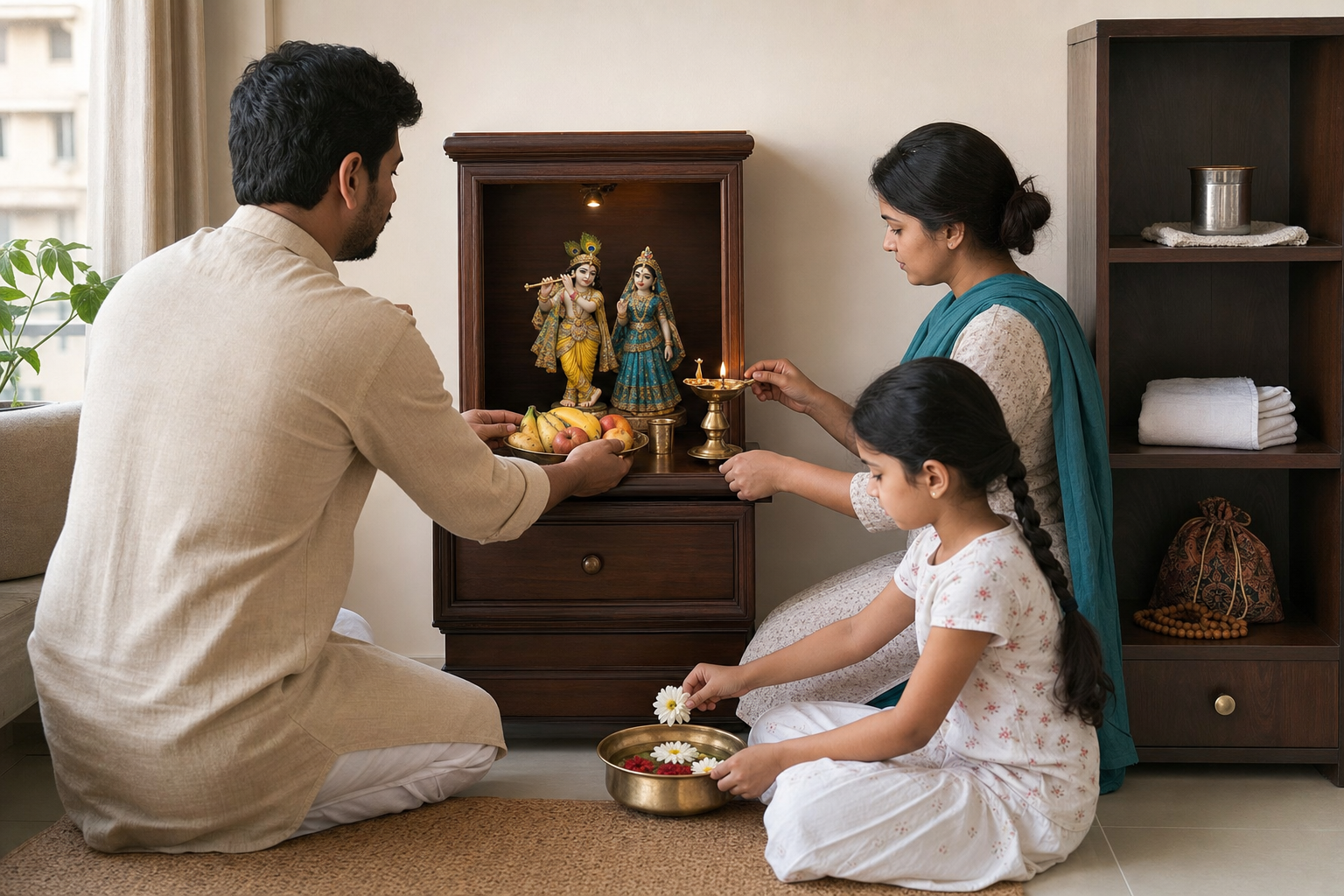
Home worship should be scaled to your actual responsibilities, training, and altar. A brief service performed cleanly and steadily is a sounder foundation than an elaborate program that is rushed, repeatedly abandoned, or altered according to mood.
Start with a routine whose parts are easy to identify:
- Prepare the place. Keep the altar and the immediate worship area clean. Store worship items so they are not casually mixed with ordinary household use.
- Choose a dependable time. Base it on the household’s real schedule. Allow preparation time so worship does not begin with panic.
- Center sacred sound. Include steady japa or kirtan and a manageable portion of hearing or reading. Do not let altar care consume the practice that gives it devotional direction.
- Offer food carefully. Prepare suitable sattvika food and follow the offering method taught in your tradition. Treat preparation, offering, honoring prasada, and cleanup as one sequence.
- Use the procedure you have received. If you have been trained in Panchopachara or another form of arcana, keep that approved sequence accessible. Do not fill gaps with invented mantras.
- Close the service fully. Clean the vessels, restore the worship area, and note any item that must be prepared before the next service.
If your altar includes formally installed Deities, initiated mantras, or a specific commitment received from a guru or temple authority, do not simplify the required procedure merely because a shorter routine is more convenient. Ask the responsible authority how to adapt the service when illness, travel, work, or family duties interfere.
For a family, divide participation by qualification and ability. One person can prepare the space, another can prepare an offering, and others can join the kirtan or reading. Make the boundary around specialized altar service clear without suggesting that only the pujari is engaged in bhakti. The purpose is a household oriented toward seva, not an audience watching one religious specialist.
Add complexity only after the present routine has become stable. The test is not whether you feel inspired to add another step. Ask whether the current steps are performed without habitual rushing, skipped cleanup, confused mantras, or resentment. If the base is unstable, repair it before expanding it.
Watch for drift in either direction. “My devotion is sincere, so timing and cleanliness do not matter” uses inward feeling to excuse outward carelessness. “I completed the procedure, so hearing and chanting can wait” reduces seva to completion. “The dressing will look impressive in photographs” lets an audience replace the Deity as the center of attention. Each statement identifies a practical correction: restore the schedule, restore sacred sound, or restore the altar’s theological and devotional standard.
Key takeaways
- Keep nama-sankirtana at the center of Kali-yuga sadhana; do not use its primacy to dismiss arcana, cleanliness, qualification, or sacred decorum.
- Use Pancharatra to regulate the worshiper and the service. It is not a technique for supplying power to the holy name.
- Learn formal mantras and purification procedures from the authority responsible for your lineage or altar. Do not reconstruct them from fragments.
- In a temple, turn standards into schedules, approved procedures, assigned responsibilities, and teachable handoffs.
- At home, choose a modest routine you can perform steadily. Increase it only when the existing practice is clean, unhurried, and dependable.
- Judge devotional aesthetics by tattva, festival or season, and sampradaya ethos before judging them by novelty or visual appeal.
Your next step can be small and exact. If you worship at home, write down your present sequence and bring one unresolved procedural question to a qualified guide. If you serve in a temple, document one complete seva cycle and repair its first unclear handoff. Let chanting remain the living center, and let Pancharatra make your approach to the altar attentive, reverent, and fit to be passed on.

References
