

If evolution is being discussed in your classroom, temple, vihara, gurdwara, or home, you may feel pushed toward a false choice: either accept biology and abandon Dharma, or defend Dharma by attacking evolution. You do not need to accept either premise.
The more honest position is also more useful. Evolutionary biology explains how living populations change and diversify. Dharmic philosophies examine consciousness, causation, conduct, suffering, liberation, and the meaning of human life. They sometimes meet around questions of change and interdependence, but they do not perform the same intellectual task. Keeping those tasks clear lets you respect scientific evidence without reducing Dharma to primitive science.
Start with the right division of intellectual labour
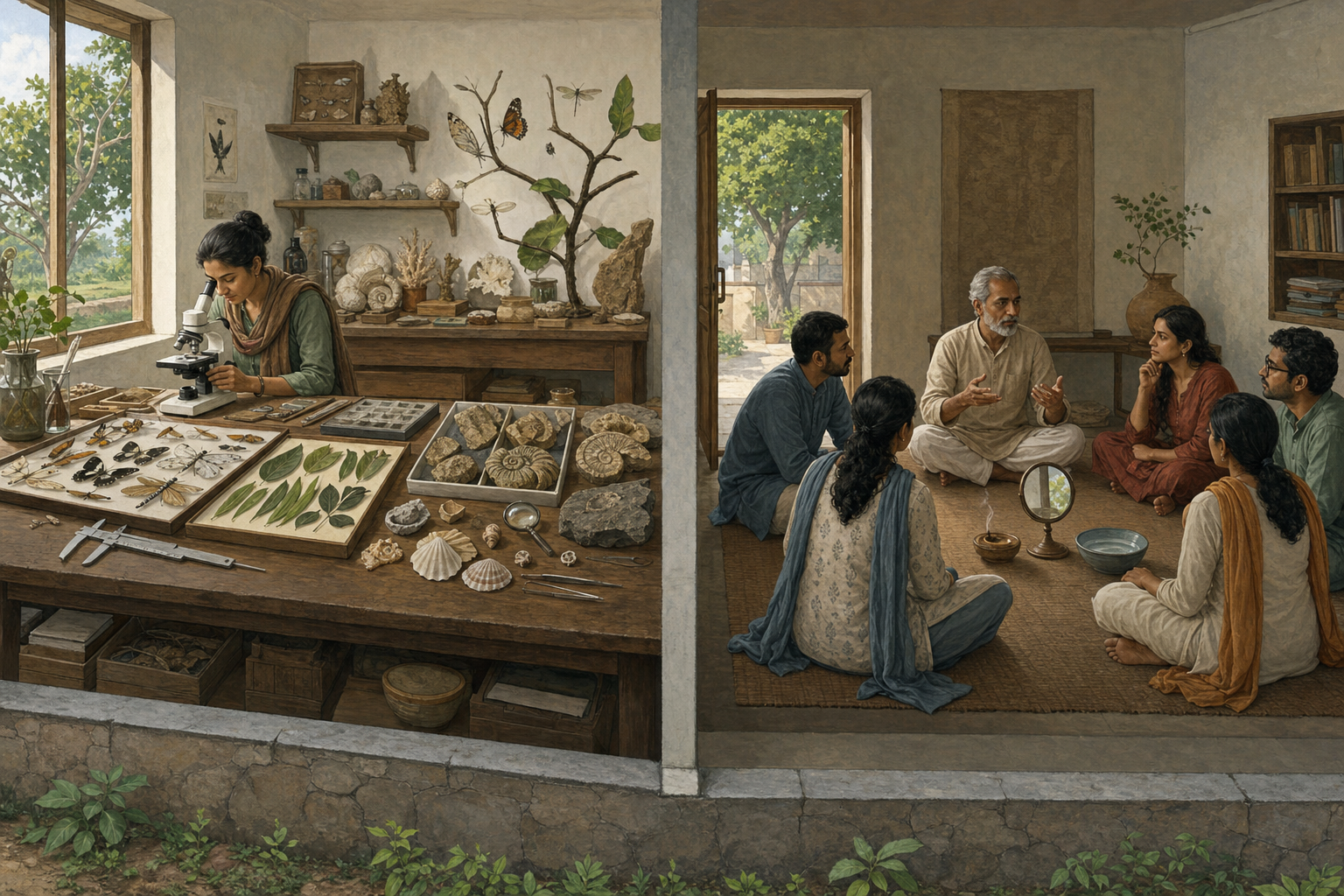
Evolution works through inherited variation across generations. Mutation and recombination contribute variation; natural selection, genetic drift, and gene flow affect what persists in populations. Phylogenetics, population genetics, the fossil record, biogeography, and evolutionary developmental biology examine different parts of that history. These are empirical explanations of diversification and adaptation, not statements about the ultimate purpose of existence.
Natural selection is non-teleological. That does not mean every evolutionary event is equally random. It means evolution is not working toward a predetermined biological destination. A useful mental picture is a branching tree, not a staircase on which every organism is trying to become more human, more intelligent, or more spiritually advanced.
Dharmic traditions often speak of purpose in a different sense. Their central concern is usually soteriological: how ignorance, attachment, harmful action, or mistaken identity may be overcome. That kind of purpose can guide a life without becoming a mechanism of heredity. Moksha, nirvana, kevala jnana, and truthful living under Hukam are not competing explanations for mutation or common descent.
This distinction gives you two reliable rules:
- Do not ask scripture to calculate genetic relationships, reconstruct a phylogenetic tree, or replace evidence about biological ancestry.
- Do not ask natural selection to decide whether compassion, self-restraint, seva, or ahimsa is morally binding.
Evolutionary science uses testable natural causes because that is how its method works. This methodological rule does not, by itself, settle every metaphysical question about consciousness or ultimate reality. The reverse boundary matters just as much: a metaphysical conviction is not experimental counterevidence. If a claim concerns biological history, it must face biological evidence.
What the four Dharmic traditions actually contribute

Hindu thought: transformation is not the same as natural selection
Several Hindu systems take change and causation seriously. Samkhya describes prakriti unfolding into a hierarchy of tattvas in the presence of purusha. Its parinama-vada treats transformation as real, while satkaryavada holds that an effect is already implicit in its cause. Nyaya-Vaisheshika examines causal regularities and combinations of atoms. These are sophisticated positions about being and becoming, but they are not theories of common descent.
Ayurvedic discussions of development and heredity offer another instructive case. The Caraka Samhita and Sushruta Samhita use the terms bija, bija-bhaga, and bija-bhagavayava: seed, seed-part, and part of a seed-part. This vocabulary shows attention to differentiated hereditary contributions. It should be presented as a pre-genetic conceptual framework, not translated casually into gene, chromosome, or nucleotide.
Puranic cosmologies explore enormous cycles of creation and dissolution. The Dashavatara can also be read symbolically as an arc from aquatic through terrestrial and increasingly complex forms. That can be a memorable teaching device. It is not a fossil sequence, a population model, or proof that modern evolutionary biology was already encoded in the avataras.
The responsible Hindu position is therefore neither embarrassment nor exaggerated priority-claiming. Use these traditions to investigate Indian philosophies of causation, transformation, consciousness, and cosmic order. Do not turn resemblance into a declaration that ancient rishis had already formulated Darwinian selection.
Buddhist thought: conditioned arising without a cosmic ladder
Pratityasamutpada, or dependent origination, teaches that phenomena arise through conditions rather than through an isolated, permanent essence. This gives Buddhist thought a powerful language for contingency and interdependence. It can sharpen how you think about ecological relationships and systems, but it must not be renamed natural selection. The two ideas address different questions.
The Aggañña Sutta presents cycles of cosmic contraction and expansion alongside an account of social development. Its importance here is not that it secretly describes biological evolution. It shows that a South Asian tradition could contemplate sweeping change without requiring a single, linear creation event. Read it in its cosmological and ethical setting rather than extracting modern biology from its narrative.
Buddhist analysis also prevents an easy merger between all Dharmic views of consciousness. Streams of vijnana are examined without positing the permanent self affirmed in some Hindu schools. If you say simply that Dharma teaches one theory of consciousness, you erase a major philosophical disagreement.
Jain thought: grades of sensory capacity are not an ancestry chart
Jain philosophy classifies embodied jivas from ekendriya, possessing one sense, to pañcendriya, possessing five. This gradation encourages careful attention to forms of life that human beings might otherwise disregard. It carries particular ethical force within a tradition centred on ahimsa.
Yet sensory classification is not phylogeny. It does not establish which population descended from which ancestral population, nor does it supply a mechanism by which traits spread. Use it to discuss sentience, moral consideration, and Jain accounts of jiva. Do not display it as an ancient evolutionary tree.
Sikh thought: lawful creation need not be spiritually empty
Sikh thought locates creation within Hukam, the order through which existence unfolds. This allows a believer to regard the regularities investigated by science as intelligible features of creation rather than threats to faith. Scientific law and Hukam are not interchangeable terms, however. Biology models observable processes; Hukam also situates human conduct within a religious and ethical order.
Simran and seva then answer a question evolution cannot answer: how should a person live within that order? Accepting mutation, selection, and common ancestry does not compel you to treat the cosmos as morally meaningless. It does require you to avoid using Gurbani as a substitute for genetics.
Keep four boundaries clear when claims collide

Most arguments become confused because one kind of question silently changes into another. This table lets you identify the switch before debating the conclusion.
| Question | What evolutionary inquiry can address | What Dharmic inquiry can address | Common mistake |
|---|---|---|---|
| Purpose | How traits and lineages persist under particular conditions, without assuming a predetermined destination. | How life may be directed toward liberation, wisdom, truthful living, or service. | Treating spiritual purpose as a biological force, or treating biological non-teleology as proof that life cannot have meaning. |
| Consciousness | How nervous systems and cognitive capacities arose, diversified, and correlate with behaviour and reported experience. | How experience, selfhood, awareness, and liberation are understood and examined through disciplined practice. | Claiming that an evolutionary account of cognition has solved every question about subjectivity, or that meditation establishes a phylogenetic claim. |
| Ethics | What behaviours affect survival, cooperation, reproduction, and population dynamics. | What ought to be done through ahimsa, compassion, restraint, equanimity, and seva. | Assuming that whatever improves reproductive success is therefore morally right. |
| Causality | Testable physical mechanisms such as inheritance, selection, drift, development, and environmental pressure. | Karma as morally structured causation and other metaphysical accounts of action and consequence. | Using karma as a genetic mechanism, or presenting a physical cause as a complete moral interpretation of an event. |
The ethics boundary is especially important. Evolution describes what happens in populations; it does not issue commandments. Historical Social Darwinism crossed that boundary by turning descriptions of competition and selection into ideological justifications for domination. Reproductive advantage is not a synonym for goodness, justice, wisdom, or dharma.
The consciousness boundary requires equal care. Standard evolutionary accounts often treat consciousness as emergent, adaptive, or connected to capacities that selection shaped. Neuroscience can investigate correlations between experience and nervous systems, yet the existence of subjective awareness still generates disagreement. Dharmic positions are themselves diverse: Samkhya distinguishes purusha from prakriti; Advaita examines atman and Brahman; Buddhism rejects a permanent self; Jainism treats jiva as a knowing substance; and Sikh teaching speaks of divine light in beings. These cannot honestly be compressed into one generic Eastern doctrine.
A biological model does not refute a metaphysical position merely by leaving it outside the model. A metaphysical position does not become scientific merely by sounding compatible with biology. Ask what kind of claim is being made, what evidence could bear on it, and whether the conclusion stays within that evidence.
Use ancient-modern parallels without manufacturing proof

Parallels can make a lesson memorable. They become misleading when resemblance is promoted into identity, prediction, or historical priority. The Dashavatara, Ayurvedic seed terminology, Jain grades of sensory life, Buddhist interdependence, and Sikh Hukam can all support serious reflection. None should be presented as a replacement for evolutionary evidence.
Use this test whenever someone claims that a Dharmic teaching anticipated modern science:
- Name the genre. Is the passage philosophical analysis, medical reasoning, cosmological narrative, devotional poetry, ethical teaching, or empirical biological work? Genre determines what kind of claim it can reasonably support.
- Identify the exact resemblance. Say whether the parallel concerns change, complexity, cyclic time, causal dependence, heredity, or lawful order. Avoid the vague claim that everything is basically the same.
- Look for a mechanism. Does the ancient idea specify inherited population-level variation, differential reproduction, genetic drift, gene flow, or common descent? If not, it is not Darwinian evolution.
- Look for a discriminating prediction. A scientific theory must expose itself to evidence that could distinguish it from alternatives. A symbolic sequence that can be rearranged or reinterpreted after the fact does not perform that work.
- State the historical status honestly. Darwin published On the Origin of Species in 1859. Nineteenth-century Europe was increasingly engaging Sanskrit literature, including through figures such as Max Müller, but direct derivation of Darwin’s theory from Indian texts remains historically unproven.
- Preserve what is distinctive. If a comparison works only after karma, purusha, anatman, jiva, or Hukam has been stripped of its traditional meaning, the comparison has stopped illuminating either side.
Responsible: The Dashavatara may be read as a symbolic progression through different forms of embodied life.
Not responsible: The Dashavatara proves that the Vedas discovered natural selection and modern phylogeny before Darwin.
The first statement invites interpretation and clearly labels it. The second combines different texts and traditions, converts symbolism into empirical proof, and makes a historical claim stronger than the evidence permits. You do not honour Dharma by making it depend on an argument that collapses under basic scrutiny.
A four-layer method for learning or teaching the subject
If you are guiding a family conversation, study circle, or class, do not begin by asking whether science and religion agree. That question is too blunt. Work through four layers, in order, and require every claim to remain in its proper layer.
First layer: establish the biological mechanism
Begin with variation, heredity, selection, drift, and gene flow. Add phylogenetics, the fossil record, biogeography, population genetics, and evolutionary developmental biology as lines of investigation. Make sure learners understand that individuals develop during a lifetime, while biological evolution concerns inherited changes in populations across generations.
Ask one diagnostic question: What observable evidence would make this ancestry or mechanism more or less likely? If nobody can answer, the discussion has probably drifted from biology into symbolism or metaphysics without admitting it.
Second layer: examine systems and interdependence
Then consider ecology, symbiosis, phenotypic plasticity, and niche construction. Organisms do not evolve as isolated objects; they live within changing environments and relationships. Buddhist dependent origination and wider Dharmic attention to interdependence can open good questions at this stage, provided you say that the resonance is philosophical rather than a one-to-one scientific equivalence.
Third layer: investigate experience in the first person
Evolution and neuroscience approach cognition from the outside through bodies, behaviour, inheritance, and neural correlates. Dharmic disciplines also train attention from within. Dhyana, Buddhist cultivation of sila and prajna, Jain vrata and ahimsa, and Sikh simran and seva develop different forms of observation and transformation.
Keep the conclusion modest. A careful report about attention, craving, self-sense, or compassion is an observation about experience. It does not prove a biological lineage. Conversely, an evolutionary reconstruction of cognition does not tell a practitioner whether a moment of awareness was clear, distracted, grasping, or compassionate. First-person and third-person inquiry can complement one another without becoming interchangeable.
Fourth layer: make the ethical question explicit
Only after the mechanisms are clear should you ask what their recognition calls you to do. Evolution can reveal contingency, adaptation, and connected histories. It cannot derive an obligation to protect life from those descriptions alone. Ahimsa, compassion, equanimity, and seva supply normative commitments that selection itself does not contain.
This is where the dialogue can change conduct rather than merely settle an argument. Jain classifications can widen moral attention beyond conspicuous animals. Buddhist interdependence can challenge the fantasy of isolated human flourishing. Hindu reflection on the unity or relation of life can deepen reverence. Sikh seva can turn that reverence into service. The traditions will justify these commitments differently, but each resists the idea that biological success defines moral worth.
Key takeaways
- You can accept evolutionary biology without pretending that it answers every question about consciousness, value, or liberation.
- Dharmic teachings about transformation, causation, and cosmic cycles are philosophically important; they are not automatically theories of common descent.
- Hindu, Buddhist, Jain, and Sikh positions must be named separately where they disagree about selfhood, consciousness, causality, and ultimate reality.
- Symbolic comparisons such as the Dashavatara-evolution parallel are useful only when they are clearly labelled as interpretations rather than scientific or historical proof.
- Science should lead when the question concerns biological mechanism. Dharmic discipline should inform first-person inquiry and ethical responsibility without being disguised as genetics.
The next time you hear that evolution disproves Dharma, that the Vedas already contained Darwinism, or that survival determines morality, write four headings: mechanism, systems, experience, and ethics. Place the claim under the heading it actually belongs to. Then ask whether its evidence supports that kind of conclusion. That small discipline will give you a better conversation than either denial or forced agreement.
References
