
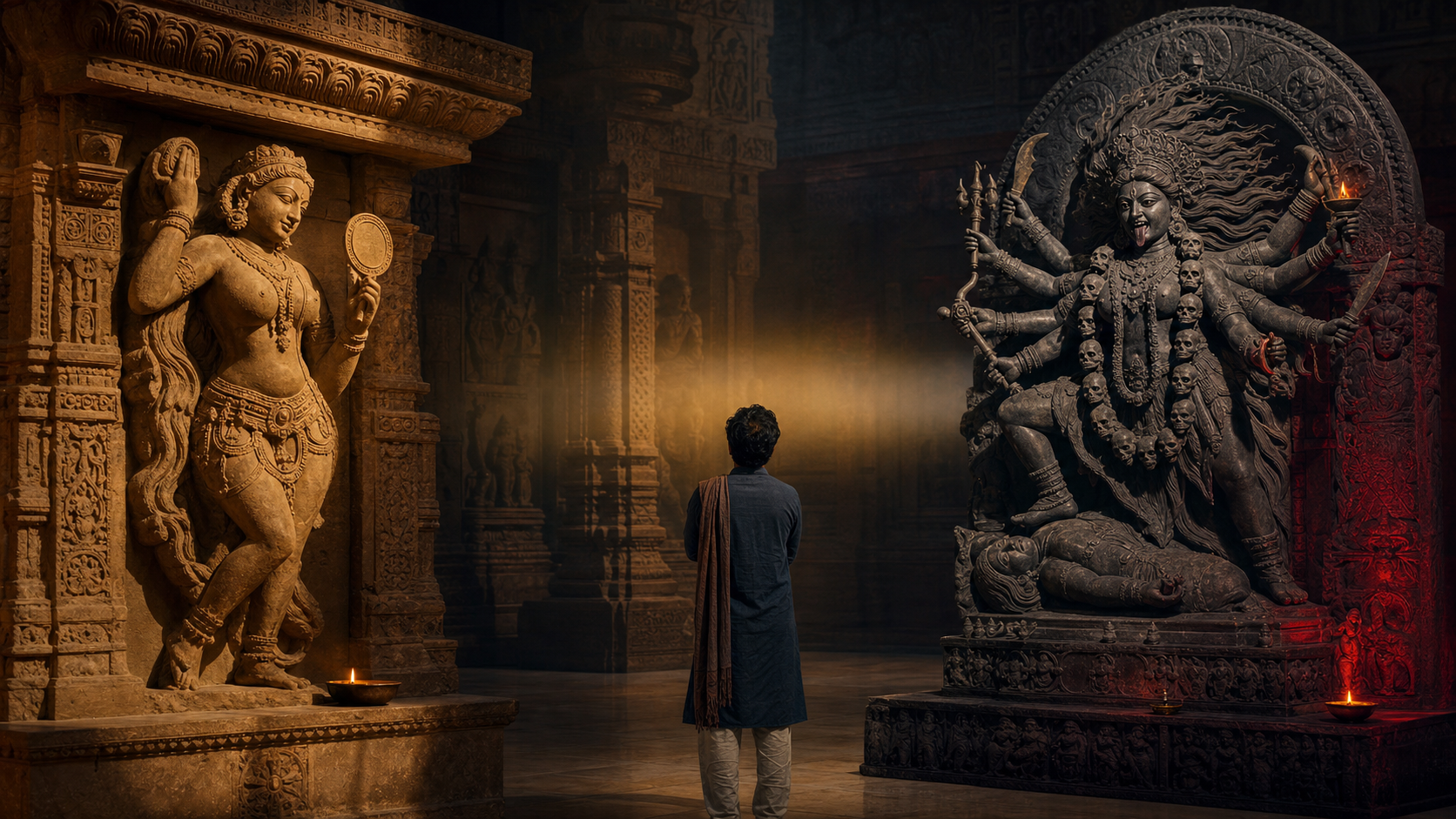
You may recognize the goddess in front of you and still not know how to read her image. A mirror-bearing maiden under a temple cornice and Guhya Kali wearing corpse earrings seem to speak opposite visual languages. Call the first decorative and the second macabre, however, and you lose the spiritual work both images are doing.
The better approach is to treat sacred feminine iconography as a carefully arranged instruction. Placement, posture, ornaments, setting, material, and even your first emotional reaction belong to that instruction. Once you learn to read those elements together, temple sculpture stops being a collection of isolated symbols and becomes a disciplined way of seeing.
Begin with placement, not the figure’s name
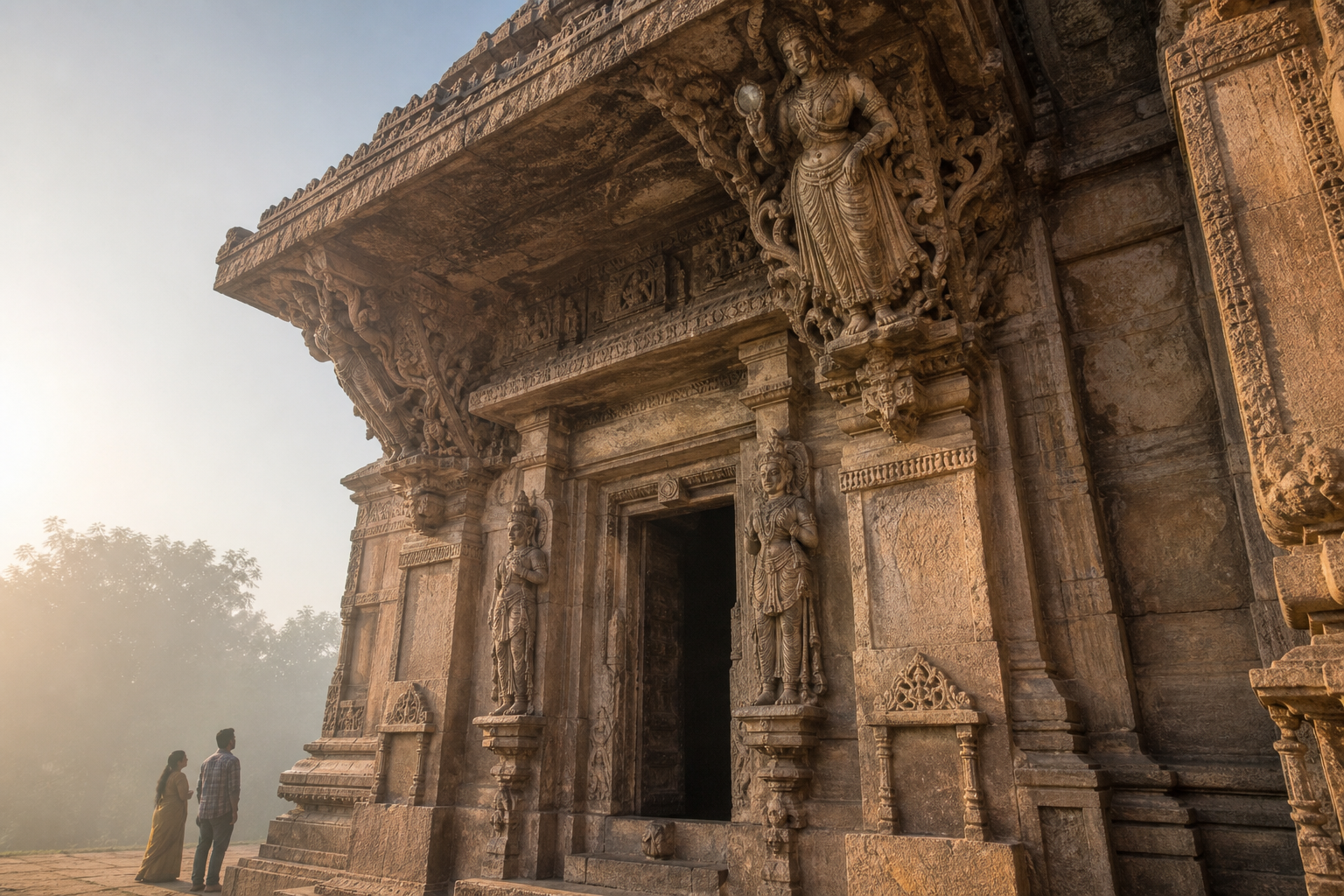
Before identifying an attribute or recalling a story, notice where the figure has been placed. Location is often the first sentence of an iconographic composition.
In Hoysala temples, madanikas commonly appear beneath the projecting cornice or emerge from pillar capitals in pillared halls and dance pavilions. At Belur, Halebidu, and Somanathapura, their intervals help organize the eye as it follows the building’s complex geometry. Although they occupy bracket positions, they are generally symbolic and ornamental rather than principally load-bearing. Their architectural role is visual: they animate transitions, mark rhythm, and invite attentive movement through sacred space.
That location changes how you read the figure. A musician in a dance pavilion is not simply holding an instrument; she binds performance to worship. A maiden beneath a cornice mediates between architecture and living form. A tree-woman at a gateway associates entry into sacred space with fecundity, growth, and auspicious presence. Placement supplies the verb that a catalogue label usually omits.
Guhya Kali requires the same attention to setting. Cremation grounds, skull-cups, severed heads, bones, or corpses create a field in which impermanence cannot be ignored. Her corpse earrings are especially concentrated signs because they place mortality at the ears, the bodily gates of hearing. Within this Tantric grammar, death becomes something to be heard as instruction rather than merely feared as an event.
When you first encounter an unfamiliar sacred image, ask three location questions:
- Is the figure at a threshold, on an exterior wall, in a hall, beside the sanctum, or inside a ritual composition?
- What happens in that part of the building: entry, circumambulation, performance, offering, meditation, or transition?
- Does the figure welcome, guard, interrupt, intensify, or redirect your attention?
Answering those questions will often prevent the two most common errors: treating a temple figure as detached decoration or treating a fierce deity as an isolated spectacle.
Radiant and fierce forms belong to one spectrum of Shakti
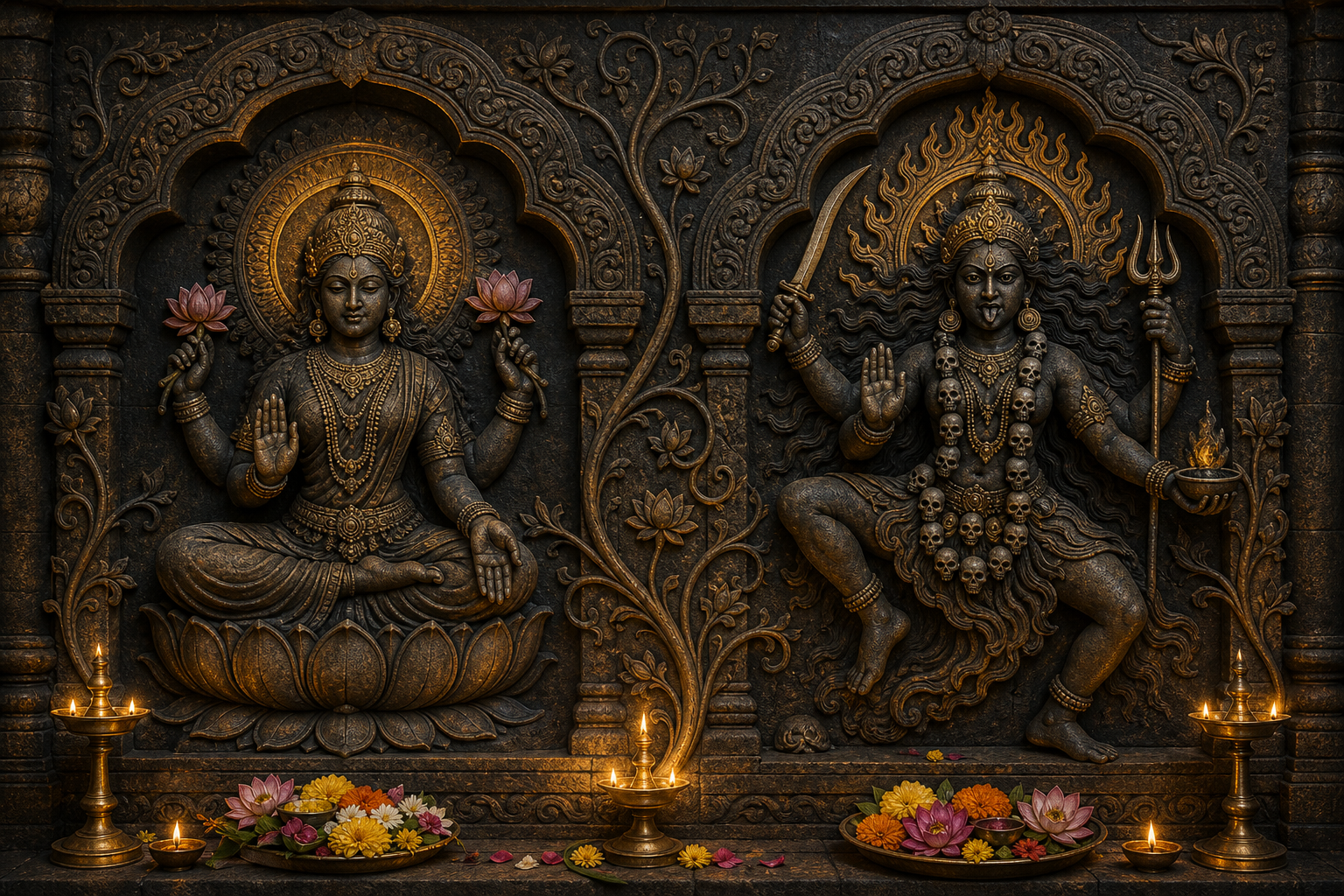
Sacred feminine imagery does not divide neatly into benevolent beauty on one side and destructive terror on the other. It presents Shakti through different operations. The power that germinates, nourishes, adorns, and gives form is also the power that ends a form when its time is complete.
The madanika expresses the auspicious register. Her tribhaṅga posture turns the body through three coordinated bends, producing poised movement rather than static display. Mirrors, parrots, flowering trees, musical instruments, bows, anklets, and elaborate coiffures connect her with refinement, fertility, disciplined skill, prosperity, and the arts. In Hoysala ensembles, gesture and expression participate in the language of abhinaya, while the variety of activities evokes the classical ideal of cultivated arts. Beauty here is not an apology for spirituality. It is one of spirituality’s pedagogical means.
The tree-woman makes that principle especially clear. The śālabhañjikā motif was already present on Buddhist and Jain monuments at Bharhut and Sanchi around the second to first centuries BCE. Its later appearances in Hindu temples retained the association between feminine presence, vegetation, abundance, and the sanctity of living nature. This movement across Hindu, Buddhist, and Jain settings reveals a shared Indic visual inheritance without making the traditions doctrinally identical.
Guhya Kali expresses a fierce register. Her name directs attention toward what is secret or esoteric, while Kali’s relation to kāla, time, places dissolution at the center of contemplation. Corpses, skulls, bones, and the cremation ground are not included to celebrate suffering. They expose the instability of every form on which fear and possessiveness try to build permanent security.
The difference between a corpse and a divine ornament is therefore not cosmetic. A corpse ordinarily signifies the apparent victory of time. When Kali wears it, the sign of defeat becomes a sign of sovereignty over fear. The inert, śava, acquires meaning through Shakti. In related imagery, Kali standing upon a corpse or upon Śiva as śava presents the same theological insight: power animates what would otherwise remain inert.
You can now see why the graceful maiden and the fearsome goddess should not be ranked as a higher and lower kind of femininity. One trains you to perceive sacred abundance without shame; the other trains you to face transience without evasion. Both challenge a diminished idea of the feminine that permits tenderness but excludes authority, dissolution, or radical knowledge.
Follow the iconographic chain from form to spiritual work
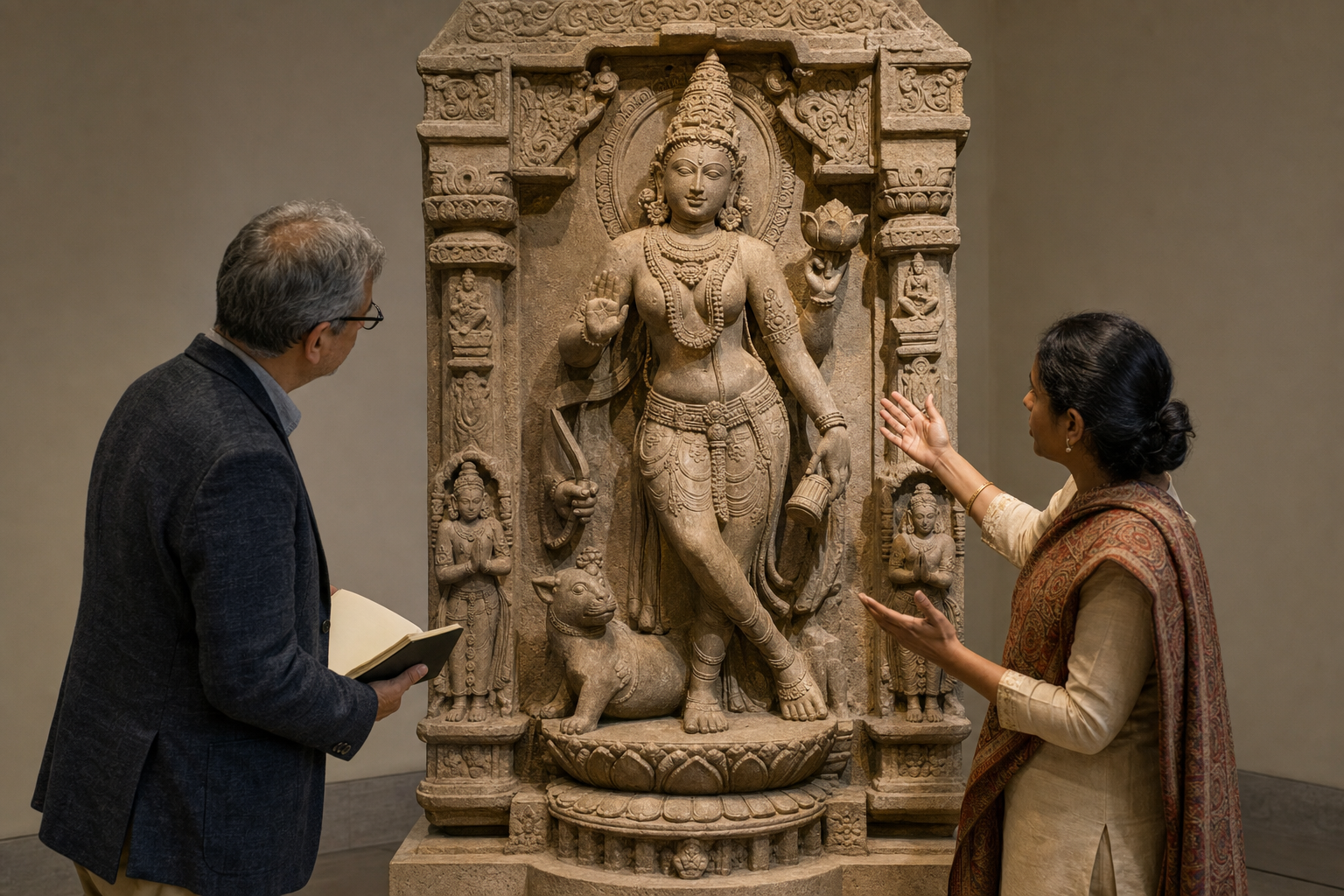
An attribute rarely carries its full meaning alone. Read it through a chain: bodily action, object, location, surrounding composition, and intended change in the viewer. This keeps you from turning iconography into a rigid dictionary in which one object always equals one abstract idea.
- Observe the body. Record stance, balance, gaze, hands, and apparent movement. Tribhaṅga, dance, stillness, and forceful posture produce different modes of attention. Do this before assigning a personality to the figure.
- Name the attribute plainly. Identify a mirror as a mirror, a parrot as a parrot, and an earring as an earring before interpreting it. Premature symbolism makes you overlook how the object is actually being held, worn, or used.
- Study the relationship. An object near the ear, mouth, hand, foot, or tree acquires meaning from that relationship. Guhya Kali’s corpse is not merely present; it is worn at the organ associated with śravaṇa, attentive hearing.
- Add architectural and ritual context. A dancer in a performance hall, a guardian at a threshold, and a fierce deity in a cremation-ground composition do not address the viewer in the same way.
- Ask what must change in you. Does the image refine speech, steady attention, awaken self-scrutiny, loosen attachment, or confront fear? A sacred symbol reaches completion in a transformed way of seeing, not in the successful recall of a label.
The following correspondences are useful starting points, not universal equations:
| Visible detail | Immediate field of meaning | A better question to ask |
|---|---|---|
| Mirror | Adornment and self-reflection | Is the figure displaying beauty, examining appearance, or turning sight toward self-knowledge? |
| Parrot | Refined speech, learning, and poetic culture | How does speech participate in the figure’s grace or discipline? |
| Flowering branch or tree | Fecundity, auspiciousness, and living nature | Does feminine touch reveal the sacred vitality of the surrounding world? |
| Instrument or dance posture | Rhythm, cultivated art, and embodied devotion | How is trained movement being admitted into worship? |
| Corpse, skull, or bone | Impermanence, fear, and transformation | Is mortality dominating consciousness, or has wisdom turned it into instruction? |
| Paired corpse earrings | Hearing, mortality, and reconciliation of opposites | What truth about change have you refused to hear? |
Material belongs in this chain as well. Hoysala sculptors used chloritic schist, often called soapstone, whose workable condition permitted hair-fine carving before the material hardened with exposure. Undercut jewelry, fine strands of hair, patterned clothing, and selective polish create changing shadows as you move. The technical precision does more than display virtuosity. It makes stone appear supple, rhythmic, and almost alive, reinforcing an image of Prakriti as active rather than inert.
Sound supplies the corresponding key in Kali’s imagery. Ears receive mantra and nāda, while śravaṇa begins the familiar movement from hearing to reflection and sustained contemplation. The paired earrings can also hold opposites in symmetry: right and left, solar and lunar, activity and receptivity, life and death. The point is not that difference vanishes from ordinary experience. It is that neither pole is ultimate when seen from a non-dual horizon. In this setting, the corpse earrings condense impermanence, listening, fearlessness, and the transcendence of duality into one visual form.
Avoid the shortcuts that flatten sacred images
Modern viewers often approach temple art with categories that are too narrow for it. You do not need to abandon critical judgement, but you do need to notice when a borrowed assumption has already decided what the image is allowed to mean.
- Do not reduce beauty to erotic display. Śṛṅgāra can include attraction, adornment, tenderness, and sensuous grace, but its temple setting also disciplines perception through proportion, rhythm, craft, and rasa. Ask how beauty directs attention before assuming it distracts from worship.
- Do not sanitize the fierce form. Replacing every skull with a vague message about positivity defeats the image’s precision. Kali asks you to face death, loss, and time directly. The symbol consoles only after it has been allowed to unsettle denial.
- Do not mistake fierce imagery for an endorsement of harm. Bone ornaments and corpse imagery transform fear symbolically; they do not authorize violence. Their ethical direction is toward clarity, non-attachment, and ahiṃsā in conduct.
- Do not force one code onto every region or lineage. Eastern Indian paintings, Nepalese paubhās, Himalayan thangkas, Hoysala brackets, Odisha temple sculpture, and Southeast Asian celestial figures can share visual ideas while retaining different ritual and theological grammars. Establish provenance before declaring a symbol’s final meaning.
- Do not confuse civilizational kinship with doctrinal sameness. Hindu reflections on anitya, Buddhist teachings on anicca and śūnyatā, Jain disciplines of aparigraha, and Sikh trust in hukam can converge in their challenge to fear and attachment. Their paths, authorities, and uses of imagery nevertheless remain distinct.
- Do not invent an esoteric practice from an image. Looking carefully at Guhya Kali can support reflection on impermanence. Initiatory visualizations, mantra-japa, regulated breath, or cremation-ground sādhana belong to specific traditions and forms of preparation. Treating an esoteric emblem as a do-it-yourself ritual prop replaces discipline with theatre.
A useful interpretation should account for more of the composition, not merely sound profound. If your reading of a mirror ignores the figure’s gaze, posture, placement, and surrounding ensemble, it is probably incomplete. If your reading of a corpse earring ignores the ear, the pair, Kali’s relation to time, and the cremation-ground field, it is too thin.
Use this method on your next temple or museum visit
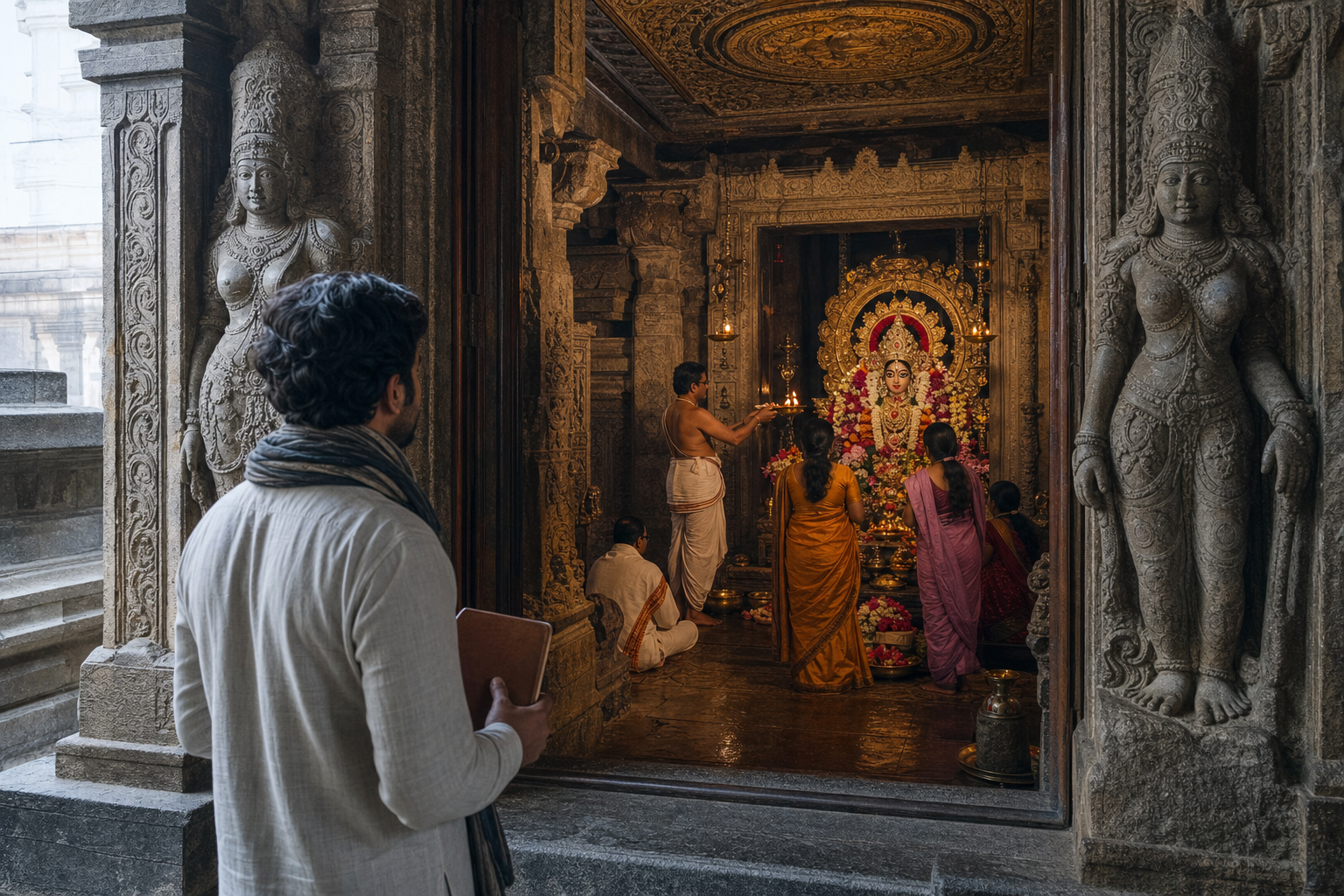
You do not need specialist vocabulary before you begin. You need an orderly encounter in which observation comes before interpretation and interpretation remains open to correction.
- Pause before reading the label. Notice where your eye lands and name your immediate response: attraction, calm, unease, curiosity, embarrassment, or resistance. The response is evidence about your encounter, not yet evidence about the figure’s canonical meaning.
- Make a visual inventory. Record placement, posture, hands, gaze, ornaments, held objects, nearby plants or animals, surrounding deities, and architectural frame. Include what the figure is doing, not only what she possesses.
- Form one provisional sentence. Use the pattern, “Because she is placed here, doing this, with this attribute, she may be directing attention toward…” The word “may” keeps the interpretation testable.
- Check the tradition and provenance. Look for the temple, region, period, sectarian setting, and local name. Use those facts to narrow your reading. A related motif elsewhere can illuminate the image, but it cannot erase local theology.
- Let one detail question you. A mirror can prompt honest self-examination. A parrot can turn attention toward the quality of speech. A dancer can reveal whether you separate discipline from grace. Kali’s earrings can ask which unavoidable ending you still refuse to hear. These are contemplative prompts, not claims that every symbol has only one fixed definition.
Key takeaways
- Read placement before decoding attributes; architecture tells you what role the figure performs.
- Treat graceful and fierce forms as different operations of Shakti, not as sacred and unsacred kinds of femininity.
- Interpret the whole chain: posture, object, bodily relationship, setting, material, and intended effect on attention.
- Use pan-Dharmic parallels to recognize shared civilizational questions, while preserving each tradition’s distinct theology and practice.
- Keep esoteric iconography distinct from self-invented ritual; careful contemplation does not require pretending to possess an initiation.
On your next visit, choose one sacred feminine figure and resist the urge to photograph it immediately. Stand where the image expects a viewer to stand. Follow one attribute through the whole composition, then write your provisional sentence. That small discipline can turn looking into darśana: not passive consumption of an object, but an encounter that teaches you how to see.
References
- DharmaRenaissance Blog — Haunting Wisdom of Guhya Kali: Decoding the Corpse Earrings in Tantric Iconography
- DharmaRenaissance Blog — Madanikas in Hindu Temples: Sacred Feminine in Stone—Symbolism, History, and Devotional Aesthetics
